U.S. Treasury Bars Crypto Exchange MEXC Global Over Alleged $16 Billion Illicit Transactions and Sanctions Evasion

The United States Department of the Treasury has taken decisive regulatory action against prominent cryptocurrency exchange MEXC Global, moving to sever the platform’s access to the U.S. financial system. According to formal announcements from federal authorities, the enforcement action stems from allegations that the exchange facilitated at least $16 billion in transactions tied directly to sanctions evasion, sophisticated cybercrime, and other illicit financial networks. The sweeping measures underline an aggressive escalation by American regulators targeting offshore digital asset platforms that fail to implement robust Know Your Customer (KYC) and Anti-Money Laundering (AML) controls.
The crackdown highlights the growing convergence between traditional geopolitical enforcement tools and decentralized finance, signaling that compliance loopholes exploited by bad actors are rapidly closing. As global financial watchdogs heighten scrutiny over virtual asset service providers (VASPs), the case against MEXC Global serves as a stark reminder of the legal and operational risks facing exchanges operating across international borders without strict adherence to regulatory standards.
FinCEN Order and Regulatory Mechanics
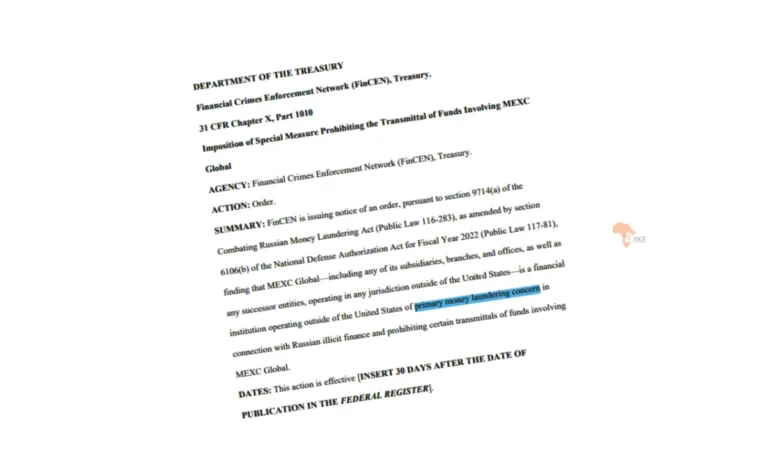
The Financial Crimes Enforcement Network (FinCEN), a bureau of the U.S. Treasury Department, issued a targeted order that effectively prohibits domestic U.S. financial institutions from processing any fund transfers or transactions involving MEXC Global. Under the terms of the administrative action, traditional banks, payment processors, and other regulated financial intermediaries must immediately cease interactions with accounts linked to the platform once the restriction formally goes into effect.
The prohibitive order is scheduled to take full legal effect 30 days following its official publication in the Federal Register. This window gives correspondent banks and domestic financial entities time to wind down operations, audit exposure levels, and implement blocking mechanisms against wallet addresses and corporate accounts associated with MEXC Global. FinCEN’s mandate relies on statutory authorities designed to protect the integrity of the U.S. financial architecture from foreign jurisdictions and entities deemed of primary money laundering concern.
By cutting off the exchange’s access to dollar-denominated clearing networks, regulators aim to isolate the platform from Western liquidity pools, severely impairing its global operational capacity. U.S. officials emphasized that the severity of the penalty reflects the sheer scale of illicit value transfer allegedly processed through the exchange’s order books and matching engines over a multi-year period.
Scope of Alleged Illicit Transactions (2021–2026)
According to forensic findings detailed by regulatory authorities, the illicit financial activity tied to MEXC Global occurred across a five-year period, specifically between May 2021 and May 2026. During this timeframe, the platform allegedly processed roughly $16 billion in transactions associated with malicious cyber actors, ransomware syndicates, and government-backed entities operating under severe international sanctions.
The network of illicit
transactions spanned multiple jurisdictions and geopolitical flashpoints, predominantly involving sanctioned actors situated in Iran, Russia, and North Korea. Analysts noted that the exchange served as a crucial liquidity venue where restricted entities could launder digital assets, convert tokens into privacy coins, or obfuscate the origin of funds through layered blockchain transactions.
Among the specific findings highlighted in the regulatory filings, FinCEN identified approximately $1.5 billion in transactions directly linked to Russian sanctions evasion. This massive sum included $232 million in direct, unmitigated transactions executed between MEXC Global accounts and entities already designated on sanctions lists maintained by the United States, the European Union, and the United Kingdom. These direct linkages to blacklisted corporate and individual actors provided federal investigators with concrete evidence of systemic compliance failures within the exchange’s internal monitoring systems.

Operation Economic Outcast and the Broader Geopolitical Strategy
The action against MEXC Global does not stand in isolation; rather, it forms a core operational component of a broader U.S. government initiative known as Operation Economic Outcast. This multi-agency Treasury campaign is explicitly designed to dismantle clandestine financial networks, front companies, and digital asset channels accused of helping the Iranian government and its affiliated proxy networks bypass comprehensive international sanctions.
Through Operation Economic Outcast, the U.S. government has intensified its focus on the intersection of cryptocurrency markets and state-sponsored economic warfare. Washington has repeatedly warned that digital assets are increasingly becoming the "tool of choice" for hostile nation-states seeking to evade traditional banking restrictions, finance regional conflicts, and procure restricted dual-use technologies.
State actors, particularly those facing heavy economic isolation, have leveraged the borderless, fast-settling nature of public blockchains to move capital outside the purview of the SWIFT network and legacy correspondent banking systems. By targeting major offshore cryptocurrency exchanges that reportedly turn a blind eye to compliance mandates, U.S. authorities are signaling that the decentralized nature of crypto assets will no longer shield facilitators from extraterritorial enforcement actions.
Scale, Reserves, and Operational Profile of MEXC Global
Prior to the announcement of the Treasury’s punitive measures, MEXC Global maintained a substantial presence in the global digital asset ecosystem. Industry tracking data indicates that the exchange routinely processed more than $1 billion in daily trading volume, positioning itself as a competitive mid-to-high-tier venue for retail and institutional cryptocurrency traders worldwide.
Furthermore, as of September 2026, the platform held approximately $5 billion in verified and estimated user reserves. These figures demonstrated significant market depth and liquidity, drawing millions of global users enticed by low trading fees and wide token variety. However, the platform’s rapid expansion and aggressive user acquisition strategies frequently drew scrutiny from international watchdogs regarding the adequacy of its compliance infrastructure.
At the time of publication and the subsequent rollout of the FinCEN order, representatives for MEXC Global had not issued an official public statement or responded to media requests for comment regarding the allegations or the impending U.S. financial ban. The silence from corporate leadership has left market participants speculating on how the exchange intends to restructure its global operations or handle potential user fund withdrawals from restricted regions.
Historical Timeline of Regulatory Escalation
The clampdown on MEXC Global represents the culmination of years of mounting tension between centralized crypto exchanges operating offshore and Western regulatory agencies. A brief chronology illustrates the escalating pressure:
- May 2021: The baseline window for the illicit transactions cited in FinCEN’s investigation begins, marking a period of rapid growth for the platform alongside increased deployment of crypto mixing and obfuscation services.
- 2023–2024: Global regulatory bodies issue repeated warnings regarding the proliferation of unregistered crypto exchanges offering derivative products and lax onboarding standards to users in restricted jurisdictions.
- July 2025: Regulatory cooperation between U.S., EU, and UK financial intelligence units intensifies, focusing heavily on blockchain analytics tracking funds flowing from sanctioned Russian and Iranian entities into Asian-headquartered digital asset platforms.
- August 2026: The U.S. Treasury officially launches Operation Economic Outcast, setting the stage for direct punitive actions against specific virtual asset service providers accused of enabling sanctions evasion.
- May 2026: FinCEN concludes its five-year analytical window, establishing the $16 billion threshold of suspicious transactions and setting in motion the formal administrative ban.
- Late 2026: FinCEN issues its formal order to cut MEXC Global off from the U.S. financial system, granting a 30-day compliance and transition window ahead of publication in the Federal Register.
Industry Implications and Market Analysis
The enforcement action against MEXC Global carries profound implications for the broader cryptocurrency industry, accelerating a trend toward institutionalization and mandatory global compliance. As regulatory perimeters expand, offshore exchanges that previously operated in legal grey areas are finding it increasingly difficult to service international clients without enforcing rigorous Know Your Customer (KYC) frameworks.
For the average retail user, such regulatory interventions highlight the counterparty risks associated with storing digital assets on centralized platforms that lack transparent legal incorporation or jurisdictional accountability. Analysts anticipate a continued migration of trading volume away from non-compliant offshore venues toward regulated centralized exchanges (CEXs) and decentralized finance (DeFi) protocols—though the latter face their own distinct regulatory headwinds regarding compliance and illicit finance.
Moreover, blockchain analytics firms and compliance software providers are expected to experience heightened demand from financial institutions striving to map out wallet exposure and avoid tainted funds linked to sanctioned entities. As the U.S. Treasury and allied international partners continue to deploy blockchain intelligence tools to trace illicit flows across public ledgers, the era of anonymous or unmonitored cross-border crypto liquidity is rapidly drawing to a close. The case of MEXC Global will likely serve as a definitive legal precedent for future enforcement actions against virtual asset service providers operating counter to international security interests.