Account management with Pardot Einstein is revolutionizing how businesses approach account-based marketing (ABM). This comprehensive guide dives deep into the strategies, tools, and techniques that Pardot Einstein provides for effective account management. We’ll explore how to segment accounts, personalize engagement, automate workflows, and leverage predictive insights to maximize results.
From understanding the basics of account management in marketing automation to mastering Pardot Einstein’s features, this guide equips you with the knowledge to build and maintain strong relationships with your most valuable accounts. We’ll use examples and real-world case studies to illustrate how Pardot Einstein can transform your ABM strategy.
Introduction to Account Management with Pardot Einstein
Account management in marketing automation is crucial for building lasting relationships with key customers. It goes beyond simple lead nurturing; it involves a deep understanding of each account’s specific needs, goals, and challenges. Effective account management strategies focus on tailoring marketing efforts to individual accounts, resulting in higher conversion rates and stronger customer loyalty.Pardot Einstein, Salesforce’s AI-powered marketing automation platform, significantly streamlines account management processes.
By leveraging machine learning, it empowers marketers to gain deeper insights into customer behavior, predict future needs, and personalize interactions at scale. This personalized approach is vital in today’s competitive landscape, allowing businesses to stand out and build lasting customer relationships.
Mastering account management with Pardot Einstein is crucial for maximizing ROI. But before you dive deep, understanding how to choose the right SEO company for your Pardot implementation is equally vital. A strong SEO strategy can significantly boost your Pardot campaigns, driving qualified leads directly to your account management efforts. So, if you’re looking to optimize your Pardot Einstein setup, remember to consider factors like experience, transparency, and reporting when choosing an SEO partner like how to choose an seo company.
Ultimately, a well-rounded approach to account management with Pardot Einstein will help you achieve your marketing goals.
Pardot Einstein and Account-Based Marketing (ABM)
Pardot Einstein empowers ABM strategies by providing a comprehensive view of each target account. It analyzes historical data, current engagement, and predicted future behavior to identify key decision-makers and tailor messaging accordingly. This allows marketers to focus their efforts on the most promising prospects within each account, maximizing ROI and improving overall campaign performance. Through personalized communication, Pardot Einstein fosters stronger relationships and drives higher conversion rates for ABM initiatives.
Benefits of Pardot Einstein for Account Management
Pardot Einstein offers a multitude of benefits for account management. These include enhanced account segmentation, automated account-based nurturing campaigns, and improved lead scoring models. By understanding the nuances of each account, marketers can develop targeted strategies that resonate with individual prospects, ultimately driving higher conversion rates and stronger customer relationships. The platform also provides insights into account health and potential risks, allowing proactive interventions to mitigate issues and maintain positive account relationships.
Integration with Salesforce Products
Pardot Einstein seamlessly integrates with other Salesforce products, creating a holistic approach to account management. This integration allows for a unified view of customer data across sales, service, and marketing. This cohesive approach provides a 360-degree view of each account, enabling marketers to understand the complete customer journey and tailor their efforts accordingly. This unified view is essential for developing highly personalized and effective account management strategies.
Key Features of Pardot Einstein for Account Management
| Feature Name | Description | Example Use Case |
|---|---|---|
| Account Segmentation | Automatically segments accounts based on various criteria, such as industry, size, or engagement level. | Segmenting accounts by industry to personalize content and messaging relevant to each sector. |
| Automated Account-Based Nurturing | Creates and manages automated nurturing campaigns targeted at specific accounts. | Automatically sending targeted emails and content to key decision-makers within a specific account. |
| Improved Lead Scoring | Uses AI to improve lead scoring models, prioritizing the most qualified leads. | Identifying and prioritizing leads based on account size, engagement level, and other factors. |
| Account Health Analysis | Analyzes account activity and engagement to identify potential risks or opportunities. | Identifying accounts that are showing signs of churn or disengagement and proactively addressing the issue. |
| Predictive Account Scoring | Predicts future account behavior and potential opportunities based on historical data. | Identifying accounts that are most likely to convert based on past interactions and trends. |
Account Segmentation and Targeting: Account Management With Pardot Einstein
Unlocking the full potential of your Pardot Einstein insights requires a strategic approach to account segmentation and targeting. This involves moving beyond basic demographic data and leveraging Pardot Einstein’s predictive capabilities to identify high-value accounts and tailor campaigns for maximum impact. This empowers you to personalize interactions and drive more effective outcomes.
Strategies for Segmenting Accounts Based on Pardot Einstein Insights
Pardot Einstein offers a wealth of data to segment accounts based on a variety of factors. Understanding these insights allows you to categorize accounts into meaningful groups, enabling more precise targeting. The key is to analyze the data provided by Pardot Einstein, which can reveal patterns and behaviors, and then develop segments that reflect these insights. This data-driven approach helps ensure your marketing efforts are aligned with the specific needs and preferences of each account segment.
Methods for Identifying High-Value Accounts Using Pardot Einstein Predictive Modeling
Pardot Einstein’s predictive modeling capabilities can help you identify high-value accounts. This involves analyzing various factors, such as historical purchasing behavior, engagement levels, and firmographic data, to identify accounts with the highest potential for conversion. This allows for strategic prioritization and focused resource allocation, maximizing the return on investment for your marketing efforts. For example, a company exhibiting consistent engagement with your content and a history of purchasing similar products may be flagged as a high-value prospect.
Targeting Specific Accounts with Personalized Campaigns Using Pardot Einstein
Once you’ve segmented your accounts, you can craft personalized campaigns that resonate with each segment. Pardot Einstein allows for the creation of dynamic content that adapts to the specific needs and preferences of each account. This involves tailoring messaging, offers, and calls to action based on the insights derived from the segments. By addressing individual account needs, you create a more compelling and engaging experience that fosters stronger relationships and drives conversions.
Examples of Different Account Segmentation Criteria
Several criteria can be used for segmenting accounts, and the ideal approach depends on your specific marketing objectives. Some examples include:
- Firmographic data: Company size, industry, location, and revenue.
- Behavioral data: Website activity, email engagement, and interaction with your content.
- Product usage: Products purchased, features used, and frequency of engagement.
- Engagement with previous campaigns: Responses to specific campaigns, engagement metrics, and interaction with sales teams.
- Predicted lifetime value (LTV): Pardot Einstein’s predictive models can estimate the potential value of a customer over their lifetime relationship with your company. This metric is invaluable for prioritizing high-potential accounts.
Account Segmentation Variables and Their Impact on Campaign Performance
A well-defined segmentation strategy can significantly impact campaign performance. The following table illustrates various account segmentation variables and their potential impact on key metrics.
| Segmentation Variable | Potential Impact on Campaign Performance |
|---|---|
| Company Size | Targeting smaller companies with tailored messaging may lead to higher conversion rates. |
| Industry | Tailoring content to the specific needs of a particular industry can increase engagement and conversion rates. |
| Product Usage | Identifying accounts actively using specific features can allow for targeted upselling or cross-selling opportunities. |
| Website Activity | Targeting accounts showing high levels of website engagement with personalized content can result in higher conversion rates. |
| Engagement with Previous Campaigns | Segmenting accounts based on past engagement can optimize future campaigns, potentially increasing response rates. |
Predictive Modeling and Insights
Pardot Einstein’s predictive modeling capabilities are a game-changer for account management. By leveraging machine learning, it goes beyond basic segmentation and targets, offering a proactive approach to identifying potential customers and nurturing high-value accounts. This capability allows marketers to focus their efforts on the most promising leads, ultimately improving campaign ROI.Pardot Einstein employs sophisticated algorithms to analyze vast amounts of data about your accounts, including historical interactions, demographics, firmographics, and behavioral patterns.
These insights are then used to generate predictions about the likelihood of a specific account converting or exhibiting desired behaviors. This predictive analysis empowers marketers to prioritize accounts, personalize outreach, and ultimately drive more effective results.
Predictive Models in Pardot Einstein
Pardot Einstein utilizes various predictive models to analyze account data. These models assess factors like account size, industry, engagement history, and predicted future behavior to generate actionable insights. Different models can be used to predict factors such as churn risk, lead scoring, or the likelihood of a purchase.
Interpreting Pardot Einstein’s Predictive Insights
Pardot Einstein presents its predictive insights in the form of scores and probabilities. Understanding how to interpret these scores is crucial for effective account prioritization. A higher score indicates a higher likelihood of a desired outcome, such as conversion or engagement. Marketers can use these scores to segment accounts and tailor their marketing strategies accordingly. This is vital for prioritizing resources and focusing efforts on the accounts with the highest potential.
Account Prioritization Based on Predictive Insights
Predictive insights can directly influence account strategy. For example, if a model predicts a high likelihood of churn for a specific account, a targeted retention strategy can be implemented to address the concerns and keep the account active. Conversely, if a model predicts high potential for a large purchase, the sales team can focus their efforts on that account to maximize revenue opportunities.
This proactive approach to account management allows for a more strategic allocation of resources.
Examples of Predictive Insights and Actions
Consider an account with a high predicted churn score. Pardot Einstein might identify this through patterns like decreased engagement with marketing emails or lack of recent website activity. In response, the marketing team can implement a series of targeted outreach campaigns to re-engage the account. Conversely, if a model predicts a high likelihood of a large purchase, sales representatives can prioritize building relationships with key decision-makers and tailoring their pitch to the account’s specific needs.
Relationship Between Predictive Scores, Account Characteristics, and Marketing Actions
| Predictive Score | Account Characteristics | Marketing Actions ||—|—|—|| High (e.g., 90+) | Large account size, high engagement, recent purchase history | Prioritize account for upselling, cross-selling, and retention strategies; personalize outreach with tailored content. || Medium (e.g., 60-89) | Moderate account size, mixed engagement history | Focus on re-engagement; provide targeted content and offers based on account interests; nurture the lead to a higher score.
|| Low (e.g., below 60) | Small account size, minimal engagement | Focus on lead qualification and nurturing to increase engagement and conversion; assess if account is worth continued effort. |
Personalized Account Engagement
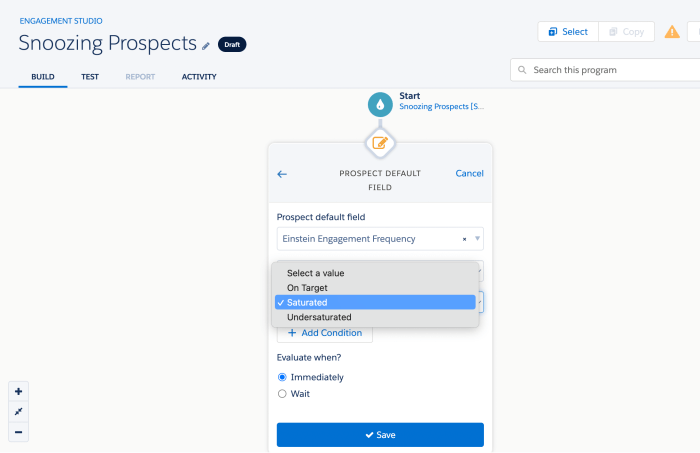
In today’s competitive landscape, businesses need to go beyond generic marketing messages and connect with individual accounts on a deeper level. Pardot Einstein empowers marketers to achieve this through personalized account engagement strategies, leveraging data insights to tailor content and messaging for each unique account. This personalized approach not only enhances customer relationships but also drives higher conversion rates and revenue.
Tailoring Content and Messaging
Pardot Einstein allows for granular control over content and messaging by analyzing account data and predicting customer needs. This detailed analysis goes beyond basic demographics and delves into account-specific behaviors, interactions, and purchasing histories. By understanding the unique needs and preferences of each account, marketers can craft highly targeted and relevant content. For example, a company selling software might tailor its messaging to highlight specific features relevant to the industry and size of the prospect account.
Using Pardot Einstein for Tracking and Analysis, Account management with pardot einstein
Pardot Einstein provides robust tracking and analysis capabilities, enabling marketers to monitor account interactions across various touchpoints. This comprehensive tracking allows for a deep understanding of how prospects engage with the brand, which touchpoints are most effective, and how engagement evolves over time. Detailed reports provide insights into email open rates, click-through rates, and other key metrics specific to each account, enabling marketers to measure the effectiveness of personalized engagement strategies.
Account management with Pardot Einstein is crucial for streamlining your marketing efforts. Effective strategies, like those discussed in exterminating marketing woes effective strategies , can help you identify and address pain points. Ultimately, this data-driven approach with Pardot Einstein empowers you to better understand your customer base and tailor your marketing accordingly.
Personalizing Email Campaigns
Personalized email campaigns are crucial for nurturing leads and driving conversions. Pardot Einstein’s predictive capabilities allow marketers to segment accounts based on their likelihood of conversion and tailor email campaigns to resonate with each segment’s unique needs. For example, an email campaign aimed at potential enterprise clients might focus on demonstrating the long-term ROI of the product, while a campaign for smaller businesses might emphasize ease of use and affordability.
Best Practices for Personalized Account Engagement
Implementing effective personalized account engagement strategies requires careful planning and execution. Here are key best practices to follow:
- Data-Driven Approach: Leverage all available data points to create a comprehensive profile of each account, including firmographic, behavioral, and interaction data.
- Segmentation Strategy: Employ Pardot Einstein’s segmentation capabilities to group accounts based on shared characteristics and predicted behavior. This targeted segmentation will allow for the creation of specific messaging tailored to each segment.
- Content Personalization: Tailor content and messaging to each account’s unique needs and preferences. Highlight specific features and benefits that align with the account’s industry, size, and goals.
- Automated Workflows: Utilize Pardot Einstein’s automation features to streamline personalized account engagement processes. This ensures consistency and efficiency in the interactions with prospects.
- Continuous Monitoring and Optimization: Regularly track and analyze account interactions to measure the effectiveness of personalized engagement strategies. Continuously refine and optimize these strategies based on data insights to achieve optimal results.
Workflow Automation for Account Management
Pardot Einstein empowers account managers to streamline their workflows, automating repetitive tasks and focusing on high-value interactions. By leveraging predictive insights and intelligent automation, businesses can personalize account engagement and boost customer lifetime value. This allows for more efficient allocation of resources, ultimately improving the overall account management strategy.Pardot Einstein’s workflow automation capabilities extend beyond basic lead scoring and campaign triggers, enabling dynamic adjustments based on real-time data.
This dynamic approach ensures that account management strategies are continuously optimized for each specific account, improving responsiveness and driving stronger relationships.
Automated Tasks with Pardot Einstein
Pardot Einstein automates a wide range of tasks crucial for effective account management. These automated processes range from lead scoring and campaign triggers to complex account-based marketing (ABM) workflows. These automation capabilities greatly improve the efficiency and effectiveness of account management activities.
- Lead Scoring: Pardot Einstein analyzes various data points (demographics, engagement, website activity) to dynamically adjust lead scores. This ensures that high-potential leads are prioritized for targeted outreach and nurturing campaigns.
- Campaign Triggers: Based on predefined criteria (e.g., account size, industry, engagement level), Einstein can automatically trigger specific campaigns for targeted accounts. This personalized approach increases the effectiveness of marketing efforts.
- Account-Based Marketing (ABM) Workflows: Einstein can automate the entire ABM process, from identifying target accounts to nurturing key decision-makers. This sophisticated automation ensures that valuable accounts receive tailored engagement.
- Nurturing Sequences: Pardot Einstein can personalize and automate nurturing sequences based on account behaviors and characteristics. This ensures that every account interaction is meaningful and relevant.
Configuring Pardot Einstein Workflows
Configuring Pardot Einstein workflows for specific account management needs involves defining clear objectives and criteria. A detailed understanding of the desired outcomes is crucial for establishing effective workflows. This includes specifying the actions that trigger the workflow and the specific responses required.
- Defining Triggers: Identify the specific events that initiate a workflow, such as a new account signup, a specific product download, or a high-value lead engagement. Clearly defined triggers ensure targeted automation.
- Mapping Actions: Determine the subsequent actions based on the defined triggers. This could involve sending specific emails, assigning accounts to specific reps, or triggering specific marketing campaigns. These actions should be carefully mapped to achieve the desired results.
- Monitoring Performance: Continuously monitor the performance of the workflows to ensure that they are meeting the desired outcomes. Adapt the workflows as needed based on real-time data and feedback. This continuous monitoring allows for optimization and improvement.
Building an Onboarding Workflow
A well-defined onboarding workflow for new accounts is critical for establishing a positive relationship and accelerating the account’s value realization. This often includes a series of personalized communications, providing essential information and guidance.
- Initial Contact: The workflow begins with an automated welcome email to the new account contact person, introducing the company and team responsible for account management.
- Product Overview: Follow up with a personalized email providing a brief overview of the company’s products and services relevant to the specific account’s needs.
- Account Team Introduction: Introduce the account manager and key team members responsible for the account, building personal connections and trust.
- Resource Links: Provide access to helpful resources such as product guides, FAQs, and contact information.
Pardot Einstein Automation Features
The following table Artikels various Pardot Einstein automation features and their corresponding use cases.

| Automation Feature | Use Case |
|---|---|
| Lead Scoring | Prioritizing high-potential leads for targeted outreach |
| Campaign Triggers | Automating campaign execution based on account criteria |
| Account-Based Marketing (ABM) Workflows | Personalizing engagement for key accounts |
| Nurturing Sequences | Automating personalized nurturing sequences for accounts |
| Workflow Actions | Performing various actions (email sends, lead assignments, etc.) |
Reporting and Analytics for Account Performance
Pardot Einstein provides powerful tools to track and measure the success of your account management strategies. Beyond basic lead scoring, Einstein allows a deeper dive into account-level performance, enabling you to understand which accounts are most valuable, which strategies are working best, and identify areas for improvement. By understanding the data, you can optimize your efforts to maximize revenue and customer lifetime value.Understanding account performance is critical for refining your account management strategy.
Pardot Einstein’s reporting and analytics features provide insights into account engagement, conversion rates, and overall ROI. This data-driven approach allows you to make informed decisions and personalize your approach for each account.
Account management with Pardot Einstein is crucial for optimizing your sales strategies. Knowing how to best target accounts is key, and understanding the current social media landscape helps immensely. For example, did you know that 10 surprising social media statistics to use for marketing reveal interesting insights into audience engagement? This data, when integrated into your Pardot Einstein account management process, can significantly improve your lead qualification and conversion rates.
Ultimately, using this type of data allows for smarter account targeting, leading to better results.
Tracking and Measuring Account Management Performance
Pardot Einstein’s reporting capabilities extend beyond basic campaign metrics. You can track and measure the effectiveness of your account-specific initiatives, such as onboarding programs, customized proposals, and personalized communication strategies. This allows for a granular view of which interactions resonate with specific accounts and which activities yield the highest conversion rates. Analyzing these metrics helps identify which tactics are most successful and allows you to adjust your approach for optimal results.
Available Reports and Dashboards in Pardot Einstein
Pardot Einstein offers a range of reports and dashboards designed to provide comprehensive account-level insights. These include reports on account engagement, such as the number of interactions, email open rates, and website visits. Furthermore, conversion-related reports, such as deal size, stage progression, and win rates for specific accounts, are available. Customizable dashboards provide a centralized view of key performance indicators (KPIs), allowing you to monitor account performance at a glance.
This allows you to quickly identify trends and adjust strategies as needed.
Analyzing Key Metrics Related to Account Engagement and Conversion
Analyzing key metrics is crucial for evaluating the success of account management efforts. Metrics such as the number of meetings scheduled, the average deal size, and the time to close a deal offer a clear picture of account performance. Engagement metrics, like email open rates and website visits, reveal account interest levels. By tracking and analyzing these metrics, you can understand which strategies are most effective and refine your approach to improve conversion rates.
Combining engagement and conversion metrics offers a holistic view of account health and provides insights for improvement.
Best Practices for Interpreting Pardot Einstein Reports
Interpreting Pardot Einstein reports requires a strategic approach. Consider the context of each account, its specific needs, and the stage of the relationship. Compare the performance of different accounts and identify commonalities and differences in engagement patterns. Focus on identifying trends and patterns, rather than isolated data points. Combine insights from various reports to gain a comprehensive understanding of account performance.
This multifaceted approach provides a more accurate picture and helps to identify opportunities for improvement.
Comparison of Reporting Options in Pardot Einstein
| Reporting Option | Description | Usefulness for Account Analysis |
|---|---|---|
| Account Engagement Reports | Tracks interactions like emails opened, website visits, and content downloads. | Provides insights into account interest levels and engagement patterns. |
| Conversion Reports | Shows progress through the sales funnel and win rates for specific accounts. | Highlights the effectiveness of account-specific strategies in closing deals. |
| Custom Dashboards | Combines multiple reports into a single view for key metrics. | Offers a centralized and dynamic overview of account performance, enabling quick identification of trends and areas for improvement. |
This table provides a concise comparison of various reporting options in Pardot Einstein, emphasizing their relevance to account analysis.
Case Studies and Real-World Examples
Pardot Einstein’s power truly shines when applied to real-world account management strategies. It’s not just about algorithms; it’s about understanding your customers’ unique needs and tailoring your approach to maximize engagement and revenue. Seeing how other businesses have leveraged Pardot Einstein to achieve specific ABM goals provides valuable insights and actionable strategies.This section dives deep into case studies, illustrating successful account management journeys and showcasing how Pardot Einstein helps companies move beyond basic lead nurturing to sophisticated account-centric strategies.
These examples demonstrate the impact of predictive modeling, personalized engagement, and automated workflows on achieving tangible results.
Successful Account Management Strategies with Pardot Einstein
Companies are increasingly using Pardot Einstein to personalize and optimize their interactions with key accounts. One common strategy involves identifying high-potential accounts using predictive models and then tailoring content and outreach to resonate with each account’s specific needs and preferences. This personalized approach fosters deeper engagement and drives stronger relationships.
Leveraging Pardot Einstein for Improved Account Management
A software company, for example, might use Pardot Einstein to segment accounts based on factors like industry, company size, and purchasing history. They can then use these segments to target specific account decision-makers with tailored content, demonstrating a clear understanding of their needs. This focused approach ensures that each interaction feels relevant and valuable, fostering a strong connection.
This personalized approach leads to higher conversion rates and increased revenue.
Achieving ABM Goals with Pardot Einstein
Another example is a healthcare provider leveraging Pardot Einstein to identify key accounts in specific target markets. By analyzing their existing data, Pardot Einstein helps pinpoint decision-makers, pain points, and opportunities within those accounts. This allows the healthcare provider to craft highly targeted messaging, ensuring their interactions align with each account’s particular needs. This precision in outreach, powered by Pardot Einstein, helps them achieve their ABM goals more effectively.
A Typical Account Management Journey with Pardot Einstein
A typical journey begins with identifying high-value accounts. Pardot Einstein helps with this by identifying accounts likely to convert and those requiring different engagement strategies. Next, tailored content is delivered based on predicted needs. Finally, automated workflows ensure consistent engagement across the entire account management process. This automation streamlines the process, ensuring timely and relevant interactions.
Key Takeaways from Case Studies
| Case Study | Key Takeaway | Impact |
|---|---|---|
| Software Company | Segmentation and targeting based on predicted needs | Increased conversion rates and revenue |
| Healthcare Provider | Targeted messaging and personalized outreach | Effective ABM campaign, increased engagement |
| E-commerce Business | Automated workflows for personalized engagement | Improved customer satisfaction and loyalty |
Closure
In conclusion, account management with Pardot Einstein empowers businesses to go beyond basic lead nurturing and focus on building strong, lasting relationships with key accounts. By understanding segmentation, personalization, automation, and reporting, you can optimize your ABM efforts and achieve significant results. This guide serves as a roadmap to help you navigate the complexities of account-based marketing with Pardot Einstein, unlocking the full potential of your customer relationships.