Distinguishing copywriting and content writing contrasts and comparisons sets the stage for understanding the nuances of these two crucial writing disciplines. Copywriting and content writing, while both serving marketing purposes, have distinct approaches, target audiences, and goals. This exploration delves into the differences in language, tone, formats, and key performance indicators (KPIs) to provide a clear understanding of each.
This analysis will explore how target audiences impact the writing style of each discipline. We’ll examine how copywriting aims to persuade, while content writing aims to inform and engage. Further, the differing content formats and styles, along with the unique language and tone used in each, will be detailed. Finally, the discussion will conclude by looking at how both disciplines can complement each other, and how understanding their distinct approaches leads to more effective marketing strategies.
Defining the Differences

Copywriting and content writing, while both crucial for marketing and communication, serve distinct purposes. Understanding these differences is essential for businesses to effectively leverage each discipline. They are often used in tandem, but recognizing their unique strengths allows for a more strategic approach to engaging target audiences.Copywriting focuses on persuasive language to drive immediate action, whereas content writing aims to establish credibility and nurture long-term relationships with readers.
This distinction impacts everything from the tone of voice to the overall structure of the content.
Defining Copywriting
Copywriting is the art and science of crafting persuasive text that compels readers to take a specific action. This action could range from purchasing a product to signing up for a newsletter. It’s focused on clear, concise messaging that directly addresses the reader’s needs and desires, often within a specific timeframe. Copywriters often employ techniques like storytelling, emotional appeals, and calls to action to motivate immediate responses.
Their goal is to transform prospects into customers.
Defining Content Writing
Content writing is the process of creating informative, engaging, and valuable content that educates, entertains, or inspires readers. It’s less focused on immediate sales and more on building brand awareness, establishing authority, and fostering trust. Content writers aim to provide solutions, answer questions, and establish thought leadership within a specific niche. Their goal is to build a community around the brand, creating a long-term relationship with the reader.
Key Differences in Approach
The core difference between copywriting and content writing lies in their objectives. Copywriting is about persuasion and immediate action, while content writing is about building relationships and establishing credibility. The following table summarizes the key distinctions:
| Term | Copywriting Definition | Content Writing Definition | Key Differences |
|---|---|---|---|
| Purpose | Persuade and motivate immediate action. | Inform, educate, entertain, and inspire. | Copywriting is transactional, content writing is relational. |
| Tone | Direct, persuasive, and often urgent. | Informative, engaging, and often conversational. | Copywriting aims for immediate impact, content writing for long-term engagement. |
| Language | Strong verbs, compelling language, concise and impactful phrases. | Clear, understandable language, relevant examples, and in-depth explanations. | Copywriting focuses on immediate impact, content writing on clarity and comprehensiveness. |
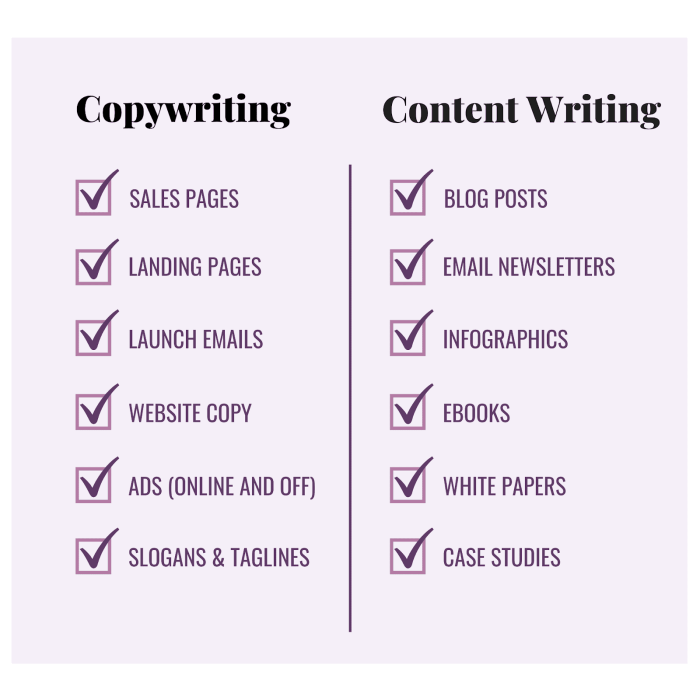
| Formats | Ads, brochures, website landing pages, email marketing, social media posts. | Blog posts, articles, white papers, ebooks, case studies, infographics, videos. | Copywriting uses formats for immediate response, content writing uses formats for long-term value. |
Target Audience and Goals
Understanding the target audience is paramount for both copywriting and content writing. Different audiences respond to different approaches, and knowing who you’re trying to reach dictates the tone, style, and overall message of your work. This understanding extends beyond basic demographics; it involves grasping their needs, motivations, and pain points. This knowledge allows for tailored communication that resonates effectively.Copywriting and content writing, while both forms of written communication, have distinct purposes.
Copywriting’s primary goal is persuasion, driving a specific action from the reader, such as making a purchase or signing up for a newsletter. Content writing, on the other hand, aims to inform, educate, and engage the audience, building trust and establishing authority. The desired outcomes reflect these core differences.
Impact of Target Audience on Approach
The target audience significantly influences the approach in both copywriting and content writing. A younger demographic might respond to a more playful and informal tone, while a more mature audience might prefer a professional and authoritative style. Understanding the audience’s knowledge level is also crucial. If the audience is unfamiliar with the product or service, the content must explain its features and benefits thoroughly.
If the audience is already knowledgeable, the content can focus on differentiating the offering from competitors or highlighting unique selling propositions.
Persuasion vs. Information and Engagement
Copywriting aims to persuade the reader to take a specific action. This persuasive intent is evident in the language used, the structure of the message, and the calls to action. Content writing, however, focuses on informing and engaging the reader. This engagement is built through valuable insights, compelling storytelling, and a conversational tone. The goal is to establish a relationship with the reader, not just to sell a product or service.
Specific Goals of Each Type of Writing
Copywriting typically has specific, measurable goals related to conversions. These goals might include increasing sales, generating leads, or driving website traffic. Content writing, conversely, aims to achieve broader goals such as establishing thought leadership, building brand awareness, and fostering a community around a particular topic.
Desired Outcomes
The desired outcomes of copywriting and content writing are directly tied to their respective goals. For copywriting, a successful outcome might be a significant increase in sales or a substantial rise in newsletter sign-ups. Content writing success is often measured by metrics like increased website traffic, improved search engine rankings, and enhanced brand reputation.
Comparison Table
| Type of Writing | Target Audience | Goals | Desired Outcomes |
|---|---|---|---|
| Copywriting | Specific, defined audience with a clear need or desire | Drive a specific action (e.g., purchase, sign-up) | Increased sales, higher conversion rates, more leads |
| Content Writing | Broader audience interested in a specific topic or industry | Inform, educate, engage, build brand awareness | Higher website traffic, improved search engine rankings, increased brand authority |
Content Formats and Styles
Crafting compelling messages requires understanding the nuances of different content formats. Copywriting and content writing, while both aiming to communicate effectively, employ distinct approaches to achieve their respective goals. This exploration delves into the diverse formats and styles used in each discipline.Understanding the tailored formats and styles used in copywriting and content writing helps determine the best approach to communicate with a target audience.
Each format has its own set of rules and conventions, which when correctly employed, can significantly enhance the effectiveness of the communication.
Copywriting Content Formats
Copywriting excels at concise and persuasive communication. Its formats are often designed to directly influence the reader’s actions, from making a purchase to visiting a website. A key characteristic of copywriting is its focus on call to actions and driving conversions.
- Ads: From print advertisements to online banner ads, copywriting for ads emphasizes brevity and impactful messaging. Examples include concise slogans, striking visuals, and compelling headlines designed to capture attention and drive immediate action. Consider the famous “Just Do It” Nike campaign, a prime example of a short, impactful slogan used effectively.
- Brochures: Brochures are a powerful tool for providing detailed information and building brand awareness. Copy in brochures needs to be clear, well-organized, and visually appealing, highlighting key benefits and features of products or services. The tone is often informative and persuasive, aiming to showcase the value proposition.
- Sales Letters: These are often used to promote specific products or services, focusing on the benefits and value proposition to persuade the reader to make a purchase. A well-crafted sales letter will build anticipation and create a sense of urgency, utilizing persuasive language and compelling storytelling.
Content Writing Content Formats
Content writing focuses on creating engaging and informative content to establish thought leadership and build brand awareness. Its goal is not to immediately drive a sale, but rather to attract and retain an audience.
Ever wondered what separates copywriting from content writing? It’s not always clear-cut, is it? While both aim to communicate effectively, copywriting often focuses on persuasion and driving immediate action, whereas content writing aims to inform and engage. Knowing how to apply the right techniques for each purpose is key. For example, understanding how to write blog posts that actually attract readers is crucial for driving traffic to your site.
Check out these seven quick win strategies for writing blog posts that will drive traffic to your site seven quick win strategies writing blog posts will drive traffic site Ultimately, mastering both approaches helps you create engaging content that converts. Ultimately, understanding these distinctions is vital for effective communication strategies.
- Blog Posts: A cornerstone of content writing, blog posts explore topics relevant to the target audience, offering insights and value. The tone is often conversational and engaging, aiming to inform, educate, or entertain.
- Articles: Articles, similar to blog posts, aim to provide information but often have a more formal and objective tone. They are typically longer-form content, addressing a specific subject in detail.
- Website Copy: This includes descriptions, “About Us” pages, and product/service pages. The tone is usually informative and persuasive, helping to guide users through the website and showcase the value of the company or product.
Content Styles and Tones
Different content formats demand different styles and tones. The goal is to resonate with the target audience and achieve the desired outcome.
| Format | Purpose | Typical Tone |
|---|---|---|
| Ads | Drive immediate action | Persuasive, attention-grabbing, concise |
| Brochures | Provide detailed information, build brand awareness | Informative, persuasive, visually appealing |
| Sales Letters | Persuade the reader to make a purchase | Persuasive, benefit-driven, compelling |
| Blog Posts | Engage and inform | Conversational, engaging, informative |
| Articles | Provide in-depth information | Informative, objective, detailed |
| Website Copy | Guide users, showcase value | Informative, persuasive, clear |
Language and Tone
Crafting compelling messages requires understanding the subtle yet significant differences in language and tone between copywriting and content writing. While both aim to communicate effectively, their approaches differ significantly, often reflecting their distinct goals and target audiences. Copywriting is persuasive, driving action, while content writing focuses on informing and educating.Copywriting’s persuasive nature frequently uses evocative language and emotional appeals to sway readers towards a desired action.
Content writing, on the other hand, relies on clarity and conciseness to effectively convey information. Understanding these nuances allows for more effective communication tailored to specific objectives.
Persuasive Language in Copywriting
Copywriting excels at using persuasive techniques to evoke emotions and drive action. This involves employing language that resonates with the target audience, tapping into their desires, fears, and aspirations. Effective copywriters understand the psychology behind purchasing decisions and craft compelling narratives to motivate readers to take the desired action.
Examples of Persuasive Language
- Limited-time offers: Phrases like “act now,” “while supplies last,” and “limited-edition” create a sense of urgency and encourage immediate action. This urgency is often a crucial component of successful marketing copy.
- Emotional appeals: Copywriting frequently employs emotional language to connect with readers on a deeper level. For instance, ads for pet adoption often focus on the emotional bond between humans and animals to inspire empathy and motivate action.
- Social proof: Highlighting testimonials, reviews, and case studies builds credibility and encourages readers to trust the product or service. Testimonials demonstrate the positive experiences of others.
Clear and Concise Language in Content Writing
Content writing prioritizes clarity and conciseness to effectively convey information. This approach ensures that the message is easily understood by the intended audience. Clear and concise language avoids jargon, complex sentence structures, and unnecessary details. Content writers focus on providing valuable information in a straightforward manner.
Ever wondered about the subtle differences between copywriting and content writing? It’s like comparing apples and oranges, sometimes. While copywriting focuses on persuasive language to drive action, content writing aims to inform and engage. Learning how to add taxonomy images category icons in WordPress, for example, is a content-writing task, whereas crafting a compelling ad copy falls squarely into the copywriting realm.
Knowing the intricacies of these visual elements can help boost your website’s overall appeal, just as a well-written piece of content can enhance user experience and engagement. how to add taxonomy images category icons in wordpress can help you make your website’s content easier to navigate and more visually appealing. Ultimately, understanding these distinctions helps you tailor your approach to the specific goals of your project.
Examples of Clear and Concise Language
- Active voice: Using active voice makes the writing more direct and easier to understand. For instance, instead of “The report was reviewed by the committee,” the active voice would be “The committee reviewed the report.”
- Precise vocabulary: Content writing uses specific and precise language to avoid ambiguity. Using technical terms when appropriate is part of conveying accurate information effectively.
- Short, simple sentences: Content writers frequently employ short and simple sentences to maintain readability and comprehension. Avoiding convoluted sentences ensures the content remains easy to digest.
Comparison Table
| Type of Writing | Language Example | Explanation |
|---|---|---|
| Copywriting | “Experience the ultimate comfort with our new mattress. Limited-time offer! Claim yours today!” | This copy uses urgency (“limited-time offer”) and emotional language (“ultimate comfort”) to persuade the reader to purchase the mattress. |
| Content Writing | “Our new mattress features advanced support technology, providing optimal spinal alignment for a restful night’s sleep. Learn more about the features.” | This content writing example focuses on providing factual information about the mattress’s features without using persuasive language or direct calls to action. |
| Copywriting | “Don’t miss out on this exclusive opportunity! Limited stock available. Shop now!” | This example highlights a sense of urgency, encouraging immediate action. |
| Content Writing | “Understanding the different types of sleep disorders is crucial for improving sleep quality. Learn more about insomnia and other common sleep issues.” | This is informative and focuses on providing factual information, suitable for an educational piece. |
Key Performance Indicators (KPIs)
Tracking the success of copywriting and content writing campaigns requires a clear understanding of the metrics that matter most. Different goals and target audiences necessitate different KPIs. This section delves into the specific KPIs used to evaluate the effectiveness of both copywriting and content strategies, highlighting the distinctions based on their unique objectives.Copywriting and content writing, while both aiming to engage audiences, differ significantly in their primary objectives.
Copywriting often focuses on driving immediate action, such as a purchase or a click, whereas content writing often aims to build brand awareness, establish authority, and nurture long-term relationships with potential customers. These differing objectives translate into unique sets of KPIs for each.
Typical KPIs for Copywriting Campaigns
Copywriting effectiveness is largely measured by its ability to convert prospects into customers. Key metrics focus on actions that directly lead to sales or desired outcomes.
- Conversion Rate: The percentage of website visitors who complete a desired action, such as making a purchase or filling out a form. A high conversion rate indicates that the copy is persuasive and effectively motivates the target audience to take the desired action. For example, a landing page with a compelling call to action might have a conversion rate of 15% compared to a similar page with less engaging copy, which might only have a 5% conversion rate.
This demonstrates the direct impact of strong copy on conversion.
- Click-Through Rate (CTR): The percentage of people who see an advertisement or link and click on it. A high CTR indicates that the copy is attention-grabbing and relevant to the target audience. A company promoting a new product on social media might see a 2% CTR for an ad with engaging copy, but only a 0.5% CTR for an ad with generic copy.
This difference highlights the importance of targeted and compelling copy for driving clicks.
- Lead Generation Rate: The number of leads generated through a marketing campaign. This could include sign-ups for newsletters, requests for a demo, or contact form submissions. A high lead generation rate indicates the copy’s ability to attract and engage potential customers.
Typical KPIs for Content Writing Strategies
Content writing strategies are assessed by their ability to build brand awareness, establish thought leadership, and drive organic traffic. Metrics focus on audience engagement and brand visibility.
- Website Traffic: The volume of unique visitors to a website. This measures the overall reach of the content and its ability to attract an audience. Increased website traffic indicates a positive response to the content, demonstrating that it’s valuable and engaging for the target audience.
- Engagement Metrics: These encompass various metrics, including time spent on page, bounce rate, and social shares. Higher engagement indicates that the content is valuable and resonates with the target audience. A blog post that encourages comments and shares suggests it’s engaging enough to retain readers and spread the message.
- Search Engine Ranking: The position of a website or webpage in search engine results pages (SERPs). Higher rankings indicate that the content is relevant and authoritative for target s, leading to more visibility and organic traffic.
- Brand Mentions: The number of times a brand is mentioned online. A higher number of mentions indicates a successful content marketing strategy that has created buzz and generated positive online conversation. If a company consistently publishes insightful articles in industry publications, that can increase the frequency of brand mentions, improving brand awareness and reputation.
Comparison of KPIs for Copywriting and Content Writing
The table below contrasts the KPIs used to evaluate copywriting and content writing strategies, highlighting their differences.
| KPI Type | Description | Method of Measurement |
|---|---|---|
| Conversion Rate | Percentage of visitors completing a desired action. | Divide the number of conversions by the total number of visitors. |
| Click-Through Rate (CTR) | Percentage of people clicking on an ad or link. | Divide the number of clicks by the number of impressions. |
| Website Traffic | Number of unique visitors to a website. | Use website analytics tools (e.g., Google Analytics). |
| Engagement Metrics (Time on Page, Bounce Rate, Social Shares) | Measures audience interaction with content. | Use website analytics tools (e.g., Google Analytics). |
| Lead Generation Rate | Number of leads generated from content. | Track form submissions, email sign-ups, and other lead generation activities. |
| Search Engine Ranking | Position in search engine results pages (SERPs). | Use tools or track search engine results for target s. |
| Brand Mentions | Number of times a brand is mentioned online. | Use social listening tools or track brand mentions on social media and news outlets. |
Case Studies and Examples
Unveiling the power of copywriting and content writing through real-world examples is crucial for understanding their respective strengths. These case studies demonstrate how specific strategies can drive impactful results, highlighting the unique contributions of each discipline. The differences in approach and desired outcomes are clearly showcased, offering valuable insights into how to effectively utilize both copywriting and content writing for business growth.The following examples showcase successful campaigns using copywriting and content strategies, revealing the key factors that contributed to their effectiveness.
These detailed analyses of real-world applications will provide actionable strategies for your own marketing initiatives.
Successful Copywriting Campaign Case Study: “The Click-Worthy Landing Page”
This case study examines a successful campaign focused on improving conversion rates through a meticulously crafted landing page.
Introduction
The campaign aimed to increase lead generation for a software-as-a-service (SaaS) company. A new landing page was designed, focusing on the pain points of potential customers.
Methodology
The copywriting team analyzed existing website traffic and customer feedback. They then crafted compelling copy that highlighted the unique value proposition of the SaaS product, emphasizing the benefits for the target audience. Key elements included strong calls to action (CTAs), clear and concise explanations of the product’s functionalities, and testimonials from satisfied customers. A/B testing was employed to refine the copy and optimize for conversions.
Results
The new landing page saw a 35% increase in conversion rates within the first month of launch. The number of qualified leads generated also rose significantly.
Conclusion
The success of this campaign stemmed from a deep understanding of the target audience, coupled with persuasive and targeted copywriting. This demonstrated how a focused approach to landing page optimization could deliver significant results in lead generation.
Successful Content Writing Strategy Case Study: “Building Brand Authority”
This case study explores how a content strategy can build brand authority and establish thought leadership in a competitive market.

Introduction
A digital marketing agency sought to enhance its brand reputation and establish itself as a leader in its field. They implemented a multi-faceted content strategy.
Methodology
The agency created a content calendar that included blog posts, articles, infographics, and videos focusing on relevant industry topics. The content was optimized for search engines () to attract organic traffic. The content also showcased expertise and offered valuable insights, positioning the agency as a reliable source of information. Guest blogging on relevant platforms also amplified their reach and credibility.
Results
The consistent production of high-quality content led to a 40% increase in organic traffic to the agency’s website. This resulted in a significant rise in inbound leads and enhanced brand visibility. Client testimonials also increased.
Conclusion
This campaign highlights the importance of creating valuable content to establish thought leadership. The consistent delivery of relevant and engaging content, combined with optimization, ultimately translated into significant improvements in brand visibility and lead generation.
Ever wondered what separates copywriting from content writing? It’s more than just a difference in titles; understanding these contrasts is key for crafting effective marketing materials. For example, knowing which tools to use is critical when you’re trying to achieve your marketing goals. Tools like those listed in 7 must have google tools for small businesses can help you optimize your content for better results, whether you’re writing a sales page or a blog post.
Ultimately, understanding the nuances of each writing style will empower your business to communicate clearly and effectively.
Overlap and Interdependence: Distinguishing Copywriting And Content Writing Contrasts And Comparisons
Copywriting and content writing, while distinct disciplines, often intertwine and rely on each other for effective marketing campaigns. They share a common goal: connecting with the target audience and driving desired actions. Understanding their overlapping areas allows marketers to leverage the strengths of both disciplines, creating a more holistic and impactful approach.The core difference lies in the primary goal: copywriting aims to persuade and drive immediate action, while content writing aims to inform, educate, and build relationships.
However, these goals can and often do overlap. For instance, a compelling product description (copywriting) can be part of a broader informative blog post (content writing), reinforcing the brand message and increasing conversions.
Instances of Overlap
The two disciplines often overlap in situations where persuasive communication is needed alongside informative content. A compelling case study, for example, combines detailed content writing with concise copywriting to showcase the benefits of a product or service. Similarly, a sales page or landing page (copywriting) needs to deliver compelling information about the product, service, or offer, which naturally overlaps with informative content writing to create trust and credibility.
Complementing Disciplines
Copywriting and content writing can effectively complement each other in various ways. For example, a blog post (content writing) can be enhanced with compelling call-to-actions (copywriting) to encourage reader engagement and conversions. Similarly, a product description (copywriting) can be enhanced by providing detailed background information and product features (content writing) to help potential customers make informed decisions.
Enhancing Content Writing with Copywriting Techniques
Copywriting techniques can significantly boost the effectiveness of content writing. Strong headlines, compelling introductions, and persuasive calls-to-action can transform a good piece of content into a highly engaging and effective piece. For example, a blog post about a new product can benefit from concise and persuasive language to grab the reader’s attention and encourage them to learn more.
Supporting Copywriting with Content Writing Strategies
Content writing strategies can support copywriting efforts by providing a foundation of information and credibility. Well-researched articles, insightful blog posts, and informative case studies can be used to build trust and establish expertise. This, in turn, strengthens the persuasive power of the copywriting pieces, allowing the brand to position itself as a knowledgeable and trustworthy authority.
Example of Synergy
Consider a company selling organic gardening supplies. Content writing can be used to create blog posts about the benefits of organic gardening, while copywriting can be used to create compelling product descriptions highlighting the specific features and benefits of their products. This combination strengthens the brand message and positions the company as an expert in organic gardening. The result is a well-rounded marketing approach that fosters trust and drives conversions.
Practical Applications
Crafting compelling narratives and persuasive messages is crucial for businesses and individuals alike. This section delves into the practical application of copywriting and content writing, showcasing how these disciplines complement each other to achieve specific goals. We’ll explore a sample project that highlights the distinct roles each plays in achieving success.Understanding the nuances between copywriting and content writing is essential for effective communication.
Copywriting focuses on driving action, while content writing aims to inform, educate, and engage. This difference is vital to a well-structured campaign.
Sample Project: Launching a New Fitness App
This project demonstrates how copywriting and content writing work together in a real-world scenario. We’ll imagine a new fitness app aiming to attract users and maintain engagement.
Scenario: A fitness app, “FitFocus,” wants to launch a marketing campaign that attracts new users and encourages ongoing participation.
Goal: Increase user sign-ups by 20% within the first month and maintain a daily active user rate of 50% over the next three months.
Copywriting Tasks
Copywriting plays a critical role in driving immediate action. It focuses on crafting compelling headlines, persuasive calls-to-action, and concise descriptions that motivate users to download and engage with the app.
- App Store Listing: Crafting a concise and compelling description highlighting key features and benefits, using persuasive language to entice potential users.
- Promotional Emails: Creating targeted emails promoting exclusive discounts and early adopter benefits, driving immediate sign-ups and app downloads.
- In-App Messaging: Writing clear and concise prompts that encourage users to complete challenges, unlock rewards, and stay motivated.
Content Writing Tasks, Distinguishing copywriting and content writing contrasts and comparisons
Content writing aims to inform, educate, and build trust. It supports the marketing efforts by creating engaging content that educates users and fosters long-term loyalty.
- Blog Posts: Developing blog posts that provide insights into healthy eating, workout routines, and mental well-being, establishing the app as a trusted resource for fitness enthusiasts.
- Social Media Posts: Crafting engaging posts showcasing user success stories, providing motivation, and highlighting app features in an informative and appealing manner.
- FAQ Page: Creating a comprehensive FAQ page addressing common questions and concerns about the app, building user confidence and reducing support inquiries.
Project Breakdown Table
This table Artikels the key tasks, highlighting the distinct copywriting and content writing approaches.
| Task Description | Copywriting Approach | Content Writing Approach |
|---|---|---|
| App Store Listing | Highlight key features, benefits, and unique selling points; use persuasive language and strong calls-to-action. | Provide a concise overview of the app’s purpose and target audience; use clear and benefit-driven language. |
| Promotional Emails | Focus on immediate action, offer exclusive incentives, and use compelling subject lines to entice users to download. | Explain the value proposition of the app and highlight how it addresses users’ fitness needs. |
| In-App Messaging | Use clear, concise prompts to guide users and encourage engagement with specific features and challenges. | Provide context and explanation for in-app features, and guide users toward positive habits. |
| Blog Posts | Present information concisely, focusing on the key takeaways that benefit users. | Provide in-depth information about relevant topics, build authority and establish trust, and promote the app as a resource. |
| Social Media Posts | Use engaging captions and visual elements to promote the app and encourage user interaction. | Share valuable information, motivational content, and inspirational quotes to engage followers. |
| FAQ Page | Provide clear and concise answers to user questions, addressing concerns directly. | Provide comprehensive information to address user concerns and provide solutions. |
Ending Remarks
In conclusion, copywriting and content writing, though distinct, are not mutually exclusive. Understanding their differences, including the various formats, target audiences, and language styles, empowers marketers to leverage each discipline’s strengths for a cohesive and effective approach. This article provided a detailed comparison, from defining the differences to examining practical applications and case studies. By highlighting the unique strengths of each, this exploration promotes a more comprehensive understanding of the world of persuasive and informative writing.