Acknowledging Recent Translators: The Global Effort to Localize Bitcoin Education

The accessibility of information remains a cornerstone of the global cryptocurrency movement, and at the heart of this initiative lies a dedicated cohort of volunteer linguists working to translate Bitcoin.org. Following a recent sponsorship initiative supported by Paxful, the Bitcoin.org project has taken the opportunity to formally recognize the contributors who have facilitated the site’s expansion into dozens of languages. This recognition underscores the vital role of decentralized collaboration in fostering worldwide financial literacy and the adoption of digital assets.
The Mandate of Global Accessibility
Bitcoin’s value proposition—a borderless, peer-to-peer electronic cash system—is inherently universal. However, the technical documentation and introductory materials that explain its function have historically been concentrated in English. As the network continues to scale, the barrier to entry for non-English speakers remains a primary challenge for mass adoption.
With tens of millions of visitors hitting Bitcoin.org annually, the platform functions as the digital front door for newcomers to the ecosystem. Current data indicates that approximately 50% of the site’s traffic originates from non-English speaking regions. This demographic divide highlights the critical necessity of localizing educational content, ensuring that users in Asia, Latin America, Africa, and Europe can engage with the protocol in their native languages.
Chronology of the Translation Initiative
The localization project has evolved significantly since its inception. Initially, the project relied on ad-hoc contributions from individual developers and enthusiasts. Over the years, the structure of the translation efforts has become increasingly formalized to maintain accuracy and technical consistency.
- Early Stages: The foundational period saw the manual translation of core whitepapers and basic landing pages. As the site grew, the community identified the need for a unified platform to manage version control and translation strings.
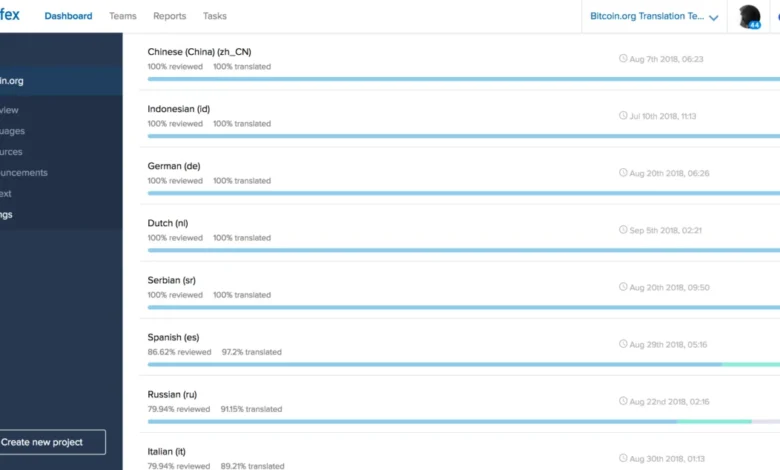
- Adoption of Transifex: The integration of Transifex, an enterprise-grade localization platform, marked a turning point. It allowed for a streamlined workflow where community members could propose translations, undergo peer review, and deploy changes directly to the site’s interface.
- 2018 Expansion: A significant milestone was reached when the project began porting developer-centric documentation into the translation pipeline. This enabled technical experts in non-English speaking countries to contribute to the code and infrastructure of the Bitcoin network, rather than merely consuming introductory material.
- The Paxful Sponsorship: The recent financial support provided by Paxful, a peer-to-peer bitcoin marketplace, served to incentivize high-frequency contributors. By rewarding these volunteers with bitcoin, the project highlighted a sustainable model for rewarding public goods in the open-source software space.
The Scope of Localization
The effort to translate Bitcoin.org is not a peripheral activity; it is a massive undertaking that encompasses over 70 distinct languages. Of these, 27 have reached a state of completion sufficient for integration into the live website. This process involves more than simple word-for-word translation; it requires a nuanced understanding of economic terminology, technical jargon, and cultural context.
The challenge is amplified by the technical nature of Bitcoin. Translators must ensure that terms like "hashrate," "private keys," and "consensus mechanisms" are accurately represented to prevent user error. A mistranslation of a security warning or a backup instruction could have real-world financial consequences for a user. Consequently, the team, co-organized by contributors such as Simon, known as "Komodorpudel," has implemented rigorous quality assurance protocols to maintain the integrity of the information.
Analyzing the Impact of Linguistic Inclusivity
The impact of this work is measurable through both traffic metrics and the geographic diversification of the Bitcoin network. When a user lands on a page that is displayed in their native tongue, the "bounce rate"—the percentage of visitors who leave the site after viewing only one page—typically decreases. By providing a familiar interface, the project encourages deeper engagement, which leads to a more informed user base.
Furthermore, the expansion into developer documentation has broader implications for the growth of the Bitcoin ecosystem. By lowering the language barrier for software engineers in regions such as South America and Southeast Asia, the project fosters the creation of localized products and services. These localized tools are often better suited to meet the specific needs of their respective communities, such as remittance services, merchant payment gateways, or offline transaction solutions.
The Economics of Open-Source Contributions
The decision to provide bitcoin as a token of appreciation for volunteer work represents an interesting evolution in the governance of open-source projects. In traditional corporate settings, translation is a cost-center managed by professional agencies. In the Bitcoin community, it is a decentralized effort.
The sponsorship by Paxful acknowledges that the labor provided by these volunteers has tangible economic value. By compensating contributors in the very asset they are helping to popularize, the project creates a circular incentive structure. It validates the "Satoshi" ethos—that the movement is composed of individuals who contribute their time and effort toward a common, global objective.
The Role of Strategic Partnerships
The success of the translation initiative is also a testament to the importance of strategic partnerships. While the volunteers provide the labor, the tools provided by platforms like Transifex and the funding provided by entities like Paxful provide the infrastructure and resources necessary to scale. This tripartite relationship—volunteers, tech providers, and industry sponsors—offers a blueprint for how other decentralized projects can sustain their operations without relying on centralized, top-down management.
Looking Toward the Future
As Bitcoin continues to mature, the requirements for translation will only increase. Future challenges include maintaining the accuracy of translations as the protocol undergoes upgrades and ensuring that new educational materials—such as articles on Layer 2 solutions like the Lightning Network—are localized with the same urgency as base-layer documentation.
The project leads have emphasized that the door remains open for new contributors. The infrastructure is now in place to allow anyone with a grasp of multiple languages to contribute to the global expansion of Bitcoin literacy. For those interested in joining, the process involves navigating the repository, coordinating with team leads, and participating in the peer-review process facilitated by the existing volunteer base.
Conclusion
The recent recognition of the volunteers behind the Bitcoin.org translation effort serves as a reminder that the digital revolution is built upon human effort. While the Bitcoin protocol operates on cold, mathematical consensus, the education required to utilize that protocol is a profoundly human endeavor. By bridging the linguistic divide, these volunteers are ensuring that the promise of Bitcoin remains available to anyone with an internet connection, regardless of the language they speak.
As the project looks toward the next phase of its growth, the commitment of these individuals will continue to be a defining factor in how the world perceives, learns about, and adopts Bitcoin. The work they perform behind the scenes is not merely a translation of words; it is the translation of a new economic paradigm into the diverse tongues of a global society. Through this persistent, decentralized collaboration, the mission of Bitcoin—to be a truly global and inclusive financial system—moves closer to reality with every translated sentence.