Binance Imposes Immediate Restrictions on MEXC Transactions Following U.S. Treasury Money Laundering Designation

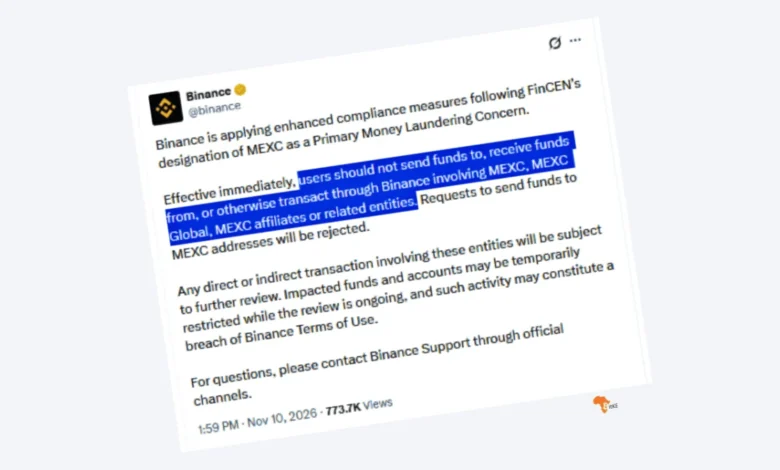
Cryptocurrency giant Binance has instituted immediate operational restrictions on all transactions involving MEXC, MEXC Global, and their associated corporate affiliates. This decisive action comes directly in the wake of a landmark enforcement measure by the United States Department of the Treasury, which formally designated the exchange as a Primary Money Laundering Concern. The rapid compliance cascade underscores the interconnected nature of modern digital asset markets, where regulatory actions taken by sovereign authorities in one jurisdiction rapidly ripple across globally distributed liquidity pools and centralized trading venues.
Under the newly enacted containment protocols, Binance users are officially barred from engaging in direct or indirect transfers with the identified entities. According to internal risk-management documentation released following the Treasury’s announcement, any outgoing transfers directed toward known MEXC deposit or withdrawal addresses will be automatically rejected by the platform’s compliance filters. Furthermore, any broader transactions presenting a secondary or tertiary nexus to MEXC will immediately trigger enhanced compliance reviews. Accounts or funds identified as having direct exposure to these restricted pathways may face temporary administrative freezes while forensic investigations and risk assessments are completed by Binance’s financial crimes compliance teams.
Chronology of Regulatory Escalation
The catalysts for Binance’s operational restrictions can be traced back to a sweeping regulatory enforcement action executed on November 6, 2026. On this date, the Financial Crimes Enforcement Network (FinCEN), a bureau of the U.S. Treasury Department, issued a formal finding targeting MEXC. The regulatory decree alleged that between May 2021 and May 2026, MEXC functioned as a critical conduit for illicit finance, facilitating at least $16 billion in suspicious transactions.
According to FinCEN’s investigative findings, the massive volume of questionable capital flowing through the platform was heavily intertwined with sophisticated cybercrime syndicates, ransomware operations, and state-sponsored sanctions evasion schemes. The U.S. government asserted that MEXC systematically failed to implement adequate anti-money laundering (AML) and know-your-customer (KYC) protocols, thereby creating an inviting harbor for bad actors seeking to launder illicit proceeds across international borders.
The progression of events highlights a growing trend among top-tier cryptocurrency exchanges: proactive risk mitigation. Rather than waiting for direct subpoenas or regulatory reprimands from western watchdogs, industry leaders like Binance are moving swiftly to sever ties with sanctioned or high-risk counterparts. This defensive posture is designed to insulate compliant platforms from secondary sanctions and preserve their banking relationships with traditional financial institutions.
Data and Scope of the Illicit Finance Allegations
The figures cited in the FinCEN designation represent some of the most staggering volumes of alleged illicit capital movement ever formally attributed to a centralized digital asset exchange outside of a full criminal indictment. The $16 billion in scrutinized transactions spans a five-year operational window, reflecting a sustained failure in transaction monitoring frameworks.
Financial crime analysts note that exchanges lacking robust surveillance infrastructure frequently become primary targets for illicit networks seeking to obfuscate the origins of funds stolen through decentralized finance (DeFi) exploits, corporate business email compromise (BEC) scams, and darknet market operations. By allowing pseudo-anonymous trading accounts or failing to investigate suspicious velocity and layering patterns, platforms like MEXC allegedly provided the velocity required to convert tainted digital tokens into fiat-equivalent assets or untraceable privacy coins.
The scope of FinCEN’s action is not merely symbolic; under Section 311 of the USA PATRIOT Act, a designation as a Primary Money Laundering Concern empowers the U.S. government to prohibit or severely restrict domestic financial institutions from opening or maintaining correspondent accounts with the targeted foreign entity. While offshore exchanges do not always maintain direct U.S. banking relationships, the global dominance of the U.S. dollar and the international reach of compliance frameworks mean that being cut off from major liquidity hubs and institutional partners is virtually fatal to a centralized exchange’s operational model.
Industry-Wide Compliance Pressure and Ripple Effects
The enforcement action against MEXC and Binance’s subsequent isolation of the exchange illuminate a broader, increasingly aggressive regulatory posture toward the cryptocurrency sector. Over the past several years, global financial regulators—including the U.S. Securities and Exchange Commission (SEC), the Commodity Futures Trading Commission (CFTC), the European Union’s Banking Authority, and various Asian financial intelligence units—have closed ranks around digital asset compliance.
The message to centralized exchanges is unequivocal: regulatory arbitrage is no longer a viable business model. Exchanges that operate in regulatory gray zones or deliberately court high-risk jurisdictions without adherence to international standards face ultimate expulsion from the global financial grid. Consequently, industry consolidation around highly compliant, heavily audited platforms is accelerating.
For Binance, which has spent the last several years restructuring its global compliance architecture, appointing traditional legal experts, and embedding rigorous identity-verification protocols, swift alignment with U.S. Treasury directives is a matter of corporate survival and rehabilitation. By cutting off MEXC instantly, Binance demonstrates to global regulators that its risk engines are capable of autonomously enforcing international sanctions and protective measures in real-time.
Fact-Based Analysis of Implications for Traders and Markets
The immediate restrictions placed on MEXC-linked transactions carry several distinct implications for everyday retail traders, institutional participants, and the wider crypto market infrastructure:
- Liquidity Fragmentation: As major platforms isolate high-risk exchanges, liquidity pools become increasingly fragmented. Traders who previously utilized MEXC for long-tail altcoin trading or high-leverage derivatives may face sudden capital lockups or forced liquidations if they are unable to withdraw assets before compliance barriers harden.
- Heightened Scrutiny on Wallet Addresses: The automated rejection of transfers to MEXC addresses means that blockchain analytics firms and exchange compliance tools are closely mapping deposit graphs. Individuals who casually interact with tainted wallets—even downstream—may find their funds flagged for secondary review, increasing the friction of day-to-day on-chain transactions.
- The Rise of Self-Custody: Incidents of this magnitude invariably drive users back toward self-custody solutions. When centralized intermediaries are rendered toxic overnight by regulatory decree, the old adage "not your keys, not your coins" regains acute relevance for market participants seeking to protect their assets from geopolitical and regulatory crossfire.
- Institutionalization of AML/KYC: The expectation for continuous, automated transaction monitoring is now the baseline for any exchange wishing to survive. Compliance is transitioning from a periodic auditing task to a real-time defensive shield, fundamentally altering how platforms handle cross-platform transfers.
Outlook and Future Regulatory Trajectory
As regulatory frameworks like the European Union’s Markets in Crypto-Assets (MiCA) regulation mature and as agencies like FinCEN continue to leverage their administrative powers under national security and anti-money laundering statutes, the perimeter of the digital asset economy will continue to tighten.
The case of MEXC serves as a cautionary tale for offshore exchanges operating without transparent regulatory oversight or robust compliance mechanisms. At the same time, Binance’s rapid implementation of transaction blocks illustrates that the largest players in the digital asset industry are prepared to sever commercial ties instantly to preserve their regulatory standing.
Market observers anticipate that enforcement actions of this nature will become increasingly frequent as blockchain analytics tools become more sophisticated, allowing authorities to map illicit financial flows with unprecedented precision. For digital asset investors, risk management now extends far beyond market volatility, encompassing counterparty risk, jurisdictional exposure, and the regulatory health of the platforms they choose to utilize.