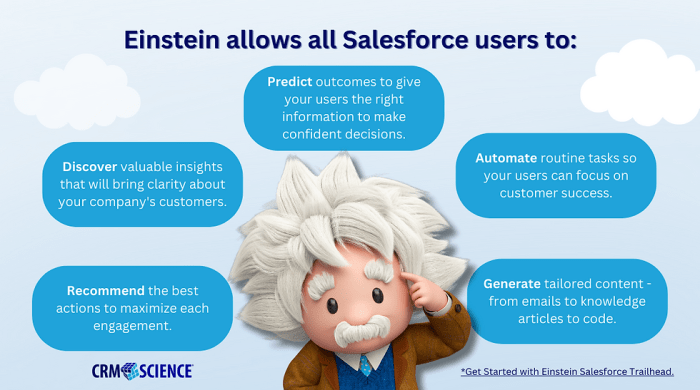
Boost CRM efficiency with Salesforce Einstein AI: Unlocking the potential of AI-powered CRM solutions to streamline sales processes, personalize customer interactions, and ultimately drive business growth. This insightful exploration delves into the core functionalities of Einstein AI, contrasting its capabilities with traditional CRM systems. We’ll uncover how Einstein AI can automate tasks, predict customer needs, and enhance forecasting accuracy.
The journey will also cover practical implementation steps, including data preparation and user training, along with strategies for measuring the impact and addressing potential challenges.
This comprehensive guide provides a practical approach to leveraging Salesforce Einstein AI to maximize CRM efficiency. We’ll examine the various ways Einstein AI can enhance sales productivity, improve customer relationships, and ultimately drive revenue growth. From automating lead qualification to predicting customer churn, we’ll explore how Einstein AI can revolutionize your CRM strategy.
Introduction to Salesforce Einstein AI for CRM Efficiency
Salesforce Einstein AI is a powerful set of artificial intelligence (AI) features integrated into the Salesforce platform. It leverages machine learning algorithms to analyze vast amounts of customer data, identify patterns, and provide actionable insights that empower sales teams to make data-driven decisions. This intelligent system helps businesses understand customer needs better, personalize interactions, and ultimately boost sales performance.Einstein AI’s core capabilities go beyond basic CRM functions.
Boosting CRM efficiency with Salesforce Einstein AI is crucial for modern businesses. Scott Brinker, a key figure in the MarTech space, often discusses the transformative power of these tools in his insightful articles, like his recent piece on the Scott Brinker MarTech New Wave , which highlights how innovative solutions like Einstein AI can reshape how companies operate.
Ultimately, leveraging AI in CRM systems is a key trend that future-proofs sales strategies and improves overall efficiency.
It uses predictive modeling to forecast sales outcomes, automate tasks, and personalize interactions, all aimed at enhancing the efficiency and effectiveness of sales teams. This AI-driven approach distinguishes it from traditional CRM systems by offering proactive insights and automated actions, leading to more targeted and impactful sales strategies.
Core Functionalities Impacting Sales Team Performance
Einstein AI provides a range of functionalities that directly benefit sales teams. These include lead scoring, opportunity forecasting, and personalized recommendations. Lead scoring helps prioritize leads based on their likelihood of converting, saving sales representatives time and effort by focusing on the most promising prospects. Opportunity forecasting uses historical data to predict the probability of closing deals, enabling sales managers to proactively manage resources and set realistic targets.
Personalized recommendations provide tailored product suggestions to customers, fostering stronger customer relationships and increasing the likelihood of repeat business.
Einstein AI vs. Traditional CRM Systems
Traditional CRM systems primarily focus on managing customer data and interactions. They offer tools for tracking sales activities, managing contacts, and generating reports. However, they often lack the predictive capabilities and automated functionalities found in Einstein AI-powered CRMs.
| Feature | Traditional CRM | Einstein AI-powered CRM |
|---|---|---|
| Data Analysis | Descriptive, reporting-focused. Analysis is primarily reactive. | Predictive, proactive. Uses machine learning to identify patterns and trends, providing actionable insights. |
| Automation | Limited automation, mostly focused on basic tasks like scheduling appointments. | Extensive automation, including lead scoring, opportunity forecasting, and personalized recommendations. |
| Predictive Capabilities | Lacks predictive modeling. Forecasting is often based on historical trends, without advanced algorithms. | Powerful predictive capabilities using machine learning. Forecasts sales outcomes, identifies potential risks, and recommends actions. |
| User Experience | Often requires significant manual effort to extract insights. Information may not be easily accessible or actionable. | Intuitive, data-driven insights are presented in a clear and actionable format. Users can leverage insights quickly. |
Boosting Sales Productivity with Einstein AI
Sales teams are constantly seeking ways to optimize their processes and improve efficiency. Salesforce Einstein AI offers a powerful toolkit for achieving this, automating tasks, and gaining valuable insights to drive better results. Leveraging AI-powered intelligence can significantly streamline your sales pipeline, from lead qualification to closing deals.Einstein AI’s predictive capabilities and automation features can transform how sales teams operate, enabling them to focus on high-value interactions and strategic initiatives.
This allows for increased revenue generation and a more rewarding sales experience.
Streamlining Sales Processes with Einstein AI
Einstein AI’s capabilities extend beyond simply automating tasks. By analyzing vast amounts of data, it provides insights that allow sales teams to understand customer behavior and anticipate needs. This proactive approach allows for more personalized outreach and targeted strategies, leading to higher conversion rates.
Automating Repetitive Tasks
Einstein AI can automate a wide range of repetitive sales tasks, freeing up valuable time for sales representatives. This allows them to concentrate on building relationships and closing deals, rather than getting bogged down in mundane administrative work.
- Lead Qualification: Einstein AI can analyze lead data to identify high-potential leads, automatically scoring them based on factors like demographics, engagement, and previous interactions. This allows sales teams to prioritize their efforts and focus on leads most likely to convert.
- Follow-up Automation: AI can automatically schedule follow-up emails or calls based on predefined rules or predicted customer behavior. This ensures consistent communication and nurturing, keeping leads engaged and informed about your offerings.
Predicting Customer Needs and Personalizing Outreach
Einstein AI excels at understanding customer behavior and needs. It can analyze data points to predict potential needs and preferences, enabling personalized communication strategies. This proactive approach fosters stronger customer relationships and leads to higher conversion rates.
Boosting CRM efficiency with Salesforce Einstein AI is key for modern businesses. Understanding your brand personality, like in brand personality an approach for professional services , is crucial for tailoring your sales approach. Ultimately, this deeper understanding helps to fine-tune your AI-powered CRM strategy for optimal results.
- Personalized Recommendations: Einstein AI can identify specific product or service recommendations tailored to individual customer needs. This personalized approach leads to more relevant and effective sales pitches.
- Proactive Outreach: AI can identify when a customer is likely to need support or require a specific product upgrade. This allows sales representatives to proactively offer solutions, strengthening customer relationships and increasing the likelihood of future purchases.
Improving Forecasting Accuracy and Revenue Projections
Accurate forecasting is critical for sales teams. Einstein AI can analyze historical sales data, market trends, and other relevant factors to provide more accurate revenue projections. This allows sales teams to make informed decisions about resource allocation and anticipate potential challenges.
- Improved Sales Forecasts: By analyzing historical sales data, market trends, and other relevant factors, Einstein AI can provide more accurate sales forecasts, reducing uncertainty and allowing for better planning and resource allocation.
- Predictive Revenue Projections: Einstein AI can analyze factors like deal size, win rates, and sales cycles to generate more accurate revenue projections, giving sales leaders a clearer picture of potential future revenue.
Sales Task Automation with Einstein AI
Einstein AI automates various sales tasks, freeing up sales representatives for higher-value activities.
| Sales Task | Einstein AI Automation |
|---|---|
| Lead Scoring | Analyze lead data and assign scores based on factors like engagement and demographics. |
| Email Campaigns | Automate email sequences based on lead behavior and predicted needs. |
| Opportunity Forecasting | Analyze historical data and market trends to generate more accurate sales forecasts. |
| Sales Pipeline Management | Identify potential roadblocks and bottlenecks in the sales pipeline and proactively address them. |
Enhancing Customer Relationship Management with Einstein AI
Einstein AI is revolutionizing how businesses manage customer relationships. By leveraging machine learning, Salesforce Einstein AI empowers companies to gain deeper insights into customer behavior, anticipate needs, and personalize interactions. This translates to improved customer satisfaction, increased sales, and ultimately, a more profitable business.Einstein AI’s capabilities extend beyond basic data analysis. It can predict customer behavior, identify trends, and proactively address potential issues, all while enabling businesses to streamline their processes and focus on building stronger, more profitable relationships with their clients.
Improving Customer Segmentation and Targeting
Einstein AI excels at identifying patterns and insights within vast datasets. This allows for sophisticated customer segmentation based on factors like purchase history, demographics, and engagement levels. This detailed segmentation empowers businesses to tailor marketing campaigns and product offerings to specific customer groups, maximizing campaign effectiveness. By understanding which customers are most likely to respond positively to specific promotions or products, companies can optimize their marketing efforts and achieve a higher return on investment.
Personalizing Customer Interactions and Communications
Einstein AI enables personalized customer interactions by analyzing individual customer data to create tailored experiences. This includes dynamic content adjustments in emails, personalized product recommendations, and targeted promotions. For example, a customer who frequently purchases gardening tools might receive tailored email recommendations for new gardening equipment. This personalized approach fosters stronger customer relationships and builds loyalty.
Identifying Customer Churn Risks and Proactive Measures
Einstein AI can analyze customer behavior to identify patterns associated with customer churn. By analyzing factors like purchase frequency, support interactions, and engagement with marketing materials, the system can predict which customers are at risk of leaving. This allows businesses to proactively reach out to these customers, offering targeted incentives, personalized support, or tailored solutions to address their concerns and retain them.
For example, a customer showing signs of potential churn might receive a personalized email campaign offering exclusive discounts or special support sessions.
Facilitating Cross-selling and Upselling Opportunities
Einstein AI can identify cross-selling and upselling opportunities by analyzing customer purchase history, browsing behavior, and product preferences. By recognizing patterns and identifying potential needs, the system can recommend complementary products or higher-value alternatives, increasing average order value. For instance, a customer purchasing a new laptop might receive recommendations for a protective case, an extended warranty, or a high-capacity external hard drive.
Customer Segmentation and Targeting Strategies
| Customer Segment | Characteristics | Einstein AI Targeting Strategies |
|---|---|---|
| High-Value Customers | Frequent purchasers, high-value transactions, significant engagement | Personalized recommendations for premium products, exclusive offers, VIP support programs |
| Low-Value Customers | Infrequent purchasers, low transaction value, minimal engagement | Targeted promotions to encourage first-time purchases, introductory offers, simplified onboarding |
| Churn-Risk Customers | Decreased purchase frequency, reduced engagement, infrequent communication | Personalized communication campaigns offering incentives, tailored support, and special offers to retain their business. |
| New Customers | Recently signed up, minimal purchase history | Personalized onboarding experiences, product recommendations based on initial purchases, and targeted promotions to encourage repeat business. |
Implementing Einstein AI for Improved Efficiency: Boost Crm Efficiency With Salesforce Einstein Ai

Unlocking the power of Salesforce Einstein AI can significantly boost your CRM efficiency, but successful implementation requires careful planning and execution. This involves understanding the integration process, optimal setup configurations, crucial data considerations, and the importance of user adoption. This guide will walk you through the steps to effectively leverage Einstein AI within your Salesforce CRM.Implementing Einstein AI is not just about adding a new tool; it’s about transforming your sales and customer service processes.
By understanding and applying Einstein AI’s predictive capabilities, you can anticipate customer needs, personalize interactions, and streamline your workflows. This results in increased sales, improved customer satisfaction, and a more efficient CRM environment.
Integrating Einstein AI into Salesforce
Integrating Einstein AI into your Salesforce CRM involves several key steps. First, ensure your Salesforce org is configured to support Einstein AI. Next, identify the specific Einstein AI features that align with your business goals. This could include features like predictive lead scoring, opportunity forecasting, or customer service recommendations. Careful consideration of your organization’s needs is crucial.
Setting Up Einstein AI for Optimal Performance, Boost crm efficiency with salesforce einstein ai
To ensure optimal performance, a structured approach to setting up Einstein AI is essential. This includes configuring the relevant data sources and ensuring data quality. Specific settings within Salesforce, like defining data models and adjusting parameters, need to be tailored to your business requirements. A thorough understanding of the specific Einstein AI features you’re using is vital.
Data Preparation and Quality Considerations
Data quality is paramount for effective Einstein AI implementation. Incomplete or inaccurate data will negatively impact the accuracy of predictions and insights. Before deploying Einstein AI, carefully review and clean your data. Identify any missing or erroneous entries and implement processes for data validation and maintenance. This step is critical to ensuring that Einstein AI provides reliable and actionable results.
User Training and Adoption
Successful AI implementation hinges on user training and adoption. Empower your team with the knowledge and skills needed to utilize Einstein AI effectively. Clearly define how Einstein AI features will impact their daily tasks and responsibilities. Regular training sessions and ongoing support are key to fostering a positive user experience.
Setting Up Einstein AI Predictive Models
A structured approach to setting up Einstein AI predictive models is essential for achieving desired outcomes. The following table Artikels a step-by-step procedure for this process:
| Step | Description | Expected Outcome |
|---|---|---|
| 1. Define the Prediction Goal | Identify the specific business outcome you want to predict (e.g., customer churn, lead conversion). | Clear definition of the prediction objective. |
| 2. Select the Data Sources | Choose the relevant data sets needed to train the model (e.g., customer demographics, purchase history). | Appropriate data sources identified for model training. |
| 3. Prepare and Clean the Data | Ensure data accuracy, completeness, and consistency to avoid errors in model training. | Cleaned and validated data ready for model training. |
| 4. Choose the Model Type | Select the appropriate model type (e.g., regression, classification) based on the prediction goal. | Suitable model type selected based on prediction goal. |
| 5. Train the Model | Train the chosen model using the prepared data to build the predictive capability. | Trained model ready for testing and deployment. |
| 6. Evaluate the Model | Assess the model’s performance through metrics (e.g., accuracy, precision) and refine it if necessary. | Validated model with acceptable performance metrics. |
| 7. Deploy the Model | Integrate the model into your Salesforce CRM workflows to automatically generate predictions. | Model successfully integrated into Salesforce CRM for real-time predictions. |
Measuring the Impact of Einstein AI
Harnessing the power of AI in your CRM requires a meticulous approach to measuring its impact. Simply implementing Salesforce Einstein AI isn’t enough; you need to track key performance indicators (KPIs) to understand its effectiveness and make data-driven adjustments. This process ensures you’re maximizing the value of your investment and ensuring that AI is working
for* you, not against you.
A comprehensive approach to measuring the impact of Einstein AI allows you to pinpoint areas of improvement and optimize your strategies. This, in turn, results in a more streamlined and efficient CRM system, leading to better customer relationships and ultimately, increased revenue.
Key Performance Indicators (KPIs) for Einstein AI Effectiveness
Understanding which KPIs to track is crucial for assessing the success of your Einstein AI implementation. Effective tracking involves a combination of quantifiable metrics that reflect the improvements in sales productivity, customer satisfaction, and revenue generation. Focusing on these metrics provides clear insights into the value AI delivers.
- Conversion Rates: This KPI directly measures the effectiveness of Einstein AI’s predictive capabilities in guiding sales teams towards closing deals. Tracking the percentage of qualified leads that convert into customers is a critical indicator of improved sales processes. A notable increase in conversion rates indicates the successful implementation of Einstein AI’s lead scoring and qualification features.
- Sales Cycle Length: Einstein AI can significantly impact the sales cycle length by automating tasks and providing insights to sales representatives. Shorter sales cycles are a direct result of streamlined processes, leading to increased revenue generation. Monitoring the sales cycle length allows you to assess whether AI is contributing to faster deal closures.
- Customer Retention Rate: Einstein AI’s ability to personalize interactions and anticipate customer needs can positively influence customer satisfaction and loyalty. Tracking customer retention rate over time provides a clear picture of the effectiveness of AI in fostering strong customer relationships. High retention rates indicate that AI is successfully supporting improved customer service.
- Customer Satisfaction (CSAT) Scores: These scores reflect the overall satisfaction of your customers with the products or services. Improved CSAT scores are a key indicator of successful AI implementation, particularly when it relates to personalization and proactive customer support. AI-powered insights can lead to improved service delivery and higher CSAT scores.
- Revenue Generation: Ultimately, the effectiveness of AI implementation is measured by the impact on revenue. Tracking revenue generated through sales processes influenced by Einstein AI provides a direct measure of the ROI. This KPI reflects the overall efficiency and effectiveness of the sales process with AI support.
Methods for Tracking and Monitoring Einstein AI Results
Implementing a robust system for tracking and monitoring Einstein AI’s performance is essential. This ensures you have the data necessary to understand the impact and make adjustments.
- Establish Baselines: Before implementing Einstein AI, establish clear baselines for your chosen KPIs. This allows for a clear comparison of performance before and after the implementation. This foundational data is crucial for identifying and quantifying improvements.
- Regular Reporting: Implement regular reporting mechanisms to monitor the KPIs. Automated reports allow for consistent tracking and identification of trends. This regular monitoring is essential for identifying patterns and potential issues quickly.
- Analyze Data Trends: Regularly analyze the data to identify trends in the KPIs. This helps pinpoint areas where Einstein AI is most effective and where further adjustments might be needed. Analyzing trends is vital for strategic decision-making and process optimization.
- A/B Testing: Use A/B testing to compare different AI-powered strategies and features. This allows for a controlled environment for measuring the impact of specific AI implementations. This provides evidence for specific AI functionalities’ effectiveness.
Examples of Einstein AI Success Stories
Several companies have successfully leveraged Einstein AI to improve CRM efficiency. These examples demonstrate the tangible benefits that AI can deliver.
- Company X: Reduced sales cycle length by 20% after implementing Einstein AI-powered lead scoring and qualification. This led to a significant increase in sales revenue. This example highlights the positive impact of AI on sales efficiency.
- Company Y: Improved customer retention by 15% through personalized recommendations and proactive customer service suggestions from Einstein AI. This highlights the importance of AI for strengthening customer relationships.

Before-and-After KPI Comparisons
The following table demonstrates potential before-and-after comparisons for key KPIs.
| KPI | Before Einstein AI | After Einstein AI | Improvement |
|---|---|---|---|
| Conversion Rate | 10% | 15% | 5% increase |
| Sales Cycle Length | 60 days | 45 days | 15 days reduction |
| Customer Retention Rate | 70% | 75% | 5% increase |
Challenges and Considerations
Implementing Salesforce Einstein AI within a CRM system, while offering significant potential, presents certain challenges. Careful planning and consideration are crucial for successful integration and maximizing the benefits of this powerful technology. Understanding these hurdles and developing proactive solutions is key to achieving a smooth transition and a positive ROI.
Data Quality and Preparation
Data accuracy and completeness are paramount for Einstein AI models to function effectively. Incomplete or inconsistent data can lead to inaccurate predictions and flawed insights. Ensuring data quality requires a robust data cleansing process. This involves identifying and correcting errors, standardizing formats, and filling in missing values. Thorough data validation procedures should be implemented to maintain data integrity throughout the implementation process.
Model Training and Tuning
Einstein AI models require training data to learn patterns and relationships. Insufficient or irrelevant training data can result in models that are not accurate or effective. Carefully selecting the right data for training and continuously monitoring model performance is crucial. Regularly adjusting and tuning models based on evolving business needs is essential for maintaining their effectiveness. This iterative approach ensures the models remain aligned with business objectives.
Boosting CRM efficiency with Salesforce Einstein AI is crucial, but understanding your market is equally important. To truly optimize your sales strategies, consider the valuable insights from the importance of market research 3 client takeaways. This knowledge will empower your AI-driven CRM to perform even better, ultimately leading to more successful sales and customer interactions.
Integration Complexity
Integrating Einstein AI with existing Salesforce CRM systems can be complex. The need to map data, configure integrations, and manage user access can be challenging. A clear understanding of the Salesforce ecosystem and the AI features being utilized is necessary. Detailed documentation and training programs are critical to equip users with the knowledge required for effective integration.
Data Security and Privacy
Data security and privacy are paramount when dealing with sensitive customer information. Einstein AI models often access and analyze customer data. Robust security measures, such as encryption and access controls, must be implemented to protect this data. Adherence to relevant data privacy regulations, such as GDPR, is essential. Transparent data handling practices and user consent mechanisms are vital for maintaining customer trust.
Ongoing Maintenance and Updates
Einstein AI models require ongoing maintenance and updates to stay relevant and accurate. The business environment is constantly changing, requiring models to adapt to new data and trends. Regularly monitoring and updating models is critical for maintaining their accuracy and effectiveness. A proactive approach to model maintenance ensures that the AI solutions continue to deliver value over time.
Einstein AI implementation, while powerful, requires careful planning and execution. Addressing data quality, model training, integration, security, and maintenance proactively ensures successful adoption and sustained value generation. Potential pitfalls, such as inaccurate data, poorly trained models, or security breaches, can be mitigated through comprehensive strategies and proactive measures.
Future Trends and Opportunities

The future of CRM is intertwined with the relentless march of artificial intelligence. Salesforce Einstein AI, currently a powerful tool, is poised to become even more integral to business strategies as AI evolves. This evolution will impact not only how businesses interact with customers but also how they operate internally. Understanding these future trends is critical for businesses seeking to leverage AI to its maximum potential.The ongoing development of AI, particularly in areas like natural language processing (NLP) and machine learning (ML), is rapidly changing how businesses can interact with customers and manage their relationships.
This will necessitate a proactive approach to staying ahead of the curve, and understanding the potential of integrating Einstein AI with other technologies is key.
Emerging Trends in AI and their CRM Impact
Advancements in natural language processing are enabling AI to understand and respond to customer queries with greater nuance and accuracy. This translates to more efficient customer service, faster issue resolution, and more personalized interactions. For example, AI-powered chatbots can handle routine inquiries, freeing up human agents to focus on complex issues, leading to a more efficient customer service experience.
Additionally, AI can now analyze vast amounts of unstructured data, like social media posts and customer reviews, to gain valuable insights into customer sentiment and identify emerging trends. These insights can be leveraged to personalize marketing campaigns and product development, leading to a more targeted approach and better outcomes.
Further Development of Einstein AI to Address Evolving Needs
Einstein AI’s potential for growth is substantial. Future developments could focus on more sophisticated predictive modeling, enabling businesses to anticipate customer needs and proactively address potential issues. Enhanced integration with other Salesforce products, like Service Cloud and Marketing Cloud, could streamline workflows and improve the overall CRM experience. For example, Einstein AI could predict customer churn based on historical data and proactively offer targeted interventions, reducing customer loss and maximizing retention.
Integration of Einstein AI with Other Technologies
The future of CRM lies in seamless integration. Integrating Einstein AI with other emerging technologies, such as the Internet of Things (IoT) and blockchain, could revolutionize customer relationship management. For example, if a customer’s IoT device identifies a potential problem, Einstein AI can automatically trigger a proactive support request or personalized service recommendation. Data from blockchain can be used to track transactions, maintain trust, and provide valuable insights into customer behaviour.
Future Possibilities of Integrating Einstein AI with Other Technologies
Integration with IoT devices will enable real-time data capture and analysis, enabling proactive support and personalized recommendations. Blockchain integration will enhance transparency and security in transactions and data management. This integration will not only improve customer experience but also streamline internal processes, creating a more efficient and responsive organization. This is a critical area for future development, as the combination of Einstein AI with other technologies can unlock new possibilities for personalized experiences, data-driven insights, and increased efficiency.
Predicted Impact of AI on CRM in the Next 5 Years
Within the next five years, AI is predicted to transform CRM from a reactive system to a proactive one. AI will empower businesses to anticipate customer needs and personalize interactions more effectively. Businesses that successfully integrate AI into their CRM strategies will likely experience a significant increase in sales, improved customer satisfaction, and reduced operational costs. For example, a retail company might use AI to predict which customers are most likely to abandon their shopping carts, sending targeted offers to encourage completion.
How Predictions Inform Business Strategies and Investments in AI
These predictions highlight the need for businesses to invest in AI capabilities and adapt their strategies accordingly. Companies should invest in training their employees on AI tools and technologies, fostering a data-driven culture, and prioritizing data security and privacy. Understanding the specific capabilities of AI tools, like Einstein AI, and their potential to transform CRM processes is critical for businesses to develop informed investment strategies.
By recognizing the evolving needs of the market, businesses can position themselves for success in the future of CRM.
Conclusive Thoughts
In conclusion, boosting CRM efficiency with Salesforce Einstein AI offers significant opportunities for businesses seeking to optimize their sales and customer relationship management. By understanding its capabilities, implementing it strategically, and addressing potential challenges, companies can harness the power of AI to enhance productivity, personalize interactions, and ultimately achieve sustainable growth. The future of CRM is undoubtedly intertwined with AI, and this exploration equips readers with the knowledge to navigate this transformative landscape effectively.