How to create UTM codes in Google Analytics is crucial for tracking website traffic and understanding campaign performance. This comprehensive guide dives deep into the world of UTM parameters, from their fundamental role in marketing to practical implementation and advanced usage. Learn how to construct, implement, and analyze UTM codes for maximum campaign effectiveness.
We’ll explore different types of UTM parameters, like source, medium, and campaign, and how to tailor them for various marketing efforts. You’ll also discover best practices to avoid common errors and ensure accurate tracking. By the end, you’ll be equipped to effectively use UTM codes for more precise campaign analysis and reporting.
Introduction to UTM Parameters
UTM parameters are crucial for tracking website traffic and understanding the effectiveness of marketing campaigns. They act as tags, essentially adding extra information to website URLs, enabling you to pinpoint the source and medium of traffic. This detailed data helps you analyze campaign performance, measure user behavior, and ultimately optimize your marketing strategies. Imagine trying to understand where your website visitors are coming from without knowing which ad or social media post sent them there—UTM parameters are the key to unlocking that information.Understanding how different channels contribute to your website traffic is vital for optimizing your marketing budget.
Figuring out UTM codes in Google Analytics is crucial for tracking website traffic. Knowing how to craft effective UTM parameters helps you understand where your website visitors are coming from, which is vital for optimizing your content marketing strategy. This is especially important when developing a content marketing playbook for your professional services firm, like this one , as you’ll want to analyze which campaigns are performing best.
Once you master UTM codes, you’ll be able to measure the effectiveness of your marketing efforts across various platforms and make data-driven decisions about your strategy.
By tracking the specific source, medium, campaign, and content, you can gain valuable insights into which channels are most successful, leading to informed decisions on future marketing campaigns. UTM parameters provide a detailed breakdown of your marketing efforts, allowing you to see which channels are driving the most valuable traffic.
Importance of UTM Parameters in Google Analytics
UTM parameters are indispensable for Google Analytics. They provide a structured way to attribute website traffic to specific marketing campaigns. Without UTM parameters, it becomes challenging to accurately measure the impact of different marketing initiatives. This can lead to ineffective resource allocation and missed opportunities for optimization. For instance, if you run a Facebook ad campaign and don’t use UTM parameters, Google Analytics won’t know the source of the traffic from that campaign, making it difficult to determine its return on investment.
Understanding User Behavior and Campaign Performance
UTM parameters offer insights into user behavior and campaign performance. By tracking the source, medium, and campaign, you can identify which channels are driving high-quality traffic and which ones are less effective. Analyzing user behavior within the context of the campaign can provide insights into what elements of your marketing strategies resonate with your audience and what elements need improvement.
Understanding how users interact with your website after clicking on a campaign link can reveal insights into the effectiveness of the landing page, the value of the offer, and the overall user experience.
Structure of UTM Parameters
The following table details the common UTM parameters used for tracking website traffic:
| Parameter Name | Parameter Value | Description |
|---|---|---|
| utm_source | The website or platform that referred the visitor (e.g., google, facebook, referral). | Indicates the origin of the traffic. |
| utm_medium | The method of traffic acquisition (e.g., cpc, social, email, referral). | Indicates the channel used to drive traffic. |
| utm_campaign | The name of the marketing campaign (e.g., holiday_sale, new_product_launch). | Specifies the particular campaign that generated the traffic. |
| utm_content | A specific element within the campaign (e.g., banner_A, banner_B). | Allows tracking of different variations of a campaign or ad. |
| utm_term | The used in a search engine campaign (e.g., marketing automation, lead generation). | Relevant only for search engine campaigns, indicating the search term that led to the click. |
Types of UTM Parameters
UTM parameters are crucial for tracking the effectiveness of your marketing campaigns in Google Analytics. They provide valuable insights into how users interact with your website after clicking on your ads or links. Understanding the different types of UTM parameters empowers you to dissect traffic sources, campaign performance, and user behavior. This section delves into the specifics of each parameter, enabling you to create tailored and insightful tracking strategies.UTM parameters work by attaching extra information to your website links, allowing you to precisely identify the source of the traffic.
This detailed data empowers you to evaluate the performance of various marketing campaigns and make informed decisions about your strategies.
Source Parameter
The source parameter identifies the website or platform where the user encountered your link. This parameter is vital for understanding where your traffic originates. For instance, if a user clicks on a link from a social media platform like Facebook, the source parameter would be “facebook.com.”
Medium Parameter
The medium parameter specifies the channel through which the user interacted with your link. Common examples include “cpc,” “organic,” “email,” “social,” or “referral.” Knowing the medium helps categorize your traffic and measure the performance of different marketing channels.
Campaign Parameter
The campaign parameter provides a broader context for the campaign that generated the traffic. For example, a campaign could be named “Summer Sale 2024.” Using this parameter allows you to analyze the performance of different campaigns.
Term Parameter
The term parameter is used to identify specific s or search terms that brought users to your website. This parameter is particularly useful for paid search campaigns. If a user clicks on an ad for “running shoes,” the term parameter would be “running shoes.”
Content Parameter
The content parameter specifies the specific piece of content that led the user to your website. For instance, a blog post title, an ad variation, or a specific social media post. This granular level of detail allows you to understand which specific content is most effective.
UTM Parameter Structure and Format
UTM parameters are appended to a standard URL. The structure is:
yourwebsite.com/?utm_source=source&utm_medium=medium&utm_campaign=campaign&utm_term=term&utm_content=content
Each parameter is separated by an ampersand (&). Note that all parameters are optional.
Examples of UTM Parameter Combinations
Here are examples illustrating various UTM parameter combinations for different marketing campaigns:
| Campaign Type | UTM Parameter Combination | Description |
|---|---|---|
| Social Media Campaign (Facebook) | yourwebsite.com/?utm_source=facebook&utm_medium=social&utm_campaign=BackToSchool&utm_content=fb_ad_123 |
A user clicks on a Facebook ad promoting a Back to School sale. |
| Paid Search Campaign (Google Ads) | yourwebsite.com/?utm_source=google&utm_medium=cpc&utm_campaign=Shoes2024&utm_term=running%20shoes&utm_content=text_ad_1 |
A user clicks on a Google Ads text ad for running shoes, part of the Shoes2024 campaign. |
| Email Marketing Campaign | yourwebsite.com/?utm_source=email&utm_medium=email&utm_campaign=Newsletter_July&utm_content=special_offer |
A user clicks on a link in an email newsletter promoting a special offer. |
By understanding and correctly implementing UTM parameters, you can gain a deep understanding of your marketing campaigns’ effectiveness and tailor your strategies for optimal results.
Creating UTM Codes

Now that you understand the purpose and different types of UTM parameters, it’s time to put them into action. This section will guide you through the process of constructing a UTM code, ensuring your campaigns are precisely tracked and analyzed in Google Analytics. We’ll explore the syntax, provide examples, and explain how to use various parameter values to glean valuable insights.
Constructing UTM Parameters
A UTM code is a string of parameters appended to a URL. These parameters provide essential data about the source, medium, and campaign of a click. This detailed information helps you identify where your traffic originates and how effective your campaigns are.
UTM Parameter Syntax
The fundamental structure of a UTM code follows a specific syntax. The parameters are appended to the URL, separated by ampersands (&). A typical UTM code looks like this: yourwebsite.com/?utm_source=source&utm_medium=medium&utm_campaign=campaign&utm_term=term&utm_content=content.
Important: Always use the `?` before the first parameter, and `&` between subsequent parameters.
Example of a UTM Code
Let’s say you’re running a social media campaign on Twitter to promote a new product, “SuperWidget.” You’d create a UTM code like this:
https://www.example.com/product/superwidget?utm_source=twitter&utm_medium=social&utm_campaign=superwidget-launch&utm_content=tweet1
Figuring out UTM codes in Google Analytics is pretty straightforward. Knowing how to craft effective UTM parameters is crucial for tracking website traffic. This directly impacts how you understand which marketing efforts are bringing in valuable leads, like those highlighted in the article “diamonds in the rough 3 keys to helping non sales staff find qualified new” diamonds in the rough 3 keys to helping non sales staff find qualified new.
Ultimately, mastering UTM parameters helps you refine your strategies for driving qualified leads and boosting your overall marketing performance. So, next time you’re ready to dive into creating UTM codes, remember the principles for maximizing your data analysis and understanding of your audience.
In this example:
utm_source=twitteridentifies Twitter as the source of the traffic.utm_medium=socialspecifies the medium as social media.utm_campaign=superwidget-launchdesignates the campaign.utm_content=tweet1pinpoints a specific piece of content, such as a particular tweet.
Using Different UTM Parameter Values
Each UTM parameter allows you to tailor your tracking to specific needs. You can use values that best describe the campaign’s source, medium, campaign name, s, or even content variations.
| Parameter | Description | Example Value |
|---|---|---|
utm_source |
The source of the traffic (e.g., social media platform, search engine, email list). | facebook, google, email |
utm_medium |
The channel used to drive traffic (e.g., social media, email, paid search). | social, cpc, email |
utm_campaign |
The name of the campaign. | winter-sale, superwidget-launch |
utm_term |
The used in search engine advertising. | superwidget, discount-code |
utm_content |
A specific piece of content (e.g., a particular ad, a specific tweet). | banner1, ad2, tweet1 |
Step-by-Step Guide to Creating a UTM Code
- Define your campaign elements. What is the source, medium, campaign name, and specific content or s?
- Choose your parameter values. Select appropriate values for each parameter, ensuring accuracy and clarity.
- Construct the URL. Use the syntax `?utm_source=source&utm_medium=medium&utm_campaign=campaign…` and append it to your website’s URL.
- Test the code. Use the UTM code in your marketing materials and monitor the data in Google Analytics to ensure it’s working as expected.
Implementing UTM Codes
Getting your UTM parameters working correctly is crucial for understanding where your website traffic is coming from. Proper implementation ensures accurate tracking and helps you optimize your marketing campaigns. Without correct implementation, you’ll be flying blind, missing out on valuable insights into your campaigns’ effectiveness.Implementing UTM parameters involves seamlessly integrating them into your website’s URLs. This allows Google Analytics to identify the source, medium, and campaign associated with each click, ultimately providing a comprehensive view of your marketing efforts.
This integration ensures that each click is tracked effectively, allowing for more informed decisions regarding future campaigns.
Manual Link Modification
Manual modification of links involves directly editing the URLs to include UTM parameters. This method works well for smaller campaigns or when you’re not using sophisticated tools. It’s important to be meticulous in your approach, as errors can lead to inaccurate data. For instance, a misplaced character can alter the entire tracking process.
- Carefully construct the URL, ensuring accurate syntax and parameter values. Incorrect syntax or missing parameters can lead to tracking errors, making the data inaccurate.
- Use a consistent naming convention for your campaigns to maintain clarity and organization in your tracking data. This will help you easily identify different campaigns and analyze their performance.
- Regularly review and validate your UTM parameters to ensure accuracy. This practice will prevent discrepancies in your analytics data and improve the reliability of your tracking insights.
Using Tools and Software
Many tools and software platforms simplify the implementation of UTM parameters. These tools often automate the process, minimizing the risk of errors and saving significant time. This automation also helps in preventing mistakes that can arise from manually entering the parameters.
- Marketing automation platforms often have built-in features to generate UTM parameters automatically. This feature eliminates the need for manual intervention, increasing the accuracy of data collection.
- Content management systems (CMS) plugins can streamline the process of adding UTM parameters to links. This automation significantly improves efficiency and reduces the chance of errors.
- Spreadsheet programs and online URL shorteners can also be used to create and manage UTM parameters. Spreadsheet programs help in organization, while URL shorteners maintain brevity and convenience in the links.
Implementation Across Different Platforms
The method for implementing UTM parameters varies slightly depending on the website platform. For example, embedding UTM parameters into social media posts will differ from adding them to a blog post on WordPress. Understanding these nuances is essential for accurate tracking.
- WordPress: Plugins can automatically add UTM parameters to links generated by the platform. This automated approach simplifies the process, reducing errors.
- Social Media Platforms: Copy and paste the generated URL into the social media platform’s post editor. Ensure the UTM parameters are included in the URL. Social media platforms often have limitations in how long a URL can be, requiring a URL shortener for better management.
- Email Marketing Platforms: Most email marketing platforms have the ability to embed UTM parameters in email links. Look for options to customize the links with UTM parameters before sending the email.
Comparison of Implementation Methods
| Implementation Method | Advantages | Disadvantages |
|---|---|---|
| Manual Link Modification | Simple for small campaigns; no additional tools required. | Prone to errors; time-consuming for large campaigns. |
| Using Tools and Software | Automated process; reduces errors; faster for large campaigns. | Requires learning a new tool or software; potential for tool limitations. |
UTM Parameter Best Practices
Optimizing your UTM parameters is crucial for accurate and insightful tracking in Google Analytics. Well-structured UTM parameters not only provide valuable data but also streamline your analysis process. Effective use of these parameters enables you to understand campaign performance, identify high-performing channels, and refine future marketing strategies. Following best practices for UTM parameters is essential for reliable data collection and comprehensive analysis.Descriptive and meaningful parameter values are paramount for actionable insights.
Vague or poorly formatted values hinder analysis and render the data less useful. By implementing best practices, you can gain a clear understanding of the sources driving traffic and measure the effectiveness of your campaigns. This leads to better-informed decisions and improved marketing ROI.
Descriptive Parameter Values
Accurate and descriptive parameter values are critical for effective tracking and analysis. Avoid using generic or ambiguous names. Instead, choose values that precisely reflect the campaign, source, and medium. For example, instead of “social,” use “facebook_ads” or “twitter_campaign.” This detailed approach allows for granular analysis, enabling you to isolate the impact of specific social media campaigns. By using precise parameter values, you ensure the data accurately represents the campaign’s performance and avoids misinterpretations.
Avoiding Common Errors
Common errors in UTM parameter implementation can significantly affect data accuracy and analysis. Careless typos or incorrect formatting can lead to inaccurate reporting, making it difficult to identify successful campaigns and their respective channels. Furthermore, missing or improperly formatted parameters can result in incomplete data, potentially skewing insights. Precise implementation is essential for reliable results.
Data Accuracy
Maintaining data accuracy is paramount for deriving meaningful insights from your UTM parameters. Typos, inconsistencies, and missing parameters can significantly impact the quality of your data. Always double-check the parameters for accuracy before implementing them in your campaigns. Inconsistent parameters across various campaigns will lead to skewed data and erroneous conclusions.
Dos and Don’ts
- Do: Use specific and descriptive values for campaign, source, medium, and other parameters. For instance, use “facebook_ads” instead of simply “social.” This allows for a precise understanding of the channel driving the traffic.
- Don’t: Use generic or ambiguous values. Vague parameters, like “social media,” obscure the source of the traffic and hinder in-depth analysis. This makes it difficult to isolate the performance of specific social media campaigns.
- Do: Strictly adhere to the correct format for each parameter. This includes ensuring that parameters are URL-encoded and that the values are separated correctly by ampersands. Following the prescribed format prevents errors in tracking and analysis.
- Don’t: Include spaces or special characters in parameter values without URL encoding. This can lead to errors in tracking and analysis.
- Do: Regularly review and update your UTM parameters to ensure they remain relevant and accurate. Changes in campaigns or marketing strategies necessitate adjustments to your parameters. This maintains consistency and avoids confusion in the data.
- Don’t: Neglect to document your UTM parameters. A documented system helps in understanding the purpose and interpretation of different parameters, especially in large-scale campaigns. Documentation ensures the data remains understandable and maintainable.
Example of a well-structured UTM parameter
A well-structured UTM parameter would look like this:
https://www.example.com/?utm_source=facebook&utm_medium=social&utm_campaign=SummerSale&utm_term=SummerDeals&utm_content=banner
This example demonstrates clear and distinct parameters, making it easy to track the source of the traffic and understand the performance of different campaigns.
Advanced UTM Parameter Usage
UTM parameters, while fundamental for tracking website traffic, unlock even greater potential with advanced applications. Leveraging them beyond basic campaign identification allows for sophisticated analyses and actionable insights. This section delves into using UTM parameters for complex tracking scenarios, different marketing channels, A/B testing, and campaign attribution.This deeper exploration reveals how to transform raw data into a comprehensive understanding of your marketing efforts.
It highlights the power of combining UTM parameters with other analytical tools to gain valuable insights and refine your strategies for optimal performance.
UTM Parameters for Complex Tracking Scenarios
Understanding how to implement UTM parameters for various tracking scenarios enhances the value of your data. By including specific parameters for each unique campaign stage or user interaction, you can track conversions at different points in the customer journey. This enables more granular analysis and facilitates the identification of bottlenecks or opportunities for improvement.
- Multi-stage campaigns: Imagine a lead generation campaign with multiple touchpoints. A user might click on a social media ad, visit a landing page, download a whitepaper, and then finally submit a contact form. Each step can be tracked with distinct UTM parameters to understand the conversion funnel. For example, using `utm_campaign=leadgen`, `utm_medium=social`, `utm_source=facebook` at the beginning and appending `utm_content=whitepaper` at the download stage, and `utm_term=contactus` for the contact form submission provides detailed insights.
UTM Parameters with Different Marketing Channels and Platforms
Effective use of UTM parameters extends to various marketing channels and platforms. Each platform has its own nuances that should be considered to maximize the tracking potential.
- Social Media: When running ads on platforms like Facebook or Instagram, include UTM parameters in your ad links. This allows you to track traffic from specific ad campaigns and posts. For example, `utm_source=facebook`, `utm_campaign=summer_sale`, `utm_medium=cpc` in the link to track the specific ad campaign that drove the traffic. A/B testing different ad creatives or targeting options can be precisely tracked.
- Search Engines: Paid search campaigns (PPC) can be meticulously tracked by incorporating UTM parameters in your ads. This data is invaluable for understanding which s are driving the most valuable conversions. For example, `utm_source=google`, `utm_medium=cpc`, `utm_term=best+running+shoes` for a search engine advertisement campaign.
- Email Marketing: Tracking email campaigns is crucial for understanding their effectiveness. Include UTM parameters in your email links to track which emails are generating the most clicks and conversions. For example, `utm_source=email`, `utm_medium=newsletter`, `utm_campaign=winter_sale` in the email links.
UTM Parameters with A/B Testing
UTM parameters are indispensable for A/B testing. You can easily compare the performance of different versions of your website or marketing campaigns.
- Different ad copy: When running an A/B test comparing two versions of ad copy, use distinct UTM parameters to differentiate the traffic sources for each version. This allows for a precise analysis of which ad copy resonates best with your target audience. For example, `utm_content=versionA` and `utm_content=versionB` in the links to differentiate the versions.
- Landing page variations: Testing different landing pages to see which one generates the most conversions is a common practice. Using UTM parameters allows you to attribute conversions to specific landing pages. For example, `utm_content=landingpage1` and `utm_content=landingpage2` to differentiate the versions.

UTM Parameters for Campaign Attribution Modeling
Attribution modeling goes beyond basic tracking. It allows you to understand the various touchpoints a user interacts with before converting. UTM parameters play a pivotal role in providing the data necessary for these models.
- Multi-touch attribution: Imagine a user finding your website via a social media post, then later clicking on a display ad and ultimately converting. UTM parameters allow you to track each touchpoint. Attribution models like linear, time decay, and others can then analyze the contribution of each touchpoint to the conversion. This provides a holistic view of your marketing efforts and helps optimize your strategies for improved campaign performance.
Troubleshooting UTM Parameters: How To Create Utm Codes In Google Analytics
Troubleshooting UTM parameters is crucial for ensuring accurate tracking in Google Analytics. Incorrect or missing UTM parameters can lead to inaccurate data, hindering your ability to understand campaign performance and make informed decisions. This section will detail common issues, their solutions, and how to identify tracking discrepancies.Identifying and resolving these issues ensures your UTM parameters are correctly implemented, leading to reliable data and a better understanding of your marketing campaigns.
Common UTM Parameter Issues
Understanding the common pitfalls in UTM parameter implementation is essential for accurate tracking. Incorrect syntax or missing parameters can significantly impact data quality.
- Incorrect Syntax: Errors in the format of the UTM parameters can lead to data not being recorded properly. For example, a misspelling of a parameter name or an incorrect value type (like using a string where a number is expected) will prevent accurate tracking. Correct syntax is crucial for proper UTM parameter functionality. Ensure the correct structure is followed, including the required parameters and their expected data types.
Figuring out UTM codes in Google Analytics is crucial for tracking website traffic. Understanding your audience is key, and that’s where market research comes in. Knowing how to conduct market research, like learning about your target audience’s preferences and behaviors, helps you tailor your UTM parameters to drive better results. Once you’ve gathered the necessary insights from how to conduct market research , you can then use that knowledge to craft effective UTM codes that align with your marketing goals, ensuring you get the most out of your Google Analytics data.
- Missing Parameters: A critical error is the omission of necessary UTM parameters. Without the source, medium, campaign, or other required parameters, the data will not be attributed correctly. For instance, without a campaign name, you won’t know which campaign generated a specific click or conversion. Ensure all necessary parameters are present in the correct format.
- URL Length Restrictions: URLs have character limits. Overly long URLs with numerous parameters can cause problems. This often happens when too many parameters are added to the URL, causing the URL to exceed the maximum length. This limitation can result in the URL being truncated, which can result in tracking issues. Consider URL shortening services or condensing parameters to avoid exceeding character limits.
- Character Encoding Issues: Incorrect character encoding can also cause problems. Non-standard characters in the UTM parameter values might not be correctly interpreted, potentially causing tracking errors. Using standard character encoding (UTF-8) is crucial for reliable data transmission.
- Tracking Discrepancies: Discrepancies in the data might not always stem from obvious parameter errors. Sometimes, the issue could be a problem with the website or the way the data is collected, which would require a thorough investigation. Analyzing the collected data for anomalies, comparing data across different sources, and reviewing the entire tracking setup is important to pinpoint the root cause of any data inconsistencies.
Troubleshooting Solutions
Correcting these issues requires a systematic approach. This section details how to identify and resolve problems with UTM parameters.
| Issue | Description | Solution |
|---|---|---|
| Incorrect Syntax | Incorrect format or spelling of UTM parameters. | Double-check the format of the UTM parameters, ensuring the correct syntax is followed. Use the official Google Analytics documentation for reference. |
| Missing Parameters | Essential UTM parameters are missing from the URL. | Add the missing UTM parameters to the URL with the correct values. |
| URL Length Restrictions | The URL is too long, exceeding the maximum length. | Shorten the URL using a URL shortening service or combine/remove unnecessary parameters. |
| Character Encoding Issues | Non-standard characters in UTM parameter values. | Use standard character encoding (UTF-8) throughout the URL. |
| Tracking Discrepancies | Inconsistencies in data collected by UTM parameters. | Thoroughly investigate the website and data collection process, ensuring the tracking setup is properly configured and implemented. Review the data across different sources and look for anomalies. |
Analyzing UTM Data in Google Analytics
Understanding your marketing campaigns’ effectiveness hinges on effectively analyzing the data they generate. UTM parameters, meticulously added to your links, provide invaluable insights into user behavior and campaign performance. This section delves into accessing and interpreting this data within Google Analytics, enabling you to pinpoint successful strategies and optimize future campaigns.The key to maximizing the return on your marketing investments lies in understanding how your campaigns are performing.
By meticulously analyzing UTM data in Google Analytics, you can identify which channels and tactics are driving the most conversions, allowing for strategic adjustments and resource allocation.
Accessing UTM Data in Google Analytics
To begin analyzing your UTM data, navigate to the “Acquisition” section in your Google Analytics dashboard. Within this section, you’ll find various reports designed to provide a comprehensive overview of your traffic sources. Specific reports relating to UTM data often include “Channels,” “Source/Medium,” “Campaign,” and “All traffic” reports. These reports will display data organized by the parameters you included in your UTM codes.
Interpreting UTM Data in Google Analytics Reports
Various reports within Google Analytics provide crucial insights into your campaign performance. The “Channels” report, for example, offers a high-level view of traffic sources, grouping data by channel (e.g., organic search, social media, email). The “Source/Medium” report dives deeper, categorizing traffic by the specific source (e.g., Google, Facebook) and medium (e.g., organic search, social). The “Campaign” report allows you to analyze the performance of individual campaigns, separating data based on the unique campaign names associated with your UTM parameters.
All traffic reports will show all the data related to your website visits, but you can use filters to look into specific campaigns.
Filtering and Segmenting UTM Data
Filtering and segmenting data is crucial for focusing on specific campaigns and analyzing their performance in detail. You can filter your data based on different criteria, such as specific campaign names, date ranges, and user demographics. This granular approach enables you to isolate the performance of particular campaigns, enabling informed decision-making. Segmenting allows you to focus on particular user segments, like those who converted or those who bounced.
Analyzing UTM Data for Campaign Performance
Analyzing UTM data goes beyond simply looking at numbers. Crucial metrics to consider include:
- Conversions: Track the number of conversions generated by each campaign. This could be sales, sign-ups, or any other desired action.
- Cost per Acquisition (CPA): Calculate the cost of acquiring a customer through each campaign. Divide the total cost of the campaign by the number of conversions.
- Click-Through Rate (CTR): Assess the effectiveness of your ads or links. Calculate the CTR by dividing the number of clicks by the number of impressions.
- Bounce Rate: Examine the percentage of visitors who leave your site after viewing only one page. High bounce rates might indicate issues with the landing page or a lack of engagement with the content.
- Average Session Duration: Measure the average time users spend on your site. This metric can indicate how engaging your content is.
By closely monitoring these metrics, you can identify which campaigns are most effective, pinpoint areas for improvement, and make data-driven decisions about your marketing strategy. For example, if a particular campaign has a high bounce rate, you can analyze the landing page to identify any areas of improvement that may reduce the bounce rate.
Tools and Resources for UTM Creation
Creating UTM parameters efficiently is crucial for tracking marketing campaigns effectively. Knowing the right tools and resources can significantly streamline the process, saving you time and effort. Utilizing these tools ensures accuracy in your data collection, allowing for a more informed understanding of campaign performance.A variety of online resources and software solutions make generating UTM parameters a straightforward task.
These tools often provide pre-filled templates or simple input forms to help you construct the correct codes. Furthermore, using these tools helps to avoid errors, ensuring your data is reliable and usable for analysis.
Online UTM Parameter Generators
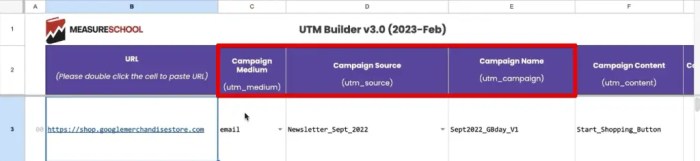
A plethora of websites offer user-friendly UTM parameter generators. These tools often provide a simple form where you enter the necessary information, and the tool automatically generates the correct UTM code. This eliminates the need for manual calculations, reducing the risk of errors. The process typically involves entering your website URL, campaign name, source, medium, and other relevant details.
- Many free online calculators are available. These tools are readily accessible and usually require minimal input to produce the UTM parameters.
- Some generators allow for customizability, providing options to add more parameters or tailor the output to specific needs. For example, some allow you to include custom dimensions.
- Using these tools ensures that the UTM code is formatted correctly, following the required structure and avoiding common mistakes that can lead to inaccurate data.
Google’s UTM Builder, How to create utm codes in google analytics
Google provides a valuable tool specifically designed for creating UTM parameters. This tool simplifies the process and offers a structured approach. Its interface is intuitive and easy to use, guiding you through each step.
- Google’s UTM builder is a convenient, free resource. It guides users through the process, preventing common mistakes.
- This tool is particularly useful for generating UTM codes for various marketing campaigns, helping to track their performance and effectiveness.
- The tool provides a clear overview of the different UTM parameters and how to use them effectively. This can be a valuable asset to anyone new to UTM codes.
Other Helpful Online Tools
Various websites provide resources and guides on UTM parameters. These resources are beneficial for learning about the best practices and the correct format for creating UTM parameters.
- Search engines like Google can be valuable resources, allowing you to find detailed explanations and examples for UTM parameter creation.
- Websites dedicated to marketing and analytics often have articles and tutorials that can be helpful for understanding and using UTM codes. These resources provide practical examples and use cases, allowing for better comprehension.
- Many blogs and forums dedicated to digital marketing often contain valuable insights and discussions about UTM parameters. These communities provide opportunities to learn from others and share experiences.
Concluding Remarks

In conclusion, mastering UTM codes unlocks powerful insights into your website traffic and marketing campaigns. By understanding the intricacies of UTM parameters, implementing them correctly, and analyzing the resulting data, you can optimize your strategies for better performance. This guide provides a solid foundation for effectively leveraging UTM codes and gaining valuable insights from your digital marketing efforts.