Leverage email marketing metrics small business to unlock powerful growth strategies. Understanding key metrics like open rates, click-through rates, and conversions is crucial for any small business looking to maximize their email campaigns. This guide will dive deep into these metrics, offering actionable insights and strategies to optimize your email marketing efforts for tangible results.
From crafting compelling subject lines to optimizing call-to-actions, we’ll explore practical techniques for increasing engagement and boosting conversions. Learn how to segment your email lists effectively for targeted messaging and track your email marketing performance using insightful dashboards and reports.
Introduction to Email Marketing Metrics for Small Businesses
Email marketing is a powerful tool for small businesses to connect with customers, build relationships, and drive sales. However, to truly understand its effectiveness, you need to track key metrics. These metrics provide valuable insights into campaign performance, allowing you to optimize your strategies and maximize your return on investment (ROI). Knowing what metrics to track and how to interpret them is crucial for success.Understanding your email marketing performance allows you to adjust your strategy for better results.
For instance, if your open rate is low, you might need to re-evaluate your subject lines or sender reputation. Tracking metrics empowers you to make data-driven decisions, rather than relying on guesswork.
Defining Email Marketing Metrics for Small Businesses
Email marketing metrics are quantifiable data points that measure the performance of your email campaigns. These metrics provide insights into various aspects of your campaigns, such as engagement, conversions, and overall effectiveness. They are essential for small businesses to understand the impact of their email marketing efforts. This allows them to make data-driven decisions and improve their campaigns over time.
Importance of Tracking Email Marketing Metrics
Tracking email marketing metrics is vital for small businesses because it provides actionable data for optimization. It allows businesses to understand what’s working and what’s not, enabling adjustments to campaigns for better results. By monitoring these metrics, small businesses can gain valuable insights into customer behavior and preferences, leading to more targeted and effective campaigns. This is crucial for maximizing ROI and achieving marketing goals.
Key Email Marketing Metrics for Small Businesses
To get a complete picture of your email marketing performance, you need to track various key metrics. These metrics offer insights into different aspects of your campaigns, such as engagement, conversion rates, and overall effectiveness. Tracking these metrics is vital for making informed decisions and optimizing your email marketing strategies.
- Open Rate: The percentage of recipients who opened your email. A higher open rate generally indicates that your subject lines are engaging and relevant to your audience. If your open rate is low, consider adjusting your subject lines to make them more enticing.
- Click-Through Rate (CTR): The percentage of recipients who clicked on a link within your email. A high CTR suggests that your email content is compelling and that the links are relevant to the recipients’ interests. Analyzing CTRs helps you understand which links are most appealing and which content resonates best with your audience.
- Conversion Rate: The percentage of recipients who took a desired action after clicking on a link within your email, such as making a purchase or filling out a form. This is a crucial metric for measuring the effectiveness of your email campaigns in driving sales or achieving other business objectives.
- Bounce Rate: The percentage of emails that were unable to be delivered to recipients. High bounce rates can indicate issues with your email list, such as incorrect email addresses or blocked servers. Addressing these issues is vital to improving deliverability.
- Unsubscribe Rate: The percentage of recipients who unsubscribed from your email list. A high unsubscribe rate may indicate that your emails are not relevant to your audience or that your frequency of sending emails is too high. Analyzing unsubscribe rates helps you understand your audience’s preferences and adjust your email strategy accordingly.
A Simple Table of Common Email Marketing Metrics
The following table summarizes common email marketing metrics and their significance for small businesses.
| Metric | Definition | Significance |
|---|---|---|
| Open Rate | Percentage of recipients who opened the email. | Indicates subject line effectiveness and recipient interest. |
| Click-Through Rate (CTR) | Percentage of recipients who clicked on a link in the email. | Measures the engagement with email content and link relevance. |
| Conversion Rate | Percentage of recipients who completed a desired action (e.g., purchase). | Measures the effectiveness of the email in driving conversions. |
| Bounce Rate | Percentage of emails that couldn’t be delivered. | Indicates potential issues with the email list or recipient servers. |
| Unsubscribe Rate | Percentage of recipients who unsubscribed from the email list. | Indicates relevance and frequency of emails to the audience. |
Measuring Email Open Rates
Opening rates are a crucial metric for email marketers. They indicate how well your subject lines and pre-headers capture the attention of your subscribers, leading to higher engagement and potentially more conversions. Understanding why emails are or aren’t opened is essential for optimizing your campaigns and boosting your ROI.A high open rate often signals a strong connection with your audience, indicating that they are interested in your content and value your communications.
Conversely, a low open rate might suggest that your subject lines aren’t compelling enough, your emails aren’t personalized enough, or your subscribers aren’t engaging with your brand as much as you’d like.
Effective Strategies to Increase Email Open Rates
Improving open rates hinges on crafting compelling subject lines and pre-headers, maintaining a strong sender reputation, and segmenting your email list effectively. These strategies, when implemented correctly, will foster greater engagement with your emails.
- Compelling Subject Lines: Craft subject lines that are concise, relevant, and intriguing. Avoid generic or misleading subject lines. Experiment with different approaches, such as using numbers, questions, or personalization. Personalization is key. Adding the recipient’s name to the subject line can increase open rates significantly.
- Strong Sender Reputation: Maintaining a strong sender reputation is critical. Ensure your emails are delivered to inboxes, not spam folders. Consistent delivery and engagement with your subscribers are crucial. A good sender reputation builds trust, leading to higher open rates.
- List Segmentation: Segment your email list based on subscriber behavior and preferences. Tailor your subject lines and content to the specific needs and interests of each segment. This targeted approach enhances relevance, leading to higher engagement and, ultimately, higher open rates.
Factors Influencing Email Open Rates
Several factors influence email open rates, from the subject line to the sender reputation. Understanding these factors will allow you to fine-tune your email campaigns for optimal results.
- Subject Lines: A compelling subject line is crucial. It’s the first impression your email makes. A clear, concise, and relevant subject line is key. Test different subject line variations to see what resonates most with your audience.
- Sender Reputation: Your email provider’s reputation directly affects your open rate. A good reputation ensures your emails are delivered to inboxes rather than spam folders. Avoid sending excessive or unwanted emails. Be mindful of email frequency and ensure your emails are pertinent to the subscribers.
- List Segmentation: Segmenting your email list allows you to send more targeted and relevant emails. This personalized approach increases the chances of your emails being opened.
- Email Frequency: Sending too many emails can lead to subscribers unsubscribing or marking your emails as spam. Find the right balance between engaging your audience and avoiding overwhelming them.
Identifying and Fixing Issues Affecting Open Rates
Monitoring your open rates and analyzing the reasons behind low numbers are crucial. By understanding the reasons, you can implement solutions to improve engagement.
- Analyzing Open Rate Data: Track your open rates and identify trends. Analyze what works and what doesn’t. Pay attention to specific subject lines, sender reputation, or list segmentation strategies that consistently yield high or low open rates.
- Testing and Iterating: Continuously test different subject lines and sender names to find what resonates with your audience. Iterate based on the results. Testing is crucial to optimize open rates.
- Addressing Sender Reputation Issues: Monitor your sender reputation and promptly address any issues. Check your sender authentication records, avoid sending excessive emails, and focus on sending relevant emails.
Subject Line Approach Comparison
| Subject Line Approach | Description | Potential Impact on Open Rates |
|---|---|---|
| Intriguing Question | Asks a question to pique interest. | High potential for increased open rates if the question is relevant and engaging. |
| Benefit-Driven | Highlights the benefit of opening the email. | Likely to increase open rates if the benefit is clear and compelling. |
| Urgency | Creates a sense of urgency. | Can increase open rates if the urgency is justified and relevant. |
| Personalized | Includes the recipient’s name or other personal details. | Potentially high open rates, depending on the personalization level. |
| Clear Subject | Clearly communicates the email’s content. | Open rates vary, depending on how well the subject aligns with the recipient’s needs. |
Analyzing Click-Through Rates (CTR)
Click-through rates (CTRs) are a crucial metric for small businesses using email marketing. They directly reflect the effectiveness of your email campaigns in driving desired actions from recipients. High CTRs indicate that your emails are engaging and compelling, leading to higher conversion rates and ultimately, more revenue. Understanding CTRs and how to improve them is vital for optimizing email marketing strategies.CTR reveals how effectively your email content encourages recipients to interact with your message.
A high CTR demonstrates that your subject lines, email content, and calls to action (CTAs) are resonating with your audience, motivating them to click and explore further. Conversely, low CTRs might suggest areas for improvement in your email campaigns.
Factors Influencing Click-Through Rates
Understanding the factors influencing click-through rates allows for strategic adjustments in email campaigns. Email content significantly impacts CTRs. Compelling subject lines and clear, concise messaging are essential for capturing attention and encouraging clicks. The visual appeal of the email, including images and layout, also contributes to engagement and thus, the click-through rate. Furthermore, the relevance of the email content to the recipient’s interests plays a significant role.
Improving Click-Through Rates
Several strategies can boost click-through rates in email campaigns. A well-crafted subject line is paramount. It needs to be concise, intriguing, and accurately reflect the email’s content. Clear and concise calls to action (CTAs) are essential. Use strong action verbs and make the CTA easily visible within the email.
A compelling layout and visual appeal are equally important. Use high-quality images and graphics, and maintain a visually appealing format that aligns with your brand identity.
Email Content and Click-Through Rates
The content of your email directly impacts CTRs. The relevance of the email to the recipient’s interests is paramount. Tailoring emails to specific segments of your audience can significantly improve engagement and, consequently, CTRs. Personalization through dynamic content, where different versions of an email are sent to different segments, can significantly enhance engagement and CTRs. Ensuring the email content is free of grammatical errors and typos enhances credibility and engagement.
Call-to-Action (CTA) Influence on CTRs
Different CTAs can significantly impact click-through rates. The effectiveness of a CTA often depends on the context of the email and the specific offer being promoted.
| Call-to-Action (CTA) | Potential Impact on CTR | Example |
|---|---|---|
| Clear and concise CTA with a strong action verb (e.g., “Shop Now,” “Learn More”) | High CTR | “Shop Now” button prominently displayed on an email promoting a new product line. |
| Ambiguous or weak CTA (e.g., “Visit our site,” “Click here”) | Low CTR | “Click here” link with no clear context within the email. |
| Multiple CTAs | Potentially high CTR, but needs careful consideration of which CTA is most important. | Email with a “Learn More” button and a “Shop Now” button, both relating to a specific product. |
Different CTAs evoke different responses. Using clear and strong CTAs in conjunction with compelling content can greatly increase engagement and improve click-through rates. A/B testing different CTAs is crucial to optimize email campaigns and achieve the best results.
Conversion Rate Optimization in Email Marketing
Email marketing, when done right, is a powerful tool for small businesses. It allows direct communication with customers, building relationships and driving sales. However, simply sending emails isn’t enough. A key metric for success is the conversion rate, which measures the percentage of recipients who take a desired action after opening your email. Optimizing this rate is crucial for turning email engagement into tangible results.Conversion rates aren’t just about the quantity of sales; they also reveal the effectiveness of your entire marketing strategy.
A high conversion rate signifies that your emails resonate with your audience and effectively guide them toward the desired action. Conversely, a low conversion rate might indicate that your calls to action (CTAs) are unclear, your email content is irrelevant, or your landing pages aren’t optimized for conversions.
Small businesses can really boost their email marketing game by tracking key metrics. Open rates, click-throughs, and conversions are crucial for understanding what’s working and what’s not. But with the rise of AI, some worry about the future of web business models, like how businesses will maintain a presence in the online world. This raises questions about the role of traditional marketing tactics like email marketing, but the truth is that strong email marketing metrics can still be a cornerstone of a successful strategy.
Leveraging these insights will help businesses adapt and thrive in the evolving digital landscape, despite the changes from ai killing web business model.
Importance of Email Conversion Rates for Small Businesses
High conversion rates translate directly into increased revenue and profitability for small businesses. A higher conversion rate means more customers completing desired actions, such as making a purchase, signing up for a newsletter, or downloading a resource. This translates into tangible financial gains and demonstrates the return on investment (ROI) of your email marketing efforts. Small businesses often rely on email marketing as a cost-effective way to reach their target audience, making conversion optimization a vital aspect of their overall marketing strategy.
Key Elements Affecting Conversion Rates in Email Marketing
Several factors influence conversion rates in email marketing. These include the quality of your email content, the clarity of your calls to action (CTAs), the design of your emails, and the overall user experience. A well-crafted subject line, compelling email copy, and visually appealing design can all contribute to higher conversion rates. Understanding these factors and their impact is crucial for optimizing your email campaigns.
Techniques to Optimize Conversion Rates Within Email Campaigns
Several techniques can significantly boost email conversion rates. These include A/B testing different subject lines, calls to action, and email designs to identify what resonates best with your audience. Personalization, tailored to individual customer preferences, is another critical element. Moreover, ensuring your emails are mobile-friendly is essential as most users access emails through mobile devices.
- A/B Testing: A/B testing involves creating variations of elements like subject lines, email copy, and CTAs. By sending these variations to different segments of your audience, you can determine which versions perform best in terms of open rates, click-through rates, and ultimately, conversions. This data-driven approach allows you to fine-tune your emails to maximize their impact.
- Personalization: Tailoring your emails to individual customer preferences increases engagement and encourages conversions. This might include using customer names, referencing past purchases, or highlighting products or services that align with their interests. Personalization builds trust and makes the customer feel valued.
- Clear and Concise Calls to Action (CTAs): Your CTAs should be clear, concise, and compelling. Use action-oriented verbs and create a sense of urgency. Use strong, contrasting colors and high visibility on the CTA button to make it stand out.
- Mobile Optimization: Ensure your emails are responsive and display correctly on various mobile devices. This is critical as a substantial portion of email opens occur on mobile devices. The email layout should be optimized for smaller screens and intuitive navigation.
Common Conversion Funnels and Corresponding Email Strategies
Optimizing email campaigns requires understanding the customer journey and how emails can influence different stages. The following table Artikels common conversion funnels and their corresponding email strategies.
| Conversion Funnel | Email Strategies |
|---|---|
| Awareness | Introduce your brand, highlight unique value propositions, and build trust. Include links to landing pages for further engagement. |
| Interest | Provide more in-depth information about your products or services. Showcase case studies or testimonials to demonstrate value. Feature relevant content, such as blog posts or articles. |
| Decision | Highlight benefits and compare your offerings with competitors. Offer limited-time discounts or promotions to encourage purchases. Provide clear and concise calls to action. |
| Action | Confirm orders, send shipping updates, and provide post-purchase support. Encourage reviews and feedback. Promote related products or services. |
Leveraging Email Marketing Metrics for Business Growth: Leverage Email Marketing Metrics Small Business
Email marketing, when done right, can be a powerful engine for small business growth. But simply sending emails isn’t enough. Understanding and effectively using email marketing metrics is crucial for optimizing campaigns and maximizing ROI. This involves more than just tracking open rates; it’s about digging deeper to identify what’s working, what’s not, and how to adjust strategies for better results.Analyzing email marketing metrics isn’t just about identifying problems; it’s a proactive approach to fine-tuning your campaigns and growing your business.
By understanding the data, you can pinpoint areas needing improvement, refine your messaging, and ultimately achieve a higher conversion rate, leading to tangible business growth.
Identifying Areas for Improvement
Email metrics offer a wealth of insights into audience engagement and campaign performance. Low open rates might suggest a problem with subject lines, while a high bounce rate indicates issues with email list hygiene or invalid email addresses. Click-through rates (CTR) reveal which aspects of your emails resonate most with your audience, helping you tailor future campaigns.Analyzing these metrics allows you to pinpoint weak areas and strengthen your strategies.
For instance, if your click-through rates are low for a specific product promotion, you might need to re-evaluate the call-to-action, the design of the promotional email, or the timing of the email campaign. High unsubscribe rates often signal that your content is irrelevant to the subscribers or that your communication frequency is too high.
Adjusting Email Campaigns Based on Data
Once you’ve identified areas for improvement, you can implement adjustments to your email campaigns. For example, if your subject lines aren’t captivating enough, you can experiment with different tones, styles, and s to see what resonates better.A decrease in open rates might suggest that your subject lines are not effective. You could try A/B testing different subject lines to see which ones perform better.
Similarly, if your conversion rates are low, you could improve the clarity and urgency of your call-to-action buttons. If a certain email segment has a high unsubscribe rate, it’s a sign that their needs are not being met. Segmentation and targeted content could resolve this issue.
Impact of Data-Driven Decision-Making on Small Business Growth
Data-driven decision-making is paramount for small businesses in the digital age. By leveraging email marketing metrics, you gain valuable insights into your customer behavior and preferences. This understanding allows you to personalize your messaging, improve your campaign performance, and ultimately boost your business’s bottom line.
“Data-driven decisions empower small businesses to adapt quickly to changing market trends and customer demands, fostering sustainable growth.”
Small businesses often lack the resources of large corporations, but email marketing metrics offer a powerful tool for leveling the playing field. By understanding your audience and refining your campaigns based on data, you can compete effectively and achieve remarkable results. For example, a small clothing retailer can use email metrics to target customers with specific products based on their past purchases and browsing history, resulting in higher conversion rates and customer satisfaction.
Analyzing Email Metrics and Implementing Improvements: A Flowchart
The following flowchart illustrates the process of analyzing email metrics and implementing improvements:
Start --> Gather Email Metrics (Open Rates, CTR, Conversions, Bounce Rates) --> Analyze Metrics for Trends and Patterns --> Identify Areas for Improvement (Subject Lines, Content, Calls-to-Action) --> Develop and Implement Strategies for Improvement --> Retest and Refine (A/B Testing) --> Evaluate Results --> Repeat Process
This cyclical process is essential for continuous improvement in email marketing.
Regularly monitoring and analyzing email metrics allows you to adapt to your audience’s preferences and optimize your campaigns for maximum impact.
Segmenting Email Lists for Better Results

Email marketing is powerful, but its true potential shines when you segment your email lists. Imagine sending a generic email about a new product to everyone on your list. Many recipients might not be interested, leading to low engagement and wasted effort. Targeted emails, on the other hand, speak directly to specific customer needs and desires, boosting open rates, click-throughs, and ultimately, conversions.
Segmentation is the key to unlocking this potential.
Segmenting your email list allows you to tailor your messages to resonate with individual customer preferences and behaviors. This personalized approach cultivates stronger relationships, leading to higher customer satisfaction and loyalty. It also significantly improves your ROI by focusing your marketing efforts on the most receptive audience segments.
Methods for Segmenting Email Lists
Effective email list segmentation hinges on understanding your customers. The key is to categorize your subscribers based on shared characteristics and behaviors. Demographics, purchase history, website activity, and engagement metrics are all valuable data points. Analyzing this data helps you craft targeted messages that resonate with specific groups.
Customer Behavior-Based Segmentation
Customer behavior provides a wealth of information for segmentation. This method focuses on how customers interact with your brand. Here are some examples:

- Recent Purchasers: Send exclusive offers and promotions to customers who recently made a purchase. This encourages repeat business.
- Abandoned Cart Recovery: Reach out to users who abandoned their shopping carts. Offer incentives to complete their purchases.
- Product Interest: Group customers based on products they’ve viewed or expressed interest in. Promote related products or offer special bundles.
- Engagement Level: Segment users based on their email engagement (open rates, click-through rates, etc.). This allows you to tailor messaging to those who are more or less interested in your content.
Demographic-Based Segmentation
Demographic data, such as age, location, and interests, can also be crucial for targeted email campaigns. Understanding your customer base’s characteristics helps tailor messages for specific needs. Examples include:
- Geographic Location: Tailor promotions and offers to customers based on their location. Local businesses might offer special deals to nearby customers.
- Purchase Frequency: Segment customers based on how frequently they make purchases. High-frequency buyers might receive exclusive perks, while infrequent buyers might be encouraged with promotions.
- Subscription Preferences: Group subscribers based on the types of content they prefer (e.g., blog posts, product updates, special offers). This allows you to deliver the most relevant content.
Impact of Targeted Emails
Targeted emails significantly impact engagement and conversions. By delivering relevant content, you’re more likely to capture attention and drive conversions. Personalized emails create a stronger connection with customers, fostering trust and loyalty.
Email List Segmentation Strategies
The following table illustrates various email list segmentation strategies and their potential outcomes:
| Segmentation Strategy | Potential Outcomes |
|---|---|
| Recent Purchasers | Increased repeat purchases, higher customer lifetime value |
| Abandoned Cart Recovery | Higher conversion rates, reduced cart abandonment |
| Product Interest | Increased product sales, improved customer satisfaction |
| High Engagement Level | Stronger customer relationships, higher brand loyalty |
| Geographic Location | Increased local sales, improved customer reach |
| Purchase Frequency | Higher lifetime value, loyalty program participation |
| Subscription Preferences | Increased engagement, improved content relevance |
Tracking and Reporting Email Marketing Performance
Keeping a close eye on your email marketing efforts is crucial for success. Monitoring key metrics and analyzing results allows you to fine-tune your strategies, identify areas for improvement, and ultimately boost your ROI. A well-structured reporting system provides actionable insights, helping you understand what’s working and what isn’t, so you can make data-driven decisions.
Effective tracking and reporting go beyond simply collecting data. It’s about transforming raw numbers into actionable strategies that enhance your email marketing campaigns.
Effective Dashboards for Tracking Email Marketing Metrics
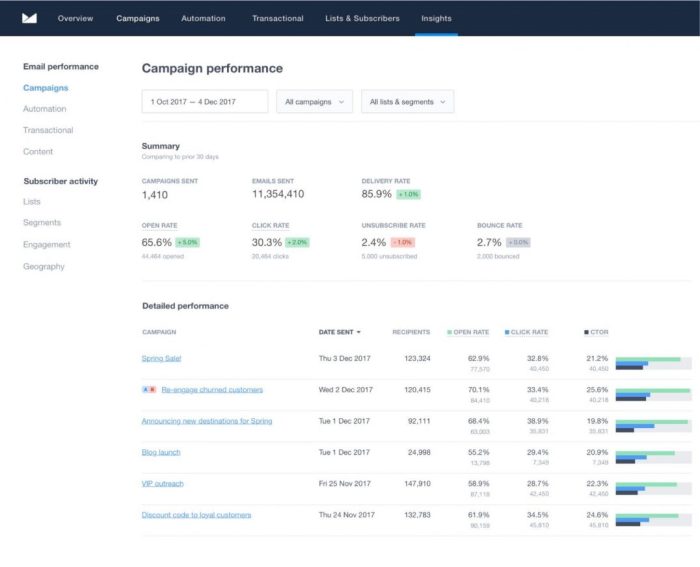
A well-designed dashboard provides a clear overview of your email marketing performance. Visual representations of key metrics, like open rates, click-through rates, and conversion rates, make it easy to spot trends and patterns. These dashboards should be easily accessible and customizable to tailor the information presented to your specific needs.
Tracking email marketing metrics is crucial for small businesses, helping you see what’s working and what’s not. Knowing open rates, click-through rates, and unsubscribe rates gives you valuable insights. However, a critical question arises when you’re analyzing those metrics: is it possible for search engines to recognize AI-generated content? This article explores that very question, which ultimately impacts how you should approach content creation and email marketing strategy.
Ultimately, understanding search engine algorithms is key to maximizing the effectiveness of your email campaigns and driving genuine results for your small business.
For example, a dashboard could display a bar graph showing the open rates of your last five campaigns, a line graph plotting click-through rates over time, and a pie chart illustrating the percentage of conversions from different email segments. Interactive elements allow for deeper dives into specific campaigns or segments.
Use of Email Marketing Reporting Tools for Small Businesses
Many user-friendly tools are available for email marketing reporting. These tools can automate the data collection and analysis process, saving you time and resources. These tools provide a structured format for presenting insights, which helps you to understand your campaign’s performance in a clearer and more efficient manner.
Several affordable or free options exist, catering to different needs and budgets. Some popular tools provide features like email campaign analytics, automated reporting, and customizable dashboards. They can streamline the process of analyzing your email marketing data and offer valuable insights for improvement.
Boosting email marketing performance for small businesses hinges on understanding key metrics. Tracking open rates, click-throughs, and conversions is crucial. Leveraging this data allows you to fine-tune your campaigns and ultimately drive more sales. A deeper dive into sales enablement strategies, like those championed by Roderick Jefferson at roderick jefferson sales enablement , can help you optimize your email sequences for maximum impact.
Ultimately, using these insights to personalize your approach and target the right customers is key to achieving remarkable results.
Importance of Regular Reporting and Analysis
Regular reporting and analysis are essential for optimizing email marketing campaigns. By monitoring performance consistently, you can identify issues early on, allowing for prompt adjustments and improvements. Consistent monitoring ensures your campaigns stay aligned with your goals and objectives.
Analyzing your data weekly or monthly, depending on your campaign frequency, helps you understand what resonates with your audience and what doesn’t. This proactive approach helps you make informed decisions about your campaigns, making them more effective and efficient over time.
Identifying Trends and Patterns in Email Marketing Performance
Analyzing your email marketing data allows you to discover trends and patterns. For example, noticing a consistent drop in open rates for emails sent on Mondays could suggest that your audience is less engaged on that day. Or, if a specific segment of your email list shows a significantly higher conversion rate for a particular product, you can tailor your future communications to better target that segment.
By observing patterns, you can adapt your strategies to enhance campaign effectiveness. For instance, understanding that emails with personalized subject lines have higher open rates allows you to tailor your future email campaigns. Consistent tracking and analysis of your email marketing data allows for the identification of these insights and patterns. This data can be used to create personalized email marketing campaigns.
A/B Testing Email Campaigns for Optimization
A/B testing is a powerful tool for email marketers to refine their campaigns and maximize their impact. By systematically comparing different versions of email elements, businesses can identify what resonates best with their audience and optimize for higher open rates, click-through rates, and conversions. This iterative process allows for continuous improvement and ensures that email campaigns are as effective as possible.
Selecting Relevant Variables for A/B Testing
A crucial aspect of successful A/B testing is the careful selection of variables to test. These variables can significantly impact campaign performance, and should be chosen strategically. Testing too many variables at once can dilute results and make it difficult to pinpoint the most effective changes.
- Subject Lines: Testing different subject lines is a cornerstone of email optimization. Varying the tone, length, and s in subject lines can significantly affect open rates. Consider using different subject line approaches: curiosity-driven subject lines, subject lines with strong calls to action, subject lines incorporating emojis, or even subject lines with personalized elements.
- Email Content: The body of the email is equally important. Test different content structures, including varying levels of detail, different formatting (images, videos, text-heavy), and diverse calls to action.
- Calls to Action (CTAs): Testing different CTAs, such as different button colors, text, and placements, is critical. A/B testing CTA variations can help you determine which phrasing and design elements inspire more clicks and conversions.
Analyzing A/B Test Results, Leverage email marketing metrics small business
Analyzing A/B test results requires a methodical approach to ensure accurate interpretation. Focus on statistically significant differences rather than minor fluctuations.
- Statistical Significance: A/B tests should be run for a sufficient period to ensure statistically significant results. Tools that provide statistical significance calculations are helpful in this process. Look for results that are statistically different and not just based on chance variation.
- Key Metrics: Track key metrics like open rates, click-through rates, conversion rates, and bounce rates. These metrics will provide insight into which variations perform better.
- Control Group: A control group is essential for comparing variations against a standard version. This baseline provides a benchmark for assessing the impact of changes.
Examples of Successful A/B Test Results
| Variation | Metric Tested | Improvement | Notes |
|---|---|---|---|
| Subject Line A: “Limited-Time Offer!” | Open Rate | +15% | More urgent tone increased interest. |
| Subject Line B: “Discover New Products!” | Open Rate | +10% | More engaging subject line, slightly less impact. |
| CTA Button Color: Green | Click-Through Rate | +8% | Green is often associated with trust and action. |
| CTA Button Color: Red | Click-Through Rate | +5% | Red can also be effective, but the green variation performed slightly better. |
| Email Content Length: Concise | Conversion Rate | +12% | Shorter emails led to higher conversions. |
Last Word

In conclusion, leveraging email marketing metrics is essential for small business success. By analyzing open rates, click-through rates, and conversions, you can identify areas for improvement and adjust your campaigns for maximum impact. Data-driven decision-making, combined with strategic segmentation and A/B testing, allows small businesses to optimize their email campaigns, drive customer engagement, and ultimately achieve sustainable growth.