
Marketing for ecommerce what works and what doesnt – Marketing for ecommerce what works and what doesn’t is a crucial aspect of success in the online retail world. This in-depth look explores various strategies, tactics, and crucial elements to help online businesses thrive. From understanding different marketing channels to crafting effective content, we’ll dive into what strategies are yielding results and which ones are falling short.
This exploration examines common strategies like , social media, and email marketing, evaluating their pros, cons, and effectiveness metrics. We’ll delve into practical tactics within each category, illustrating successful campaigns and identifying key performance indicators (KPIs). Furthermore, we’ll address customer acquisition and retention, content marketing, pricing strategies, promotions, and the vital importance of measuring marketing success to adapt and improve.
E-commerce Marketing Strategies
E-commerce has revolutionized the retail landscape, transforming the way businesses connect with customers and drive sales. A well-defined marketing strategy is crucial for success in this digital arena, allowing businesses to reach their target audience effectively and convert them into loyal customers. Understanding the nuances of various marketing channels and evaluating their effectiveness is paramount for achieving sustainable growth.Effective e-commerce marketing goes beyond simply creating a website.
It involves a multifaceted approach encompassing various strategies and channels to connect with the target audience and drive sales. This includes understanding the customer journey, optimizing the website for conversions, and implementing targeted advertising campaigns. Analyzing the effectiveness of each strategy is key to adjusting campaigns for maximum impact.
Common E-commerce Marketing Strategies
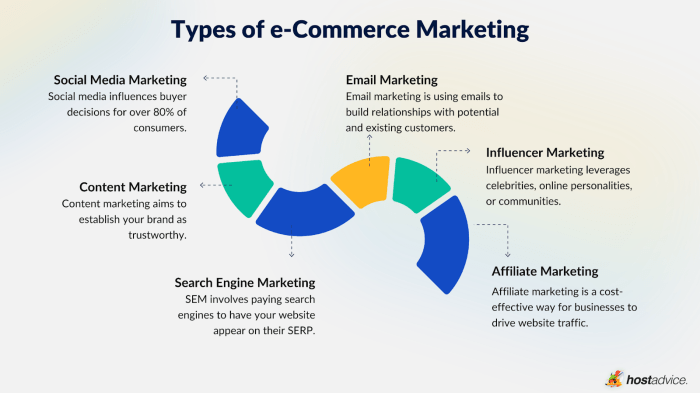
E-commerce marketing strategies encompass a broad range of tactics, each designed to reach specific customer segments and achieve particular business objectives. These strategies are not mutually exclusive and often complement each other, creating a synergistic effect. The success of a particular strategy often depends on factors like target audience, budget, and business goals.
Comparison of Marketing Channels
Different marketing channels cater to different customer segments and business objectives. Understanding the strengths and weaknesses of each channel is crucial for optimizing marketing efforts.
- Social Media Marketing: Leveraging platforms like Instagram, Facebook, and TikTok allows businesses to connect with their target audience directly. It enables the creation of engaging content, running targeted ads, and fostering community engagement, fostering a brand presence and driving traffic to the online store. Examples include influencer collaborations, interactive contests, and live shopping events.
- Email Marketing: Email marketing remains a powerful tool for nurturing leads and driving conversions. Targeted email campaigns can keep customers informed about new products, promotions, and exclusive offers. Effective email marketing strategies include personalized email content, segmentation, and A/B testing to optimize campaign performance.
- Search Engine Optimization (): Optimizing website content for search engines like Google improves organic visibility. This involves research, content creation, and technical website optimization to improve search rankings and drive organic traffic to the website. High-quality, informative content tailored to user searches are key components of successful campaigns.
Framework for Evaluating Marketing Strategy Effectiveness
A framework for evaluating marketing strategy effectiveness should incorporate measurable key performance indicators (KPIs). These KPIs provide insights into the effectiveness of each strategy, enabling businesses to adapt and optimize their approach.
- Website traffic: Tracking website traffic helps understand the reach of marketing efforts and identify areas for improvement. Analyzing traffic sources, user behavior, and conversion rates provide crucial insights into campaign performance.
- Conversion rates: Conversion rates indicate the effectiveness of marketing campaigns in driving desired actions, such as purchases or sign-ups. A high conversion rate suggests the marketing efforts are effectively targeting the right audience.
- Customer acquisition cost (CAC): CAC measures the cost of acquiring a new customer. Analyzing CAC helps optimize marketing spending and identify strategies that yield the highest return on investment.
E-commerce Marketing Strategies Table
| Strategy | Pros | Cons | Effectiveness Metrics |
|---|---|---|---|
| Search Engine Optimization () | High potential for long-term, organic traffic; cost-effective in the long run; builds trust and credibility; targets a broad audience. | Time-consuming results; requires ongoing effort and optimization; difficulty in predicting ROI; susceptible to algorithm changes. | Organic website traffic, rankings, bounce rate, time on site, conversion rate. |
| Social Media Marketing | Targeted advertising options; direct engagement with customers; brand building; opportunity for viral campaigns; fast results in some cases. | Requires consistent effort and content creation; limited control over user engagement; algorithm changes impact visibility; potential for negative reviews. | Social media engagement (likes, shares, comments), reach, website traffic, conversion rate from social media, cost per acquisition (CPA). |
| Email Marketing | Direct communication with customers; highly targeted campaigns; cost-effective; nurture leads; measurable results. | Requires building an email list; potential for spam complaints; email deliverability issues; high volume email may not be appealing. | Open rates, click-through rates (CTRs), conversion rates from emails, unsubscribe rates. |
Effective Tactics for E-commerce
Driving sales in the competitive e-commerce landscape requires a multi-faceted approach. Effective tactics are crucial for maximizing visibility, engagement, and conversions. This section delves into specific strategies, highlighting successful campaigns and key performance indicators (KPIs) for measuring success.E-commerce success hinges on understanding and implementing the right strategies. By focusing on key areas like , social media, and email marketing, businesses can significantly improve their online presence and achieve their sales goals.
Search Engine Optimization ()
Optimizing online visibility through is essential for long-term e-commerce success. A strong strategy ensures your products appear prominently in search results, driving organic traffic to your website.
- Research: Identifying relevant s that potential customers use when searching for products is critical. Tools like Google Planner can help uncover these terms. This research informs product descriptions, page titles, and meta descriptions, enhancing search engine ranking.
- On-Page Optimization: Optimizing individual product pages with relevant s, compelling descriptions, and high-quality images is vital. This improves user experience and search engine ranking. An example includes optimizing product titles with specific s like “women’s leather handbag black” rather than just “handbag.”
- Off-Page Optimization: Building high-quality backlinks from reputable websites enhances your website’s authority in search engine algorithms. Guest blogging on relevant industry sites or participating in online forums can contribute to off-page optimization.
Social Media Marketing
Leveraging social media platforms is crucial for engaging with potential customers and driving traffic to your online store. Building a strong social media presence helps establish brand awareness and loyalty.
- Targeted Advertising: Utilizing social media platforms’ advertising tools allows you to reach specific demographics and interests. This targeted approach increases the likelihood of conversions. For instance, a jewelry store could target users interested in fashion and accessories on Instagram.
- Content Marketing: Creating engaging content such as product demos, behind-the-scenes glimpses, and user-generated content can attract a wider audience. This builds trust and promotes brand awareness. Fashion brands frequently use Instagram to showcase new collections with high-quality photos and videos.
- Influencer Marketing: Partnering with influencers relevant to your target audience can significantly expand your reach and credibility. Influencers can introduce your products to their followers, leading to increased sales and brand awareness. A beauty product company collaborating with a beauty influencer to promote a new lipstick collection.
Email Marketing
Email marketing remains a powerful tool for nurturing customer relationships and driving sales. Targeted email campaigns can increase customer engagement and conversions.
- Segmentation: Segmenting your email list based on customer behavior, purchase history, and interests allows for more personalized messaging. This increases the relevance and effectiveness of your email campaigns. For example, a clothing retailer might segment customers based on their preferred clothing styles.
- Automated Emails: Automating welcome emails, abandoned cart reminders, and post-purchase follow-ups significantly increases engagement and sales. These automated sequences can enhance customer experience. For instance, an automated email sequence reminding customers of items left in their shopping carts.
- Promotional Emails: Sending targeted promotional emails with discounts, exclusive offers, and new product announcements can boost sales and encourage repeat purchases. Examples include email newsletters announcing special discounts on specific items or highlighting new product launches.
Paid Advertising (PPC)
Paid advertising campaigns, particularly pay-per-click (PPC) advertising, can generate immediate traffic and conversions. Targeted PPC campaigns can quickly reach a wider audience.
Figuring out what works in ecommerce marketing is a constant challenge. One key area that often gets overlooked, but can make a massive difference, is email marketing. Mastering the art of engaging email campaigns, like in building the arch all about email marketing , is crucial. Ultimately, understanding what resonates with your target audience and what falls flat is vital for any successful ecommerce strategy.
- Targeted Campaigns: Utilizing platforms like Google Ads and social media advertising platforms allows you to target specific s, demographics, and interests, optimizing campaign performance. For example, an e-commerce store for outdoor gear can target users searching for “hiking boots” or “camping equipment.”
- A/B Testing: Testing different ad copy, images, and landing pages can significantly improve ad performance and conversion rates. Experimentation helps identify what resonates best with your target audience.
- Conversion Tracking: Monitoring and analyzing campaign performance through conversion tracking allows for continuous optimization. This data allows businesses to refine campaigns for maximum return on investment (ROI).
Customer Acquisition and Retention
Attracting new customers and keeping existing ones are crucial for the long-term success of any e-commerce business. Effective strategies for customer acquisition and retention are not just about marketing; they involve understanding customer needs and providing value throughout the entire customer journey. This requires a multifaceted approach that considers everything from initial engagement to building lasting relationships.A robust customer acquisition and retention strategy is essential for driving sales and achieving sustainable growth in the competitive e-commerce landscape.
It encompasses attracting new customers while simultaneously nurturing existing ones to become loyal advocates. Successful strategies focus on understanding customer pain points, offering solutions, and fostering a positive brand experience.
Attracting New Customers, Marketing for ecommerce what works and what doesnt
Attracting new customers requires a multifaceted approach that goes beyond simple advertising. A comprehensive strategy should consider the entire customer journey, from initial awareness to purchase and beyond. Targeting the right audience is paramount, focusing on demographics, interests, and online behavior. This involves understanding the specific needs and preferences of the target audience.
Figuring out what marketing strategies actually work for e-commerce can be tricky. Sometimes, the most obvious approaches fall flat, while seemingly insignificant tactics yield surprising results. Leveraging the right AI tools, like the ones available at best AI marketing tools , can really help. Ultimately, understanding your target audience and tailoring your approach remains crucial for successful e-commerce marketing, regardless of the tools you use.
- Targeted Advertising: Utilizing platforms like Google Ads, social media ads, and retargeting campaigns allows for precise targeting of potential customers based on demographics, interests, and online behavior. This approach significantly increases the chances of reaching the right audience, maximizing campaign effectiveness. For example, a clothing retailer can target users interested in specific styles or brands through social media ads, driving highly qualified traffic to their online store.
- Influencer Marketing: Partnering with relevant influencers can significantly expand reach and credibility. Influencers can introduce the brand to their followers, generating interest and driving traffic to the e-commerce site. For example, a beauty brand collaborating with a beauty vlogger can expose their products to a wider audience, leading to increased sales.
- Search Engine Optimization (): Optimizing the website for relevant s helps improve organic search rankings, driving targeted traffic from search engines. This approach is cost-effective and allows the brand to attract customers actively searching for products or services. For instance, a kitchenware store optimizing their website for s like “best nonstick cookware” will appear higher in search results, attracting customers interested in these products.
Retaining Existing Customers
Retaining existing customers is often more cost-effective than acquiring new ones. Strategies for retaining customers include providing excellent customer service, offering exclusive deals, and building a sense of community. Customer retention emphasizes long-term value and relationship building.
- Personalized Recommendations: Providing personalized product recommendations based on past purchases and browsing history can encourage repeat purchases. This shows customers that the brand understands their needs and preferences, leading to a positive experience. For example, an online bookstore recommending similar books based on past purchases fosters customer loyalty.
- Loyalty Programs: Implementing loyalty programs rewards repeat customers with exclusive discounts, points, or early access to sales. These programs incentivize repeat purchases and build brand loyalty. A coffee shop loyalty program that rewards customers with discounts on subsequent purchases is a great example.
- Excellent Customer Service: Providing prompt and helpful customer support through various channels like email, phone, and live chat is crucial for addressing customer concerns and resolving issues quickly. This approach builds trust and confidence in the brand, encouraging repeat purchases and positive word-of-mouth referrals. For instance, a tech company responding to customer inquiries about product issues promptly builds customer trust and fosters loyalty.
Building Customer Loyalty and Advocacy
Building customer loyalty and advocacy involves creating a positive brand experience and fostering a sense of community. Loyal customers are more likely to recommend the brand to others, creating valuable word-of-mouth marketing.
- Community Building: Creating online communities through social media groups or forums allows customers to connect with each other and the brand. This fosters a sense of belonging and encourages positive interactions, building brand loyalty and advocacy. For example, an online gaming store creating a Facebook group for their customers enables direct communication and community engagement.
- Customer Feedback and Reviews: Actively seeking and responding to customer feedback is crucial for understanding customer needs and preferences. This process can identify areas for improvement, leading to a better customer experience and increased brand loyalty. Collecting and responding to customer reviews builds trust and credibility.
Content Marketing in E-commerce

Content marketing is no longer a “nice-to-have” but a crucial element for any successful e-commerce business. It’s about creating valuable, relevant content to attract and engage your target audience, ultimately driving sales and fostering brand loyalty. By providing helpful information and engaging experiences, you position your brand as a trusted resource, setting the stage for customers to see you as a valuable partner in their purchasing journey.Creating compelling content is more than just stuffing s into articles.
It requires understanding your audience’s needs and pain points, and delivering content that directly addresses them. High-quality content establishes trust, increases brand awareness, and generates organic traffic, all of which translate into tangible business results.
Figuring out what marketing strategies work best for e-commerce can be tricky. Some tactics, like flashy ads, might seem effective, but ultimately fall flat. Understanding the nuances of SEO is key to success, and hiring an expert company like benefits of hiring an SEO company can dramatically boost your online visibility. Ultimately, a well-rounded approach, combining effective SEO with targeted ads and engaging content, is crucial for thriving in the competitive e-commerce landscape.
Content Formats for E-commerce
A variety of content formats can be effectively employed in e-commerce marketing. Different formats cater to different preferences and learning styles within the target audience.
| Content Format | Description | Example | Target Audience |
|---|---|---|---|
| Blog Posts | Informative articles that delve into specific topics related to your products or industry. They can address customer questions, provide product reviews, or offer insights into trends. | A blog post discussing the benefits of sustainable materials in clothing. | Customers interested in environmentally friendly products, those researching product features, and potential buyers seeking detailed information. |
| Videos | Short, engaging videos that showcase products, provide tutorials, or highlight customer testimonials. | A video demonstrating how to assemble a furniture product or showcasing a product in action. | Visual learners, customers who prefer to see a product in use, and those interested in quick demonstrations. |
| Infographics | Visually appealing graphics that present data, statistics, or comparisons in a clear and concise manner. | An infographic comparing different types of phone cases based on durability or price. | Customers seeking quick overviews, those interested in data-driven comparisons, and individuals who prefer visual representations. |
| Webinars | Online seminars where experts or product specialists discuss relevant topics and answer audience questions. | A webinar hosted by a nutritionist discussing the best ways to use a new protein powder. | Customers interested in in-depth information, those seeking expert opinions, and individuals wanting a live Q&A session. |
| Case Studies | Detailed accounts of how a product or service has solved a problem for a customer or business. | A case study illustrating how a particular software improved productivity for a small business. | Potential customers seeking real-world examples of how a product can benefit them, and those looking for concrete results. |
Creating Valuable Content
Effective content resonates with customers by addressing their needs and offering solutions. It should be well-researched, well-written, and engaging. Focus on providing unique insights and perspectives, not just rehashing existing information. Consider using a mix of content formats to cater to diverse learning styles and preferences.
Importance of a Consistent Content Calendar
A consistent content calendar is essential for e-commerce businesses. It ensures a steady flow of valuable content, keeping your audience engaged and informed. This proactive approach to content creation and scheduling will allow you to consistently provide relevant information and products to your customers.
Types of E-commerce Content
The content you create should reflect your brand’s personality and the needs of your target audience. Focus on topics relevant to your products and industry. Consider providing valuable insights and expertise that position you as a leader in your field.
Pricing and Promotions
Pricing and promotions are critical levers for driving sales and shaping customer perception in e-commerce. Effective strategies not only boost immediate revenue but also foster long-term customer loyalty and brand image. Understanding how pricing models impact sales and customer perception, along with creating compelling promotions, are key to success.Pricing strategies profoundly influence sales and customer perception. A well-defined pricing strategy can attract customers seeking value and create a perceived quality impression, while an inappropriate strategy can repel them and damage the brand’s reputation.
This careful consideration is essential to achieving optimal results.
Impact of Pricing Strategies on Sales
Pricing strategies directly impact sales volume and profitability. A competitive price point can attract a wider customer base, while a premium price, supported by strong perceived value, can justify higher costs and appeal to customers seeking exclusivity and quality.

Different Pricing Models
Various pricing models exist, each with its own strengths and weaknesses. Choosing the right model depends on factors such as product cost, market competition, and target customer profile.
- Cost-Plus Pricing: This method involves adding a fixed markup to the production cost of a product. It’s straightforward to implement but may not always reflect the true value customers perceive in the product. This approach is often used in industries with standardized products where precise cost calculation is relatively easy.
- Value-Based Pricing: This model focuses on the perceived value of the product to the customer. It considers factors like customer needs, perceived benefits, and the competitive landscape. Value-based pricing often results in higher prices but can justify premium pricing if the product offers exceptional value, quality, or service. For instance, luxury brands often use this model successfully.
- Competitive Pricing: This model sets prices based on competitor pricing. It’s useful in highly competitive markets, allowing businesses to stay competitive and attract customers seeking the best possible value.
Effective Promotions to Boost Sales
Promotions are vital tools for driving sales and attracting new customers. Well-designed promotions can incentivize purchases, generate excitement, and create a sense of urgency.
- Limited-Time Offers: Creating a sense of urgency can motivate customers to act quickly. Examples include flash sales, limited-quantity offers, and seasonal promotions.
- Discounts and Coupons: These are classic promotions that can incentivize purchases. Discounts can be offered for specific products, product categories, or entire purchases.
- Bundling: Offering multiple products together at a discounted price can increase average order value and promote sales of complementary items. A common example is the bundle offers for software or hardware packages.
- Loyalty Programs: Loyalty programs reward repeat customers, encouraging them to continue purchasing from your store. They create a sense of community and foster customer loyalty.
Strategies for Creating Appealing Promotions
Crafting effective promotions requires careful planning and execution. Understanding the target audience and their needs is paramount.
- Highlighting Value: Promotions should clearly communicate the value proposition to the customer. Highlighting the benefits and savings associated with the promotion is key.
- Clear Communication: Promotions should be clearly communicated across all marketing channels, making it easy for customers to understand the offer and take advantage of it.
- Strong Call to Action: Effective promotions include a clear call to action, urging customers to take the desired action (e.g., “Shop Now,” “Get Your Discount”).
Measuring Marketing Success
Knowing where your e-commerce marketing efforts stand is crucial for optimizing campaigns and achieving your business goals. A key aspect of any successful marketing strategy is the ability to measure its impact accurately. This involves understanding which metrics matter most and how to effectively track and analyze them.Analyzing marketing performance allows for data-driven adjustments, leading to better outcomes.
This proactive approach involves regularly monitoring key performance indicators (KPIs) and using insights gained to refine your strategy. The data you collect isn’t just numbers; it’s a roadmap to improve customer engagement, boost sales, and ultimately, increase profitability.
Key Performance Indicators (KPIs) for E-commerce
Understanding the most important metrics for your e-commerce business is essential for evaluating marketing effectiveness. Different KPIs provide insight into various aspects of your marketing strategy, such as customer acquisition, engagement, and conversions. Tracking these metrics helps you identify what’s working and where adjustments are needed.
- Website Traffic: Tracking website traffic reveals the number of visitors to your site. This provides a fundamental understanding of the reach of your marketing campaigns. High traffic numbers usually correlate with successful marketing efforts. However, traffic alone doesn’t indicate engagement or conversion.
- Conversion Rate: The conversion rate measures the percentage of website visitors who complete a desired action, such as making a purchase. A higher conversion rate indicates a more effective marketing strategy that encourages desired actions.
- Customer Acquisition Cost (CAC): CAC measures the average cost of acquiring a new customer. This helps you evaluate the efficiency of your marketing spend and identify areas for cost optimization. A low CAC suggests your marketing campaigns are generating a significant return on investment (ROI).
- Customer Lifetime Value (CLTV): CLTV estimates the total revenue a customer is expected to generate throughout their relationship with your business. A high CLTV demonstrates the long-term value of your customer base and the success of your customer retention strategies.
- Bounce Rate: The bounce rate is the percentage of visitors who leave your website after viewing only one page. A high bounce rate could indicate issues with website design, content relevance, or the effectiveness of your marketing channels.
Tracking Marketing Performance
Various tools and platforms provide a centralized system for monitoring and analyzing e-commerce marketing data. These platforms facilitate data collection, reporting, and interpretation, providing valuable insights for campaign optimization.
- Google Analytics: Google Analytics is a comprehensive web analytics platform that provides insights into website traffic, user behavior, and conversion rates. It offers a wealth of data on how users interact with your website, allowing you to identify areas for improvement.
- Shopify Analytics: For Shopify stores, Shopify Analytics provides detailed data on sales, marketing channels, and customer behavior. It’s an integrated solution that allows for a seamless analysis of marketing performance within your store’s platform.
- Social Media Analytics: Social media platforms like Facebook, Instagram, and Twitter offer built-in analytics tools. These tools provide insights into audience engagement, campaign performance, and content effectiveness on these platforms.
Analyzing Marketing Data
Analyzing marketing data involves identifying trends, patterns, and correlations to determine what’s working and what’s not. Data visualization tools can transform complex data sets into easily digestible charts and graphs.
- Identify Trends: Regularly review data to pinpoint trends in customer behavior and marketing campaign performance. Identify patterns in traffic sources, conversion rates, and customer acquisition cost over time.
- Spot Correlations: Analyze correlations between marketing activities and business outcomes. For instance, examine whether specific marketing campaigns correlate with increased sales or customer acquisition.
- Identify Areas for Improvement: Identify areas where your marketing efforts are underperforming. Focus on campaigns with low conversion rates or high customer acquisition costs.
Adapting Strategies Based on Performance Analysis
Based on the analysis, adapt marketing strategies to improve campaign performance and achieve desired outcomes. Regularly evaluating and adjusting strategies ensures campaigns remain effective and aligned with business objectives.
- Refine Targeting: If certain demographics are not converting, adjust your targeting to reach a more receptive audience. Re-evaluate your marketing messages and channels to resonate better with the target audience.
- Optimize Campaigns: Adjust campaign messaging, creatives, and budget allocation based on data insights. Modify your approach if certain marketing campaigns are not performing as expected.
- A/B Testing: Implement A/B testing to compare different versions of marketing materials, such as landing pages or ad copy. Choose the variation that yields the best results in terms of conversions and other desired outcomes.
What Doesn’t Work: Marketing For Ecommerce What Works And What Doesnt
E-commerce thrives on successful marketing strategies, but failure is just as instructive. Understanding whatdoesn’t* work is crucial for building a thriving online business. Avoiding common pitfalls and recognizing the reasons behind marketing flops allows entrepreneurs to allocate resources effectively and adapt their approaches for optimal results. Many businesses fall victim to neglecting crucial aspects, resulting in wasted resources and missed opportunities.
Common Marketing Mistakes in E-commerce
E-commerce businesses often make avoidable mistakes that hinder their growth. These errors, stemming from various factors like poor market research, ineffective targeting, or flawed execution, can significantly impact sales and brand perception. Ignoring customer feedback, failing to adapt to evolving consumer trends, and not monitoring marketing performance are just some of the pitfalls that can lead to stagnation and decline.
Reasons for Strategy Failure
Several factors contribute to the failure of e-commerce marketing strategies. Insufficient budget allocation, poor understanding of the target audience, and lack of a clear value proposition are common culprits. A mismatch between the chosen marketing channels and the desired customer segments can also lead to ineffective campaigns. Moreover, neglecting to track and analyze campaign performance results in a lack of data-driven adjustments, preventing optimization and hindering growth.
Case Studies of Failed E-commerce Businesses
Several e-commerce businesses have failed due to poor marketing strategies. One example is a company that launched a new product line without adequate market research, leading to a lack of consumer interest. Another business failed to adapt to changing consumer preferences and lost market share to competitors. These failures highlight the importance of thorough research, adaptation, and continuous monitoring of marketing performance.
These case studies reveal that failure often stems from a lack of adaptation to the ever-evolving market dynamics.
Common Marketing Pitfalls and Solutions
| Pitfall | Description | Example | Solution |
|---|---|---|---|
| Ignoring Mobile Optimization | A website not optimized for mobile devices results in a poor user experience, leading to high bounce rates and lost sales. | A clothing retailer’s website is difficult to navigate on a smartphone, leading customers to abandon the site and shop elsewhere. | Develop a responsive website design, ensure smooth navigation across all devices, and conduct thorough mobile testing. Use tools to simulate different screen sizes and resolutions. |
| Poor Customer Service | Slow response times, unhelpful support, and a lack of empathy create a negative customer experience, deterring repeat business and brand loyalty. | A consumer contacts an online retailer for assistance with a defective product, but the response is delayed and unhelpful, leaving the customer frustrated. | Implement a multi-channel customer support system (e.g., live chat, email, phone), provide clear and comprehensive product information, train customer service representatives on effective communication and problem-solving, and promptly address customer concerns. |
| Inconsistent Branding | A company that has inconsistent branding across its various marketing channels makes it difficult to create a strong brand identity and recognition. | A furniture store uses different logos and color schemes on its website, social media, and email marketing, making it hard for customers to recognize the brand. | Develop a comprehensive brand style guide outlining brand elements such as logos, color palettes, typography, and tone of voice. Ensure consistent application of these guidelines across all marketing channels. |
| Lack of Clear Value Proposition | If a company fails to communicate what makes its products or services unique, customers are less likely to be interested in purchasing from them. | A cosmetics company promotes its products with generic marketing messages that don’t highlight the specific benefits or unique features of their products. | Identify and articulate a clear value proposition highlighting the key benefits and unique selling points of the product or service. Use this value proposition in all marketing materials to effectively communicate the brand’s unique selling proposition. |
Outcome Summary
Ultimately, successful e-commerce marketing requires a multifaceted approach that considers various factors, from strategy to execution. Understanding what works and what doesn’t is crucial for achieving your online business goals. By analyzing effective strategies and recognizing common pitfalls, you can fine-tune your approach for optimal results. This comprehensive guide empowers you to make informed decisions and drive growth in the dynamic world of online retail.