Salesforce sales engagement boosting sales is crucial for modern businesses. This comprehensive guide dives into strategies, integrations, personalized experiences, and measurement techniques to maximize your Salesforce ROI. Learn how to leverage Salesforce features for enhanced engagement, analyze successful campaigns, and prepare for future trends in sales engagement.
We’ll explore various approaches to sales engagement, highlighting their strengths and weaknesses. From tailoring strategies to individual customer needs to integrating Salesforce with other tools, this guide provides actionable insights and real-world examples to help you boost your sales performance.
Salesforce Sales Engagement Strategies
Salesforce Sales Cloud empowers businesses to connect with prospects and customers effectively. A key aspect of this power lies in the strategic implementation of sales engagement, which involves proactive and personalized interactions. This approach goes beyond simply tracking interactions; it’s about cultivating meaningful relationships and driving revenue growth. Effective sales engagement strategies are tailored to specific business needs and market dynamics, often incorporating automation, AI, and data-driven insights.
Different Salesforce Sales Engagement Strategies
Salesforce offers a range of strategies to optimize sales engagement, from nurturing leads to closing deals. These strategies often involve integrating various tools and features within the Salesforce platform, enabling comprehensive tracking and analysis of interactions. Successful implementation necessitates a deep understanding of the target audience and a clear definition of goals.
Best Practices for Implementing Sales Engagement Strategies
Implementing sales engagement strategies effectively involves careful planning and execution. A key practice is aligning the strategy with the overall business objectives. This ensures that engagement efforts contribute directly to revenue generation and overall business success. Further, ongoing monitoring and adaptation based on performance data are crucial for optimization.
Salesforce Sales Engagement is a powerful tool for boosting sales, but maximizing its potential often involves strategic digital marketing tactics. One key area is leveraging cross-device remarketing strategies within Google Analytics, like cross device remarketing google analytics , to retarget potential customers across multiple platforms. This targeted approach helps ensure your Salesforce Sales Engagement efforts resonate with the right audience at the right time, ultimately leading to improved sales conversion rates.
Various Approaches to Sales Engagement
Different approaches to sales engagement cater to various business needs and customer profiles. These approaches vary in their emphasis on automation, personalization, and data analysis. Understanding the strengths and weaknesses of each approach allows businesses to choose the most suitable strategy for their specific context.
Sales Engagement Strategies Table
| Strategy Name | Description | Benefits | Potential Drawbacks |
|---|---|---|---|
| Account-Based Marketing (ABM) | Focusing sales efforts on key accounts, often high-value or strategically important clients. Involves detailed account profiling and tailored engagement plans. | Increased revenue from key accounts, deeper customer relationships, improved targeting, better ROI. | Requires significant upfront investment in research and planning, can be resource-intensive, demands skilled resources for execution. |
| Lead Nurturing | Systematically engaging with leads through targeted communication, offering valuable content, and guiding them through the sales funnel. | Higher lead conversion rates, reduced sales cycle length, improved customer experience, cost-effective. | Requires consistent effort and monitoring, can be time-consuming, may not work for all types of leads. |
| Sales Automation | Utilizing Salesforce tools to automate repetitive tasks, like lead assignment, email campaigns, and follow-up reminders. | Increased efficiency, reduced workload, improved consistency, better data tracking. | Requires careful setup and training, may not address complex sales scenarios, potential for automation overload if not managed correctly. |
| AI-Powered Sales Engagement | Leveraging artificial intelligence to personalize interactions, predict customer behavior, and optimize sales processes. | Highly personalized interactions, accurate lead scoring, improved forecasting, enhanced customer experience. | Requires significant investment in AI tools and expertise, potential for data bias, complexity in interpreting AI insights. |
| Social Selling | Leveraging social media platforms to engage with prospects and build relationships, using social listening and engagement. | Expanded reach, increased brand visibility, improved lead generation, more direct customer interactions. | Requires consistent engagement and content creation, risk of negative feedback, potential for distraction from core sales activities. |
Salesforce Integration for Enhanced Sales
Salesforce, a powerful CRM platform, excels at managing customer interactions. However, its true potential often lies in its ability to seamlessly integrate with other tools. Integrating Salesforce with complementary platforms streamlines workflows, automates tasks, and ultimately, boosts sales productivity. This integration allows for a holistic view of the customer journey, from initial engagement to final purchase. By connecting various data points, companies can gain a richer understanding of their customers, personalize interactions, and drive more effective sales strategies.Salesforce’s robust API enables the connection with a wide array of sales and marketing tools.
Salesforce sales engagement is a game-changer for boosting sales, no doubt. But to truly maximize its potential, understanding how to create compelling content is key. For example, learning how to craft effective ecommerce content marketing strategies, like in the no lies how to get ecommerce content marketing right guide, will help you create content that resonates with your target audience and drives conversions.
This will ultimately enhance the effectiveness of your Salesforce sales engagement efforts and lead to more successful sales outcomes.
This interoperability allows businesses to consolidate data, automate processes, and provide a more cohesive customer experience. This integrated approach leads to more efficient sales teams, improved customer satisfaction, and ultimately, increased revenue. The key is choosing the right integrations to optimize your specific sales processes.
Salesforce Integration with Other Sales Tools
Effective sales strategies hinge on efficient data management and streamlined workflows. Integrating Salesforce with other sales tools empowers businesses to achieve this. Integrating Salesforce with tools like marketing automation platforms, project management software, and e-commerce platforms allows for a unified view of the customer journey, from initial contact to final purchase. This creates a more efficient and effective sales process.
Examples of Successful Integrations
Many businesses have successfully integrated Salesforce with other platforms to enhance their sales performance. One example involves a company that integrated Salesforce with a marketing automation platform. This integration allowed them to automatically route qualified leads to sales representatives, significantly reducing lead response times. Another company integrated Salesforce with their e-commerce platform, enabling automated order updates and personalized product recommendations directly within the Salesforce CRM.
These integrations are crucial in optimizing sales efforts.
Impact on Sales Productivity
Integrating Salesforce with other sales tools demonstrably boosts sales productivity. By automating tasks like lead routing and order updates, sales representatives can focus on higher-value activities, such as relationship building and closing deals. This automation translates into more efficient use of time and improved sales conversion rates. This enhanced efficiency leads to a more focused and productive sales team.
Integration Table
This table illustrates the integration of Salesforce with various tools and the impact on sales.
| Tool Name | Integration Method | Impact on Sales |
|---|---|---|
| Marketing Automation Platform | API Integration, Custom Objects | Automated lead routing, personalized marketing campaigns, improved lead qualification, reduced lead response times |
| Project Management Software | API Integration, Custom Objects | Improved project tracking, enhanced collaboration, visibility of sales pipeline stages, improved sales forecasting |
| E-commerce Platform | API Integration, Data Synchronization | Automated order updates, personalized product recommendations, real-time inventory updates, improved customer service response times |
| Accounting Software | API Integration, Data Synchronization | Automated invoice processing, improved financial reporting, streamlined revenue recognition, improved sales forecasting |
Boosting Sales Through Personalized Experiences
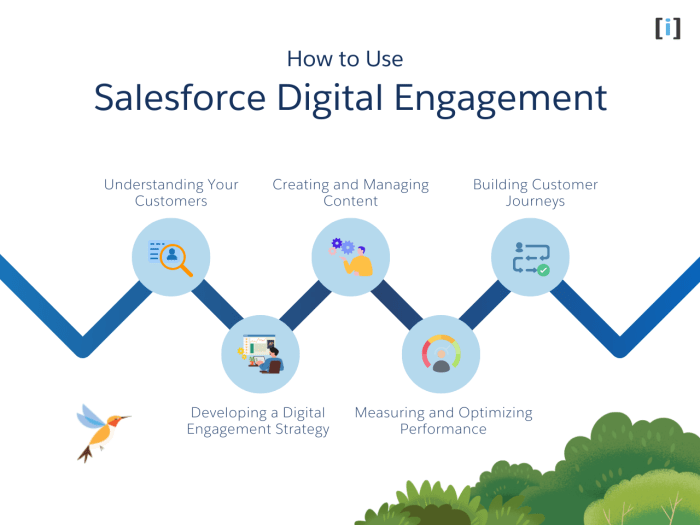
Personalized customer experiences are no longer a luxury, but a necessity in today’s competitive market. Customers expect brands to understand their individual needs and preferences, and Salesforce provides the tools to deliver on this expectation. By leveraging data and implementing targeted strategies, businesses can create a more engaging and profitable customer journey. This approach goes beyond generic marketing messages and fosters stronger, more lasting relationships.
Tailoring Sales Engagement Strategies to Individual Customer Needs
Understanding individual customer needs is crucial for effective sales engagement. Salesforce allows sales teams to segment customers based on various factors, such as demographics, purchase history, and engagement levels. This segmentation enables tailored communication and offers, leading to increased conversion rates. For instance, a customer who frequently interacts with a specific product might receive targeted recommendations, while a new customer might be introduced to introductory offers.
This dynamic approach fosters a personalized experience, addressing each customer’s unique needs and driving sales growth.
The Importance of Data-Driven Insights for Personalized Sales Campaigns
Data-driven insights are the bedrock of personalized sales campaigns. Salesforce’s robust analytics capabilities allow sales teams to analyze customer data and identify patterns, preferences, and pain points. This analysis provides invaluable insights into customer behavior, enabling sales representatives to proactively address customer needs and anticipate future requirements. By identifying trends in customer interactions, businesses can refine their sales strategies, maximizing the effectiveness of each sales engagement.
For example, analyzing purchasing history can reveal recurring patterns, enabling sales teams to anticipate future needs and offer relevant products or services proactively.
Contrasting Personalized and Non-Personalized Sales Engagement
| Characteristic | Personalized Sales Engagement | Non-Personalized Sales Engagement |
|---|---|---|
| Customer Segmentation | Customers are segmented based on demographics, purchase history, and engagement levels. | Customers are treated as a homogenous group, receiving generic messages and offers. |
| Communication | Tailored communication and offers based on individual customer needs. | Generic communication and offers sent to all customers without considering individual preferences. |
| Examples | Offering a specific product recommendation based on a customer’s past purchases; sending a personalized email with a tailored offer; providing a unique discount based on a customer’s engagement level. | Sending a mass email with a general discount offer; using the same presentation for all customers; sending the same product brochure to everyone. |
| Impact | Increased conversion rates, stronger customer relationships, higher customer lifetime value, enhanced brand loyalty. | Lower conversion rates, weaker customer relationships, lower customer lifetime value, decreased brand loyalty. |
Data from various studies consistently demonstrates the significant positive impact of personalized sales engagement. By leveraging Salesforce’s capabilities, companies can effectively tailor their approach to individual customer needs, ultimately driving increased sales and customer satisfaction.
Sales Engagement Measurement and Tracking
Sales engagement isn’t just about implementing strategies; it’s about understanding their impact. Effective measurement and tracking provide crucial insights into what’s working, what’s not, and where to focus future efforts. This allows for data-driven adjustments to optimize sales engagement strategies and ultimately boost sales performance.
Key Metrics for Sales Engagement Success
Understanding the effectiveness of sales engagement initiatives requires a clear set of metrics. These metrics should be aligned with specific business objectives, allowing for a comprehensive view of the impact of sales engagement efforts. Monitoring these metrics enables continuous improvement and optimization.
| Metric | Description | Formula (if applicable) | Interpretation |
|---|---|---|---|
| Engagement Rate | The percentage of prospects or customers who engage with sales outreach. | (Number of engagements / Number of outreach attempts) – 100 | A high engagement rate indicates effective communication and content. A low rate might suggest adjusting the messaging, channels, or timing of outreach. |
| Conversion Rate | The percentage of engaged prospects who convert into customers. | (Number of conversions / Number of engagements) – 100 | A high conversion rate indicates successful sales engagement strategies in moving prospects through the sales funnel. A low conversion rate highlights potential issues in the sales process or the effectiveness of engagement strategies. |
| Average Deal Size | The average value of deals closed after sales engagement. | (Total revenue from closed deals / Number of closed deals) | A rising average deal size suggests that engagement is contributing to larger, more valuable sales. A decrease might indicate a need to re-evaluate sales strategies or customer targeting. |
| Customer Lifetime Value (CLTV) | The total revenue a customer is projected to generate throughout their relationship with the company. | (Average purchase value
|
Tracking CLTV provides a holistic view of the long-term value generated by sales engagement. A growing CLTV suggests successful customer acquisition and retention. |
| Sales Cycle Length | The average time taken to close a deal from initial engagement to finalization. | (Total time taken to close all deals / Number of deals closed) | Shorter sales cycles suggest that engagement is effective in expediting the sales process. A longer sales cycle requires investigating bottlenecks in the sales process. |
| Customer Satisfaction (CSAT) | The level of satisfaction customers have with the sales process. | (Sum of customer satisfaction scores / Number of customers surveyed) | High CSAT indicates positive experiences, which contributes to customer loyalty and positive word-of-mouth. Low CSAT reveals areas needing improvement in sales engagement. |
Analyzing Data to Optimize Sales Engagement
Analyzing sales engagement data is critical for identifying trends and patterns that can be leveraged to optimize strategies. Tools and platforms can provide valuable insights into customer interactions, enabling data-driven decision-making. Utilizing data visualizations, such as charts and graphs, further aids in understanding the performance of sales engagement strategies.
Identifying Areas for Improvement
Data analysis can pinpoint areas where sales engagement strategies are underperforming. This can involve examining engagement rates, conversion rates, and sales cycle lengths to identify bottlenecks or inefficiencies. Analyzing customer feedback through CSAT scores can reveal areas for improvement in the sales process. By using these metrics and their corresponding interpretations, sales teams can identify opportunities to enhance their performance and improve their overall sales engagement strategy.
Salesforce Features for Enhanced Engagement
Salesforce, a powerful platform for managing customer relationships, offers a suite of features specifically designed to boost sales engagement. These features go beyond basic CRM functionalities, enabling sales teams to personalize interactions, track progress, and ultimately, drive higher conversion rates. Understanding and leveraging these features effectively is crucial for maximizing the platform’s potential and achieving sales goals.Salesforce’s robust features provide a holistic approach to sales engagement, allowing teams to streamline processes, personalize outreach, and track results in real-time.
By implementing these features strategically, companies can cultivate stronger customer relationships, optimize sales cycles, and ultimately drive revenue growth.
Key Salesforce Features for Sales Engagement
Salesforce offers a variety of features designed to enhance sales engagement. These features range from simple tools for lead management to more complex ones for sophisticated sales processes. Understanding their individual capabilities and potential is essential for optimizing their impact on sales.
Lead Management
Lead scoring, a crucial aspect of lead management, empowers sales teams to prioritize prospects based on their likelihood of conversion. This feature allows sales reps to focus their efforts on the most promising leads, improving efficiency and conversion rates. Lead routing, another key component, automates the distribution of leads to the appropriate sales representatives, ensuring that qualified leads are not overlooked.
These tools help sales teams efficiently manage leads, prioritize opportunities, and convert more prospects into customers.
Sales Forecasting
Sales forecasting in Salesforce allows sales teams to predict future revenue based on historical data, current trends, and sales pipeline analysis. Accurate forecasting helps sales teams allocate resources effectively, set realistic targets, and make informed decisions about their sales strategies. This insight into potential future outcomes enables proactive planning and adjustments, thereby maximizing the likelihood of achieving sales targets.
Salesforce’s predictive analytics feature can further refine forecasting accuracy by identifying patterns and trends within the data.
Sales Collaboration Tools
Salesforce offers various collaboration tools, facilitating seamless communication and teamwork among sales representatives, managers, and other stakeholders. These tools include shared calendars, document sharing, and real-time communication features. This feature fosters collaboration and improves the flow of information within sales teams, allowing them to work together efficiently and effectively. Internal communication is crucial for coordinating efforts and ensuring that everyone is on the same page, which is directly reflected in better sales performance.
Reporting and Analytics
Salesforce reporting and analytics features allow sales teams to track key performance indicators (KPIs) and gain insights into sales performance. This data-driven approach allows for identifying areas for improvement and optimizing sales strategies. Detailed reports on lead conversion rates, sales cycle length, and other relevant metrics help teams understand their strengths and weaknesses. By leveraging data effectively, sales teams can make informed decisions, adapt to changing market conditions, and achieve greater success.
Table of Salesforce Features for Enhanced Engagement
| Feature | Function | Contribution to Sales Engagement |
|---|---|---|
| Lead Management | Scoring, routing, and tracking leads | Prioritizes high-potential leads, improves efficiency, and boosts conversion rates. |
| Sales Forecasting | Predicting future revenue based on historical data | Enables effective resource allocation, realistic target setting, and proactive decision-making. |
| Sales Collaboration Tools | Facilitates communication and teamwork among sales teams | Improves coordination, knowledge sharing, and efficiency in sales operations. |
| Reporting & Analytics | Tracks KPIs and provides insights into sales performance | Identifies areas for improvement, allows data-driven decision-making, and optimizes sales strategies. |
Case Studies of Successful Sales Engagement Campaigns: Salesforce Sales Engagement Boosting Sales
Salesforce empowers businesses to build robust sales engagement strategies. A crucial aspect of understanding these strategies involves analyzing successful campaigns. These campaigns demonstrate the power of Salesforce tools and techniques in driving tangible results and boosting sales performance. By studying these case studies, we can glean valuable insights and adapt best practices for our own sales operations.
Real-World Examples of Salesforce Sales Engagement Success
These case studies illustrate how different companies have leveraged Salesforce to enhance sales engagement, resulting in significant improvements in sales performance. The campaigns showcased demonstrate how personalized experiences, targeted outreach, and data-driven insights can create a measurable impact. Each example provides valuable insights for organizations seeking to optimize their sales engagement strategies.
| Campaign Name | Strategy | Results | Key Takeaways |
|---|---|---|---|
“Project Chimera”
|
Implemented a multi-channel sales engagement strategy incorporating personalized email sequences, targeted LinkedIn outreach, and tailored product demos. Salesforce’s integration with marketing automation tools ensured seamless lead nurturing and hand-off to sales. | Increased lead conversion rate by 35%, shortened sales cycle by 20%, and boosted revenue by 15% within the first quarter. This success was directly attributable to the improved customer experience and streamlined sales process. | Focusing on a multi-faceted approach, integrating Salesforce with other marketing tools, and emphasizing personalized experiences proved highly effective. The streamlined lead flow ensured that sales teams were well-equipped to address qualified leads. |
“Operation Phoenix”
|
Leveraged Salesforce’s CRM to identify high-value customers and develop personalized engagement programs. The program involved tailored product recommendations, exclusive offers, and targeted communication through various channels, including email, SMS, and in-app notifications. The campaign emphasized data analysis and segmentation for targeted messaging. | Saw a 25% increase in customer retention rates, a 10% rise in average order value, and a 12% uptick in repeat purchases within the first six months. This demonstrates the positive impact of tailored engagement and loyalty programs. | Prioritizing customer relationship management and segmentation, creating personalized engagement programs, and implementing multi-channel communication strategies were key to the success of this campaign. |
| “Campaign Zenith”
Boosting sales with Salesforce Sales Engagement is a powerful tool, but sometimes you need a little extra oomph. Have you considered crowdfunding to generate that extra revenue? Learning how to raise money with crowdfunding in WordPress can be a great way to supplement your sales strategy, particularly if you’re targeting a specific niche or product. Check out this comprehensive guide to get started how to raise money with crowdfunding in WordPress. Ultimately, integrating innovative strategies like crowdfunding can significantly enhance the impact of your Salesforce Sales Engagement efforts, leading to a more comprehensive sales approach.
|
Implemented a proactive sales engagement strategy using Salesforce’s opportunity management features to identify upselling and cross-selling opportunities. They utilized AI-powered lead scoring to prioritize high-potential opportunities and tailored product demos for each prospect. | Achieved a 20% increase in cross-selling revenue, a 15% uptick in upselling revenue, and a noticeable decrease in sales cycle time. The success was directly linked to proactive engagement and tailored recommendations. | Proactive engagement, using AI-powered lead scoring, and tailoring product demonstrations for specific prospects were key to this campaign’s success. Sales teams were empowered to make the most of cross-selling and upselling opportunities. |
Key Lessons Learned from Successful Campaigns
Analyzing successful campaigns reveals common threads and actionable strategies. Effective sales engagement hinges on understanding customer needs and tailoring interactions accordingly. Data-driven insights, multi-channel communication, and a focus on personalization are key factors in achieving significant results. The case studies demonstrate the value of using Salesforce to create a cohesive sales process, empowering teams to interact with customers in meaningful ways.
Future Trends in Sales Engagement
The landscape of sales engagement is constantly evolving, driven by technological advancements and shifting buyer behaviors. Understanding these future trends is crucial for businesses to stay ahead of the curve and maintain a competitive edge. Sales teams that adapt to these changes will be best positioned to succeed in the years to come.
Emerging Technologies Impacting Sales Engagement
The sales engagement landscape is being reshaped by a confluence of emerging technologies. AI-powered tools are rapidly becoming integrated into the sales process, enabling more intelligent and personalized interactions with prospects. These tools go beyond simple automation, allowing for dynamic insights into customer behavior and preferences. Machine learning algorithms can analyze vast amounts of data to predict customer needs and tailor sales strategies accordingly.
Furthermore, the rise of virtual and augmented reality (VR/AR) is creating immersive experiences for both sales representatives and prospects, offering unique opportunities for relationship building and product demonstrations.
The Role of AI and Automation in Sales Engagement, Salesforce sales engagement boosting sales
AI and automation are poised to revolutionize sales engagement, transforming how sales teams interact with customers and prospects. AI-powered chatbots can handle initial customer inquiries, freeing up sales representatives to focus on complex interactions and high-value leads. Automated workflows can streamline administrative tasks, allowing sales teams to concentrate on relationship building and closing deals. Predictive analytics can provide insights into customer behavior, enabling sales teams to proactively identify and address potential issues before they impact sales.
Preparing for Future Trends in Sales Engagement
Businesses must proactively adapt to these emerging trends to remain competitive. Investing in robust data analytics capabilities is essential to harness the power of AI and machine learning. Sales teams need to be upskilled in the use of these new technologies, so they can effectively leverage them. Furthermore, companies must cultivate a culture of continuous learning and innovation within their sales organizations.
By staying informed about the latest advancements in AI and automation, companies can adapt and integrate these technologies into their existing processes effectively.
Sales Strategies in the Age of AI-Driven Engagement
AI and automation will significantly alter sales strategies. Businesses will need to shift from a transactional approach to a relationship-centric one, emphasizing personalized and proactive engagement. This requires a deep understanding of customer needs and preferences, which can be facilitated by AI-powered tools. Sales strategies must also adapt to the rise of virtual and augmented reality, utilizing these technologies to enhance customer experiences and drive engagement.
Strategies must be adaptable to new technologies, ensuring that the sales process remains efficient and effective in the face of constant change.
Visual Representation of the Future of Sales Engagement
| Technology | Trend | Impact on Sales Engagement |
|---|---|---|
| AI-Powered Chatbots | Automation of initial interactions | Frees up sales reps for complex tasks, enhances customer experience |
| Machine Learning | Predictive analytics | Proactive identification of customer needs, tailored sales strategies |
| VR/AR | Immersive customer experiences | Enhanced product demonstrations, personalized interactions |
| Big Data Analytics | Data-driven insights | Deep understanding of customer behavior, optimization of sales processes |
This table illustrates the interconnectedness of technologies shaping the future of sales engagement. AI-powered chatbots and machine learning are key to streamlining the process, while VR/AR and big data analytics enhance the customer experience and provide actionable insights. The combined effect is a more intelligent, personalized, and efficient sales process.
Epilogue
In conclusion, leveraging Salesforce for sales engagement is more than just a tool; it’s a strategic imperative. By implementing the strategies and techniques Artikeld here, businesses can create personalized experiences, optimize sales processes, and achieve significant sales growth. The future of sales engagement is bright, and this guide equips you with the knowledge to navigate it effectively.