LLM-Powered Risk Management: A Novel Approach to Algorithmic Trading

The quest for a consistent edge in financial markets has led many quantitative traders to explore the potential of Large Language Models (LLMs). However, a significant hurdle has emerged: the inherent difficulty in reliably predicting future market returns. This challenge, as highlighted by researcher E.P. Chan (2024), often leads to the failure of LLM-driven trading strategies that are primarily focused on directional forecasting. José Carlos Gonzales Tanaka, in a recent analysis, proposes a paradigm shift, advocating for LLMs to function not as market predictors, but as sophisticated risk managers, dictating investment allocation rather than market direction.
This innovative strategy leverages DeepSeek, an advanced LLM, to dynamically adjust portfolio exposure based on market conditions. The core idea is to move away from predicting whether a stock will go up or down, and instead, focus on assessing risk. The LLM is tasked with evaluating the current market state – derived from historical price action and volatility patterns – and deciding how much capital should be deployed. This approach aims to achieve a calibrated, regime-aware exposure, ranging from 50% to 100% long, with no shorting or leverage involved.
A crucial element of this strategy is its adaptive nature. A monthly walk-forward loop ensures that a fresh LLM policy is generated, and guardrail thresholds are re-optimized on a regular basis. This iterative process allows the strategy to adapt to evolving market dynamics. Furthermore, robust safety mechanisms, known as "hard guardrails," are integrated to prevent catastrophic losses. These include volatility stops, drawdown stops, and a forced re-entry mechanism, designed to act as a fail-safe even when the LLM’s recommendations might prove insufficient. The entire strategy has undergone rigorous out-of-sample (OOS) verification from January 2023 onwards, providing a testament to its real-world applicability.
Understanding the Foundations: Prerequisites for Success
To fully grasp the intricacies of this LLM-driven risk management strategy, a foundational understanding of several key concepts is essential. On the technical front, proficiency in Python, particularly with libraries like pandas for DataFrame manipulation and numpy for array operations, is crucial for time-series analysis. Familiarity with making API calls using the requests library is also beneficial. For those seeking to refresh these skills, resources such as "Python for Trading: A Step-By-Step Guide" offer comprehensive coverage.
Beyond programming, a solid grasp of backtesting methodologies is assumed. This includes understanding the significance of out-of-sample evaluation and the computation of key performance metrics like the Sharpe Ratio, Sortino Ratio, Calmar Ratio, and Maximum Drawdown. The article "What Is Backtesting & How to Backtest a Trading Strategy Using Python" serves as an excellent refresher for these concepts.
Strategically, the approach sits at the confluence of three core ideas: market regimes, LLM-assisted decision-making, and risk-aware position sizing. The concept of market regimes, which involves discretizing continuous price signals into labeled states, is explained in detail in "Market Regime using Hidden Markov Model." The walk-forward loop, a critical component for robust backtesting and model validation, is thoroughly covered in "Walk-Forward Optimization (WFO): A Framework for More Reliable Backtesting." For position sizing, principles of volatility targeting and the intuition behind the Kelly criterion, as discussed in "Position Sizing Strategies and Techniques in Trading," provide the necessary framework. Finally, this strategy builds upon prior work, specifically extending the DeepSeek workflow introduced in "AI Forex Backtesting with LLM Regime Labels: DeepSeek vs KMeans in Python." Understanding the process of passing compact numeric summaries to an LLM and parsing strict JSON policy tables is a prerequisite for appreciating the LLM’s role in this strategy.
The Paradigm Shift: From Prediction to Risk Assessment
The genesis of this strategy lies in a critical re-evaluation of how LLMs can be effectively employed in trading. Many existing LLM-powered trading strategies falter because they ask the LLM to perform a task that is fundamentally intractable for any model: predicting tomorrow’s price direction for liquid, large-cap stocks like Apple (AAPL). Such predictions, even with advanced AI, lack a reliable edge.
Instead, the proposed strategy reframes the LLM’s role. Drawing from research that distinguishes between predicting returns and volatility [Chan, 2024], the LLM is tasked with assessing risk. The pivotal question shifts from "Will the stock go up or down tomorrow?" to "Given how this stock has behaved in various market states over time, does today’s state suggest full investment, or should I reduce exposure?"
This reframing allows the LLM to analyze a table of historical statistics for each identified market state. These statistics include mean return, standard deviation, and a Sharpe-like score. Based on this analysis, the LLM outputs a policy dictating the appropriate investment level for each state, ranging from 50% to 100% long exposure. This "regime-aware exposure" aims to provide a more robust and adaptable trading approach.
The Control Panel: Configuring the Strategy
Every well-designed backtest begins with a centralized control panel, allowing for easy modification of experimental parameters. This strategy employs a layered approach to settings, encompassing data parameters, cost assumptions, and the crucial exposure mapping that translates the LLM’s output into concrete position sizes.
Three key exposure constants – LONG_FULL_EXP (typically 1.0), LONG_HALF_EXP (e.g., 0.8), and FLAT_EXP (e.g., 0.5) – serve as the bridge between the LLM’s qualitative risk assessment and the portfolio’s actual risk. The intentional setting of FLAT_EXP to 0.5, rather than 0.0, is a deliberate design choice. It signifies that a cautious signal from the LLM translates to a reduction in exposure, not an outright exit from the market. This floor ensures the strategy continues to participate in positive market drift, even during periods of uncertainty. As the analysis highlights, in a bull market, a complete cash exit on every cautious signal could significantly erode compound annual growth rate (CAGR).
Settings such as MAX_FLAT_DAYS and REENTRY_SIZE are incorporated to address a subtle but potentially devastating issue: the guardrail deadlock. This problem, which can silently cripple a strategy, is elaborated upon in the discussion of guardrail logic.
Data Integrity: The Bedrock of Algorithmic Trading
The adage "no data, no strategy" holds particularly true in algorithmic trading. However, it is not merely about data availability; it is about data quality and suitability. For a stock like AAPL, which has undergone multiple stock splits since 1990, ensuring data accuracy is paramount. The auto_adjust=True flag in data retrieval is non-negotiable. Without it, split-adjusted prices would introduce artificial return spikes, corrupting downstream calculations such as rolling volatility, z-scores, and trend indicators. A defensive sanity check immediately following feature engineering, implemented with just a couple of lines of code, has proven instrumental in preventing backtests from yielding erroneous results.
Feature Engineering: Painting the Market’s Mood
Raw price data indicates market levels, but features reveal its underlying sentiment or "mood." This strategy computes seven distinct signals from OHLCV (Open, High, Low, Close, Volume) data. The singular objective of these features is to provide a compact and interpretable description of the prevailing market state. Traders are encouraged to explore additional technical indicators, such as those offered by the ta-lib library, to further enrich the feature set.
Discretizing Market States: Creating Understandable Segments
Continuous features can be challenging to interpret and lead to an overwhelming number of combinations. To address this, each signal is binned into two or three categories. These binned signals are then combined to form a single, comprehensive state string. This process results in 12 distinct market states, a manageable number for the LLM to process and one that typically yields hundreds of historical examples for each state.
Several design choices are noteworthy. The volatility threshold, for instance, utilizes a rolling 252-day median rather than a fixed value. This adaptive approach ensures that the definition of "high volatility" remains relevant across different market environments, from the low-volatility periods of 2017 to the more turbulent post-COVID era. The resulting state strings are intentionally human-readable, facilitating the LLM’s use of its world knowledge to infer the historical risk implications of states like "trending upward in a calm, overbought market."
The LLM as Risk Manager: Crafting the Policy Table
This segment represents the core of the strategy. On a monthly cadence, DeepSeek is prompted to analyze historical statistics for each market state and generate a policy table. This table dictates whether to be fully invested, partially invested, or to pull back from the market for each specific state.
The critical design decision lies in how the task is framed for the LLM. While a strategy asking the LLM to predict directional moves (LONG/SHORT/FLAT) is prone to failure, the optimal framing positions the LLM as a risk manager, not a forecaster.
Computing State Statistics: The process begins with computing the statistics that the LLM will use for its analysis. A one-day lag is employed to prevent lookahead bias, ensuring that the state at the close of day t-1 is used to inform decisions for day t. The "sharpe_like" column in this table is particularly important, as a strongly positive value historically indicates good risk-reward potential for the next day in that market state, while a negative value suggests the opposite. A value near zero implies inconclusive evidence.
The Prompt: Guiding the LLM’s Decision-Making: The system prompt is the philosophical anchor of the strategy. Its careful construction is paramount. Three guiding principles shape this prompt:
-
Explicit Reframing: The prompt clearly states what the LLM should not do ("Your job is NOT to predict tomorrow’s price direction") before defining its actual task. This explicit directive helps prevent the model from reverting to its default direction-forecasting tendencies.
-
Default to Action, Penalize Inaction: The prompt includes a "Default bias: LONG. Most states should be LONG." instruction. This counteracts the LLM’s natural inclination towards conservatism when uncertain. In a long-only strategy on a stock with positive long-term drift, maintaining a flat position incurs a real opportunity cost by missing out on the market’s expected returns.
-
Strict JSON Output with Retry: The requirement for strict JSON output, coupled with a defined schema, prevents the LLM from embedding extraneous prose that could disrupt parsing. The inclusion of a retry mechanism and an increased
max_tokenslimit (2000) helps mitigate issues where responses might be truncated mid-JSON, leading to silent parsing failures.
A practical tip for efficient LLM usage is to cache responses. The cache key incorporates the month, symbol, model name, and a version tag. This allows for free re-runs of the backtest once the cache is populated, with the cache file being a human-readable JSON dictionary for inspection.
From Policy to Position Sizing: Incorporating Volatility Targeting
The LLM’s output is a qualitative judgment (e.g., LONG full, LONG half, FLAT). This needs to be translated into a quantitative position size – the fraction of capital to invest. This conversion occurs in two stages: first, mapping the LLM’s action to a base exposure, and second, scaling this exposure using volatility targeting.
Exposure Mapping: This step defines the strategy’s risk-taking personality. The three defined exposure levels (e.g., 1.0, 0.8, 0.5) dictate how aggressively the LLM’s risk signals translate into actual position adjustments. These are tunable parameters; if the LLM proves too cautious, increasing FLAT_EXP can maintain more capital deployment without altering the core prompt.
Volatility Targeting: The aim of volatility targeting is to maintain a relatively constant risk contribution from the strategy, irrespective of the market regime. When realized volatility exceeds a predefined target, the strategy automatically scales down its position. Conversely, in calmer periods, it scales up, though a MAX_LEVERAGE cap prevents excessive risk-taking through leverage.
Momentum Tilt: An additional layer adds a +/-15% tilt to the position size based on 63-day momentum. This gives the strategy a directional bias aligned with prevailing trends without overriding the LLM’s qualitative risk assessment. The final position is constructed in the build_agent_positions function, which uses lagged state and volatility data to avoid artificially forcing the first day of each month into a flat position. The execution timing ensures that the position decided at the close of day t-1 is held throughout day t, earning the return of that day without any lookahead bias.
Hard Guardrails: The Safety Net for Extreme Events
While the LLM is designed to assess risk based on historical patterns, markets can exhibit unprecedented behavior, such as flash crashes or sudden liquidity crunches. Hard guardrails serve as a critical last line of defense, operating independently of the LLM’s judgment.
Three primary triggers can override the LLM’s recommended position:
- Volatility Stop: If realized volatility exceeds a defined
vol_stopthreshold and a short-term volatility measure (e.g., 5-day volatility) exceeds 80% of thevol_stop(an acceleration condition), the position is cut to zero. This dual condition prevents premature exits triggered by temporary, single-day volatility spikes. - Drawdown Stop: If the strategy’s equity falls below a
dd_limitfrom its peak and the trend is demonstrably broken (e.g., negative 63-day momentum and price below the 50-day moving average), the position is also liquidated to zero. This trend-confirmation filter prevents exits during temporary pullbacks within a broader bull market. - Cooldown Period: Following the activation of either the volatility or drawdown stop, the strategy remains flat for a specified
cooldown_days.
A "warning zone" is also implemented. If the drawdown exceeds 60% of the dd_limit, the position is halved, creating a tiered response: a warning (halving position) at 60%, a hard stop (exit plus cooldown) at 100%, and a forced re-entry mechanism after MAX_FLAT_DAYS.
The Guardrail Deadlock: A Silent Strategy Killer and Its Fix
A subtle but critical bug can plague drawdown stop implementations: the guardrail deadlock. This occurs when a drawdown stop triggers, setting the position to zero. With no active position, equity stagnates, causing the peak equity to remain above the current frozen equity. Consequently, the drawdown check continues to fire daily, perpetually locking the strategy in a zero-position state.
The solution involves a re-entry counter. After a defined MAX_FLAT_DAYS (approximately two trading weeks), the re-entry gate opens, and the strategy resumes at full size (REENTRY_SIZE=1.0 multiplied by the agent’s proposed position). Once re-entered, equity can begin to accrue again, either recovering above the drawdown threshold or triggering another waiting period. This mechanism effectively breaks the deadlock.
Monthly Guardrail Re-optimization: The thresholds for the guardrails (vol_stop, dd_limit, max_delta, cooldown_days) are re-optimized monthly via a grid search on the training window. This ensures that the risk gates adapt to market conditions at the same frequency as the LLM’s risk assessment, albeit with an increased computational cost for the grid search. Maintaining this synchronized cadence ensures the risk controls remain aligned with the policy they are designed to protect.
The Walk-Forward Loop: Ensuring Out-of-Sample Integrity
Walk-forward backtesting is the closest approximation to honest out-of-sample testing without the necessity of waiting for future market data. The principle is straightforward: at any given point in time, the model only has access to information that would have been available at that specific time, thus eliminating hindsight bias.
The implemented loop operates on a monthly basis. For each out-of-sample month from January 2023 onwards, the strategy trains on the preceding three years of data, generates an LLM policy, and then trades for the subsequent month. Crucially, equity and positions are carried forward continuously, without resetting to an initial capital base at the beginning of each month. Following the completion of the loop, the monthly blocks are stitched together to form a continuous OOS equity curve, allowing for the comparison of both the agent-only and the guardrailed versions of the strategy.
Performance Metrics and Analysis: Evaluating the Strategy’s Efficacy
Upon completion of the walk-forward loop, a comprehensive suite of risk-adjusted performance metrics is computed for all three equity curves (buy-and-hold benchmark, agent-only, and agent with guardrails). The inclusion of the buy-and-hold benchmark is essential for a realistic assessment of the strategy’s value proposition.
CAGR vs. Sharpe Ratio: Unveiling Different Narratives: The strategy’s CAGR (12.5% and 12.8% for the two configurations) may appear modest compared to the buy-and-hold benchmark’s 27.1%. However, this comparison can be misleading due to the vastly different risk profiles. The LLM agents operate with annualized volatilities of 14.1% and 13.9%, significantly lower than AAPL’s 25%. When viewed through the lens of risk-adjusted returns (Sharpe Ratio), the performance gap narrows considerably.
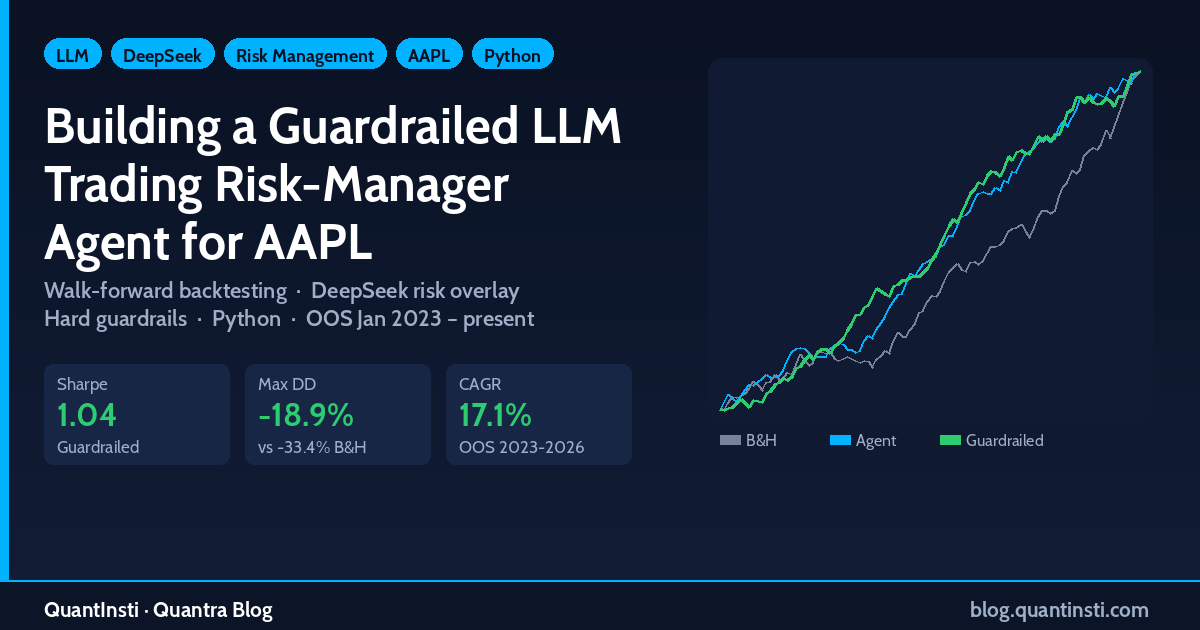
Guardrails: A Trade-off Between Return and Drawdown Reduction: The implementation of guardrails results in a slight reduction in CAGR, reflecting the cost of increased caution. However, this comes with a notable benefit: a decrease in maximum drawdown from -33% to -18%. During periods of market stress, the guardrails effectively mitigated larger losses. The agent-plus-guardrails version emerges as a potentially suitable choice for risk-managed portfolios, while the agent-only version serves as a baseline to quantify the guardrails’ impact.
The Honest Takeaway: Risk Modulation Over Alpha Generation: With the current set of features and LLM prompt, the strategy does not outperform the buy-and-hold benchmark in terms of CAGR. The primary value proposition of the LLM lies in its ability to modulate risk rather than generate alpha. For investors seeking to participate in market upside while simultaneously reducing severe drawdowns, this strategy demonstrates potential. However, for those aiming to outperform a passive index, the development of more sophisticated predictive features is necessary.
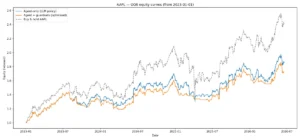
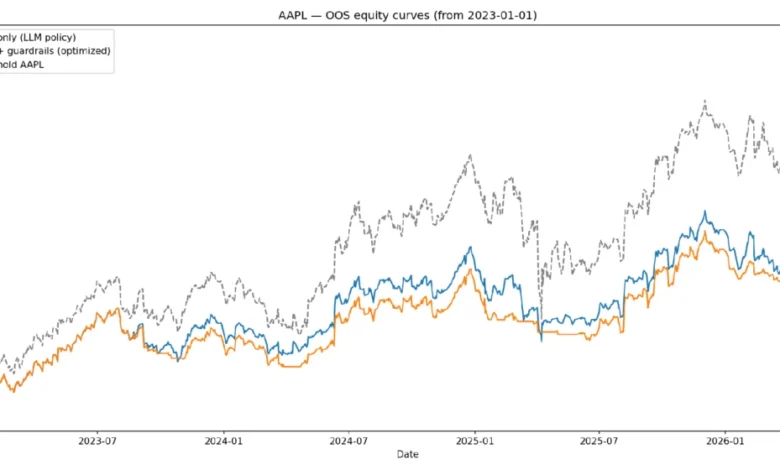
The accompanying equity curve chart visually corroborates these findings. All three curves exhibit growth through 2023-2024, indicating participation in AAPL’s uptrend. The Agent + Guardrails curve shows a tendency to detach downwards more slowly during corrections, illustrating the guardrails’ effectiveness in trimming exposure. The Buy & Hold strategy finishes highest due to AAPL’s strong uptrend and shallow corrections during this period. However, in more volatile or bear markets, the lower volatility and reduced drawdown of the guardrailed strategy would likely translate into a clearer risk-adjusted advantage, as indicated by the Calmar ratio (0.91 for the guardrailed strategy vs. 0.88 for Buy & Hold).
Future Enhancements: Elevating Strategy Performance
The developed strategy serves as a robust foundation. Further research and development can focus on several key areas to enhance its performance:
Signal Quality:
- Multi-horizon Momentum: Incorporating 5-day and 63-day cumulative returns alongside the current 20-day trend score can provide the LLM with a more nuanced understanding of trend stages.
- Earnings Blackout: Mandating a
FLAT_EXPposition in the two trading days surrounding quarterly earnings releases can mitigate significant gap risk without introducing lookahead bias. - Macro Regime Filter: Adding a feature indicating whether the S&P 500 is above or below its 200-day moving average can provide the LLM with crucial market-wide context, especially during broad market downturns.
- Volume Z-score: Including today’s volume relative to its 20-day average can signal potential reversals (unusually low volume) or confirm momentum (unusually high volume).
Position Sizing:
- Kelly Fraction Hints: Providing the LLM with a fractional Kelly size hint per state, calculated from training statistics, could lead to more optimized capital allocation.
- Regime-Conditional Leverage Cap: During high-volatility states, tightening the
MAX_LEVERAGEcap can prevent the rapid rebuilding of positions into still-stressed markets after a guardrail re-entry. - Continuous Size Output: Requesting a continuous exposure output in the range of [0, 1] from the LLM can enable finer-grained position modulation and smoother equity curves, although it requires more stringent output validation.
Guardrail Robustness:
- Relative Drawdown Limit: Replacing absolute drawdown limits with a relative measure comparing strategy equity to a buy-and-hold benchmark can prevent false exits during bull markets.
- Noise-Filtered Volatility Stop: Requiring multiple consecutive days of elevated volatility before triggering the stop can eliminate spurious signals from short-lived spikes.
- Separate Cooldowns: Implementing distinct cooldown periods for volatility and drawdown stops acknowledges that these events have different durations and recovery patterns.
- Guardrail Optimization Frequency: Testing alternative re-optimization cadences (annual, semi-annual, quarterly) for guardrails can balance adaptability with robustness against overfitting.
LLM Prompting:
- Comparative Ranking Prompt: Instructing the LLM to rank states by risk/reward and assign exposure based on rank tiers can prevent the model from assigning similar conservative biases to all states.
- Regime Classification First: Prompting the LLM to first classify the overall market regime (BULL, CHOP, STRESS) can anchor its per-state exposure decisions to a coherent macro view.
- Multi-Model Comparison: Running the same prompt through multiple LLMs and comparing their outputs can provide a stronger signal of robustness and reliability.
Evaluation:
- Rolling Sharpe Chart: Visualizing rolling one-month Sharpe ratios over the OOS period can reveal the persistence of the strategy’s edge.
- Volatility-Targeted Benchmark: Including a volatility-targeted buy-and-hold as a benchmark helps isolate the LLM’s contribution versus the impact of volatility targeting alone.
- Transaction Cost Sensitivity Sweep: Reporting results across various transaction cost assumptions (e.g., 0.5, 1.0, 2.0 bps) assesses the strategy’s resilience to trading frictions.
Frequently Asked Questions:
-
Q: Why use an LLM when a simple rule might suffice?
A: While simple rules can capture straightforward relationships, LLMs offer an advantage in handling ambiguous or borderline states where statistical evidence is mixed. The LLM’s ability to synthesize complex patterns can lead to smoother, more nuanced decision-making compared to rigid rule-based systems. Comparative analysis with rule-based approaches is crucial to validate the LLM’s added value. -
Q: What is the guardrail deadlock and its implications?
A: The guardrail deadlock is a scenario where a drawdown stop, by setting the position to zero, halts equity growth indefinitely, thus perpetuating the drawdown condition and locking the strategy out of the market. TheMAX_FLAT_DAYSre-entry mechanism is designed to prevent this by forcing a partial re-entry after a set period. -
Q: Can this strategy be applied to other assets?
A: Yes, the architecture is adaptable to any liquid single stock or ETF with sufficient historical data. Adjustments would include changing the symbol and re-downloading data. For assets with less history than AAPL, reducing the training window (TRAIN_YEARS) is advisable to ensure statistically robust state analysis. -
Q: What are the API costs associated with running this strategy?
A: The DeepSeek API, known for its cost-effectiveness, incurs minimal charges for this strategy. A full out-of-sample run, involving approximately 40 API calls with a maximum token limit, costs less than $0.10 at current pricing. Subsequent runs are free once the LLM responses are cached. -
Q: What is the most impactful next step for performance improvement?
A: Enhancing the quality and breadth of the state features is identified as the most significant avenue for improvement. Leveraging a wider array of technical indicators from libraries liketa-libcan substantially refine the signal quality provided to the LLM.
Conclusion: A Framework for Risk-Aware Algorithmic Trading
The strategy presented herein represents a framework for LLM-assisted risk management, rather than a definitive alpha-generating solution. The LLM’s value proposition lies not in market prediction, but in its capacity to discern subtle differences between market states, offering a more nuanced approach than simple threshold-based rules.
The architecture is structured in three layers: feature engineering and state bucketing translate raw price data into LLM-interpretable signals; the LLM prompt, framed as a risk manager, establishes a monthly exposure policy; and the hard guardrails, complete with their re-entry mechanism, provide essential safeguards against extreme market events.
The results demonstrate a strategy that participates in market upside while significantly reducing maximum drawdowns. This risk-mitigation capability offers tangible benefits for real-world portfolios. While the current implementation represents a foundational step, opportunities for refinement abound in areas such as feature engineering, LLM prompting, and guardrail optimization. The walk-forward methodology ensures honest evaluation, and the modular design facilitates experimentation. The ultimate learning comes from actively engaging with the code, modifying parameters, and observing the outcomes, thereby fostering a deeper understanding of LLM-driven trading systems.
For those interested in further exploration, resources such as the "Learning Track: Quantitative Trading for Beginners," the "Trading Using LLM: Concepts and Strategies" track, and the "Executive Programme in Algorithmic Trading (EPAT)" offer comprehensive pathways to deepen knowledge in quantitative trading and machine learning applications.
References:
[Chan, 2024] E. P. Chan, “Machine Learning in Trading,” YouTube, 2024. Available: https://www.youtube.com/watch?v=VzF-tvz3DAk&t=411s
Note: The strategy concept originated from the author. The blog content was generated with AI assistance and curated/edited by the author. This blog is for educational and illustrative purposes only. Trading in financial markets involves substantial risk of loss. The code and concepts discussed are not financial advice. Always exercise caution and thoroughly understand any automated trading system before deploying it in a live environment.