Critical Security Flaw Exposes WordPress Sites to Remote Code Execution During the Patching Process

The ecosystem of content management systems faces a sophisticated threat vector as security researchers uncover a profound vulnerability in how core software updates are processed. Identified under the tracking designation CVE-2026-119977, this critical security flaw reveals a paradox in standard web security practices: the very mechanism designed to secure a website can inadvertently expose it to malicious exploitation during the exact window it is being patched. Discovered by Umut Bayram, a senior security researcher at Picus Security, the vulnerability highlights systemic architectural challenges in automated software deployment pipelines, affecting millions of self-hosted WordPress installations globally.
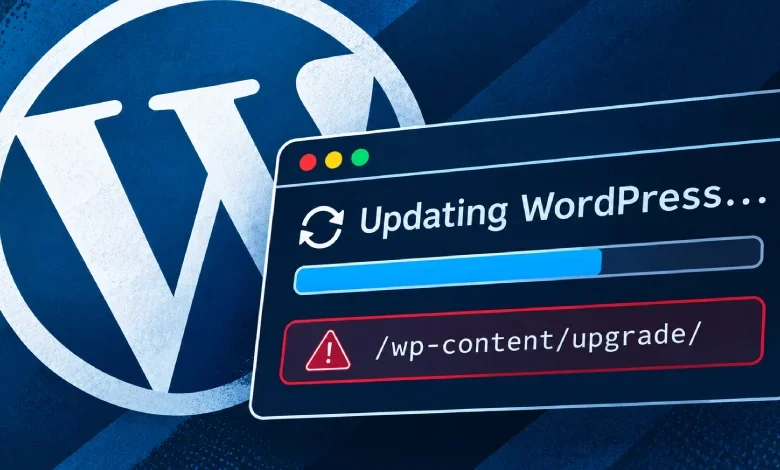
The core of the issue resides within the update routine utilized across versions 4.7 through 7.1.3 of the world’s most popular content management system. When a WordPress instance initiates a full core update, the software downloads a complete package and unpacks it into a temporary directory situated within the public-facing wp-content/upgrade folder. Because this temporary directory includes the WordPress installer script and remains accessible via standard web requests, an unauthenticated remote attacker who accurately predicts or discovers the directory’s path can interact with the installer. If the adversary times their strike to coincide precisely with the update process—before the system executes its cleanup routines—they can establish a rogue database connection, generate an unauthorized administrative session, and execute arbitrary PHP code under the privileges of the web server.
The chronology surrounding the discovery, public disclosure, and subsequent weaponization of CVE-2026-119977 underscores an accelerated threat landscape. The vulnerability was quietly patched by WordPress core developers with the release of version 7.1.4, alongside synchronized security backports for older active branches dating back to version 4.7. However, malicious actors demonstrated remarkable agility. Telemetry gathered by Wordfence, a prominent WordPress security firm, revealed that automated attack probes began targeting websites merely nine minutes after the publication of their dedicated firewall rules. Peak scanning activity persisted for over fourteen hours, perfectly mirroring the temporal signature of automated scripts designed to harvest vulnerable websites during their brief update window.
Shortly after public advisories were disseminated, proof-of-concept exploit codes began circulating within public code-sharing platforms like GitHub. These repositories included scripts explicitly tailored to exploit the predictable naming conventions of temporary directories generated by older updater codes found in versions 5.9 through 7.1.3. Recognizing the severe and immediate risk of active exploitation in the wild, the United States Cybersecurity and Infrastructure Security Agency (CISA) formally added CVE-2026-119977 to its Known Exploited Vulnerabilities catalog, compelling federal civilian executive branch agencies and strongly urging private sector entities to apply immediate mitigations.
Technical Anatomy of the Update Vulnerability
Understanding the mechanics of CVE-2026-119977 requires a deep dive into the software upgrade life cycle of WordPress. Historically, when a web administrator triggers a core update or when background automated routines execute, the application utilizes an internal class structure—specifically the core-upgrader component—to handle file acquisition and deployment.
In affected versions running WordPress 5.9 and later, the update routine unpacks the fresh core archive into a predictable subdirectory within wp-content/upgrade, naming the folder after the base name of the downloaded archive file. Crucially, the code responsible for unpacking and initiating this sequence is the legacy code already present on the server before the update commences. Because this old code dictates the naming convention, the resulting directory name can be accurately forecasted by an external observer.
An attacker exploiting this state of affairs can leverage the installer script located inside the temporary directory to upload a malicious wp-config.php file. When the core upgrader subsequently finalizes the file replacement phase, the malicious configuration file can overwrite or manipulate the legitimate operational parameters of the target site. Even more critically, Umut Bayram’s technical analysis demonstrated that an attacker who hits the system during the brief window of file staging can initialize a rogue WordPress instance, attach it to an external database under their control, and execute system commands with the file-system and process permissions of the underlying web server daemon (such as Apache or Nginx).

The CVSS v3.1 base score assigned to CVE-2026-119977 stands at a formidable 8.1 out of 10, categorizing it as a high-severity risk due to the potential for complete remote code execution and subsequent site takeover. While official WordPress security advisories initially rated the practical impact as low—presumably due to the narrowness of the exploitation window—independent security labs and telemetry data rapidly proved that automated botnets could reliably scale the timing attacks across thousands of targets simultaneously.
Nuances of Exposure: Complete Packages versus Partial Updates
A critical finding highlighted in subsequent technical clarifications is that not every software update introduces the same level of exposure. The vulnerability’s footprint depends heavily on whether WordPress deploys a complete core package or a differential (partial) update package.
Partial packages—often deployed during minor point releases within the same branch, such as transitioning from version 7.1.3 to 7.1.4—contain exclusively the files that have been modified between the two distinct iterations. If the specific installer files and configuration bootstrapping scripts are absent from the differential archive, the unpacked temporary directory cannot function as a standalone installer, thereby nullifying the remote code execution vector.
Conversely, major updates, cross-branch upgrades (such as moving from 7.0.7 to 7.1.4), and forced reinstalls invariably rely on complete core packages. These exhaustive archives inherently pack the vulnerable installer components into the temporary directory. Furthermore, automated updater routines will automatically fall back to deploying a complete package if the local site environment fails integrity checks or if file checksums do not match the official WordPress repository records.
As Umut Bayram summarized during follow-up technical briefings, the ultimate determinant of vulnerability is not simply whether a package is partial or complete, but whether the legacy updater code residing on the target server prior to the patch application has been updated to handle temporary folder generation securely. In version 7.1.4 and subsequent branch patches, the codebase has been altered to assign cryptographically random names to temporary update directories and to safeguard configuration file handling, ensuring that subsequent update cycles do not recreate the flaw.
Mitigation Strategies and Defensive Engineering Recommendations
Given that automated exploitation tools are actively scanning the internet for unpatched instances during the maintenance window, system administrators and managed hosting providers must implement robust defense-in-depth measures before initiating software updates. Standard reliance on automated dashboard updates without prior environmental hardening leaves sites exposed to the narrow but lethal exploitation window.
Security researchers and incident responders strongly advocate for the following procedural steps prior to executing core upgrades:

-
Restrict Web Server Access to the Upgrade Directory: Before initiating any core update, administrators should modify their web server configuration files (such as Apache .htaccess rules or Nginx server block directives) to explicitly deny HTTP and HTTPS access to the wp-content/upgrade folder. Because WordPress interacts with this directory directly via the local file system on the server disk, blocking external web access via the browser will not disrupt the internal update mechanisms, yet it will completely blind external attackers attempting to locate and execute the staged installer scripts.
-
Execute Manual Out-of-Root Deployments: For high-security environments or enterprise deployments, administrators can bypass the web-accessible update routine entirely. This involves downloading the official core package directly, unpacking it in a directory completely outside the web root (the folder structure served directly by the web server), carefully copying the core application files into place while strictly preserving existing wp-config.php and wp-content directories, and finally executing the database schema update script via command-line utilities or administrative hooks.
-
Post-Update Forensics and Integrity Auditing: For websites that remained active on an affected version during the initial disclosure period or underwent standard automated updates without prior perimeter blocking, security firms recommend conducting thorough forensic checks. Administrators should audit the server file system for unauthorized PHP files introduced during the update window, review administrative user accounts for unauthorized additions, examine web server access logs for anomalous requests targeting the wp-content/upgrade path, and verify core file integrity against official cryptographic checksums.
It is vital to note that command-line tools such as WP-CLI (specifically the wp core update command) do not inherently mitigate this vulnerability on their own, as they invoke the underlying core upgrader classes which execute the same file-unpacking sequences into the shared temporary directory structure. Furthermore, legacy installations running WordPress version 4.6 and earlier—which no longer receive official security support from the vendor—remain permanently vulnerable unless migrated to actively maintained software branches.
Industry Implications and the Broader Web Security Landscape
The discovery and active exploitation of CVE-2026-119977 serve as a sobering reminder of the complex attack surfaces inherent in modern web application design. Content management platforms that power over forty percent of the global internet face constant, automated scrutiny from sophisticated threat actors ranging from opportunistic cybercriminals to state-sponsored persistent threat groups.
The incident also highlights an ongoing security dilemma: the tension between user-friendly software design and strict defensive engineering. The convenience of one-click updates and seamless automated background patching has dramatically raised global patch adoption rates across the web ecosystem. However, as demonstrated by this vulnerability, the procedural mechanics required to apply a patch can occasionally introduce transient states of extreme vulnerability if the transition from unpatched code to patched code is not handled atomically.
As cybersecurity agencies like CISA continue to monitor active exploitation campaigns targeting CVE-2026-119977, managed service providers, web hosting companies, and individual site owners are urged to review their patch management workflows. Moving forward, software architects within the open-source community will need to re-evaluate the staging and execution phases of automated deployment pipelines to ensure that maintenance operations cannot be weaponized against the very systems they are intended to protect.