The Widening PPI-CPI Gap Threatens Record Corporate Profit Margins as Costs Mount

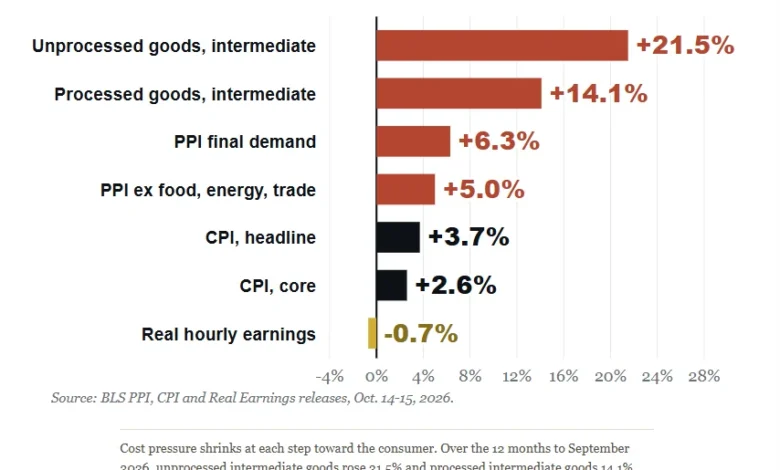
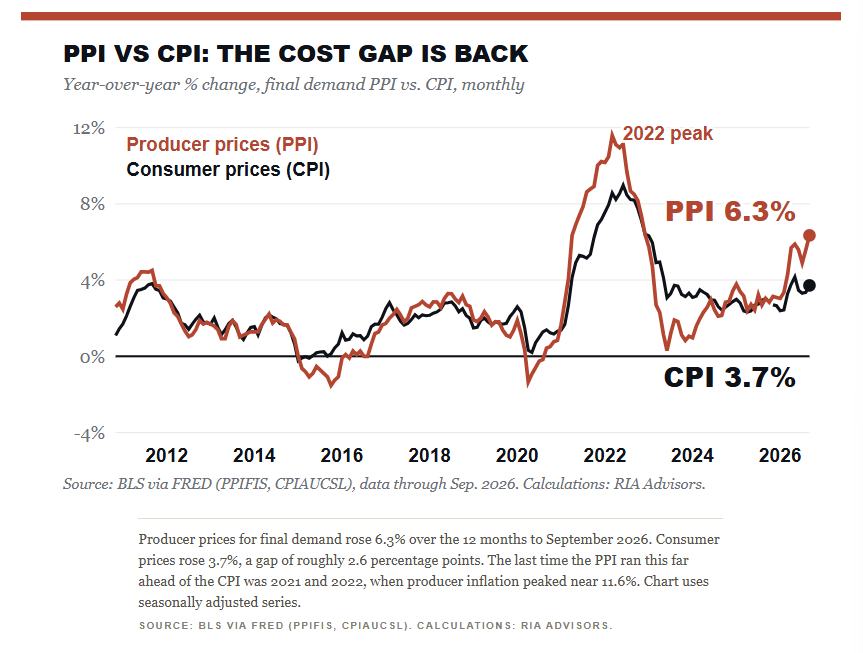
Financial markets have long focused on the headline Consumer Price Index (CPI) to gauge the trajectory of American inflation, frequently overlooking the critical signals emanating from the Producer Price Index (PPI). Recent economic data reveals a stark and potentially destabilizing divergence between wholesale and retail inflation metrics. While the headline CPI has printed at a relatively contained 3.7%, the PPI for final demand surged 1.3% in a single month—representing its largest single-month jump since March 2022—pushing the annual wholesale inflation rate to 6.3%.
This growing chasm between what producers pay for inputs and what consumers pay at the checkout counter has created the widest PPI-versus-CPI gap since 2022. Historically, this dynamic serves less as a conventional inflation warning and more as an urgent alert regarding corporate profit margins. With corporate America currently operating against a backdrop of historic profitability, economists and market analysts are increasingly questioning whether businesses can continue to absorb soaring input costs or if a painful margin squeeze is imminent.
Understanding the Divergence: PPI Versus CPI
To comprehend the implications of this macroeconomic shift, analysts must distinguish between the two primary inflation indicators. The CPI acts as a lagging or coincidental measure of consumer purchasing friction, tracking the end-user price of a standardized basket of goods and services. Conversely, the PPI measures the average changes in selling prices received by domestic producers for their output. Intermediate stages of the PPI further track the expenses businesses incur for raw materials, energy, and components.
In essence, the PPI captures the cost side of the corporate income statement, whereas the CPI reflects the revenue side for consumer-facing entities. When producer prices begin to outpace consumer prices, a financial bottleneck is created. Businesses along the supply chain are forced to make a difficult choice: absorb the additional expenses to protect sales volumes or pass the costs onto consumers who are already grappling with constrained purchasing power.
A historical review of the data highlights that these two metrics generally track in tandem during periods of economic stability. Meaningful divergences typically occur during major macroeconomic shocks. For instance, the collapse of global oil prices in 2015 and 2016 reduced producer costs faster than retail prices, providing a substantial tailwind for corporate margins. Conversely, the inflationary spike of 2021 and 2022 exerted immense pressure on businesses. While the current gap is narrower than the peak observed in 2022, it is widening from a significantly higher baseline of corporate profitability, altering the financial arithmetic for public companies.
The Overloaded Price Pipeline and Energy Shocks
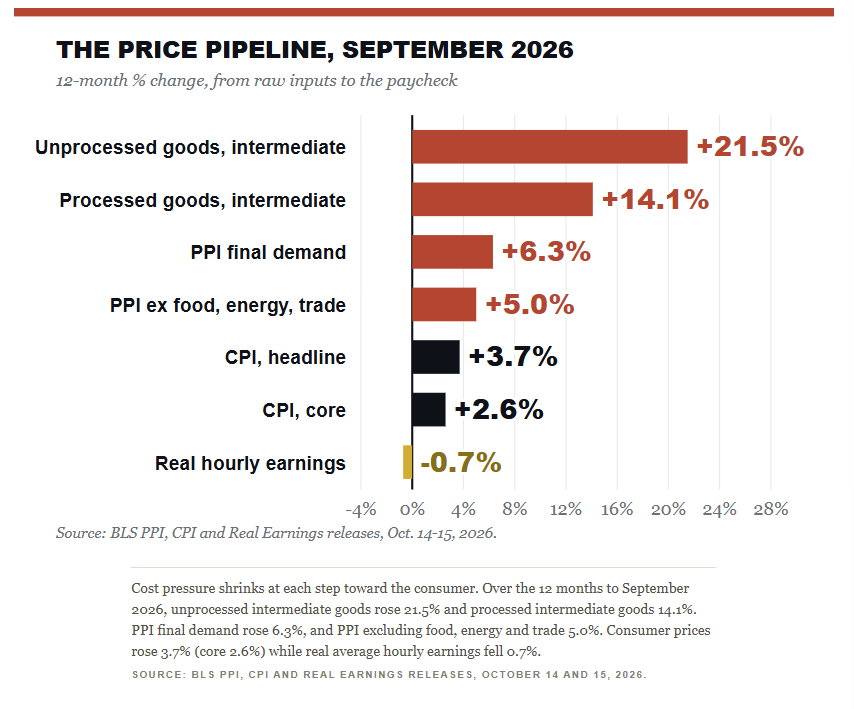
A closer examination of the production pipeline indicates that headline figures understate the underlying cost pressures. The PPI is constructed across multiple stages of processing, revealing how price increases cascade from raw commodities to finished goods. According to data from the U.S. Bureau of Labor Statistics, prices for processed goods for intermediate demand rose by 14.1%, while the index for unprocessed goods for intermediate demand jumped by a staggering 21.5%.
This sequential progression tells a clear economic story. Raw input costs have escalated by more than 20%, but by the time these expenses navigate refiners, manufacturers, freight carriers, and retailers to reach consumer shelves, retail inflation remains below 4%. This discrepancy confirms that a substantial portion of the financial burden is being absorbed internally by businesses situated between the raw input stage and the retail counter.
Energy volatility has served as the primary catalyst for these recent pressures. Final demand energy prices escalated by 10.8% in a single month, driving up gasoline station sales by 6.4%. Such energy shocks reverberate simultaneously through every sector of the economy—influencing fuel, freight, chemical processing, and packaging long before the end consumer encounters the higher price tag.
Economists emphasize the structural difference between "good inflation" and "bad inflation." Good inflation is typically demand-driven and accompanied by rising real wages, allowing consumers to comfortably absorb higher prices. Bad inflation, conversely, stems from supply shocks and rising input costs without a corresponding increase in household purchasing power. When bad inflation takes hold, it eventually destroys the demand upon which it relies, setting the stage for potential contractions in corporate earnings.
Wall Street Optimism Versus Macroeconomic Reality
Despite mounting cost pressures throughout the supply chain, equity analysts maintain historically high expectations for corporate earnings. According to data compiled by FactSet for the third-quarter reporting season, blended S&P 500 earnings growth reached 30.2%, with expectations centered around 28.4% for the fourth quarter and 32.9% for the full calendar year.
Furthermore, FactSet reported that the net profit margin for the S&P 500 reached a record 17.0% in the second quarter, followed by a projected 14.9% in the third quarter—the second-highest level recorded since tracking began in 2009. Macroeconomic data corroborates this high-water mark for profitability, showing that after-tax corporate profits reached 13.1% of Gross Domestic Product (GDP) in the second quarter, nearly double the long-run historical average of 7.4 maintained since 1947.

Contrarian analysts, however, view this widespread optimism with caution. Consensus projections that assume pricing margins will remain near record highs while input costs run at double-digit rates rely on the assumption that companies can seamlessly transfer these expenses to end-users. This assumption becomes increasingly tenuous when evaluated against consumer wage data. Real average hourly earnings fell by 0.7% over the course of the year, leaving households with limited financial flexibility. When retail sales figures are adjusted to exclude volatile gasoline purchases, consumer spending growth slows to a marginal 0.2%, indicating that fuel costs have accounted for the majority of recent retail revenue gains.
Historical Precedents: When Margins Meet Reality
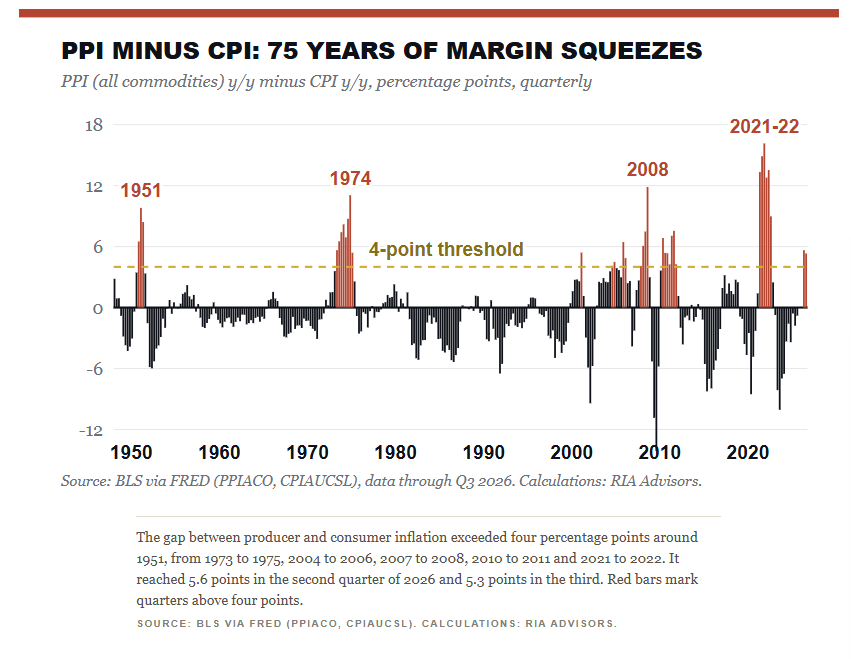
To evaluate the potential trajectory of profit margins, researchers have examined historical periods where producer inflation significantly outpaced consumer inflation. Analysis of long-run PPI and GDP data reveals that wide PPI-CPI gaps have frequently preceded contractions in the corporate profit share of GDP.
In four out of six major historical episodes where producer inflation substantially exceeded consumer inflation, the corporate profit share of GDP fell by one to four percentage points within a two-year window. The specific periods that avoided this margin compression—notably 2004–2006 and 2010–2011—shared a defining characteristic: consumers possessed robust financial support to absorb higher costs. In the mid-2000s, this spending was sustained by mortgage equity withdrawals, while the post-2009 recovery was supported by improving employment and central bank liquidity programs.

These historical patterns suggest that a widening PPI-CPI gap does not automatically destroy profit margins on its own. Rather, it compresses margins when end consumers lack the real income required to sustain higher price points.
Broader Implications and Strategic Outlook for Investors
The ongoing divergence between wholesale and intermediate price pressures and stagnant real wages presents a complex environment for institutional and retail investors alike. With the 10-year Treasury yield trading near 4.9%, investors possess a viable alternative to equity valuations that price in the permanence of peak profit margins.
Market strategists advise close monitoring of corporate earnings guidance rather than headline earnings "beats," which have frequently relied on lowered consensus expectations. During earnings calls, executive commentary regarding freight, energy, and raw material expenses will provide clearer insight into how fourth-quarter margins are expected to perform. Furthermore, downward revisions to future earnings estimates often precede official confirmation of margin compression in financial statements.
Ultimately, the persistent gap between the Producer Price Index and the Consumer Price Index signals that corporations are currently absorbing expenses that their customer base cannot sustainably afford. As record-high profit margins leave diminishing room for additional cost absorption, the macroeconomic resolution of this gap will likely depend on whether consumer wage growth can catch up to the elevated price pipeline—or if corporate earnings will face a necessary and historical reversion.