How AI Wealth Advisors Are Uncovering Hidden Portfolio Risks and Reshaping Personal Finance


The integration of artificial intelligence into wealth management has reached a new milestone as retail investors increasingly leverage advanced algorithmic tools to audit complex portfolios. Recent deployment data from AI-driven financial platforms indicate that automated portfolio X-rays are frequently identifying significant, uncalculated asset concentrations stemming from overlapping exchange-traded funds (ETFs) and mutual funds. This phenomenon, which often leaves investors vulnerable to unexpected market corrections, has brought algorithmic wealth advisory tools to the forefront of modern financial planning.
The Evolution of Automated Portfolio Auditing
For decades, individual investors managing multi-account net worths across various institutions—including rollover IRAs, 401(k)s, SEP IRAs, and taxable brokerages—have relied on static dashboards and manual calculations to track asset allocation. Traditional financial software typically provides a high-level summary of holdings, categorizing assets by broad classes such as equities, fixed income, and cash. However, these conventional interfaces often fail to calculate true single-stock exposure when an investor holds broad-market index funds alongside individual equities.
Algorithmic wealth advisory platforms, such as the SEC-registered platform Mezzi, utilize natural language processing and deep database integrations to scan multiple financial institutions simultaneously. By performing a comprehensive "Diversification X-ray," these systems evaluate underlying assets within ETFs—such as the heavy weighting of mega-cap technology stocks within S&P 500 index funds—and aggregate them with direct stock ownership. This capability addresses a fundamental blind spot for investors whose mental accounting is anchored to historical purchase prices or simplified portfolio views.
Case Study: Uncovering Hidden Equity Exposure

A prominent example of this technological application involves a long-term equity investor who utilized an AI-powered advisory platform to conduct a comprehensive portfolio audit. The investor, holding a complex net worth spread across more than 40 financial accounts, initially estimated individual holdings in a major technology conglomerate—specifically Alphabet Inc. (Google)—to be between $900,000 and $1,000,000.
Upon connecting all equity portfolios to the AI advisory platform, the system revealed a true exposure level of approximately $1.3 million. The discrepancy was attributed to cumulative ETF overlap; because the S&P 500 index contains a significant allocation to the technology firm, index funds held across multiple retirement and taxable accounts quietly compounded the investor’s direct share ownership.
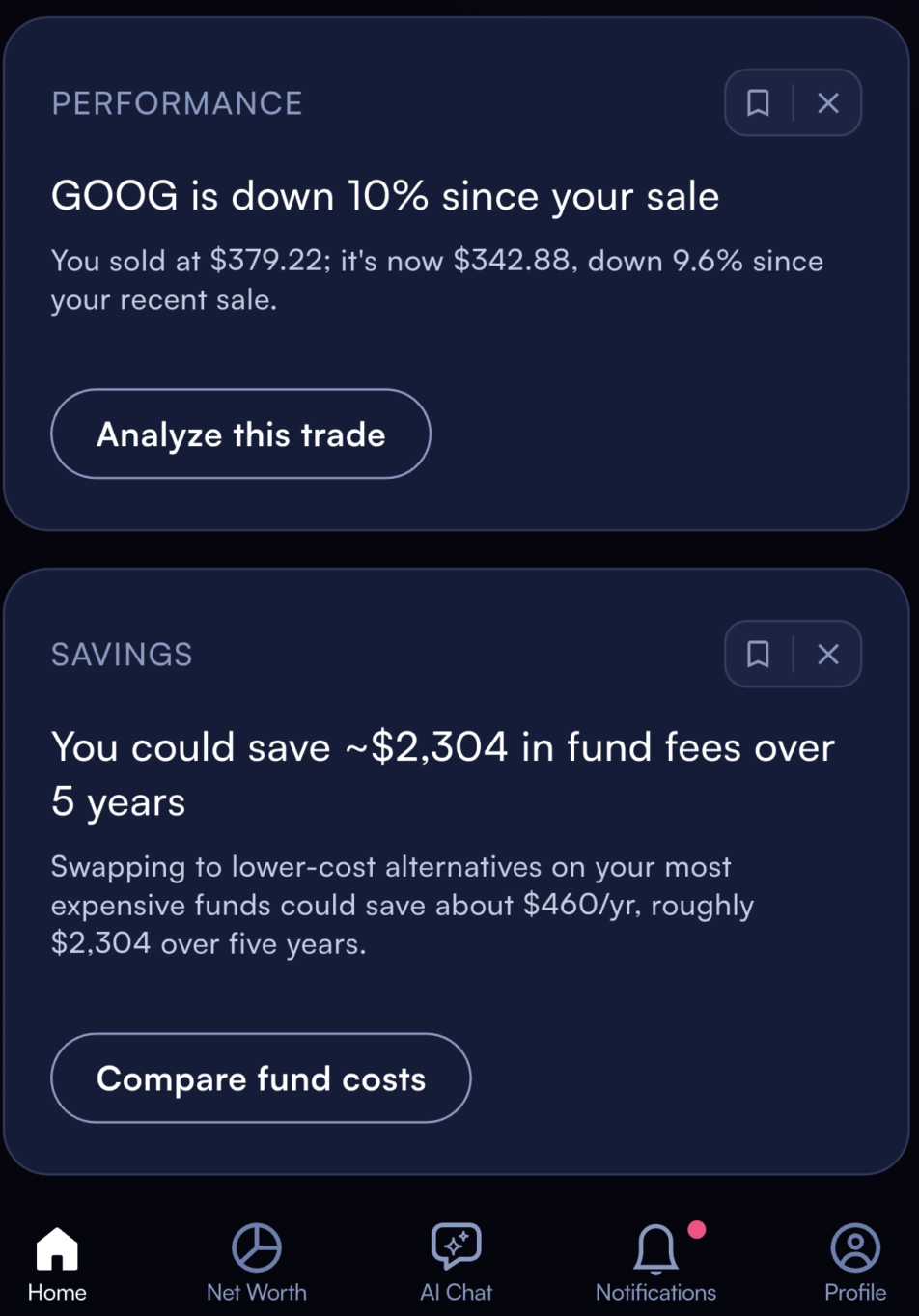
Acting on the platform’s recommendation to rebalance and reduce individual equity concentration, the investor executed a series of adjustments in tax-advantaged accounts, selling a portion of the concentrated position and systematically reinvesting the proceeds into broader market indexes. Weeks after the rebalancing occurred, the target equity experienced a sharp market correction driven by high-profile executive departures and broader sector volatility, effectively shielding the portfolio from substantial drawdowns. Financial analysts note that while market timing remains inherently unpredictable, automated risk exposure management allows investors to mitigate downside volatility by identifying systemic concentration risks before they materialize.
Behavioral Economics and the Role of Automated Reminders
Beyond raw asset aggregation, financial technologists emphasize the psychological benefits of automated wealth advisors. Behavioral finance research consistently demonstrates that investors are prone to cognitive biases, such as loss aversion and the "ostrich effect"—the tendency to ignore underperforming assets because monitoring them invokes negative emotions.
Standard portfolio tracking tools require proactive user engagement, meaning investors frequently review winning positions while neglecting stagnant or declining assets. AI-driven financial assistants function as continuous monitors, capable of flagging divergent performance metrics, tax-loss harvesting opportunities, and valuation anomalies without requiring manual prompts. For instance, automated systems can analyze historical transaction data to surface accurate cost bases for long-held value traps or cyclical equities, enabling more precise execution of tax-loss harvesting strategies designed to offset long-term capital gains.
Regulatory Frameworks and Industry Adoption
As the market for automated financial planning tools expands, regulatory scrutiny remains a critical factor. Platforms operating as digital wealth advisors or AI investment assistants are generally required to register with the Securities and Exchange Commission (SEC) or state regulatory bodies, depending on their operational scope and fee structures. SEC registration mandates adherence to fiduciary standards, ensuring that algorithmic recommendations align with established compliance frameworks regarding client best interests.
Industry observers note that the maturation of financial technology startups—particularly those with multi-year operational histories and robust data security protocols—is accelerating institutional and retail adoption. Distribution channels are shifting as fintech firms partner with established financial commentators and thought leaders to educate consumers on portfolio transparency. Furthermore, integration with modern banking APIs allows these platforms to monitor not only public equities and fixed income but also real estate holdings, private equity investments, cash equivalents, and revolving credit liabilities, providing a holistic balance sheet view previously accessible only through high-net-worth private banking services.
Broader Market Implications and Future Outlook
The rise of conversational, interactive wealth management applications signals a transition from passive financial tracking to active, query-based portfolio interrogation. Rather than interpreting complex tables and percentage allocations independently, users can interact with financial datasets using natural language queries—asking specific questions regarding tax liabilities, dividend yields, advisory fees, and sector weightings.
As these technologies continue to integrate machine learning models trained on vast financial datasets, industry analysts project increased adoption among retail investors managing complex, multi-generational wealth. While human financial planners retain a distinct advantage in complex estate planning, behavioral coaching, and bespoke tax structuring, AI-driven advisory layers are filling a vital operational gap by providing continuous, granular oversight of multi-institution balance sheets. This technological shift underscores a broader industry trend toward radical transparency, equipping everyday investors with analytical capabilities historically reserved for institutional asset managers.