Navigating Capital Calls and Post-FIRE Venture Capital Risks in an Era of Artificial Intelligence

The intersection of early retirement, aggressive venture capital deployment, and the looming economic disruptions of artificial intelligence has sparked intense debate among modern financial commentators. Following a series of candid disclosures regarding a temporary cash crunch at age 49—stemming from a relentless wave of private market capital calls—financial analysts and retail investors alike have scrutinized the mechanics of post-Financial Independence, Retire Early (FIRE) liquidity management. While critics argue that heavy exposure to private equity and venture capital introduces reckless volatility at the top of market cycles, proponents contend that structured illiquidity serves as an essential psychological and financial safeguard against market panics and generational wealth erosion.
The Anatomy of a Liquidity Crunch
The core debate centers on the distinction between a liquidity problem and a solvency problem. A solvency deficit implies a terminal lack of net worth relative to liabilities, often culminating in severe distress such as mortgage foreclosures or bankruptcy. Conversely, a liquidity deficit describes a temporary mismatch between short-term cash outflows and readily accessible capital, a condition that frequently manifests during periods of high-frequency capital calls in private equity portfolios.

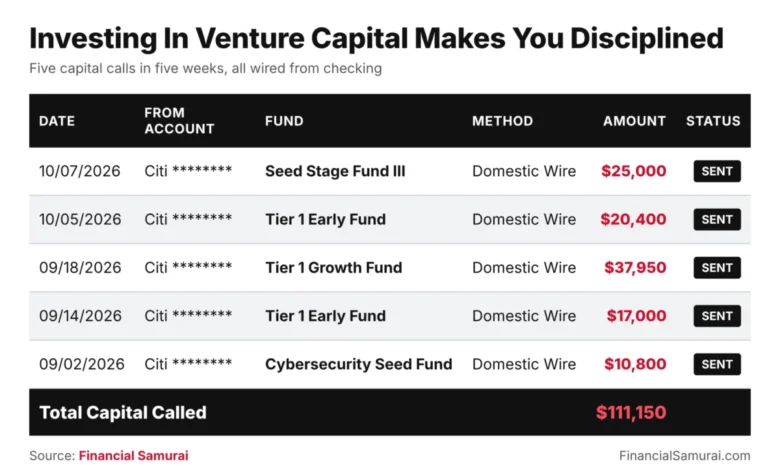
Recent transaction logs highlight the ferocious pace at which venture funds can demand capital. In a notable five-week window, an aggregate of $111,150 was transferred across five separate capital calls to private venture funds. For individuals who have exited the traditional labor force, such obligations frequently outpace combined passive and digital income streams.
This phenomenon is not isolated to retirees. Even high-earning professionals, such as managing directors at major investment banks earning nominal base salaries alongside heavily deferred and taxed bonuses, often experience significant cash flow constraints. High state tax withholding rates, combined with multi-year vesting schedules for deferred cash and stock, mean that paper wealth rarely translates directly into immediate liquidity. Consequently, unexpected capital call clusters force retirees and conservative investors to confront severe cash flow management challenges.
Venture Capital Allocation Strategy Post-FIRE
For investors who achieved financial independence prior to the mainstream acceleration of generative artificial intelligence, the macroeconomic landscape has shifted dramatically. Supplemental retirement income streams face unprecedented headwinds as automated systems challenge traditional consulting, creative, and administrative labor markets. To combat inflationary pressures and secure long-term capital preservation, a subset of retired investors has turned toward aggressive alternative asset allocation.

To mitigate catastrophic risk while pursuing alpha, institutional and experienced retail investors typically employ strict portfolio ring-fencing. Standard risk management frameworks in this sector generally dictate specific structural boundaries:
- Private Market Caps: Limiting private investments—including venture capital, venture debt, and angel syndicates—to a maximum of 20% of total investable capital.
- Total Equity Exposure: Restricting combined private and public equity exposure to no more than 50% of overall net worth to curtail portfolio volatility.
- Top-Tier Fund Selection: Directing capital exclusively toward top-tier venture managers, given historical data demonstrating that the majority of venture funds fail to consistently outperform major public benchmarks like the S&P 500 or the NASDAQ composite.
By ring-fencing a distinct fraction of net worth for high-risk private placements, investors attempt to insulate the remaining 80% of their capital from emotional, reactionary trading during broader economic downturns.
The Psychology of Capital Calls and Forced Discipline
Behavioral finance research consistently indicates that individual investors represent the single greatest risk to their own portfolios during market corrections. The psychological friction associated with public market investing—where executing a sale requires nothing more than a single tap on a mobile device—frequently leads to panic selling at market bottoms.
Venture capital and private equity structures fundamentally alter this dynamic through enforced illiquidity. General partners typically deploy committed capital gradually over a three-to-five-year horizon. Consequently, capital calls continue unabated regardless of prevailing market sentiment, forcing investors to acquire assets at lower valuations during macroeconomic contractions even when personal risk aversion dictates hoarding cash.
Furthermore, proponents of private market investing highlight the psychological utility of long-term capital commitment. For parents navigating the uncertainty of an AI-driven economic future, committing capital to high-growth private enterprises functions as a multi-decade hedge. The short-term discomfort of maintaining tight household budgets is counterbalanced by the anticipation of liquidity events occurring precisely as the next generation reaches adulthood and enters the workforce.
Broader Economic Implications and Industry Reactions
The aggressive deployment of capital into venture funds—particularly within artificial intelligence, deep tech, and enterprise software—reflects broader systemic trends in private markets. Industry observers note that an abundance of institutional and high-net-worth liquidity chasing a finite number of high-quality startup deals has driven valuations upward, necessitating larger fund sizes to maintain competitive positioning.

However, this environment has also amplified socioeconomic anxieties. Public commentary from prominent artificial intelligence executives regarding the large-scale displacement of white-collar and knowledge-based labor has ignited fierce pushback from families and labor advocates. Economists and financial planners suggest that this friction underscores a widening divergence between the speculative windfalls enjoyed by technology creators and the defensive financial positioning required by households seeking to safeguard their children’s future economic mobility.
Portfolio Drift and Risk Profile Management
Financial advisors emphasize the necessity of periodic portfolio audits to combat structural asset allocation drift. Over extended periods of rising public equity markets, unmanaged portfolios can organically shift from conservative allocations—such as traditional balanced models—into aggressive risk profiles without any direct intervention from the investor.
Experts recommend utilizing comprehensive analytical tools and professional consultations to stress-test asset distribution against potential macroeconomic downturns. Ensuring that liquidity reserves align with actual cash flow requirements remains paramount, particularly for retirees and early retirees who lack a continuous W-2 income stream to absorb unexpected capital demands. Ultimately, navigating the tension between aggressive wealth accumulation and capital preservation requires a disciplined framework capable of withstanding both market volatility and the shifting paradigms of the modern global economy.