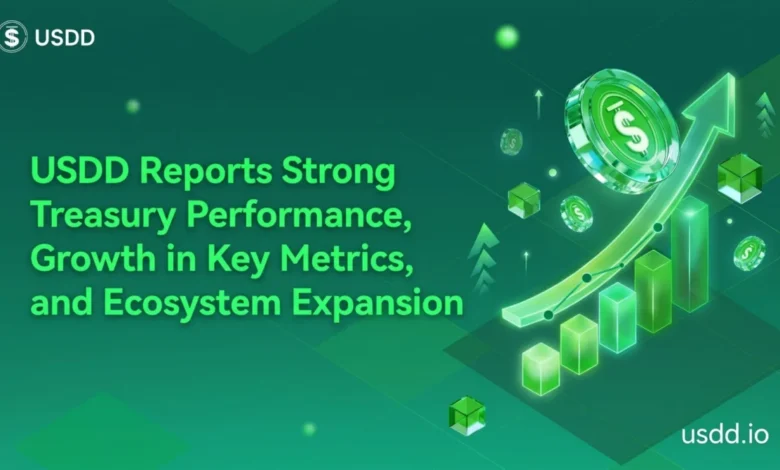
USDD Reports Record-Breaking Q3 2026 Financial Performance, Surpassing $1.48 Billion in Circulating Supply and Expanding Multichain Utility

The decentralized finance sector has experienced a profound evolution in how algorithmic and overcollateralized stablecoins manage capital efficiency, treasury health, and multichain interoperability. Amid this broader industry transformation, the decentralized stablecoin protocol USDD has released its comprehensive financial and operational report for the third quarter of 2026. Highlighting a period of robust expansion, the data underscores significant milestones achieved across global treasury revenues, circulating supply metrics, Total Value Locked (TVL), and strategic ecosystem integrations. As decentralized assets increasingly vie for market share against centralized counterparts, USDD’s latest performance metrics offer a revealing look into the mechanisms driving sustainable yield generation, cross-chain utility, and user adoption across major blockchain networks including TRON, Ethereum, and BNB Chain.
Comprehensive Financial Performance and Q3 2026 Treasury Insights
At the core of USDD’s recent announcements is an unprecedented financial performance during the third quarter of 2026. According to the official protocol disclosures, USDD generated $9.70 million in treasury revenue during Q3, representing a notable quarter-over-quarter increase of 26.7%. Concurrently, the protocol’s total treasury balance crossed a critical psychological and financial threshold, exceeding $30 million for the first time in its operational history to close at $31.24 million.
Financial analysts monitoring the protocol attribute this substantial growth primarily to the performance of Smart Allocator, USDD’s automated on-chain asset allocation and management system. During Q3 alone, the Smart Allocator engine was responsible for generating $9.11 million in income. By dynamically deploying capital reserves across carefully vetted decentralized finance (DeFi) strategies, the Smart Allocator exemplifies a modern approach to sustainable, protocol-owned liquidity management. Furthermore, the protocol has maintained a strict adherence to on-chain transparency, allowing market participants, researchers, and token holders to independently verify treasury allocations, yield generation pathways, and asset distribution in real-time via public dashboards.
Market Capitalization Surges Amid Competitive Stablecoin Landscape
The broader market presence of USDD experienced a sharp acceleration during the middle of October 2026. Data compiled in a joint market research publication by the RWA Foundation and Token Terminal revealed that USDD recorded the single largest market capitalization expansion among the top ten global stablecoin issuers during the week of October 12 to October 19, 2026.
During this concise seven-day window, USDD’s market capitalization surged by $180.3 million. This singular expansion accounted for approximately 40 percent of the combined $449.1 million growth registered by the top ten stablecoin projects collectively. To contextualize this growth within the competitive landscape, competing stablecoin protocol Sky secured the second position with an expansion of $86 million, while United Stables recorded a more modest growth of $22.8 million.
This short-term surge translated into broader long-term metrics. By October 29, 2026, USDD’s total circulating supply had successfully surpassed the $1.48 billion mark, cementing its status as the preeminent decentralized stablecoin operating within the TRON network ecosystem. Simultaneously, the protocol’s Total Value Locked (TVL)—representing the aggregate value of collateral and assets supporting the ecosystem—reached a formidable $2.18 billion.
Multichain Expansion Strategy: TRON, Ethereum, and BNB Chain
While USDD originated and maintains its deepest liquidity roots within the TRON network, the protocol’s long-term roadmap has heavily emphasized a deliberate multichain expansion strategy. By extending operations to Ethereum and the BNB Chain, the protocol has sought to capture liquidity and onboard users native to disparate blockchain environments.
As of late October 2026, Ethereum plays a critical role in this multichain architecture. Out of the total circulating supply of $1.48 billion, approximately $329.94 million—representing roughly 22.3 percent—resides on the Ethereum blockchain. This cross-chain distribution enables holders to access complex Ethereum-based decentralized applications, lending markets, and automated market makers without being restricted to a single layer-1 network. Similarly, integrations across the BNB Chain have exposed USDD to alternative high-throughput retail and institutional liquidity pools.
Industry observers note that this multichain deployment is not merely an exercise in availability, but a structural necessity for modern stablecoins aiming to serve as universal mediums of exchange and yield-bearing instruments across the fragmented Web3 landscape.
Deepening DeFi Integrations and Earning Mechanisms
Beyond raw capitalization figures, USDD has aggressively pursued ecosystem partnerships designed to enhance the practical utility and yield-generating capacity of the asset for end-users. The introduction of USDD Earn, for instance, allows participants to deposit native USDD and receive sUSDD in return. This mechanism currently establishes a competitive base Annual Percentage Yield (APY) of 4 percent, accompanied by flexible withdrawal terms and an absence of rigid lock-up periods.
To broaden distribution and accessibility, USDD has established strategic integrations with major gateway platforms such as Binance Wallet and Gate DEX. These partnerships have been complemented by targeted ecosystem initiatives, including promotional campaigns like TRON DeFi Summer, which are designed to incentivize liquidity provision and trading volume. For advanced market participants seeking higher risk-adjusted returns, the protocol has integrated with sophisticated yield-layering protocols such as Pendle and Morpho, enabling specialized lending and looping strategies.
However, financial advisors and protocol developers consistently remind users that while these advanced DeFi configurations maximize potential earnings, they also introduce complex smart contract and market risks, necessitating careful risk management by individual participants.
Reducing Friction: GasFree Transfers and Network Fee Innovations
A persistent bottleneck in the mainstream adoption of digital stablecoins has been the friction and cost associated with transaction gas fees. Traditionally, users executing stablecoin transfers on networks like TRON were required to hold native tokens—such as TRX—exclusively to pay for network compute costs. USDD has actively addressed this pain point through structural payment integrations with GasFree and TokenPocket.
Introduced in August 2026, the GasFree integration allows users to execute USDD transfers and pay the associated transaction fees directly in USDD, eliminating the mandatory requirement to hold underlying network gas tokens. Wallets supporting this native fee abstraction model currently include TronLink, Guarda, Klever Wallet, and eDir. Comparative on-chain data indicates that USDD transfers facilitated via GasFree cost approximately 0.5 USDD per transaction, offering a cost-effective alternative to standard USDT transfers on the same network, which have historically averaged around 1.5 USDT under comparable conditions.
Complementing this, the TokenPocket integration has similarly positioned USDD as a primary network fee payment option. Through initiatives like TokenPocket’s Gas Boost Season campaign—which offered a temporary 50 percent gas fee subsidy for users opting to settle network fees in USDD—the protocol has successfully lowered operational costs for active traders and everyday participants. These friction-reducing measures have transformed USDD from a purely speculative or passive store of value into a highly practical medium for wallet-to-wallet settlements and micro-transactions.
Implications and Future Outlook for Decentralized Stablecoins
The third quarter of 2026 marks a watershed moment for USDD, illustrating how overcollateralized decentralized stablecoins can achieve both aggressive market penetration and strict financial sustainability. By coupling a $9.70 million quarterly treasury revenue with a diversified multichain footprint spanning TRON, Ethereum, and BNB Chain, the protocol has insulated itself against single-network downturns while capturing diverse revenue streams.
Looking forward, the sustained trajectory of USDD will depend heavily on prevailing macroeconomic conditions within the digital asset markets, regulatory developments concerning algorithmic and overcollateralized stablecoins, and the continuous execution of its technological roadmap. Nevertheless, the combination of robust treasury reserves, innovative gas abstraction mechanics, and expanding DeFi utility positions USDD as a compelling case study in the maturity of decentralized monetary infrastructure. As the digital economy continues to demand stable, transparent, and high-utility financial instruments, protocols that successfully balance yield generation with risk mitigation and user-centric design will likely define the next era of global finance.
Related posts: