Industrial AI on the Factory Floor: Insights from Poka, ABB, and GE Vernova on Scaling Frontline Technology

For decades, digital transformation in manufacturing has promised a unified, data-driven operational landscape. Yet, despite trillions of dollars invested in digitized enterprise resource planning (ERP) systems, manufacturing execution systems (MES), and cloud data lakes, factory operators are frequently left piecing together fragmented information from isolated silos. Variances in legacy machinery, disparate plant-level workflows, and the generational knowledge gap of a retiring workforce continue to hinder the consistent application of operational insights across global manufacturing networks.
Recent academic literature underscores these persistent architectural hurdles. A 2026 study published in Data in Brief highlights inconsistent data-exchange standards as a primary structural barrier to seamless industrial interoperability. Simultaneously, comprehensive cybersecurity guidelines issued by the Australian Signals Directorate and allied international partners emphasize that robust operational technology (OT) security must be anchored directly in rigorous safety protocols and verified, localized operational knowledge rather than purely abstract IT paradigms.
As industrial organizations accelerate their adoption of artificial intelligence into physical workflows, engineering leaders face an unforgiving operational reality. They must successfully bridge disconnected data repositories while strictly adhering to the uncompromising safety and uptime requirements of physical production environments.
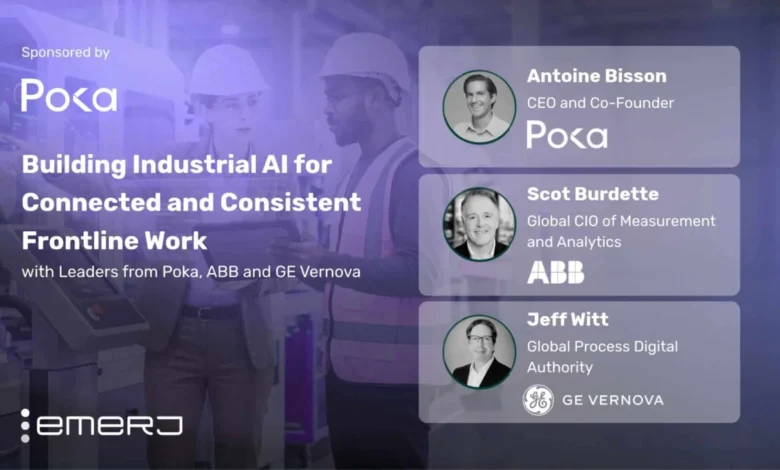
To examine how industrial leaders are navigating these critical constraints, Emerj recently convened top-tier manufacturing executives on the Emerj AI in Business Podcast. The high-profile panel featured Antoine Bisson, CEO and Co-Founder at Poka (recently acquired by industrial software giant IFS); Scot Burdette, Global CIO of Measurement and Analytics at ABB; and Jeff Witt, Global Process Digital Authority at GE Vernova.
Their overarching consensus dismantled a prevalent misconception in enterprise technology: industrial AI cannot simply mirror generic enterprise AI tools trained on office productivity workloads. Instead, industrial AI must be architecturally purpose-built around frontline operators, safety-first governance frameworks, and the complex, messy realities of physical manufacturing assets.
Chronology and Background of Industrial AI Integration
The journey toward modern industrial artificial intelligence has evolved through distinct phases over the past twenty years. In the early 2010s, the "Industrial Internet of Things" (IIoT) wave focused heavily on sensorization, data capture, and predictive maintenance dashboards. However, these early initiatives frequently resulted in alert fatigue, as engineers were inundated with telemetry data detached from human context.
By the early 2020s, cloud computing and advanced machine learning models began offering deeper analytical capabilities. Yet, enterprise IT architectures often struggled to penetrate the operational technology layer due to cybersecurity risks and network isolation policies.
The current landscape—spanning 2025 and 2026—marks a definitive pivot toward AI-native software solutions embedded directly into frontline workflows. Industry milestones underscore this shift: Poka’s strategic evolution under Antoine Bisson, transitioning from co-founder and CTO to Chief AI Officer in 2025 and subsequently CEO in 2026, reflects a broader market demand for software platforms specifically designed to ingest shop-floor realities and translate them into governed, actionable guidance. Concurrently, veteran operational leaders like ABB’s Scot Burdette and GE Vernova’s Jeff Witt are spearheading digital blueprints that prioritize standardization, edge computing, and ergonomic human-machine collaboration over speculative automation.
Designing Purpose-Built Industrial AI for Controlled Physical Operations
Unlike corporate administrative environments where an erroneous software prompt results in a minor document revision, manufacturing errors carry severe consequences. On a factory floor, incorrect guidance or mismanaged equipment settings can trigger catastrophic downtime, extensive equipment damage, or severe worker injuries. Consequently, governance and safety cannot be treated as post-deployment software patches; they must be foundational pillars baked into the core architecture of industrial AI systems.
Antoine Bisson emphasizes that commercial viability in the industrial sector hinges entirely on tangible, risk-managed value creation.
"It cannot be some fluff; it cannot be just AI, AI, AI," Bisson explains. "It needs to be tangible; it needs to be providing something that is concrete to the customer. Even if it takes more time to go to market, I’d rather do this and provide real value that is governed, that is safe, and safety is also a really key topic here."
This safety imperative dictates strict control over what data frontline workers can access and how generative AI models are permitted to formulate responses. Furthermore, the physical network topology of manufacturing plants imposes hard technical limits. Jeff Witt of GE Vernova points out that critical shop-floor equipment is deliberately air-gapped or isolated from external enterprise networks to mitigate cyber threats.
For real-time applications involving active process control or asset management, organizations cannot rely exclusively on remote cloud infrastructure. Instead, architectures must leverage edge computing—running localized models physically closer to the machinery to ensure ultra-low latency and uninterrupted operation even during network partitions.
Crucially, industrial AI governance draws a hard operational boundary between recommending an action and executing it. While generative interfaces can automatically log an issue, suggest root causes, or draft maintenance tickets, automatic equipment adjustments remain strictly regulated. Bisson notes that autonomous machine reconfiguration is only viable as a downstream capability, permissible strictly under conditions of previously validated pattern recognition combined with mandatory human verification and sign-off.
Bridging Connected Operational Data and Context-Specific Guidance
Data connectivity is meaningless without contextualization. A machine alert indicating a temperature spike is abstract telemetry until it is instantly correlated with the specific product batch running on the line, the upstream maintenance history of the asset, the ambient operating conditions, and the exact skill level of the machine operator on duty.
Scot Burdette of ABB highlights this complexity within high-precision, manufacture-to-order environments. In these workflows, product specifications shift dynamically with every single customer order, and consecutive production stages are often managed by entirely different shifts and teams. Seamless cross-functional communication and intuitive access to relevant operational documents are prerequisites for maintaining quality and throughput.
Moreover, Burdette connects data access directly to workforce enablement. Local plant teams must be thoroughly equipped not only to retrieve digital information but to accurately interpret and apply it within their specific tasks. Cross-training, standardized workflow modeling, and institutional knowledge-sharing ensure that raw data translates into competent frontline execution.
Jeff Witt illustrates this necessity through standard shop-floor troubleshooting. When a machine fault occurs, an experienced operator inherently brings localized awareness to the situation—knowing the quirky behavior of a specific pump, the recent shifts in material quality, and the immediate environmental factors. If an AI assistant provides a generic, one-size-fits-all diagnostic response that ignores these localized variables, it instantly loses the trust of the frontline worker. Trust, once broken on the factory floor, is exceedingly difficult to regain.
To combat this, leading manufacturers are mapping the lifecycle of plant floor issues from detection to resolution:
- Automated anomaly detection captures raw machine telemetry.
- Integrated AI layers ingest contextual data, including machine state, asset history, and operator identity.
- Tailored, asset-specific troubleshooting steps are delivered instantly to the worker’s interface.
- Human operators assess, execute, and validate the corrective action.
- System feedback loops capture the outcome to refine future model accuracy.
Workflow-Embedded Assistance and Frontline Usability
Deploying sophisticated algorithms yields zero return on investment if frontline workers reject the interface. Manufacturing personnel operating in high-tempo, physically demanding environments have little patience for clunky software that requires navigating multiple menus, opening separate chat windows, or manually inputting granular asset metadata.
Burdette stresses that usability must precede complex performance metrics. Workers need intuitive tools that streamline, rather than encumber, their daily routines. For instance, when technicians encounter an unfamiliar diagnostic code in the field, modern workflow-embedded assistance allows them to access step-by-step diagnostic manuals instantly or connect seamlessly with a remote domain expert via live video and shared diagnostics.
Innovations in multimodal AI are also eliminating administrative friction during issue reporting. As Bisson highlights, instead of forcing operators to manually categorize an anomaly, attach multiple photos, and type lengthy descriptions across fragmented text fields, advanced tools now permit natural voice descriptions or single-touch image capture. The underlying AI automatically interprets the visual or auditory input, categorizes the issue, and drafts the preliminary maintenance record.
Furthermore, autonomous agent workflows can streamline supervisory oversight. If a production line experiences downtime exceeding a predefined threshold—such as 15 minutes—an autonomous agent can automatically generate an incident report, query historical data for potential root causes, and package the findings for shift supervisors. This preparation drastically accelerates response times while preserving human accountability for the ultimate operational decision.
Standardizing Workflows for Repeatable Multisite Deployment
A common pitfall in industrial digitalization is localized success that fails to scale. A predictive maintenance algorithm or digital work instruction platform that excels in a single pilot plant often encounters severe friction when deployed across a global manufacturing footprint comprising dozens of facilities with legacy equipment variations and localized cultural practices.
Bisson advocates for aggressive standardization as the natural next phase following plant-level digitization. By standardizing digital work instructions, core operating procedures, and essential skill matrices across disparate sites, manufacturers can transform isolated tribal knowledge into reusable enterprise assets.
Before introducing artificial intelligence into any physical workflow, Jeff Witt strongly advises establishing absolute process maturity through rigorous lean manufacturing principles.
"Has the process been fully documented? Has the process been optimized? Have we applied lean principles to this and taken all of the waste out of this process already?" Witt asks, emphasizing that automation should never be used to mask an inherently inefficient or broken process.
GE Vernova utilizes a standardized asset hierarchy—mapping data cleanly from enterprise division down to individual plant, production line, work cell, and specific physical asset (such as an industrial pump)—utilizing uniform data templates. While establishing this uniform data architecture demands significant upfront capital and engineering discipline, the long-term dividend compounds exponentially as subsequent AI and analytics applications plug effortlessly into the standardized framework.
Concluding Strategic Implications for Industrial Leadership
Evaluating and scaling industrial AI requires a disciplined, multi-step roadmap that balances technological capability with physical reality. Industry leaders are increasingly converging on a standardized deployment sequence:
- Conduct a comprehensive asset and data inventory to identify existing operational silos and missing telemetry gaps.
- Fully document, streamline, and optimize physical workflows using established lean manufacturing methodologies.
- Establish robust, secure data exchange standards and edge-computing architectures that respect operational security and network isolation.
- Implement purpose-built, workflow-embedded AI tools designed explicitly for frontline ergonomics and safety governance.
- Pilot solutions within controlled environments, gathering continuous user feedback via structured validation mechanisms.
- Standardize successful workflows and data templates to ensure seamless, repeatable scaling across global enterprise multisite operations.
By anchoring artificial intelligence in rigorous process optimization, uncompromising safety governance, and deep respect for the realities of frontline physical operations, industrial organizations can transition from fragmented digitization to truly scalable, AI-native manufacturing excellence.