Real Wages in 2026 Slip Below Zero, Forcing a Reckoning for Consumer Stocks and Household Budgets

By Lance Roberts
The modern American consumer finds themselves at a critical economic crossroads as real wages slide into negative territory for the first time in three years. While macroeconomic reports frequently highlight nominal wage increases and broader labor market metrics, the underlying reality for households tells a sharply divergent story. Driven primarily by escalating energy costs, the squeeze on purchasing power is bypassing traditional gross domestic product measurements and showing up immediately on Main Street, manifesting directly in the performance of consumer discretionary equities and retail earnings reports.

The disconnect between headline figures and individual financial wellness stems from a combination of persistent energy inflation, tightening credit conditions, and a cooling labor market. Financial analysts and market strategists are closely monitoring these developments as third-quarter corporate earnings roll in, seeking signals to determine how long households can maintain spending habits before a broader economic contraction takes hold.
The Divergence Between Nominal Growth and Real Purchasing Power
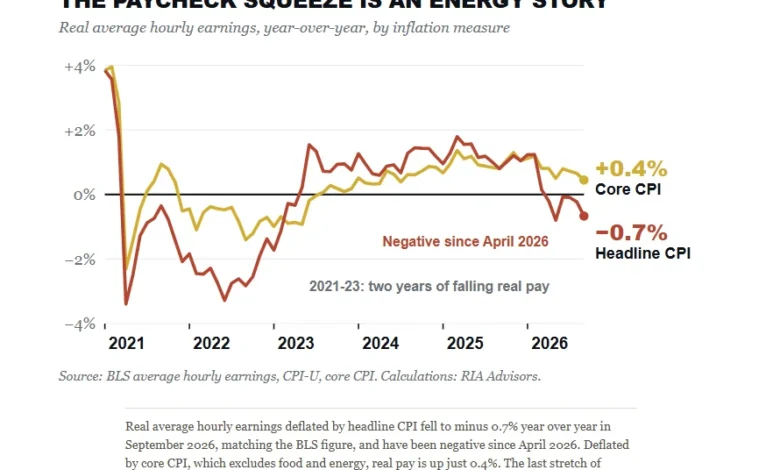
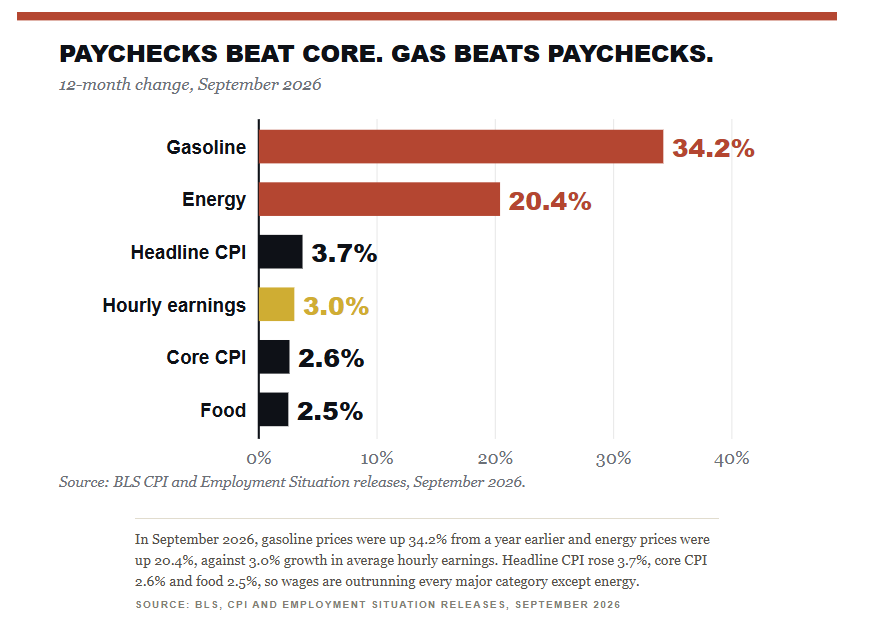
To understand the current strain on American households, one must examine the metrics released by the Bureau of Labor Statistics (BLS). Nominal average hourly earnings rose approximately 3.0% over a recent twelve-month period, a figure that economic optimists often cite as evidence of a robust labor market. However, when adjusted for inflation using the headline Consumer Price Index (CPI), the narrative shifts dramatically.
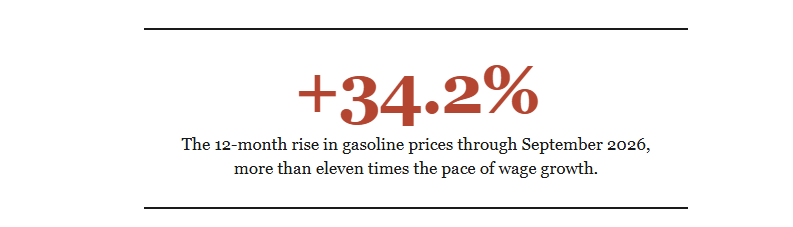
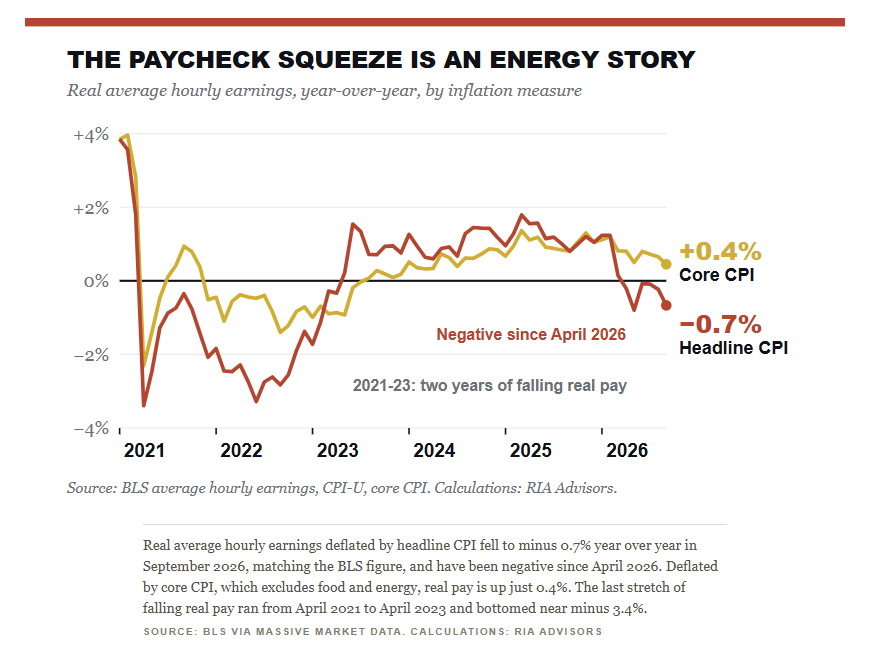
Real average hourly earnings fell 0.7% over the twelve months leading up to September, marking the most substantial decline since the spring of 2023. This contraction is fundamentally an energy story. Gasoline prices surged by 34.2% over the same timeframe, while the broader energy index climbed 20.4%. By contrast, food prices rose a modest 2.5%, and core CPI—which strips out volatile food and energy components—ran at a tamer 2.6%.
This dichotomy explains why economists and consumers view the economy through entirely different lenses. When deflated by core CPI, real wages appear to eke out a meager 0.4% annual growth rate. When deflated by headline CPI—representing the actual prices paid at the grocery register and the fuel pump—real pay has registered negative growth monthly since April. Households at the lower end of the income distribution, who spend a significantly larger portion of their disposable income on commuting and basic utilities, bear the heaviest burden of this energy tax.
Chronology of the 2026 Consumer Squeeze
The path toward negative real wage growth developed progressively across the year, marked by several key economic inflection points:
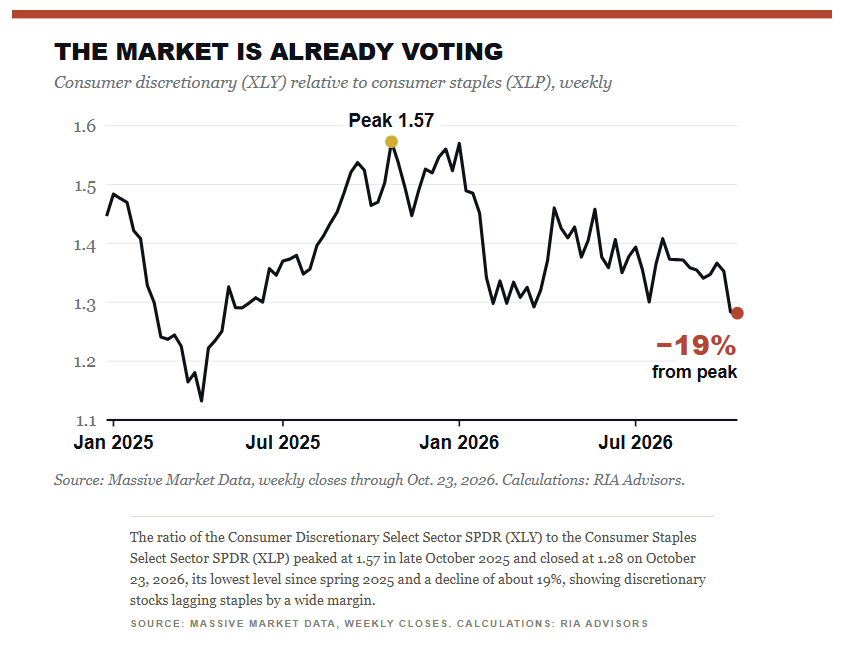
- Early 2025 to Late 2025: Consumer discretionary stocks reached a cyclical peak relative to consumer staples, buoyed by residual optimism and steady spending patterns.
- February 2026: The ratio between consumer discretionary and consumer staples equities began a notable breakdown, signaling that sophisticated market participants were repositioning portfolios ahead of visible inflationary pressures.
- Spring 2026: Geopolitical tensions impacting petroleum flows pushed Brent crude above $115 a barrel, subsequently driving headline CPI figures higher. Real hourly pay turned negative on a year-over-year basis in May, with headline inflation peaking at 4.2%.
- Summer 2026: Labor market momentum visibly cooled. The September jobs report revealed a meager payroll addition of just 29,000 jobs, alongside downward revisions for July. Job openings plateaued near 7.1 million, contrasting sharply with the multi-million openings recorded during the inflationary spike of 2022.
- Fall 2026: Real hourly earnings fell deeper into the negative, forcing households to rely more heavily on revolving credit lines and extended work hours to bridge the widening gap between income and expenses.
Workarounds, Debt, and the Limits of Consumer Resilience
When faced with declining real purchasing power, consumers rarely curtail spending instantaneously. Instead, they deploy tactical workarounds to maintain their standard of living. Economic data from late 2026 highlights three primary mechanisms households are utilizing to bridge the income deficit.
First, workers are logging additional hours. The average workweek expanded by approximately 0.6% compared to the previous year. While these extra hours temporarily buffered weekly earnings against inflationary pressures during the summer months, they proved insufficient by September as the energy tax compounded.
Second, consumers are maintaining spending velocity despite flat real disposable income. Real consumer spending outpaced income growth in late summer, driving the personal saving rate down to roughly 4.1%.
Third, households are increasingly turning to debt markets. Total credit card balances climbed to $1.26 trillion by the second quarter, with serious delinquency rates hovering near 7% annualized. Auto loan delinquencies have similarly remained elevated. Financial experts note that financing temporary living expenses with high-interest revolving debt creates a long-term structural drag on household budgets. Long after commodity prices stabilize, consumers remain burdened by compounding interest payments originating from routine expenditures like filling a gas tank.
Comparative Analysis: 2026 Versus 2022
Skeptics often point out that real wages experienced a much steeper decline in 2022—dropping by more than 3% at their worst point—without triggering an immediate collapse in consumer spending. However, market observers emphasize that the economic backdrop of 2022 offered distinct shock absorbers that are largely absent today.
In 2022, job openings exceeded 11 million, allowing workers to quickly change employment to secure higher wages. Furthermore, many households still retained a cushion of pandemic-era savings.
By contrast, the economic landscape of 2026 features a tighter labor market characterized by a 4.2% unemployment rate, minimal payroll expansion, and roughly 7.1 million job openings. Economists describe this environment as a "low hire, low fire" market. Because workers cannot easily leverage job mobility to offset inflation, a modest drop in real wages in 2026 carries more damaging psychological and financial repercussions than the larger percentage drop did four years earlier.

Corporate Reactions and Equity Market Implications
Wall Street has not waited for official gross domestic product reports to price in these pressures. The performance of consumer-facing equities reflects a decisive defensive rotation. The ratio of consumer discretionary stocks to consumer staples has declined significantly from its late-2025 peak, illustrating a market-wide shift away from discretionary retail, travel, and leisure toward defensive staples.
Third-quarter earnings reports validate this cautious repositioning. Fast-food chains and major retailers have reported sluggish volume growth, with customers ordering fewer items per transaction and actively seeking lower-priced alternatives—a phenomenon executives frequently describe as "trading down" or catering to a "choiceful consumer." While headline retail sales figures may appear stable on the surface, stripping out the inflationary impact of gasoline reveals a much more subdued underlying trend in core retail demand.
Outlook and Portfolio Management Strategies
The primary debate among market analysts centers on whether the current energy-driven squeeze is transient. Bullish forecasters argue that commodity shocks historically reverse themselves, and a significant drop in crude oil prices could rapidly push real wages back into positive territory.
However, given ongoing geopolitical complexities in major energy corridors and persistent supply chain vulnerabilities, portfolio managers increasingly advocate a defensive posture. Prudent capital allocation in the current environment prioritizes companies with strong balance sheets, robust pricing power, and insulation from middle- and lower-income consumer fatigue.
Ultimately, the trajectory of the broader economy remains tethered to the health of the American worker. As households exhaust their temporary workarounds of extended hours, depleted savings, and revolving credit, the lagging effects of negative real wages will continue to test the limits of consumer endurance.
Related posts: