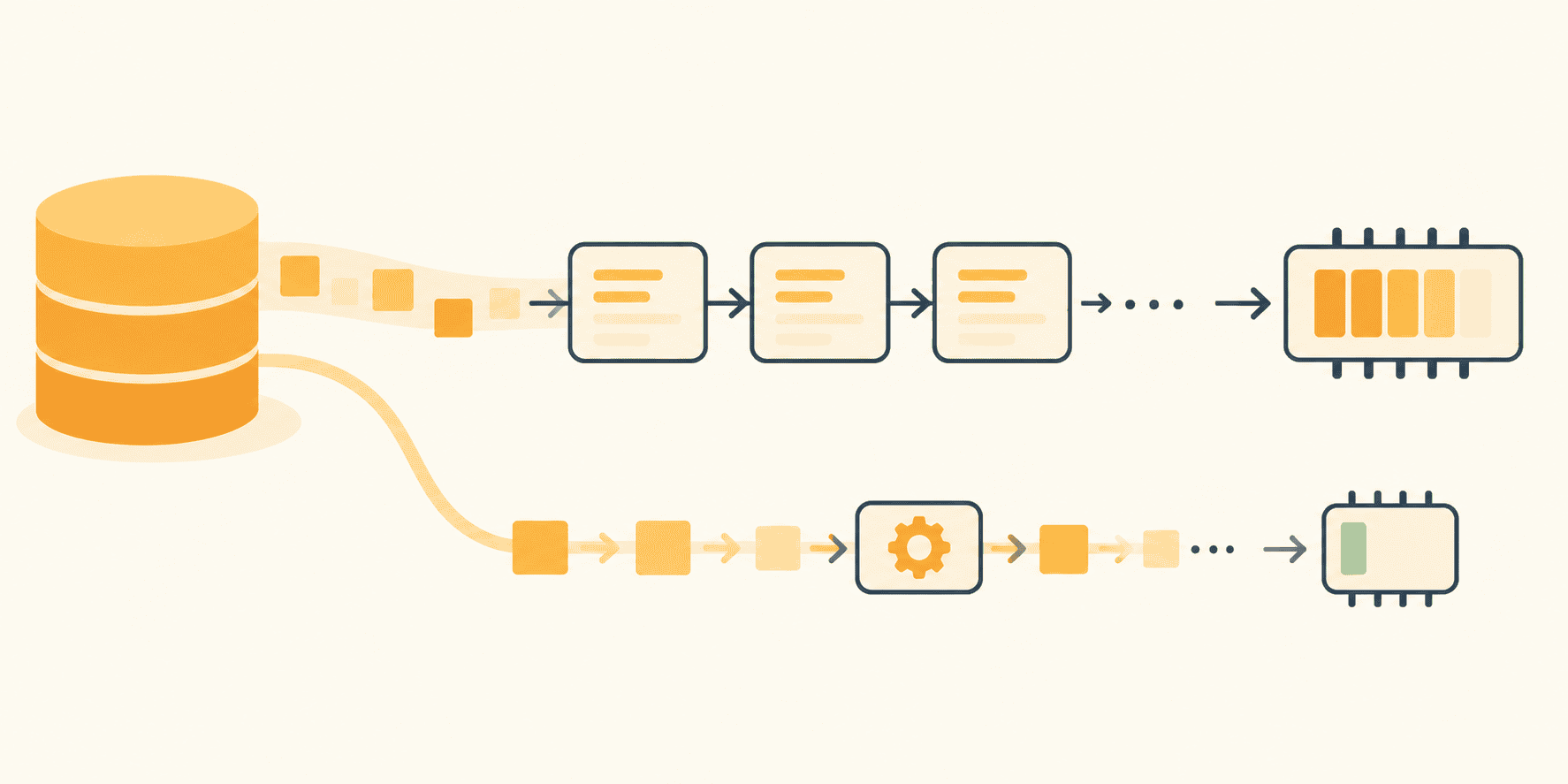
Data processing pipelines are the backbone of modern enterprise infrastructure, yet they frequently encounter critical failure points when scaling from development environments to production workloads. A common scenario involves a script that functions perfectly during initial testing, only to collapse under the weight of real-world data volume. When log rotation cycles shift and a week’s worth of traffic is consolidated into a multi-gigabyte file, standard list-based processing approaches often trigger a MemoryError, causing the entire application to crash. This systemic vulnerability arises not from flawed logic, but from an "eager" approach to memory management—where the program attempts to load entire datasets into RAM before processing begins.
The Anatomy of a Memory Bottleneck
The fundamental issue in many data-intensive Python applications is the reliance on list comprehensions and eager loading. When a developer writes code to open a log file, parse its contents, filter for specific errors, and calculate latency thresholds, they often create a series of lists. Each list necessitates the allocation of enough memory to hold every record simultaneously. For a 9 GB log file, this means the system must have at least 9 GB of available RAM just to hold the raw strings, not accounting for the additional overhead of the parsed dictionary objects.
Historically, this "eager" methodology has been a silent contributor to production outages. In the context of large-scale log analysis, these failures often occur during nightly batch jobs. The chronology of such a failure is predictable: a developer builds a tool that works on a small subset of data (a "snapshot"). As the data volume grows—driven by increased user activity or extended log retention policies—the process consumes more memory than the host machine provides. Eventually, the operating system’s Out-Of-Memory (OOM) killer terminates the process to protect system stability. This is not merely a coding error; it is a failure to implement streaming architecture, a concept Python has supported for over two decades.
The Iterator Protocol: A Contract for Scalability
At the heart of streaming architecture is the iterator protocol, a robust mechanism that allows programs to process data without loading it entirely into memory. An iterable—such as a file object, list, or string—serves as the source, while an iterator acts as the cursor, tracking the current position within the data. When a standard for loop executes, Python internally calls iter() on the source, followed by repeated calls to next() until the StopIteration exception is raised.
This contract ensures that only a single item (or a small buffered chunk) resides in memory at any given time. Unlike a list, which is a static collection of items, an iterator is a dynamic stream. Once an item is yielded and processed, it is eligible for garbage collection, effectively decoupling the memory usage of the application from the total size of the input file. This allows for the processing of terabyte-scale datasets on machines with minimal RAM, provided the developer maintains this "lazy" state throughout the entire pipeline.
Architectural Best Practices for Lazy Pipelines
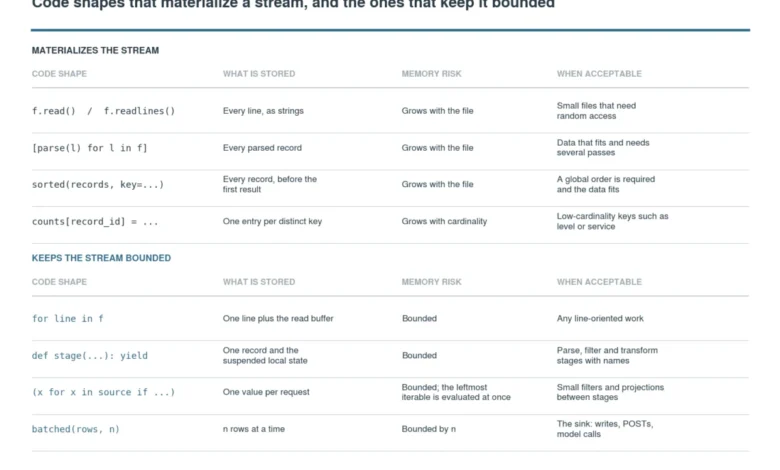
Transitioning from an eager to a lazy architecture requires a shift in how parsing and filtering stages are constructed. The primary objective is to avoid "materialization," where a lazy stream is inadvertently converted back into a list.
1. Leveraging Built-in File Iterators
The most immediate optimization available to any Python developer is the use of the file object itself as an iterator. Replacing f.readlines()—which loads the entire file into a list—with for line in f: enables line-by-line reading. This change alone can reduce memory consumption by several orders of magnitude, moving from gigabyte-level footprint to mere kilobytes.
2. Implementing Generator Functions
For more complex transformations, developers should utilize generator functions, identified by the yield keyword. A generator function pauses its execution state, preserving local variables until the next value is requested by the caller. This "suspension" capability is essential for creating modular, testable stages. For instance, one function might handle log parsing, while another filters by severity level, and a third calculates performance metrics. Each stage remains independent and agnostic of the total data volume.
3. Strategic Use of Generator Expressions
For simpler, one-line transformations, generator expressions provide a concise syntax that mirrors list comprehensions. By wrapping an expression in parentheses rather than square brackets, the developer creates a generator that evaluates elements on demand. It is critical to remember that the leftmost iterable in a generator expression is evaluated immediately; therefore, developers must ensure that the source is already an iterator or a function that returns one.
Managing Boundaries with Batching
While laziness is the ideal state for internal data processing, there is a point where the stream must interface with external systems—such as databases, APIs, or disk storage. These sinks typically require data in batches. The introduction of itertools.batched() in Python 3.12 provides a standardized, memory-efficient way to group stream elements.
By defining a specific batch size, developers can balance the overhead of frequent I/O operations against the memory cost of holding a subset of data. For example, processing 1,000 records at a time ensures that memory usage remains constant, regardless of whether the total input contains 100,000 or 100,000,000 records. This approach transforms the "memory bug" from an unbounded growth problem into a predictable, configurable constraint.

Validation and Measurement
A common pitfall in streaming development is the assumption that an architecture is efficient without empirical verification. The use of the tracemalloc library is essential for any performance-critical pipeline. By measuring the "peak" memory usage—the maximum amount of RAM allocated at any point during execution—developers can objectively evaluate their success.
Research into memory profiling shows that eager scripts often demonstrate a linear correlation between input file size and peak memory consumption. In contrast, optimized streaming pipelines show a flat memory profile, where the peak remains tied to the defined batch size rather than the total data length. If the peak memory does not drop after refactoring, it usually indicates a failure to maintain laziness, such as the accidental application of list() or sorted() to a generator object.
Broader Implications and Future-Proofing
The implications of adopting these patterns extend far beyond simple log parsing. These techniques are directly applicable to modern AI and machine learning workflows, where dataset sizes often exceed available VRAM. By treating data as a continuous flow rather than a static collection, organizations can improve the stability of their data engineering pipelines and reduce cloud infrastructure costs.
Furthermore, a streaming-first approach improves code maintainability. By breaking down complex processing tasks into modular, generator-based stages, developers create code that is easier to debug, unit test, and extend. A pipeline where each component is clearly defined as a stage in a stream is inherently more readable and less prone to the "spaghetti code" that often characterizes large-scale data scripts.
In summary, the transition to memory-efficient processing is a fundamental requirement for modern data-driven applications. By respecting the iterator protocol, minimizing the use of eager collections, and carefully managing the boundaries where streams meet external sinks, developers can build systems that are not only performant but also capable of scaling gracefully to meet the demands of an increasingly data-intensive world. Failure to implement these patterns invites the very memory bottlenecks that cause critical production downtime, turning a simple maintenance task into a high-stakes failure.