MassMutual’s Decade-Long Tech Strategy Yields Record $3.9B Earnings and 237,000 Saved Hours via AI Integration

Massachusetts Mutual Life Insurance Company (MassMutual) has long maintained a reputation as a cornerstone of stability in the mutual life insurer sector, serving a growing community of more than 4 million policyowners and customers. Demonstrating the fruits of a deliberate, long-term technological evolution, the company recently reported outstanding financial results for fiscal year 2025. MassMutual achieved a record $3.9 billion in statutory operating earnings, backed by a robust total adjusted capital base of $34.4 billion and nearly $1.1 trillion in life insurance protection currently in force.
Beneath these historic financial figures lies a transformative operational strategy. According to the company’s 2025 annual report, this financial strength is directly tied to a decade-long, sustained investment in digital infrastructure. Today, over half—specifically 51%—of MassMutual’s workforce utilizes broad-based generative artificial intelligence productivity tools. In 2025 alone, these deployments saved an estimated 237,000 operational hours, fundamentally reshaping how internal teams handle complex, labor-intensive tasks.
For enterprise executives across the financial services sector, MassMutual’s trajectory highlights a central industry dilemma: how to dramatically improve service speed and operational efficiency while simultaneously maintaining absolute accuracy, rigorous governance, and ironclad control over financial risk. By examining MassMutual’s dual implementation of generative AI for policy support and machine learning for automated underwriting, industry leaders gain a clear blueprint for scaling innovation responsibly.
Bridging Decades of Policy Data with Generative AI
Life insurance is inherently a long-term contract, with policies often remaining in force for decades. This longevity presents a recurring logistical hurdle for customer service representatives and financial professionals who must frequently interpret and explain contractual terms written under older, legacy product guidelines. Historically, locating specific clauses or provisions within archives spanning thirty or forty years required tedious manual searches, often forcing representatives to escalate questions up to centralized contact centers.
To resolve this operational bottleneck, MassMutual engineered a specialized generative AI assistant designed to rapidly retrieve policy information. First highlighted publicly in early 2025, the tool provides employees with an intuitive interface—resembling consumer-grade applications like ChatGPT—to query complex contract archives instantly.
The successful deployment of this assistant was far from instantaneous; it was built upon a cloud-based data platform that Chief Information Officer Sears Merritt’s engineering team spent 36 months meticulously developing. This foundational period was dedicated to gathering, cleaning, structuring, and organizing decades of disparate company data.
By shifting policy-information searches toward employee self-service, the assistant has shortened the critical path from a client’s inquiry to a definitive answer. In February 2025, performance metrics revealed that the tool successfully reduced overall response times by 10%. Furthermore, financial advisors decreased their reliance on the main contact center, placing approximately 5% fewer calls for routine support. These combined efficiencies demonstrate that empowering advisors with secure, rapid-retrieval AI tools directly reduces administrative friction without sacrificing client-facing quality.
Mitigating Risk Through Training and Human-in-the-Loop Governance
While the efficiency gains of generative AI are clear, MassMutual’s leadership has maintained a cautious, risk-managed approach, deliberately withholding direct consumer-facing AI applications until internal guardrails are fully proven. A core component of this risk mitigation strategy is mandatory employee training.
Before gaining access to the generative AI assistant, all employees must complete formal instruction covering the technology’s inherent capabilities, operational limitations, and known tendencies to produce inaccuracies. Access is strictly contingent upon an employee’s demonstrated readiness to critically assess automated output.
This internal policy aligns with the company’s broader governance framework, which is detailed extensively in its annual disclosures. MassMutual’s corporate governance model enforces strict data transparency, robust privacy protections, mandatory human review for any AI-initiated decisions, and continuous monitoring systems. Furthermore, the company assigns distinct operational responsibilities across an AI system’s lifecycle, prioritizing model reviews based on risk thresholds.

For corporate leaders seeking to deploy similar tools, the operational takeaway is definitive: faster data retrieval only creates genuine business value if employees are thoroughly trained to recognize when an automated answer requires deeper secondary review and human intervention.
Transforming Life Insurance Underwriting Through Machine Learning
While generative AI optimizes customer service and administrative workflows, predictive machine learning has fundamentally rewritten MassMutual’s approach to life insurance underwriting. Traditional underwriting has long been characterized by friction: applicants frequently endure months of waiting periods while undergoing physical examinations, blood draws, and urinalysis.
To streamline this process while preserving actuarial precision, MassMutual pioneered advanced predictive models, notably underpinning the MassMutual Mortality Score (M3S) and the LifeScore360 platform. Documented extensively by the company’s data science teams in peer-reviewed literature, this algorithmic approach leverages historical data and machine learning to score mortality risk efficiently.
The development of these models required deep cross-disciplinary collaboration. MassMutual’s data scientists worked in close partnership with actuaries, medical doctors, internal underwriters, and external reinsurers. For organizations attempting to automate highly regulated decisions, this cross-functional collaboration serves as a vital prerequisite for establishing accurate decision boundaries before deployment.
The Chronology and Scale of Algorithmic Underwriting
The foundational machine learning model was trained on a massive historical dataset comprising approximately 908,000 life insurance applications spanning from 1999 to 2014, complete with laboratory testing results. This dataset encompassed 9.16 million exposure years and roughly 15,700 observed deaths, though a significant portion of early questionnaire data required manual digitization from paper archives.
To evaluate this complex data, MassMutual utilized a machine learning technique known as a random survival forest. This algorithm estimates a ten-year mortality risk derived from nearly 60 distinct applicant inputs, subsequently converting that risk assessment into a standardized life score ranging from 0 to 100. Higher scores indicate lower relative risk when evaluated within peer groups defined by specific five-year age bands, sex, and smoking status.
MassMutual rolled out this capability in carefully managed stages:
- Pilot Phase: The company initiated a 1,000-case pilot program, running the algorithmic system in parallel with human underwriters to benchmark accuracy.
- Initial Expansion: Automation was introduced for best-class offers on policies up to $1 million for applicants aged 17 to 40.
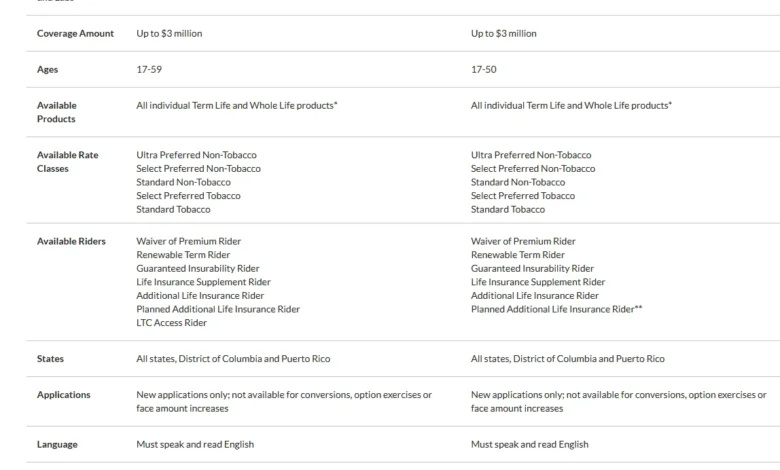
- Broadened Criteria: The threshold was subsequently expanded to cover policies up to $3 million and ages up to 59.
- Full Integration: The system eventually scaled to incorporate all standard-and-above risk classes, successfully automating the underwriting evaluation for approximately 90% of applications falling within these operational parameters.
Today, this legacy of algorithmic evaluation has evolved into flexible commercial programs, including the MassExpress Fluidless offering, which provides eligible applicants aged 17 to 50 with coverage up to $3 million without requiring traditional medical examinations or lab tests. However, human oversight remains deeply embedded in the workflow. Meeting published eligibility criteria does not guarantee an automatic offer; underwriters retain control over edge-case exceptions, and a percentage of otherwise eligible applicants are systematically held out at random for audit and quality control purposes.
Strategic Implications for Industry Leaders
MassMutual’s decade-long integration of artificial intelligence and machine learning offers a masterclass in enterprise technology transformation. By systematically coupling technological deployment with rigorous internal governance—such as mandatory AI training for service staff, phased underwriting rollouts, and continuous human-in-the-loop review—the mutual insurer has successfully navigated the delicate balance between rapid operational scaling and stringent risk management.
As financial institutions worldwide race to capture productivity gains through artificial intelligence, MassMutual’s experience proves that sustainable success is built on a foundation of clean enterprise data, cross-functional risk ownership, and a steadfast refusal to sacrifice oversight for speed.