Canton Coin Secures Milestone SEC No-Action Letter, Clarifying Digital Commodity Status for Network Participants

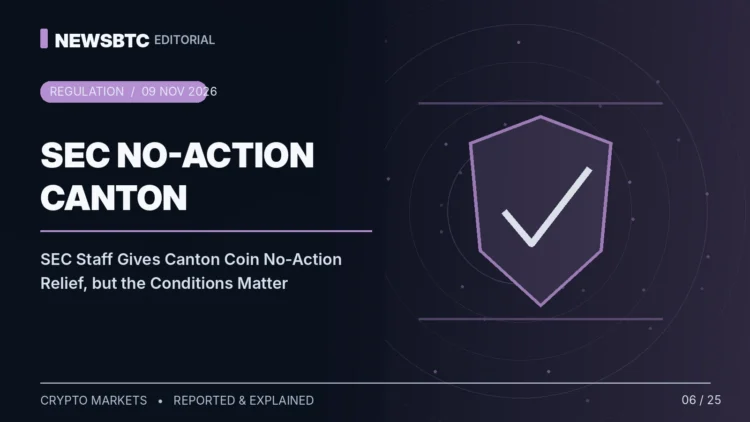
The landscape of digital asset regulation in the United States reached a significant juncture on November 3, when the staff of the Securities and Exchange Commission’s (SEC) Division of Corporation Finance issued a highly anticipated no-action response regarding Canton Coin. This regulatory development provides a vital layer of clarity for network participants, validating that Canton Coin aligns with the definition of a digital commodity as outlined in the Commission’s preceding March interpretation. While the decision marks a notable shift in how decentralized networks may navigate federal oversight, legal and financial experts emphasize that the ruling is strictly circumscribed, applying only to the specific factual matrix presented by the applicants rather than serving as a blanket exemption for all cryptographic tokens or secondary market transactions.
The core of the SEC staff’s position rests upon a rigorous evaluation of Canton’s operational architecture. Specifically, the regulatory review focused on the documented absence of a central controlling authority and the direct correlation between the token’s utility and the programmatic, automated functions of the underlying blockchain network. Furthermore, the no-action letter addresses the minting mechanics of Canton Coin, which is distributed among a decentralized cohort of super validators, standard validators, and application providers under carefully structured protocol rules. Based on these operational realities, the Division of Corporation Finance confirmed it would not recommend enforcement action if network participants engage in the specified token minting activities without prior registration under the Securities Act of 1933 and the Securities Exchange Act of 1934.
Market observers and legal scholars have been quick to underscore the precise nature of this administrative relief. A no-action letter represents an expression of staff-level enforcement discretion rather than a formal judicial ruling, a legislative enactment, or a Commission-wide legal mandate. Consequently, while it offers substantial operational comfort to entities directly interacting with the Canton network, it does not alter the fundamental statutory definitions of securities law, nor does it establish binding precedent for other blockchain projects operating under different economic or technical models.
Chronology of Regulatory Evolution and the Path to the November 3 Decision
To fully understand the weight of the November 3 no-action response, one must examine the broader timeline of regulatory discourse governing digital assets in the United States. For years, the intersection of blockchain technology and federal securities law has been characterized by ambiguity, with market participants frequently navigating a fragmented regulatory environment often described by critics as "regulation by enforcement."
The groundwork for the recent Canton Coin determination can be traced back to cumulative shifts in agency guidance, culminating in the SEC’s landmark March interpretation regarding digital commodities. That March framework established critical criteria for distinguishing between traditional investment contracts and functional digital assets, emphasizing factors such as network maturity, decentralized governance, and utility-driven tokenomics.
Following the release of the March guidance, developers and legal counsel representing the Canton ecosystem initiated a dialogue with the Division of Corporation Finance. Through a detailed interpretive request, the applicants submitted exhaustive documentation outlining the network’s technical specifications, validator distribution models, and economic incentives. This multi-month consultative process culminated in the November 3 response, marking a rare instance of a major layer-1 network securing tailored administrative feedback under the Commission’s updated digital commodity framework. This chronology highlights a gradual transition toward conditional, fact-specific regulatory dialogue, offering a potential roadmap for other compliant blockchain networks seeking regulatory alignment.
Detailed Examination of the Factual Record and Structural Prerequisites
The SEC staff’s willingness to grant no-action relief was heavily contingent upon the unique factual representations set forth in the application. Unlike many early-stage cryptocurrency offerings characterized by initial coin offerings (ICOs), pre-mines controlled by founders, and centralized marketing efforts, the Canton network presented a model built upon operational decentralization and utility-based distribution.
According to the submitted factual record, participants within the Canton ecosystem receive tokens exclusively as compensation for performing critical network infrastructure tasks—such as validating transactions—or for developing and hosting decentralized applications. Crucially, token holders do not rely on the managerial or entrepreneurial efforts of a central corporate entity to generate profits. Instead, the economic value and operational continuity of the token are tied directly to the deterministic, programmatic execution of the network code.
The SEC’s response explicitly underscores the fragility of this exemption, issuing a stern caution that even minor deviations from the described operational model could nullify the staff’s position. Token issuers utilizing public presales, maintaining centralized discretion over token supply, or employing speculative rewards structures cannot automatically apply this legal analysis to their own projects. Regulatory relief in this context is inextricably bound to the specific activity, governance structure, and historical record of the applicant, reinforcing the principle that compliance in the digital asset sector remains an intensely fact-driven endeavor.
Institutional Implications and Financial Market Integration
For institutional participants, particularly those operating within traditional financial markets, regulatory clarity is the primary prerequisite for widespread adoption. Canton has deliberately positioned itself as infrastructure tailored for complex financial market applications, where enterprise-grade operators require absolute legal certainty regarding node operation, validator participation, and network reward accrual.
Historically, ambiguous regulatory treatment has created significant friction for financial institutions evaluating blockchain infrastructure. Uncertainty surrounding the securities status of network tokens can impede internal legal reviews, complicate procurement processes, disrupt custody solutions, and deter institutional capital deployment. By addressing the specific mechanics of Canton Coin minting, the SEC staff’s response removes a prominent regulatory roadblock for entities seeking to utilize the network for enterprise settlements, asset tokenization, and institutional workflows.
Despite this progress, financial institutions must maintain a comprehensive compliance framework. The no-action letter is narrowly tailored to registration requirements under specific provisions of the federal securities laws; it does not exempt institutions from a myriad of other regulatory obligations. Depending on how an entity utilizes the network, it remains subject to existing rules enforced by various regulatory bodies, including broker-dealer regulations, banking compliance standards, Office of Foreign Assets Control (OFAC) sanctions, Bank Secrecy Act (BSA) and anti-money laundering (AML) mandates, and derivatives oversight. Furthermore, the letter does not provide blanket approval for every complex financial product constructed on top of the Canton network, nor does it supersede separate statutory frameworks governing financial intermediaries and securities markets.
Comparative Industry Impact and the Search for a Compliance Template
The issuance of the Canton Coin no-action letter has reverberated across the broader cryptocurrency and blockchain development community. Industry stakeholders and legal professionals are meticulously analyzing the document to discern what specific decentralization metrics, governance thresholds, and utility features influenced the SEC staff’s decision-making process.
However, legal experts warn against a "copy-and-paste" approach to regulatory compliance. Simply adopting the terminology, technical nomenclature, or validator classifications used in the Canton application will not insulate other blockchain networks from regulatory scrutiny if their underlying operations do not mirror the cited facts. For development teams, the central question remains whether their network’s control structures, economic incentives, operational independence, and historical launch trajectories genuinely align with the rationale articulated by the agency.
Moreover, the regulatory landscape remains fluid. As the SEC’s March interpretation and the November staff response demonstrate, digital asset policy is evolving through administrative practice. Subsequent formal rulemaking by the Commission, judicial interventions in ongoing federal litigation, or legislative action by the U.S. Congress could significantly alter the practical realities of token issuance and network participation in the near future.
Broader Economic Context and Related Market Developments
The regulatory clarity achieved by Canton Coin arrives amid a broader institutional push toward tokenized real-world assets (RWAs) and blockchain-based market infrastructure. Financial exchanges and traditional financial institutions are increasingly exploring distributed ledger technology to streamline clearing, settlement, and asset issuance.
For instance, recent initiatives by major market participants—such as the New York Stock Exchange expanding its engagement with transfer agents for planned tokenized securities venues—illustrate a growing demand for robust, compliant blockchain rails. In this economic environment, regulatory assurances regarding native network tokens are essential components of a broader institutional ecosystem. When foundational tokens like Canton Coin achieve legal clarity, it reduces systemic risk for secondary service providers, including institutional custodians, clearinghouses, and specialized transfer agents.
Nevertheless, industry analysts emphasize that regulatory clarity is distinct from commercial success or financial performance. While administrative rulings remove legal uncertainty and foster an environment conducive to technological experimentation, they do not guarantee secondary market liquidity, long-term network security, or positive investment returns for end users.
Outlook and Future Compliance Monitoring
As developers, investors, and legal practitioners digest the implications of the November 3 no-action response, attention is turning toward future regulatory guidance and practical execution. Observers advise stakeholders to read the SEC staff’s response in tandem with the original interpretive request to fully grasp the boundaries of the permitted activities.
Moving forward, market participants will closely monitor how institutional players practically implement custody solutions, manage validator node distribution, and navigate secondary market trading for Canton Coin. Additionally, industry groups will track whether the SEC adopts a standardized pathway or issues further interpretive releases addressing other decentralized network models.
Ultimately, the Canton Coin no-action letter represents a precise, fact-specific administrative assurance regarding defined minting and operational activities. It is not an open-ended license for indiscriminate tokenization, nor is it a universal statutory exemption. Instead, it serves as a milestone case study in how transparent engagement with regulatory bodies can yield targeted legal certainty within an evolving and complex financial ecosystem.