Resistance Mounts as 33 Major Corporations Block OKX and NYSE Parent ICE from Tokenizing Their Shares

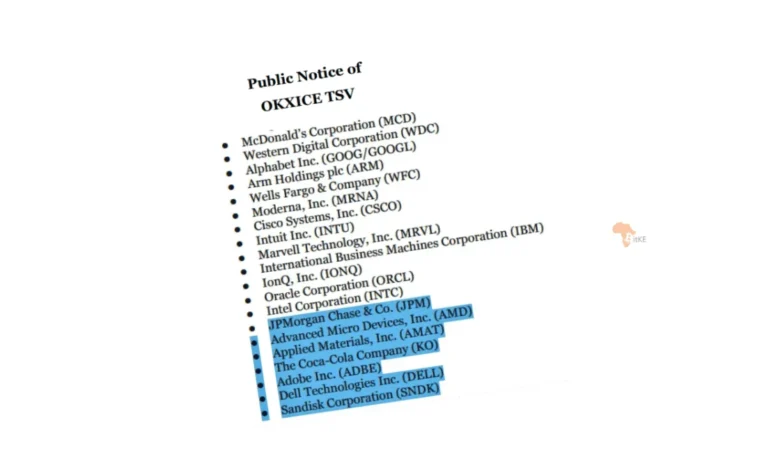
Corporate resistance to the intersection of traditional equity markets and blockchain technology has reached a significant milestone, as the total number of companies objecting to a high-profile tokenization initiative climbs to 33. According to an official notice dated October 27, 2026, seven additional firms have formally rejected plans by cryptocurrency exchange OKX and Intercontinental Exchange (ICE)—the parent company of the New York Stock Exchange (NYSE)—to trade tokenized versions of their corporate shares.
This latest wave of pushback brings the total number of objectors to nearly half of the 62 blue-chip companies initially targeted for inclusion by the joint venture, known as OKX-ICE. The growing friction highlights a fundamental tension in the ongoing evolution of financial markets: while digital asset infrastructure providers and forward-thinking regulators are eager to build 24/7 on-chain trading ecosystems, traditional corporate boardrooms remain deeply skeptical, protective, and hesitant to relinquish control over how their equities are traded, represented, and settled.
The Anatomy of the OKX-ICE Tokenization Initiative
The joint venture between OKX and ICE was conceived to bridge the gap between legacy financial systems and decentralized finance (DeFi). The proposed platform aims to revolutionize how equities are bought, sold, and managed by introducing tokenized representations of traditional stocks. Under the operational framework outlined by the joint venture, these tokenized assets would trade around the clock—free from the standard opening and closing bells of traditional exchanges—utilizing on-chain liquidity pools rather than legacy order books.
Furthermore, transactions within the ecosystem are designed to settle instantly or near-instantaneously using stablecoins, bypassing the traditional multi-day clearing and settlement cycles managed by institutions like the Depository Trust & Clearing Corporation (DTCC).
The initiative operates under a specialized five-year innovation exemption granted by the U.S. Securities and Exchange Commission (SEC). This regulatory carve-out was designed to give qualifying financial technology platforms a sandboxed environment to test the viability, security, and efficiency of tokenized securities trading under a modified regulatory framework. Proponents of the exemption argue that such trials are vital for maintaining U.S. competitiveness in global financial technology, offering investors deeper liquidity, fractional ownership opportunities, and frictionless cross-border access.
A Growing Wave of Institutional Defiance
Despite the regulatory green light from the SEC, the OKX-ICE initiative faces a structural hurdle that technology cannot easily code around: corporate consent. Under the terms of the SEC’s innovation exemption, participating platforms are permitted to build the necessary blockchain infrastructure, but target companies retain the ultimate veto power. Specifically, corporations can explicitly block third-party venues from issuing, listing, or trading tokenized versions of their shares without direct authorization.
This veto power has proven to be a formidable roadblock. The initial phase of the OKX-ICE venture targeted 62 prominent U.S.-listed corporations. However, as notices have rolled in over recent months, enthusiasm from the corporate sector has been severely tempered.
The opposition list has steadily expanded to include an array of household names and technological powerhouses. Following earlier high-profile joiners—such as technology giants Intel, IBM, Oracle, Cisco, and quantum computing pioneer IonQ—seven additional firms joined the blockade in the latest reporting period. While the complete roster of objecting companies features a diverse mix of industries, the overarching trend is clear: major corporations are exercising their right to opt out of the experiment.

To date, the vast majority of objecting companies have chosen not to publicly elaborate on their specific motivations, leaving market analysts and investors to parse the underlying causes of their hesitation. Despite the mounting resistance and the quiet departures of nearly half its prospective roster, OKX-ICE has yet to announce an official launch date for the platform, leaving the future timeline of the project shrouded in uncertainty.
Background Context: The Tokenization Movement and Regulatory Landscape
The friction between OKX-ICE and listed corporations cannot be viewed in isolation; it is part of a broader, systemic shift toward the tokenization of Real-World Assets (RWAs). Over the past several years, Wall Street institutions, fintech startups, and central banks have increasingly explored Distributed Ledger Technology (DLT) as a means to modernize financial market infrastructure. Proponents argue that tokenization offers profound operational efficiencies, including reduced counterparty risk, lower administrative overhead, automated compliance via smart contracts, and round-the-clock market accessibility.
However, tokenizing equities is vastly different from tokenizing fixed-income products, commodities, or fiat currencies. Unlike government bonds or stablecoins, equities represent fractional ownership in a specific operating enterprise. Corporate leadership and legal teams view equity structure as a core element of governance, shareholder relations, and market stability.
The introduction of uncoordinated, third-party tokenized trading venues introduces a myriad of complex legal, operational, and regulatory questions. For instance, companies worry about potential market fragmentation, where liquidity for a single stock is split between the traditional exchange (such as the NYSE) and various blockchain-based liquidity pools. Such fragmentation could potentially introduce price discrepancies, increase volatility, and complicate corporate governance matters such as voting rights, dividend distributions, and share buyback programs.
Analysis of Implications: Why Major Corporations Are Hesitating
From a legal and operational standpoint, the mass rejection of the OKX-ICE platform by corporate issuers points to several rational concerns:
- Fragmentation of Share Liquidity and Price Discovery: Traditional exchanges like the NYSE maintain centralized, highly regulated order books that ensure fair and orderly price discovery. Corporations are wary of alternative venues—particularly those utilizing decentralized liquidity pools and stablecoin settlement—siphoning off trading volume and creating disjointed pricing metrics for their equity.
- Regulatory and Legal Uncertainty: Even with a five-year SEC innovation exemption, corporate legal departments operate in a risk-averse environment. The legal status of tokenized shares in the event of platform insolvency, smart contract exploits, or regulatory shifts remains a gray area. Companies may prefer to avoid association with experimental platforms to shield themselves from potential shareholder litigation or regulatory enforcement actions.
- Control Over Corporate Identity and Shareholder Registry: Public companies maintain strict oversight of their shareholder base through transfer agents. On-chain trading, particularly involving permissionless or pseudonymous liquidity pools, can obscure the true identity of beneficial owners. Corporations often value direct relationships with institutional and retail investors, fearing that tokenization could alienate traditional stakeholders or invite predatory market manipulation by anonymous actors.
- Technological and Operational Risks: Integrating legacy corporate equity structures with blockchain protocols requires relying on smart contracts and bridge infrastructure. Any security vulnerability, oracle failure, or technical glitch within the OKX-ICE ecosystem could directly impact the perception and stability of a company’s stock.
The Road Ahead for Digital Securities
The stall in the OKX-ICE rollout serves as a crucial case study for the broader digital assets industry. It demonstrates that technological capability and regulatory permission are insufficient on their own to drive market adoption. Without the active buy-in and cooperation of the underlying asset issuers, tokenization initiatives risk stalling out before they even leave the starting gate.
For exchanges and fintech innovators, the message is clear: future tokenization efforts must focus heavily on addressing the legitimate concerns of corporate issuers. This may involve offering companies greater control over where and how their tokenized shares trade, ensuring robust compliance and anti-money laundering (AML) controls within on-chain pools, and demonstrating clear benefits to corporate governance and investor relations.
As the financial sector watches to see how OKX and ICE respond to this 33-company blockade, the debate over the future of equity trading continues to intensify. Whether this resistance represents a permanent rejection of third-phase tokenization or merely a temporary speed bump in the inevitable digitization of global capital markets remains one of the most pressing questions facing modern finance.