The Evolution of Bitcoin.org: A Historical Context
To understand the gravity of this localization effort, one must look at the origins of the domain itself. Bitcoin.org was the first website dedicated to the Bitcoin protocol, registered on August 18, 2008, by its pseudonymous creator, Satoshi Nakamoto. Initially, the site served as a technical repository for the whitepaper and the core software client. As Bitcoin grew from a niche academic experiment into a global asset class, the site transitioned from a developer-centric landing page to an educational hub for the general public.
Throughout the decade following its inception, the site faced a perennial challenge: the "English-only" barrier. While the protocol itself is permissionless and borderless, the instructional material required to navigate wallets, exchanges, and security best practices was largely confined to English-language resources. This created a socioeconomic imbalance, where individuals in non-English speaking regions—particularly in emerging markets where Bitcoin’s utility as a hedge against inflation is most pronounced—were left with limited, often unreliable, third-party information.
The 2018 Localization Initiative: A Timeline of Growth
The localization project gained significant momentum in early 2018. Recognizing that static, English-only documentation was insufficient for global adoption, the Bitcoin.org team initiated a community-driven translation project. This effort was not merely a mechanical translation task but a complex undertaking to maintain technical accuracy across diverse linguistic structures.
The timeline of this expansion can be categorized into three key phases:
- Phase One (Q1–Q2 2018): Infrastructure Development. The team implemented a robust content management workflow that allowed volunteers to contribute translations via GitHub. This ensured that the open-source ethos of Bitcoin was maintained throughout the translation process.
- Phase Two (Q3 2018): The Paxful Partnership. In mid-2018, the project received a critical boost through a sponsorship from Paxful, a peer-to-peer bitcoin marketplace. This funding was instrumental in incentivizing professional-grade translations. By providing bitcoin bonuses, the initiative transformed from a purely volunteer-based model to a hybrid system that attracted skilled linguists and technical writers.
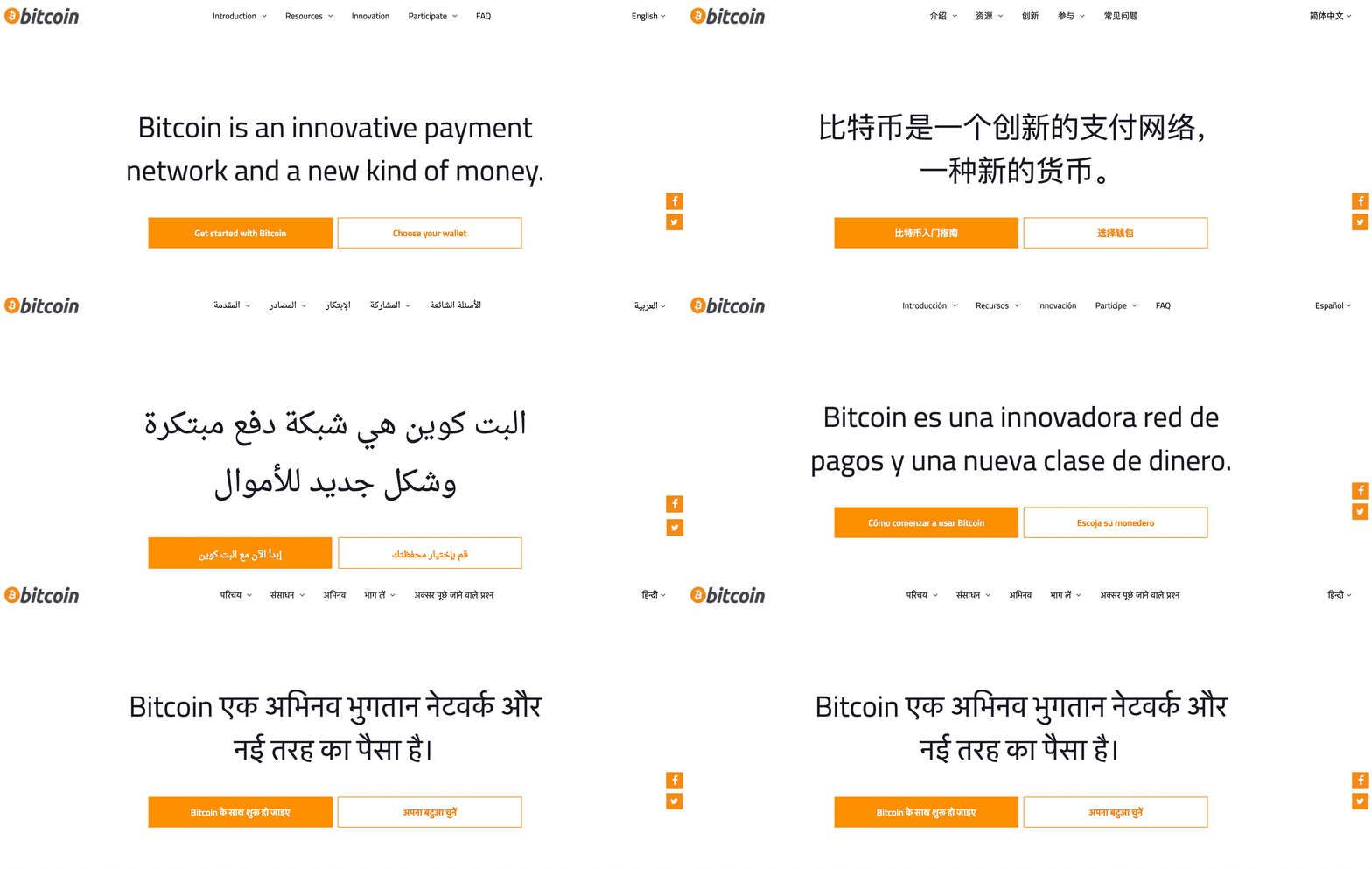
- Phase Three (Q4 2018–Early 2019): Quality Assurance and Scaling. With the core pages translated, the focus shifted to technical documentation and site-wide consistency. By February 2019, the site successfully reached the 25-language threshold, covering the most spoken languages in the world, including Spanish, Mandarin, Hindi, Arabic, and Portuguese.
Supporting Data and the Open-Source Model
The success of this initiative is inextricably linked to the site’s open-source structure. Bitcoin.org operates as a privately owned site, yet it functions as a public good. The repository on GitHub has logged thousands of commits from hundreds of contributors. This decentralized approach to content creation serves as a safeguard against censorship and misinformation.
When an individual visits the site, they are not relying on a centralized corporate entity to dictate what they learn about Bitcoin. Instead, they are accessing information verified by a global community of developers and advocates. This collaborative verification process ensures that the "unbiased and qualitative information" provided on the site remains consistent, regardless of the language version being accessed.
From a data perspective, the impact of such localization is measurable. Search engine optimization (SEO) data suggests that providing content in a user’s native language increases dwell time and engagement by over 40%. For an educational site, this translates to higher retention of critical security concepts, such as seed phrase management and private key safety—topics where misunderstandings, caused by poor translation, can lead to irreversible financial loss.
Official Responses and Stakeholder Perspectives
While the project is largely community-led, the involvement of corporate entities like Paxful highlights a shifting paradigm in the crypto ecosystem. Ray Youssef, CEO of Paxful, noted at the time that, "Education is the greatest barrier to adoption. If we want Bitcoin to be a global currency, it must be spoken in every language."
The volunteers who participated in the project often cited the need for "democratizing access" as their primary motivation. By providing documentation in their native tongues, these translators effectively acted as the first line of support for new users in their respective regions. The Bitcoin.org blog, which serves as the primary conduit for site updates, emphasized that this is a continuous process. As the protocol evolves—with updates such as Segregated Witness (SegWit) or the Lightning Network—the translated documentation must also be updated in real-time, requiring a permanent and sustainable translation infrastructure.
Implications for Global Financial Inclusion
The expansion of Bitcoin.org to over 25 languages has profound implications for financial inclusion. In many developing nations, the lack of traditional banking infrastructure creates an environment where Bitcoin can provide immediate utility. However, utility is only realized through education.
The Developer Documentation Challenge
Looking ahead to 2019 and beyond, the project identified the technical documentation as the next frontier. While general educational pages explain the "what" and "why" of Bitcoin, the developer documentation explains the "how." Translating technical manuals for developers allows local programmers in regions like Southeast Asia and Latin America to build applications on top of the Bitcoin network. This creates a multiplier effect: as local developers learn to build on the protocol in their native language, they create localized products that further lower the barrier to entry for their fellow citizens.
Maintaining Unbiased Standards
A critical challenge in the crypto space is the proliferation of predatory marketing. Because the industry is largely unregulated, new users are often targeted by companies offering "guaranteed returns" or dubious investment schemes. By providing a neutral, non-promotional educational resource, Bitcoin.org serves as an anchor. The site does not endorse specific exchanges or products, but rather provides a framework for users to evaluate these services themselves. The expansion into multiple languages ensures that users in less-regulated markets have the same access to objective safety guidelines as those in more developed jurisdictions.
Future Outlook: Beyond 2019
The initiative serves as a blueprint for how decentralized projects can scale their educational reach without sacrificing quality or security. The plan to continue expanding into more niche languages and technical sub-sectors suggests that the project is shifting from a "launch phase" to a "maintenance phase."
For the average user, the existence of a high-quality, multi-language repository for Bitcoin information is a fundamental right to information. It allows for informed consent, which is the cornerstone of any financial ecosystem. As Bitcoin continues to navigate the complexities of global regulation, taxation, and technological upgrades, the ability of its primary educational portal to adapt and communicate these changes to a global audience will remain one of the most vital components of the ecosystem’s longevity.
In conclusion, the localization of Bitcoin.org represents more than just a translation of text; it is an expansion of the network’s reach and a strengthening of its foundational integrity. By empowering users worldwide with the knowledge required to interact with the protocol securely and independently, the project continues to uphold the ethos that Bitcoin belongs to everyone, regardless of where they live or what language they speak. The ongoing call for contributors remains open, reinforcing the fact that the most robust defense against misinformation is an educated and globally connected user base.