Crypto Market Slumps to August Lows as Macro Pressures, AI Sector Divergence, and Institutional Sell-Off Weigh on Sentiment


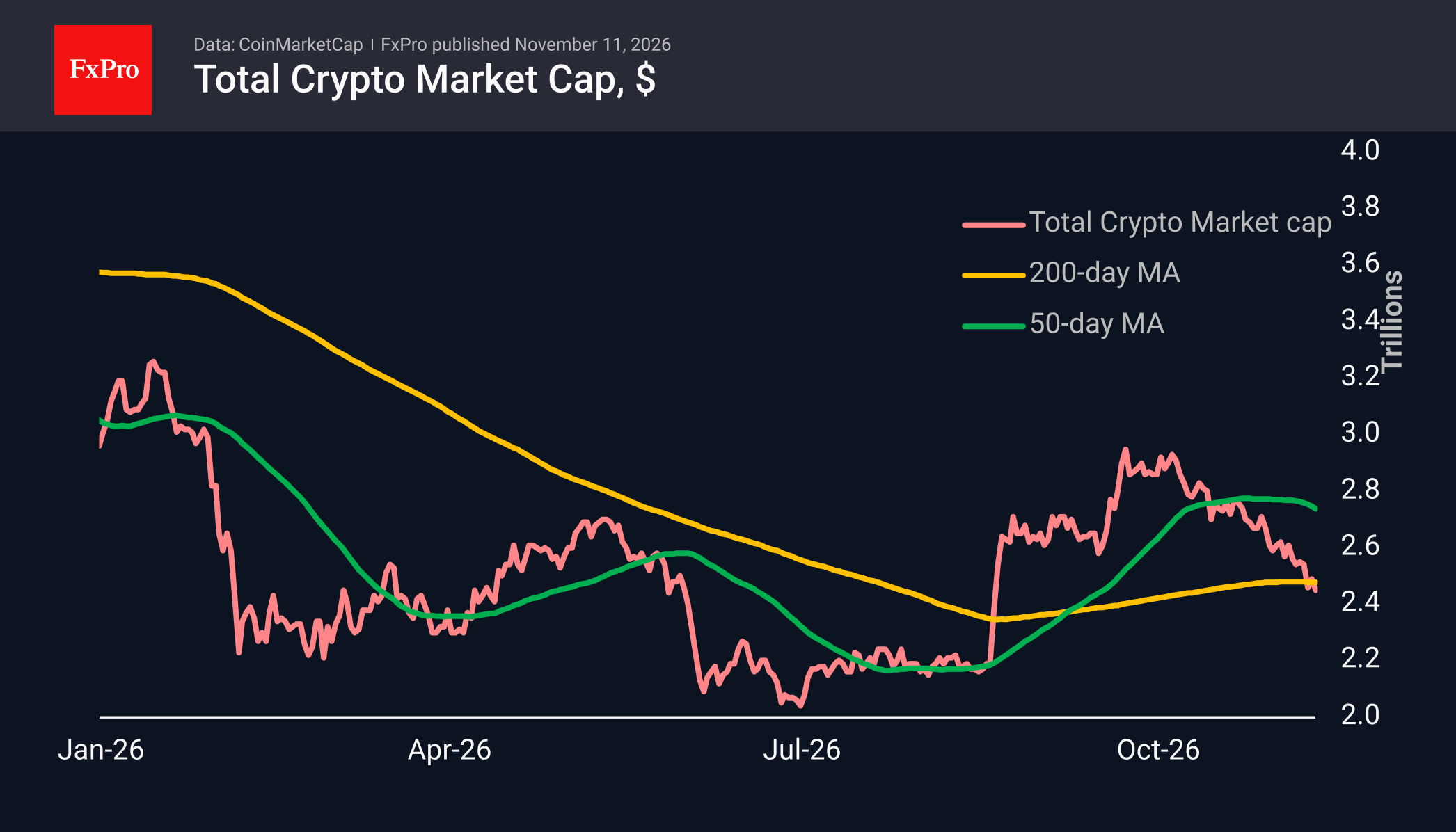
The global cryptocurrency market capitalization experienced a sharp contraction, shedding more than 1.5% over a 24-hour window to settle at $2.45 trillion. This descent marks the digital asset sector’s lowest valuation since August, driven by a confluence of macroeconomic headwinds, shifting capital allocation toward traditional equities, and mounting sell-side pressure from corporate holders and large-scale investors. While global equity markets have remained resilient in the face of robust economic indicators, cryptocurrencies have noticeably lagged, decoupling from risk-on stock indices and falling deeper into correction territory.
Macroeconomic Pressures and the Equity-Crypto Divergence
The stark divergence between equities and digital assets stems primarily from shifting expectations regarding United States monetary policy. Recent macroeconomic reports revealed higher-than-expected Consumer Price Index (CPI) figures, pointing to stubborn, accelerating inflation. Concurrently, stronger-than-anticipated U.S. labor market data and subsequent commentary from Federal Reserve officials have fundamentally altered interest rate projections. Markets are now pricing in a realistic probability of a 50-basis-point rate hike by the Federal Reserve during its December meeting.
This hawkish pivot triggered a powerful rally in the U.S. dollar, propelled by an economy that continues to defy predictions of a broader slowdown. While traditional equity markets have managed to absorb the implications of a persistently strong economy and higher borrowing costs, digital assets and precious metals have borne the brunt of the capital drain. Furthermore, structural market dynamics are exacerbating the crypto-specific downturn. Market analysts note that institutional capital is increasingly rotating out of digital assets and flowing into artificial intelligence ventures ahead of high-profile corporate public offerings, notably Anthropic’s anticipated IPO. This phenomenon mirrors the capital flight observed between May and June, where surging interest in AI infrastructure directly siphoned liquidity away from the crypto ecosystem.
Bitcoin Tests Critical 200-Day Moving Average Support
Bitcoin, the undisputed bellwether of the asset class, has relinquished the crucial $74,000 threshold, sliding back to test its vital 200-day moving average. The lackluster rebound observed earlier in the week was swiftly overridden by renewed waves of selling pressure, dragging flagship token prices down to levels not seen since late summer.
The historical context of Bitcoin’s price trajectory highlights a distinct shift in market psychology over the past several months. In August, bullish momentum was decisively catalyzed by statements from senior U.S. Treasury officials and the Federal Reserve, which injected optimism into spot markets. However, as the fourth quarter progressed, macroeconomic fundamentals steadily eroded buyer enthusiasm. Investors grew increasingly wary of the central bank’s hawkish stance against inflation, leading to a systematic retreat of speculative capital.
From a technical analysis perspective, the cryptocurrency now sits at a critical technical crossroads. Market technicians emphasize the immense significance of the current test of the 200-day moving average. A decisive breakdown below this moving average could invalidate long-term structural support, triggering an accelerated wave of stop-loss liquidations and significantly extending the downward sell-off. Conversely, simply holding the current price band will not suffice to ignite a bullish market reversal; analysts underscore that a robust, volume-backed upward impulse directly off this support level is mandatory to restore investor confidence.

On-Chain Metrics and Institutional Liquidation Trends
Underpinning the price correction are mounting on-chain indicators pointing toward sustained distribution by large-scale market participants. Data compiled by analytics providers indicates that whale addresses and corporate entities are increasingly transferring Bitcoin balances to centralized exchanges, naturally amplifying immediate selling pressure. Although aggregate market leverage ratios have declined from their yearly peaks, they remain at elevated levels that leave leveraged long positions vulnerable to sudden liquidations. Industry observers note that for the downward trend to halt and for sustainable upward momentum to resume, natural buyers must aggressively re-enter the spot market.
Analyst Quinten François points out that Bitcoin has re-entered the valuation zone defined by the Market Value to Realized Value (MVRV) indicator, a historical threshold that previously materialized during the sharp market corrections of 2020 and 2023. Meanwhile, analyst Mark Harvey highlights that Bitcoin has breached the lower boundary of its long-term power-law growth corridor. Historically, breaches of this magnitude have coincided with profound macro shocks, most notably the collapse of the FTX exchange and the unprecedented liquidity crash witnessed during the onset of the COVID-19 pandemic in early 2020.
Adding to the supply-side weight, corporate treasuries have actively reduced their crypto exposure throughout the year. According to blockchain intelligence firm Lookonchain, 14 publicly traded corporations have collectively offloaded approximately 108,247 Bitcoin, valued at an estimated $8.08 billion, since the beginning of 2026. Significantly, more than half of this aggregate volume originated from just two corporate sellers: MARA and Riot Platforms. This institutional distribution has strained spot market absorption capacity, leading crypto educator Benjamin Cowen, founder of Into the Cryptoverse, to suggest that the broader correction may persist over the coming weeks, with a definitive market bottom potentially materializing in December.
Altcoin Sector Performance and Divergent Trends
While the broader market suffered universal pullbacks, individual altcoins displayed idiosyncratic price action amidst the broader rout. Over the 24-hour trading window, the overall ratio of gainers to losers stood severely skewed at approximately 1 to 6, illustrating widespread capital withdrawal across mid- and small-cap tokens.
Among the few actively traded altcoins bucking the macro trend were Internet Computer (ICP), which advanced 4.8%; Avalanche (AVAX), gaining 4.5%; and Cosmos (ATOM), up 2.6%. Conversely, the most pronounced downward movements were concentrated in Uniswap (UNI), which tumbled 7%; Dash (DASH), dropping 4.3%; and Basic Attention Token (BAT), sliding 2.8%.
Institutional Infrastructure Developments and Traditional Finance Integration
Despite the prevailing bearish price action in retail and speculative corners of the market, traditional financial institutions and enterprise infrastructure providers continue to press forward with blockchain integration and tokenization initiatives.
In the banking sector, U.S.-based PNC Bank has officially partnered with Coinbase to initiate live testing of a specialized enterprise service designed to accept and process USD Coin (USDC) payments natively on the Ethereum network. This institutional-grade settlement solution is engineered to drastically accelerate cross-border international settlements while optimizing corporate treasury management and liquidity access.
Concurrently, traditional capital market infrastructure is embracing decentralized ledger technology for high-level operations. The New York Stock Exchange (NYSE) has announced plans to utilize the Avalanche blockchain network for clearing and settlement operations on its upcoming tokenized securities trading platform. To meet strict regulatory and compliance requirements, the exchange will deploy a permissioned, private blockchain architecture equipped with controlled participant access, ensuring institutional-grade security and governance.
Regulatory Landscape and Political Oversight Horizons
The intersection of cryptocurrency, prediction markets, and federal oversight is also preparing for a significant legislative shift. U.S. Senator Elizabeth Warren has signaled an intention to substantially ramp up federal scrutiny of prediction markets and digital asset initiatives associated with the family of President Donald Trump. This heightened oversight is anticipated to take shape as Senator Warren is widely expected to assume the influential role of chair of the Senate Banking Committee in January. The prospective leadership transition has already drawn attention from industry advocacy groups and legal compliance experts, who expect increased regulatory friction surrounding decentralized finance, prediction platforms, and politically aligned digital asset ventures.
Broader Market Implications and Future Outlook
The convergence of accelerating macroeconomic inflation, shifting monetary policy expectations, and persistent institutional distribution has placed the digital asset ecosystem under its most severe fundamental test in months. As Bitcoin hovers precariously near its 200-day moving average, market participants are closely monitoring upcoming U.S. economic prints and Federal Reserve communications for clues regarding the December rate decision.
While speculative enthusiasm has undeniably cooled in response to the macroeconomic tightening cycle and competing capital lures such as artificial intelligence ventures, foundational institutional adoption continues to march forward unabated. The integration of stablecoin settlement rails by legacy commercial banks and the adoption of high-performance public-private chains by premier equity exchanges demonstrate that underlying utility is maturing independently of short-term price volatility. Whether the market finds its cyclical bottom in the closing weeks of the fourth quarter or experiences a prolonged consolidation phase will ultimately depend on the return of spot market liquidity and macroeconomic stabilization.
Related posts: