The Great Tech Reckoning: Investors Demand Fiscal Discipline as AI Hype Meets Capital Reality


Big tech’s historic spending spree is hitting a wall of investor skepticism, as the Nasdaq 100’s recent brush with correction territory signals a definitive shift in market sentiment. For years, the promise of generative artificial intelligence was enough to sustain aggressive valuations and massive capital expenditure. Today, that narrative is being scrutinized through the cold lens of free cash flow, debt sustainability, and tangible return on investment. As market participants recalibrate their portfolios, the focus has pivoted from mere growth to the ability of companies to fund their own expansion in an environment defined by higher interest rates and increased volatility.
The recent market volatility was catalyzed by a confluence of earnings reports that exposed the cracks in the tech sector’s armor. Alphabet’s report revealed negative quarterly free cash flow, an alarming metric for a company of its stature. Amazon’s over-extension in infrastructure spending and Intel’s gloomy guidance further unnerved a market already anxious about the long-term viability of chip demand and the supply chain bottlenecks plaguing the semiconductor industry. While Microsoft’s robust cloud growth provided a glimmer of optimism, affirming that AI demand remains structural, investors are no longer content with revenue figures alone. The mandate from Wall Street has become clear: show the cash that remains after the massive infrastructure bills are paid.
A Shifting Financial Paradigm
In a world where the cost of capital is significantly higher than it was during the preceding decade of near-zero interest rates, the mechanics of corporate growth are under intense pressure. Companies that rely heavily on debt to fund their data center build-outs are finding that interest costs are eroding their margins. Conversely, those that attempt to raise capital through equity issuance face the ire of existing shareholders wary of dilution.

This divergence is creating a new dividing line in the equity markets. On one side are the "self-funders"—companies with mature business models and strong balance sheets that can finance their AI ambitions internally. On the other are the "dependent borrowers," whose growth is inextricably linked to the availability of cheap credit. Data suggests that the market is beginning to price this risk accordingly, with approximately 10.7% of technology-sector leveraged loans now trading at distressed levels. This figure, which exceeds the levels observed during the height of the COVID-19 pandemic, highlights a systemic vulnerability that extends beyond stock price fluctuations and into the credit markets.
Sector Rotation and the Search for Value
The selloff in major technology names has not resulted in a wholesale retreat from the equity markets. Instead, it has sparked a rotation into sectors that offer better defense against interest rate volatility and economic uncertainty. Healthcare and energy have emerged as the primary beneficiaries of this shift.
Healthcare, in particular, is demonstrating structural resilience. Large-cap drugmakers, including firms like Eli Lilly and Gilead Sciences, are benefiting from an essential, inelastic demand for their products. Current market data shows that approximately 88% of healthcare constituents are trading above their 200-day moving averages, a high degree of participation that suggests a robust, broad-based recovery. For these companies, growth is driven by innovation in treatment pipelines rather than the speculative AI infrastructure spending that characterizes the tech sector.
Energy remains a sector of interest, provided investors maintain a focus on financial quality. Companies like ExxonMobil and Chevron, which possess the cash reserves to fund their capital expenditure and dividend obligations, continue to look attractive. However, analysts are advising caution regarding fuel refiners, where recent share-price appreciation may have outpaced the reality of tightening refining margins.
The banking sector also presents a nuanced opportunity. As interest rates remain elevated, net interest margins for banks with stable, low-cost deposit bases are poised for growth. The caveat, however, is the health of the broader economy; if persistent high rates eventually trigger a significant slowdown in consumer spending and commercial activity, rising loan losses could quickly negate the benefit of higher interest income.
The Credit Market Stress Test
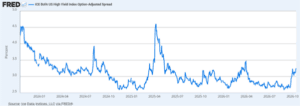
The US High Yield Option-Adjusted Spread (OAS)—the premium investors demand to hold corporate debt over government bonds—serves as a barometer for market anxiety. Currently hovering around 3.2 percentage points, up from 2.6 percentage points at the end of August, this spread indicates that the credit markets are becoming increasingly sensitive to default risk.
While this level is not yet at a crisis point, the trajectory is significant. Should these spreads widen toward the 4% threshold, it would signal a broader systemic risk, potentially restricting access to capital for the very AI-related projects that have driven the market over the last eighteen months. For investors, the takeaway is that a company’s ability to navigate the current credit environment is just as important as its technological competitive advantage.
Tesla and the Question of Deliverables
Among the high-profile tech names, Tesla remains at the center of the debate regarding capital efficiency. The recent unveiling of the Tesla Roadster 2, complete with SpaceX thrusters, generated significant media attention but did little to address the fundamental questions surrounding the company’s near-term profitability. With quarterly earnings pending, the market is looking for more than just marketing innovation; it is looking for evidence of sustainable cash generation.
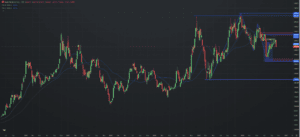
Technically, the stock is at a crossroads. After a 7.3% decline last week, Tesla fell to $355, dropping below its 20-week moving average of $366. To regain momentum, the stock must clear several key resistance levels, including the 50-week moving average at $396 and the critical $410 zone. Until the company can prove that its heavy investment cycle is beginning to yield a commensurate improvement in free cash flow, the risk of a further slide toward its July lows remains a tangible concern.
Resilience in the Cryptocurrency Markets
The digital asset space, led by Bitcoin and Ethereum, is also experiencing its own stress test. A recent high-profile security breach at a centralized platform provided a real-time assessment of market sentiment. Notably, Bitcoin’s price action remained relatively contained, suggesting that the industry may have matured beyond the era of cascading contagion that defined the collapses of 2022.
Despite this relative stability, both Bitcoin and Ethereum are navigating headwinds. Bitcoin is down approximately 7.6% in October, while Ethereum has seen a steeper decline of 16.4%. Institutional interest, as measured by ETF flows, has also cooled, with significant net outflows recorded in both Bitcoin and Ethereum products.
The current technical floor for Bitcoin is clustered around $76,000, which aligns with the "short-term holder cost basis"—the price at which investors who acquired their holdings within the last 155 days currently stand. A sustained move below this level could trigger a wave of selling as these recent holders face unrealized losses. For now, the market is waiting to see if these support levels hold, or if the current resilience will be tested by further macroeconomic pressure.
Strategic Portfolio Considerations
As the market navigates this period of repricing, the most important lesson for investors is to maintain a long-term perspective. Drawdowns are a natural, albeit painful, part of the investment cycle, often acting as a mechanism to flush out excess leverage and expose business models that are built on shaky foundations.
Investors are encouraged to reassess their portfolio concentration. The era of buying the "Magnificent Seven" or any high-growth tech stock indiscriminately is effectively over. Instead, the focus should be on companies that possess the financial strength to weather a high-interest-rate environment. Businesses that can fund their own future from existing operations are better positioned to survive the current volatility than those dependent on the whims of the debt markets.
Ultimately, the goal is to own companies where the fundamentals provide enough conviction to hold through periods of noise and uncertainty. While a cheaper entry price is always welcome, a business model that produces consistent cash flow is the only true hedge against a market that is finally beginning to prioritize fiscal reality over speculative potential. As the AI trade continues to mature, the winners will be those who can demonstrate that their technology is not just a revolutionary invention, but a profitable enterprise.
Related posts: