Bitcoin’s On-Chain Divergence: Institutions Drive Uptrend as Retail Investors Remain Sidelined, Hinting at Further Growth Potential

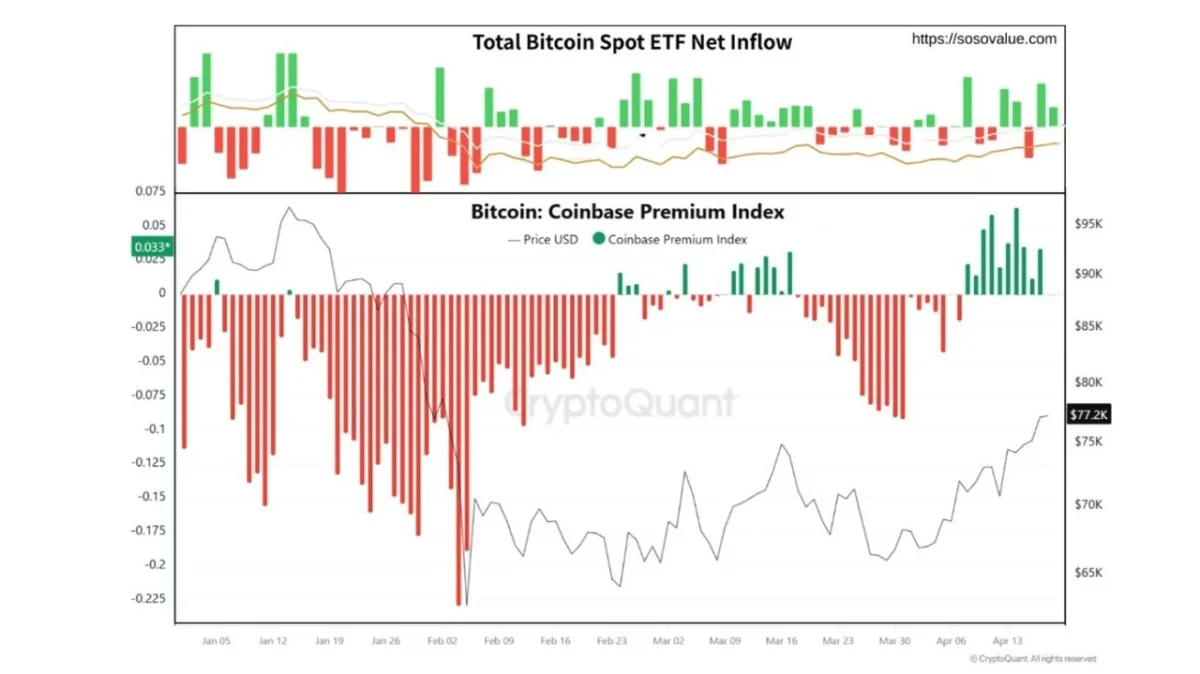
A recent comprehensive on-chain analysis has illuminated a significant divergence in investor behavior within the Bitcoin market, distinguishing sharply between the robust accumulation by institutional players and the lingering skepticism among retail investors. This analytical observation suggests that Bitcoin’s current price trajectory may possess substantial untapped potential, indicating more room for upward movement than has been observed thus far in the ongoing market cycle. The findings point to a sophisticated, institutionally-led rally that is evolving beneath a surface marked by widespread retail apprehension, a classic precursor to extended bullish phases in cryptocurrency markets.
Institutional Momentum: ETF Flows and Coinbase Premium Drive Uptrend
The core of this analysis, meticulously conducted by crypto research and education firm XWIN Research Japan and published as a Quicktake post on the CryptoQuant platform, focuses on critical structural shifts emerging within the Bitcoin ecosystem. The firm’s investigation hinges on three primary indicators: the Total Bitcoin Spot ETF Net Inflows, the Coinbase Premium Index, and the Fear & Greed Index. Each of these metrics offers a unique lens into market sentiment and capital flows, collectively painting a detailed picture of the current investment landscape.
The Total Bitcoin Spot ETF Net Inflows measure the aggregate movement of Bitcoin into or out of the recently approved spot Exchange Traded Funds (ETFs) in the United States. These instruments have revolutionized access to Bitcoin for traditional finance participants, allowing institutional investors, wealth managers, and even some retail investors to gain exposure to Bitcoin without directly holding the asset. Since their groundbreaking approval in January 2024, these ETFs have quickly become a dominant force in Bitcoin’s market dynamics, often dictating daily price movements through their substantial buying or selling pressure.
Complementing this, the Coinbase Premium Index tracks the price difference of Bitcoin between Coinbase, a leading US-based cryptocurrency exchange popular with institutional and high-net-worth investors, and other global exchanges. A positive premium on Coinbase typically signals strong buying pressure from US-based investors, often interpreted as institutional demand given Coinbase’s significant institutional client base. Conversely, a negative premium can indicate selling pressure or weaker demand from this cohort.

According to XWIN Research Japan, both the ETF Flows and the Coinbase Premium Index, currently registering around 0.56, are displaying a strong positive correlation. This alignment is not merely coincidental; it provides compelling evidence that inflows into spot Bitcoin ETFs are directly correlating with spot demand on platforms favored by US institutions. Crucially, the analysis posits that institutional buying often precedes the public reporting of ETF inflows, rather than being a direct consequence. This implies a proactive and strategic accumulation by large entities that then manifests in reported ETF figures and premium indices. The consistent positive premium on Coinbase, therefore, serves as a vital signal that US investors, particularly institutions, are actively re-engaging and are becoming the essential drivers behind Bitcoin’s upward price momentum. This sustained institutional interest has been a hallmark of Bitcoin’s performance throughout 2024, providing a solid demand floor even during periods of increased volatility.
Retail Hesitation: The Persistent "Wall of Worry"
In stark contrast to the aggressive institutional accumulation, the Fear & Greed Index narrates a distinctly different and less optimistic story regarding retail investor participation. This index, which gauges overall market sentiment by analyzing various factors such as volatility, market momentum, social media sentiment, and trading volume, currently hovers within the 10-30 range. These readings firmly place the market sentiment within the "Fear" to "Extreme Fear" categories, unequivocally indicating that the vast majority of retail investors remain on the sidelines, largely disengaged from the ongoing price action.
This persistent "sidelining" of retail investors is largely attributed to the significant losses many incurred during previous market downturns and corrections. The memory of sharp drawdowns, coupled with the inherent volatility of cryptocurrency markets, has fostered a cautious, if not fearful, approach among smaller investors. While institutional investors, driven by sophisticated models, long-term strategic allocations, and the "flow and structure" of traditional finance, continue their systematic accumulation, retail investors remain hesitant. This dichotomy creates a classic market phenomenon known as the "Wall of Worry" rally. In such a scenario, the price of an asset, in this case Bitcoin, continues to ascend despite widespread skepticism, fear, and a lack of broad-based retail participation. Each new price high is met with disbelief rather than excitement, causing many retail investors to miss out on significant gains as they wait for an "ideal" entry point that may never materialize at lower levels.
XWIN Research Japan emphasizes that this dynamic suggests the market is currently in the early to mid-phase of an institutionally-led uptrend. During this phase, retail participation is notably absent from the primary factors actively driving prices higher. However, the analysis also presents a crucial potential inflection point: should retail activity eventually pick up with predominantly bullish intent, driven by a fear of missing out (FOMO) as prices climb further, the premier cryptocurrency could experience an exponential acceleration in its upward trajectory. The eventual capitulation of retail fear and their re-entry into the market is often a characteristic feature of later-stage bull runs.
Historical Precedents and Market Cycles

The current market structure, characterized by a leading institutional charge and lagging retail enthusiasm, is not unprecedented in Bitcoin’s history. Past bull cycles, notably those in 2017 and 2021, often began with "smart money" – early adopters, high-net-worth individuals, and eventually institutions – quietly accumulating before a broader retail frenzy took hold.
In 2017, Bitcoin’s ascent from under $1,000 to nearly $20,000 was initially fueled by growing awareness and a burgeoning ecosystem, but it was the dramatic surge in retail interest and media coverage that propelled it to its peak. Similarly, the 2021 bull run saw significant institutional adoption, with companies like Tesla and MicroStrategy adding Bitcoin to their balance sheets, alongside a renewed wave of retail engagement spurred by pandemic-era liquidity and social media trends. However, even in these cycles, there was often an initial phase where the price moved significantly before the mainstream public fully recognized the opportunity.
A key background factor for Bitcoin’s cyclical behavior is the "halving" event, which occurs approximately every four years. This event reduces the reward miners receive for validating transactions, thereby cutting the supply of new Bitcoin entering the market. Historically, halvings have preceded significant bull runs due to the supply shock they introduce. While not explicitly mentioned in the original source, the most recent halving in April 2024 (or the lead-up to it, depending on the article’s precise timing) provides a critical macroeconomic context for the current institutional accumulation. Institutions, with their long-term investment horizons, are often positioning themselves in anticipation of these supply-side shocks and their potential impact on price.
The Broader Landscape: Macro Factors and Regulatory Environment
The emergence of institutional dominance in the current Bitcoin cycle cannot be fully understood without acknowledging the broader macroeconomic and regulatory environment. Globally, institutions are increasingly seeking uncorrelated assets to diversify portfolios, especially in an era marked by persistent inflation concerns, geopolitical uncertainties, and shifting monetary policies. Bitcoin, often referred to as "digital gold," presents itself as an attractive hedge against traditional financial market volatility and currency debasement.
The approval of spot Bitcoin ETFs in the United States by the Securities and Exchange Commission (SEC) in January 2024 was a watershed moment. This regulatory green light provided unprecedented legitimacy and accessibility for institutional investors. Before ETFs, investing in Bitcoin often involved navigating complex direct custody solutions or less regulated futures markets. The ETFs, offered by established financial giants like BlackRock, Fidelity, and Franklin Templeton, provide a familiar, regulated, and highly liquid investment vehicle, effectively bridging the gap between traditional finance and the nascent digital asset space. This regulatory clarity and ease of access have been instrumental in enabling the "flow and structure" that facilitates institutional accumulation. The ongoing competition among these ETF providers also drives efficiency and liquidity, further benefiting institutional investors.

Expert Insights and Analytical Rigor
The insights provided by XWIN Research Japan, leveraging CryptoQuant’s robust data platform, underscore the increasing sophistication of cryptocurrency market analysis. On-chain analysis, which involves scrutinizing the public ledger of blockchain transactions, allows researchers to gain unparalleled transparency into market behavior that is often opaque in traditional financial markets. By tracking metrics like coin movements, wallet activity, exchange flows, and premium indices, analysts can infer the intentions and actions of different investor cohorts, offering a deeper understanding of market structure beyond simple price charts.
This rigorous, data-driven approach is crucial for investors seeking to navigate the complex and often emotionally charged cryptocurrency markets. It moves beyond speculative narratives to provide actionable intelligence based on verifiable blockchain data. The emphasis on accuracy, relevance, and impartiality in such research ensures that market participants receive well-founded insights, aligning with the highest standards in financial reporting and analysis.
Potential Trajectory and Future Outlook
Given the current dynamics, where institutions are leading the charge while retail remains on the sidelines, Bitcoin’s price trajectory appears poised for continued growth. The "institutional-led uptrend" suggests a more stable and potentially prolonged bull market, as large capital inflows provide sustained demand. The current valuation of Bitcoin, which stood at approximately $75,703 at press time, having experienced a modest 2.24% decline over the past day according to CoinMarketCap data, reflects a market that is consolidating after significant gains but maintains strong underlying support from institutional buying.
The critical trigger for an accelerated upside will likely be the eventual shift in retail sentiment. As Bitcoin continues to set new all-time highs and its price gains become increasingly difficult to ignore, the "Fear & Greed" index is expected to climb into the "Greed" and "Extreme Greed" territories. This typically signals the re-entry of retail investors, often driven by FOMO, who then add significant liquidity and momentum to the market. When this widespread retail participation combines with the foundational institutional demand, Bitcoin could experience exponential growth phases, characteristic of past bull cycles. However, predicting the exact timing of this retail capitulation remains challenging, as it often depends on a confluence of price action, mainstream media coverage, and overall market euphoria.
Risks and Considerations
While the outlook appears bullish based on current on-chain signals, it is imperative to acknowledge the inherent risks and volatility associated with the cryptocurrency market. Bitcoin, despite its growing institutional acceptance, remains a highly speculative asset. Potential headwinds include unforeseen regulatory crackdowns in major jurisdictions, significant macroeconomic shifts that could reduce risk appetite globally, or substantial profit-taking by early institutional investors who have already realized considerable gains.
Furthermore, the "Wall of Worry" can also be a double-edged sword. While it signals potential for growth, it also means that the market is more susceptible to sudden corrections if institutional sentiment were to reverse quickly. Investors are always advised to conduct their own thorough research and to consider their risk tolerance before making any investment decisions. Past performance is not indicative of future results, and the digital asset space continues to evolve rapidly.
Conclusion
The latest on-chain analysis paints a compelling picture of Bitcoin’s current market phase: a robust, institutionally-driven uptrend proceeding amidst a backdrop of lingering retail fear. The positive correlation between Bitcoin Spot ETF net inflows and the Coinbase Premium Index unequivocally highlights the proactive accumulation by sophisticated US-based investors. Simultaneously, the low readings on the Fear & Greed Index confirm that retail participants largely remain unengaged, a classic setup for a "Wall of Worry" rally. This structural divergence positions Bitcoin for potentially significant further growth, especially if and when retail investors eventually overcome their skepticism and re-enter the market with bullish intent. The journey from niche digital asset to a recognized institutional investment vehicle continues, with profound implications for its future price discovery and broader adoption.