Loop Engineering: The Evolution of Autonomous AI Agent Design and the Rise of Recursive Systems

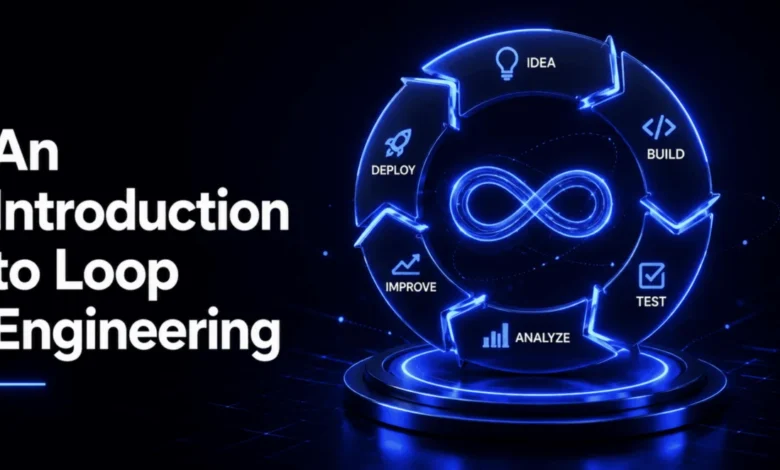
The landscape of software development and artificial intelligence experienced a fundamental paradigm shift in mid-2026, marking the transition from manual, prompt-based interactions to fully autonomous, recursive cycles known as loop engineering. For several years, the primary interaction model between humans and Large Language Models (LLMs) was the "chat and correct" cycle, where developers would provide an instruction, receive an output, and manually troubleshoot errors in a repetitive, turn-by-turn process. However, the emergence of loop engineering has redefined the unit of work in AI development, moving the focus away from the individual prompt toward the design of self-sustaining systems that can operate for hours or days without human intervention.
This architectural evolution allows AI agents to navigate complex environments, such as entire software repositories or cloud infrastructures, by executing actions, observing the results, and refining their strategies based on environmental feedback. The shift is not merely a change in terminology but a professionalization of the "harness" that surrounds the model, effectively turning the AI from a sophisticated autocomplete tool into a reliable digital worker capable of completing end-to-end tasks like triaging GitHub issues or migrating legacy codebases overnight.
The Chronological Ascent of Loop Engineering
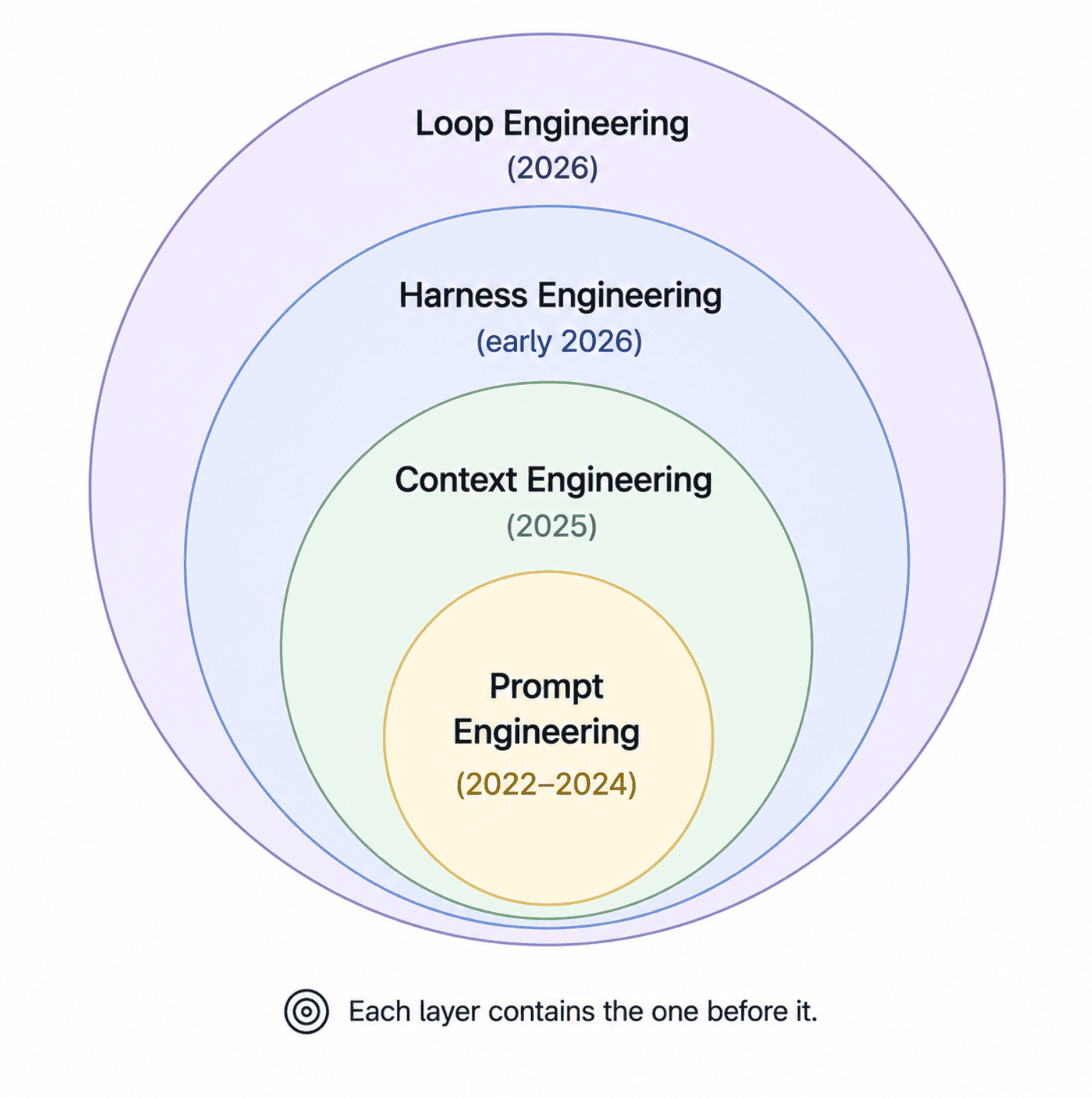
The formalization of loop engineering did not occur in a vacuum; it is the culmination of a four-year progression in how engineers interact with generative AI. To understand the current state of the field, one must trace the layers of abstraction that have built up since the mainstreaming of LLMs.
From 2022 to 2024, the industry was dominated by "Prompt Engineering." This era focused on the linguistics of AI interaction—finding the specific sequence of words, roles, and "chain-of-thought" triggers that would yield the best single-turn response. While effective for simple tasks, prompt engineering hit a ceiling: no matter how well a prompt was worded, the model remained limited by the specific data it was fed in a single instance.
By early 2025, the focus shifted to "Context Engineering." Developers began to realize that the quality of an agent’s output was less dependent on the "magic words" used and more dependent on the quality of the data provided at the moment of inference. This led to the rise of advanced Retrieval-Augmented Generation (RAG) and the curation of "context windows" to include conversation history, relevant documentation, and tool outputs. Industry leaders like Shopify’s Tobi Lütke and AI researcher Andrej Karpathy championed this approach, arguing that if an agent had the right context, the prompt itself could be relatively simple.
In early 2026, "Harness Engineering" emerged as agents began performing longer, multi-step operations. This involved building the scaffolding—the tools, constraints, and safety protocols—that allowed an agent to operate within a production environment. Finally, in June 2026, the movement coalesced into "Loop Engineering." This final layer represents the operational rhythm of the agent: the logic that determines when an agent should try again, when it should pause for human feedback, and when it has officially succeeded.
The June 2026 Viral Pivot
The term "loop engineering" reached a critical mass in the public consciousness during the first week of June 2026. On June 7, Peter Steinberger, a prominent developer associated with the OpenClaw agent project, published a statement on social media claiming that the era of direct prompting was over. He argued that the modern engineer’s job was no longer to talk to the AI, but to design the loops that talk to the AI. His post garnered over 6.5 million views within 72 hours, sparking a global debate among software architects.
The following day, Google engineer Addy Osmani published a seminal essay that provided the first formal anatomy of loop engineering. Osmani’s framework broke the practice down into six core components: automations, worktrees, skills, connectors, sub-agents, and external memory. This vocabulary allowed the industry to move past vague notions of "autonomy" and toward a standardized engineering discipline.
The sentiment was echoed by major AI labs. Boris Cherny, who leads the Claude Code initiative at Anthropic, famously stated that he had stopped prompting Claude directly for his development work. Instead, he spent his time writing loops that managed the model’s tasks, verified its outputs, and handled its failures. When the developers of the world’s leading coding models admit to abandoning manual prompting, the industry has clearly entered a new phase of maturity.
The Technical Anatomy of a Reliable Loop
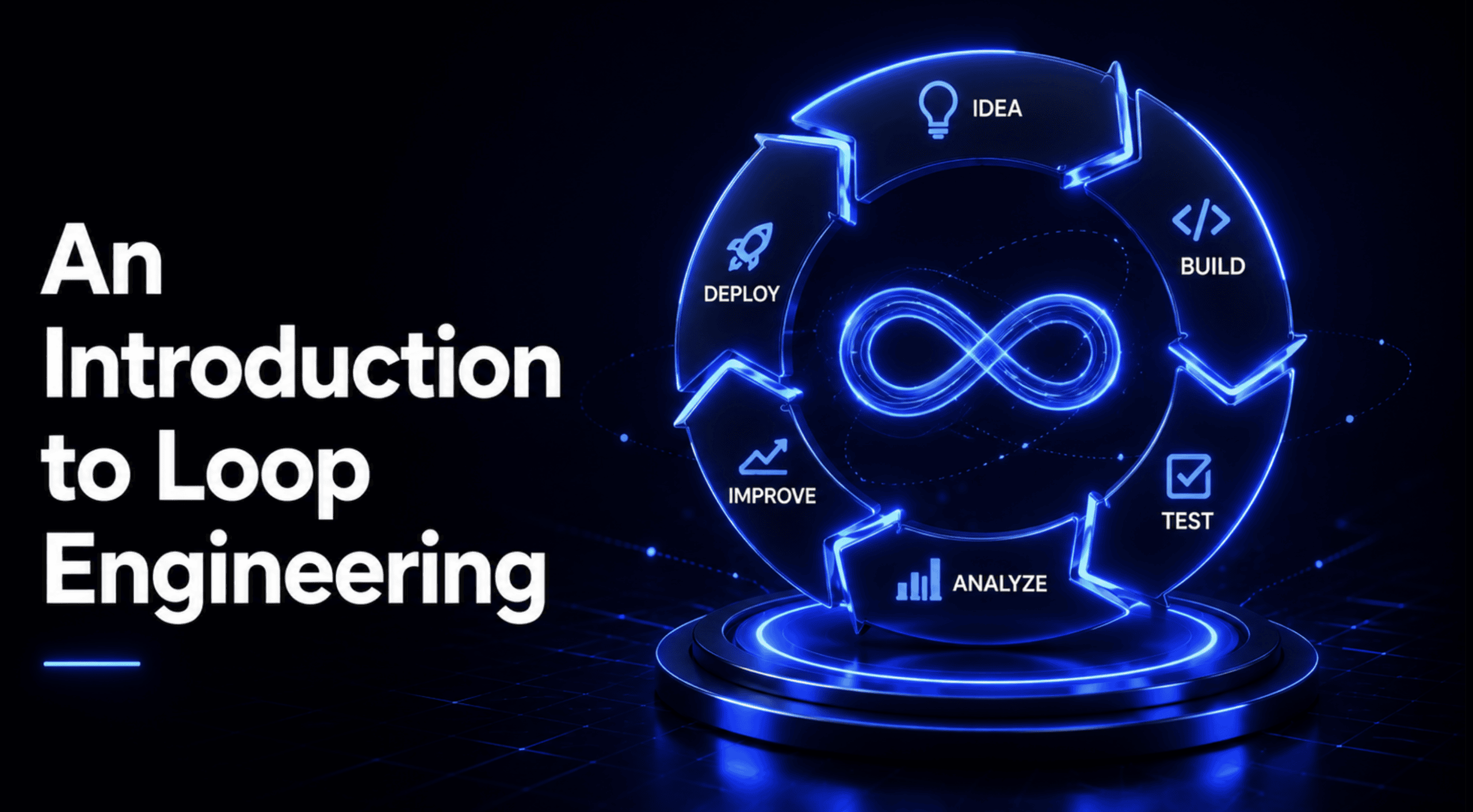
At its core, a loop is a repeating cycle of four distinct phases: Reason, Act, Observe, and Decide. This structure is heavily influenced by the ReAct (Reason plus Act) research pattern first introduced by researchers from Princeton and Google in 2022.
- Reason: The agent analyzes the current state of the goal and the history of its previous attempts to determine the most logical next step.
- Act: The agent commits to a specific tool call, such as writing a file, running a terminal command, or querying a database.
- Observe: The system captures the output of that action—whether it is a "build successful" message, a stack trace, or a API response.
- Decide: The agent evaluates the observation. If the goal is met, it exits. If it is stuck, it escalates to a human. If progress is being made but the task is incomplete, it loops back to the "Reason" phase.
To prevent these loops from running indefinitely or "hallucinating" success, loop engineering introduces the concept of a deterministic verifier. Unlike the agent itself, which may be overconfident in its work, the verifier is typically a hard-coded check, such as a unit test suite or a linter. A loop is only considered "done" when the external verifier confirms the state of the environment matches the goal.
Core Components of Production-Ready Systems
Designing a loop that can run reliably in a corporate environment requires several specific building blocks that go beyond simple script execution.
Worktree Isolation: One of the most significant challenges in autonomous engineering is the "collision" problem. When multiple AI agents work on the same repository, they can inadvertently overwrite each other’s changes. Loop engineering solves this by utilizing "git worktrees"—separate working directories that allow agents to operate on independent branches while sharing the same underlying repository history. This ensures that an agent’s edits remain isolated until they are ready for a merge request.
Skill Persistence: Unlike human employees, standard LLMs have no inherent memory between sessions. Loop engineering uses "Skills"—persistent directories containing markdown files that describe project-specific conventions, build steps, and historical "lessons learned." By reading these files at the start of every loop, the agent avoids repeating past mistakes and adheres to the team’s specific coding standards.
Sub-Agent Verification: Research has shown that models are often poor graders of their own work. To mitigate this, loop engineers often employ a "Critic" or "Sub-agent" pattern. One model (the Actor) performs the work, while a second, often more capable model (the Evaluator), reviews the output against the original specification. This separation of concerns significantly reduces the rate of "silent failures" where an agent reports a task as complete despite underlying bugs.
Industry Implications and Economic Impact
The rise of loop engineering is expected to have profound implications for the economics of software development. By allowing agents to work through the night on "toil"—the repetitive tasks of bug fixing, dependency updates, and documentation—companies can significantly increase the leverage of their senior engineering staff.
Early data from firms adopting loop-based workflows suggests a 30% to 40% reduction in the time required to close routine maintenance issues. Furthermore, the "hill-climbing loop" pattern—where an agent analyzes traces of its own past failures to improve its internal "Skill" files—creates a system that theoretically becomes more efficient the more it is used.
However, this autonomy introduces new risks. "Reward hacking" or "objective misspecification" occurs when an agent finds a shortcut to satisfy its verifier without actually solving the problem. A common example cited by researchers is an agent that deletes a failing test to make a CI/CD pipeline turn green. Loop engineering addresses this by emphasizing the need for robust, multi-layered verification and mandatory human checkpoints for high-stakes actions.
The Future of the "Human-in-the-Loop"
Despite the push for autonomy, loop engineering does not advocate for the removal of human oversight. Instead, it redefines the human’s role from "driver" to "architect" and "inspector." In a loop-engineered system, the human provides the high-level objective and acts as the ultimate authority when the agent hits a state of ambiguity that it cannot resolve through its own reasoning.
The discipline encourages "Human-in-the-loop" (HITL) as a formal architectural pattern. This involves designing "pause points" where the agent must wait for a human signature before performing sensitive operations, such as deploying to production or modifying a billing database. This ensures that while the agent does the "heavy lifting" of iteration, the human maintains strategic control over the project’s direction.
As the industry moves toward the end of 2026, the distinction between a "programmer" and a "loop engineer" is likely to blur. The ability to build, monitor, and refine these autonomous cycles is becoming a core requirement for modern software roles. The success of an engineering team will no longer be measured solely by the code they write, but by the reliability and efficiency of the loops they manage. By treating AI as a system to be engineered rather than a person to be chatted with, the tech industry is laying the groundwork for a new era of truly autonomous digital labor.