Navigating the AI Cybersecurity Paradox: What Mature Security Programs Need Before Deployment

Enterprise Chief Information Security Officers (CISOs) are currently navigating a turbulent technological landscape defined by intense pressure to acquire and deploy artificial intelligence-powered security tools. However, as software vendors increasingly rebrand legacy offerings under the umbrella of AI, cybersecurity leaders face a daunting operational challenge: distinguishing tools that genuinely reduce systemic risk from those that merely inflate operational budgets. Compounding this issue, deploying sophisticated machine learning models or generative AI agents atop foundational vulnerabilities—such as weak access controls, poorly categorized data, or opaque network perimeters—often exacerbates existing security gaps rather than closing them.
Recent empirical research underscores the scale of this disconnect. According to findings published by the World Economic Forum, roughly one-third of global organizations currently maintain no formal process for assessing the security posture of AI tools prior to deployment. This oversight persists even as 87 percent of enterprise leaders identify AI-related vulnerabilities as the fastest-growing cyber risk facing modern corporations.
Parallel insights from the National Institute of Standards and Technology (NIST) highlight that third-party generative AI solutions introduce acute privacy and information-security risks, heavily dictated by the scope of data and systems they are granted permission to access. Demonstrating this vulnerability in practice, a Cloud Security Alliance study revealed that 53 percent of organizations have experienced incidents where AI agents exceeded their intended operational permissions, with 47 percent suffering a direct security breach involving an AI agent over the past year. Furthermore, data compiled by ISACA indicates that 56 percent of digital trust professionals remain uncertain of how quickly their organizations could successfully halt a rogue or compromised AI system during an active security incident.
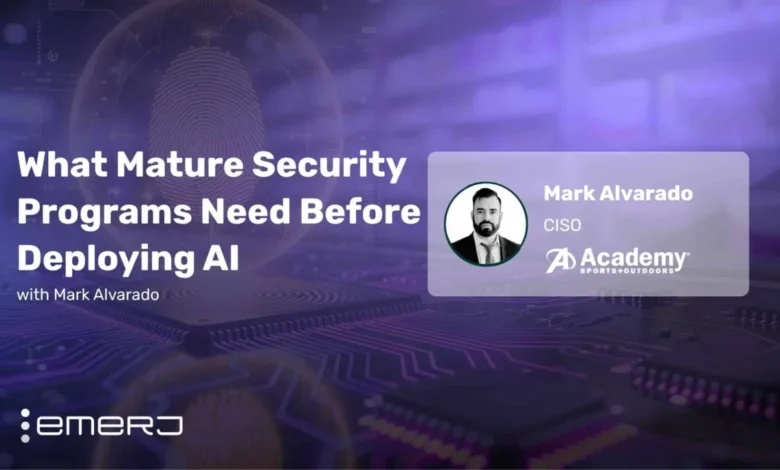
To dissect these mounting pressures, Yolandi de Weerdt, host of the AI in Business podcast by Emerj, recently sat down with Mark Alvarado, CISO at Academy Sports + Outdoors. Their discussion focused on mapping out strategies for security leaders to separate authentic AI utility from marketing hype, while examining how unchecked automation can compound legacy vulnerabilities across identity management, data governance, network security, and human behavioral practices.
The Evolution of Enterprise AI Adoption: A Timeline of Risk
The rapid acceleration of enterprise AI integration did not occur in a vacuum; it represents the culmination of a multi-year technological shift that caught many traditional risk management frameworks off guard.
Between 2022 and 2023, the widespread availability of consumer-grade generative AI ignited a profound "shadow AI" phenomenon. Employees across industries began uploading sensitive corporate data, source code, and proprietary financial information into external large language models without the knowledge or consent of their respective IT departments. This grassroots adoption forced corporate boards to react quickly, shifting budgets away from traditional perimeter defense toward rapid AI acquisition.
By 2024, software vendors responded to this demand by embedding machine learning algorithms and generative features into virtually every category of enterprise software, from endpoint detection and response (EDR) platforms to security orchestration, automation, and response (SOAR) tools. By 2025 and into 2026, the market reached a saturation point characterized by vendor over-promising and buyer fatigue. Regulatory bodies, including NIST and the European Union through the implementation of the EU AI Act, began establishing strict compliance mandates, forcing CISOs to transition from reactive purchasing to rigorous, governance-first evaluations. It is within this regulatory and operational crucible that seasoned security leaders like Alvarado are redefining how organizations vet and deploy intelligent automation.
Problem-Led Evaluation: Cutting Through Vendor Noise
Vendor marketing frequently emphasizes an AI tool’s ability to detect threats at unprecedented speeds. However, Alvarado argues that external vendors can never fully comprehend a specific enterprise’s internal architecture, operational workflows, or unique threat profile as thoroughly as internal security teams. Consequently, the burden of proof rests squarely on the buyer.
Drawing from his extensive background in business analysis, Alvarado approaches cybersecurity investments through a disciplined, methodical framework. Historically, when a business unit requested a new technological solution, effective analysts would document the current workflow, map out the desired future state, and outline precise technical requirements before researching market options or lobbying for stakeholder buy-in.
Alvarado applies this exact sequence to modern security investments. Before evaluating software capabilities or engaging in pricing negotiations, security leaders must draft a formal problem statement. This document should identify potential solutions, calculate the true total cost of ownership—including integration, maintenance, and potential false-positive remediation—and serve as the foundational charter for the project. Whether the proposed solution incorporates advanced artificial intelligence or relies on deterministic logic, this foundational exercise forces clarity, frequently validating the necessity of a tool or preventing wasteful spending before a budget request is ever submitted.
Moreover, Alvarado stresses the importance of establishing a universally understood definition of "AI" during vendor discussions. Because buyers and sellers often use the term colloquially to describe everything from basic automated scripts to complex autonomous agents, technical, financial, and legal stakeholders must reach a consensus on terminology before entering contract negotiations.
Human behavior represents the final, and often most volatile, variable in the evaluation equation. Alvarado advocates for comprehensive AI governance programs that provide employees with unambiguous guidelines regarding acceptable use cases, prohibited applications, and critical questions to ask prior to deployment. Without cultural buy-in and employee education, technical controls inevitably fail as users seek out shadow IT alternatives to bypass restrictive guardrails. As Alvarado succinctly notes, deploying expensive security controls without addressing user behavior is analogous to installing high-end locks on a house while leaving windows open; regardless of the hardware’s cost, determined intruders will find a way inside.
Identity, Data, and Network Visibility as Non-Negotiable Foundations
According to Alvarado, if an enterprise security program was not fundamentally sound prior to the introduction of AI, artificial intelligence will only magnify those existing flaws exponentially. The prerequisite for any successful AI deployment begins with deep organizational self-awareness: knowing precisely how enterprise architecture is mapped, where critical data assets reside, and where the corporate network edge truly exists.
Alvarado identifies three foundational pillars that organizations must prioritize and "button down tight" before introducing AI into their security architectures. While these programs do not need to achieve absolute perfection—a pursuit that is often cost-prohibitive—they must reach a level of operational maturity where security teams can definitively answer three core questions before an AI system goes live:
- Identity Management: Who or what is currently accessing our systems, and are those privileges strictly limited to the principle of least privilege?
- Data Governance: Where is our sensitive, regulated, and proprietary data stored, how is it classified, and who currently has read and write permissions?
- Network Visibility: What constitutes normal baseline traffic across our internal network segments and cloud environments, and can we instantly isolate anomalous behavior?
While acknowledging that cybersecurity encompasses numerous other critical domains, Alvarado emphasizes that cloud migration and escalating threat volumes make identity, data, and network visibility the vital substrates upon which successful AI security tools must operate. Only by establishing these foundations can organizations hope to successfully "fight AI with AI."
Response Thresholds and Material Business Risk
Once visibility over identity, data, and network activity has been established, AI excels at processing massive volumes of telemetry to identify deviations from established operational baselines. Alvarado conceptualizes this dynamic using a relatable metaphor: the enterprise network is a road, connected devices are automobiles, digital identities represent the drivers, and credentials function as the keys. An unexpected alteration in route, destination, device, or data access strongly suggests that an unauthorized actor may be operating the account.
Because human behavior is fundamentally habitual, machine learning models can accurately profile normal activity for every identity and surface deviations for review. However, a statistical deviation does not inherently signify malicious intent, as legitimate business needs frequently shift.
This reality forces CISOs to establish clear operational thresholds. Alvarado distinguishes between asking a user to confirm an unusual login via multi-factor authentication and taking away the "keys" entirely by instantly revoking an identity or severing a network connection. When behavioral patterns diverge so drastically from the norm that an organization faces catastrophic exposure, security teams must act first and investigate second.
This aggressive posture ties directly into Alvarado’s philosophy regarding the core responsibilities of a CISO:
"Fundamentally, at a CISO level, your job is not to stop every little thing that happens. You can, that’s great. There’s a cost associated with it. Your job is to keep the event from being material. The material threshold is different for every company, and each company should determine what that material threshold is. That’s how you make sure that you’re making good use of funds, because your program’s gonna cost."
— Mark Alvarado, CISO at Academy Sports + Outdoors
By defining this materiality threshold, organizations can tailor their risk tolerance and defense spending accordingly. While acting prematurely on a false positive carries operational friction—such as temporarily interrupting an employee’s workflow—Alvarado notes that these disruptions are easily resolved by restoring access once verification is complete. In his experience, stakeholders rarely object to security teams erring on the side of caution.
Broader Implications and Industry Outlook
The insights articulated by security leaders like Alvarado point toward a necessary maturation phase in enterprise cybersecurity. As the initial wave of market hype surrounding artificial intelligence subsides, organizations are realizing that generative models and autonomous agents are force multipliers of existing organizational capability—magnifying both strengths and weaknesses alike.
Regulatory scrutiny from bodies such as NIST and international data protection authorities will likely continue to tighten compliance expectations regarding algorithmic transparency, data lineage, and automated decision-making. Consequently, enterprises that fail to establish robust data governance and identity management will find themselves increasingly vulnerable not only to external threat actors, but to internal compliance penalties and operational instability caused by runaway AI agents.
Ultimately, the successful integration of AI into corporate security programs requires abandoning impulsive, vendor-driven purchasing habits in favor of structured problem-solving. By anchoring AI deployments to rigorous business problem statements, enforcing strict foundational controls around data and identity, and defining clear thresholds for material risk, enterprises can transform artificial intelligence from an unpredictable operational hazard into a reliable, defensible shield against modern cyber threats.