Dormant Supply Chain Vulnerabilities Exploded as Compromised GitHub Actions Briefly Re-Emerged

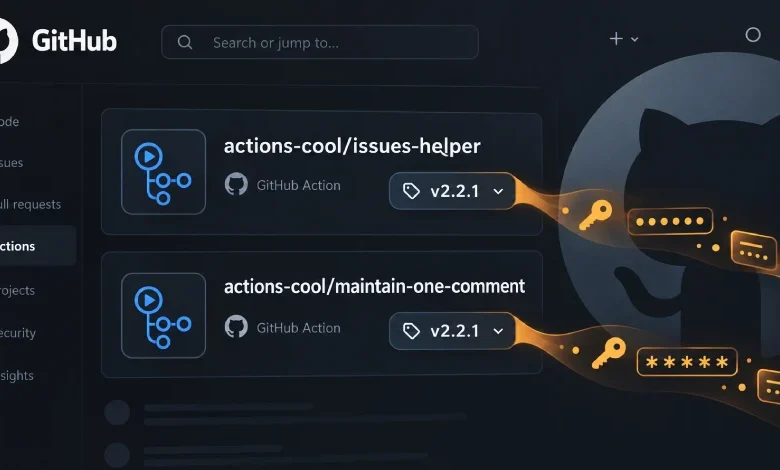
Software supply chain security faced an unexpected and alarming test in September 2026, when two malicious GitHub Actions—previously neutralized months prior during the infamous "Mini Shai-Hulud" campaign—briefly became accessible to the public once again. The inexplicable re-activation exposed a glaring loophole in how development teams rely on mutable version tags for continuous integration and continuous deployment (CI/CD) pipelines. Without a single line of new code being pushed by threat actors, the resurrected repositories immediately began serving malicious payloads to downstream software projects, underscoring the enduring risks of stale dependencies and inadequate incident hygiene.
The incident centers around two widely used GitHub Actions designed to automate standard repository maintenance tasks, such as managing incoming pull requests, cleaning up inactive issues, and maintaining automated bot commentary. Initially compromised on May 18, 2026, these actions were weaponized to execute malicious code designed to harvest sensitive environment variables, credentials, and API tokens from any CI/CD pipeline that triggered them. Once exfiltrated, these confidential details were funneled directly to an attacker-controlled command-and-control server.
The Anatomy of the Mini Shai-Hulud Campaign
To understand the severity of the September re-emergence, security analysts must examine the broader context of the threat landscape in the spring of 2026. The initial compromise of the GitHub Actions in mid-May was quickly tied by threat intelligence researchers—most notably from the software supply chain protection firm Socket—to a coordinated and sophisticated threat cluster known as "Mini Shai-Hulud."
This cluster first captured the cybersecurity community’s attention when researchers discovered malicious payloads injected into popular packages within the @antv ecosystem on the Node Package Manager (npm) registry. Investigators connected the dots between the npm supply chain incursions and the GitHub Actions compromise by tracking shared infrastructure, specifically pointing to an identical data exfiltration domain (t.m-kosche[.]com) utilized across both attack vectors.

Philipp Burckhardt, head of threat intelligence at Socket, highlighted the cross-ecosystem nature of the threat at the time, confirming that the incidents were not isolated, single-platform nuisances, but rather parts of a unified, multi-channel campaign designed to harvest developer credentials at scale. For weeks following the May disclosures, platform administrators worked furiously to purge malicious code, isolate compromised accounts, and shut down offending repositories to stem the tide of credential theft.
The September Re-activation: A Ghost in the Pipeline
The situation took a bizarre and dangerous turn on September 16, 2026. Sometime between 11:09 a.m. and 6:16 p.m. GMT+2, both of the previously disabled GitHub Actions repositories mysteriously became accessible again on the platform. Official reasons behind why the repositories were restored remain shrouded in ambiguity, but the operational fallout was immediate and severe.
According to Socket researcher Karlo Zanki, the core of the problem lay in the fact that the original release tags associated with the repositories had never been cleaned up or deleted during the initial remediation phase in May. These lingering release tags still pointed directly to the malicious code introduced months prior. Consequently, any software project or developer workflow configured to reference these actions by a mutable version tag (such as @v1 or @latest) automatically resumed downloading and executing the harmful payload upon its next scheduled or event-driven run.
Because these housekeeping actions typically execute on a daily cadence or trigger automatically whenever a contributor opens a pull request or files an issue, the window of exposure was catastrophically small. In practice, most dependent repositories likely fetched and executed the malicious script within hours of the repositories coming back online, entirely bypassing the need for threat actors to deploy new infrastructure, engineer novel exploits, or alter their tactics.
Challenging Conventional Incident Response Paradigms
Security analysts point out that this incident breaks the mold of typical software supply chain attacks. Historically, supply chain breaches are defined by freshness: a newly published malicious package version, a freshly hijacked maintainer account, or a newly injected workflow configuration.

In contrast, the September 2026 incident demonstrated a novel threat vector: the weaponization of history. The threat actors behind Mini Shai-Hulud did not need to touch their infrastructure or write new code. They simply relied on the persistence of mutable references and a breakdown in administrative state management.
"Most supply chain incidents involve something new," explained Socket researcher Karlo Zanki. "This one did not. No new code was published and no configuration was changed. This incident shows that a mutable tag can be compromised, contained, and then reactivated without any change to your own workflow file. SHA pinning removes that dependency on the upstream repository’s state."
Broader Implications for Enterprise CI/CD Security
The brief revival of the Mini Shai-Hulud repositories serves as a stark wake-up call for DevOps engineers, security architects, and platform administrators regarding the inherent fragility of modern software development pipelines. Modern software development relies heavily on third-party integrations, open-source libraries, and automated actions to accelerate delivery pipelines. However, this modularity introduces extensive attack surfaces.
When platform providers remediate compromised assets, the assumption among developers is often that the threat has been entirely neutralized across all dimensions. This event proves that incomplete hygiene—such as leaving historic version tags intact on quarantined repositories—can leave an open back door. If a repository is later reinstated, intentionally or by administrative oversight, those dormant tags act as automated time-bombs.
Furthermore, the incident highlights the critical importance of secure pinning practices within CI/CD configurations. Many organizations routinely reference GitHub Actions using semantic versioning tags (e.g., actions/checkout@v3), which are inherently mutable. A mutable tag means that the code executed by the pipeline can change if the underlying repository tag is altered, re-pointed, or—in this case—restored to a previously compromised state.

Recommended Mitigation and Remediation Strategies
In the wake of this security lapse, cybersecurity experts and platform authorities are strongly urging development teams to audit their CI/CD pipelines immediately. Organizations must transition away from trusting mutable version tags for critical external workflows.
To safeguard software supply chains against similar dormant or resurrected threats, developers and security teams are advised to implement the following technical best practices:
- Adopt Full SHA Pinning: Instead of referencing GitHub Actions by branch names or mutable version tags (such as
@v1or@main), configure workflows to reference actions by their immutable, full 40-character commit SHA (e.g.,actions/checkout@8f4b7f84864c84a7531718442553635161995713). This ensures that the exact, verified code snippet executed is static and immune to upstream repository changes or tag tampering. - Conduct Comprehensive Workflow Audits: Regularly review all YAML configuration files within the
.github/workflowsdirectory to identify and catalog every third-party action in use. Ensure that internal visibility extends to transitive actions called by primary dependencies. - Rotate Compromised Credentials: Given that the original May 2026 campaign focused on credential harvesting from CI/CD environments, any organization that utilized the affected housekeeping actions should immediately rotate all API keys, deployment tokens, cloud credentials, and SSH keys that were accessible within those execution environments.
- Implement Principle of Least Privilege: Restrict the permissions granted to GitHub Actions tokens (
GITHUB_TOKEN). Limit write access and secret availability strictly to workflows that genuinely require them, minimizing the blast radius if an action is compromised. - Monitor Upstream Dependencies: Utilize software composition analysis (SCA) and specialized supply chain security tools capable of detecting anomalous repository behavior, untrusted maintainer activities, and risky tag mutations in real-time.
As software development grows increasingly automated, the security of the tools building the software is just as important as the security of the code itself. The second-act failure of the Mini Shai-Hulud GitHub Actions underscores that digital hygiene cannot stop at temporary containment; it requires architectural resilience, immutable references eternalized through cryptographic pinning, and constant vigilance across the entire software lifecycle.
Related posts: