The Myth of the Dart-Throwing Monkey and the Hard Reality of Modern Stock Selection

The enduring Wall Street fable suggests that a chimpanzee throwing darts at a financial broadsheet could outperform the average professional money manager. While this anecdote serves as a humorous critique of the financial services industry, current market data from 2026 suggests the reality is significantly more unforgiving. For the individual investor, the stock market has transitioned into an environment where the divide between the elite performers and the broad market is not just a statistical anomaly, but a structural feature of modern equity indices.
Through the close of trading on September 24, 2026, the S&P 500 demonstrated robust growth, posting a year-to-date return exceeding 13%. However, this headline figure obscures a turbulent landscape occurring beneath the surface. An analysis of the index reveals that only 35% of individual constituents are currently outpacing the index itself. More strikingly, four out of every ten stocks in the S&P 500 are currently recording negative returns for the year. This disparity highlights a market driven by extreme concentration, where the performance of a select few "mega-cap" entities masks widespread underperformance among the broader corporate population.
The Widening Gap Between Winners and Losers
The 2026 fiscal year has proven to be a period of intense polarization for equity valuations. While indices have thrived, a quarter of the companies within the S&P 500 have suffered declines of 10% or more. Household names have not been immune to this trend; companies such as Lululemon and Nike have seen their market capitalizations contract by 51% and 42%, respectively. Similarly, industrial and consumer staples like FedEx, Domino’s, and Netflix have faced significant headwinds, posting double-digit losses.
Conversely, the top tier of the market has experienced unprecedented surges. Nineteen stocks within the index have recorded returns exceeding 100% since the start of the year. This cohort includes companies like SanDisk (+665%), Dell (+341%), Intel (+232%), and CrowdStrike (+124%). This dichotomy creates a "slugging percentage" effect: the market succeeds not because the average company is performing well, but because the extreme outliers produce enough capital appreciation to carry the entire index forward.
A Historical Shift in Buy-and-Hold Efficacy
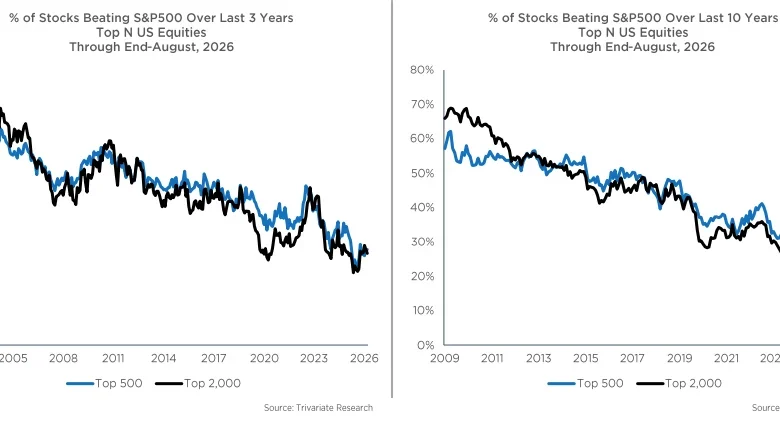
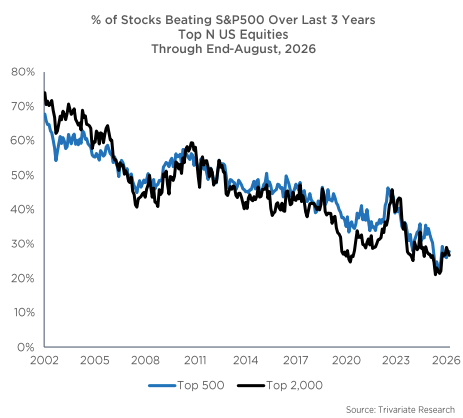
The assumption that long-term "buy-and-hold" strategies are the panacea for wealth creation is facing renewed scrutiny. According to a recent report by Adam Parker of Trivariate Research, the probability of an individual stock outperforming the broader S&P 500 over extended horizons has plummeted. Data indicates that over a 10-year period, only 23% of stocks have managed to beat the benchmark index. The three-year performance metrics tell a similarly discouraging story for stock-pickers.
This represents a stark departure from the post-dot-com era, where win rates for individual stocks frequently hovered between 60% and 70%. The current trend suggests that the "easy money" phase of picking individual winners has become increasingly difficult. When examining the delta between performance cohorts, the disparity is staggering: over the last decade, underperforming stocks have lagged behind the index by an average of 205%, while the top-tier winners have outperformed the index by an average of 600%.
The Failure of First-Level Thinking
Investor Howard Marks, co-founder of Oaktree Capital Management, famously distinguished between "first-level" and "second-level" thinking. First-level thinking is simplistic: "This is a good company, so I will buy the stock." Second-level thinking requires an assessment of market sentiment, asking, "This is a good company, but does everyone already know it? Is it priced for perfection?"
For the past several years, the market has rewarded first-level thinkers. Investors who simply bought into well-known technology giants—Apple, Google, Microsoft, Meta, and Tesla—have seen exceptional returns, regardless of whether those stocks were objectively "undervalued" by traditional metrics. In a market where momentum is king, the analytical rigor of second-level thinking has occasionally been punished by the relentless upward trajectory of these dominant firms. However, market historians warn that such concentration is rarely sustainable in perpetuity. As these mega-caps reach saturation points or face regulatory scrutiny, the market cycle will eventually necessitate a rotation, potentially shifting the advantage back toward broader participation.
The Strategic Shift Toward Passive Management
The growing difficulty in picking individual winners has contributed to the massive institutional and retail migration toward passive index funds. The primary advantage of an index-based strategy is the mathematical inevitability that the winners are captured automatically, and the losers are pruned through the periodic rebalancing inherent in the index structure. When an investor owns the index, they are not relying on their own ability to identify the next Nvidia; they are relying on the market’s ability to allocate capital to the most productive enterprises over time.
For the active manager, this environment presents the most challenging landscape in modern history. To outperform a market dominated by a handful of high-growth stocks, an active manager must be "meaningfully different" from the index. However, being different in a market where the majority of stocks are lagging behind the benchmark is a high-risk proposition. If an active manager deviates from the top-performing tech sector, they almost certainly face immediate underperformance.
Implications for Future Market Cycles
Looking forward, the question remains whether the current trend of extreme concentration will continue to define the decade. History suggests that market leadership is cyclical. The "Nifty Fifty" era of the 1970s and the technology bubble of the late 1990s both saw periods of extreme concentration that eventually corrected. If the concentration of the S&P 500 wanes, the current reliance on a few dominant entities will fade, and a broader array of companies may begin to drive market growth.
For individual investors, the 2026 market serves as a cautionary tale regarding the risks of portfolio concentration. While the allure of picking the next massive winner remains high, the empirical data suggests that the probability of success through individual stock picking has significantly diminished. The modern investor must decide between two paths: adopting a more rigorous, active strategy that accounts for momentum and macroeconomic shifts, or embracing the passive approach, acknowledging that the market’s inherent structure is designed to let the winners carry the losers.
As the financial markets move into the final quarter of 2026, the data confirms that the "dart-throwing monkey" is not an effective investment strategist. In an environment where the spread between winners and losers is at a historical high, the passive investor is effectively offloading the burden of selection to the market itself. Meanwhile, those who choose to pick their own winners must contend with the fact that, in the current market cycle, the house—defined by the index—is winning with unprecedented consistency. Whether this represents a permanent change in market mechanics or a temporary aberration remains the primary debate among economists and market participants as they look toward 2027.