High-Severity Flaw in Elementor Website Builder Exposes Over Two Million WordPress Sites to Complete Takeover

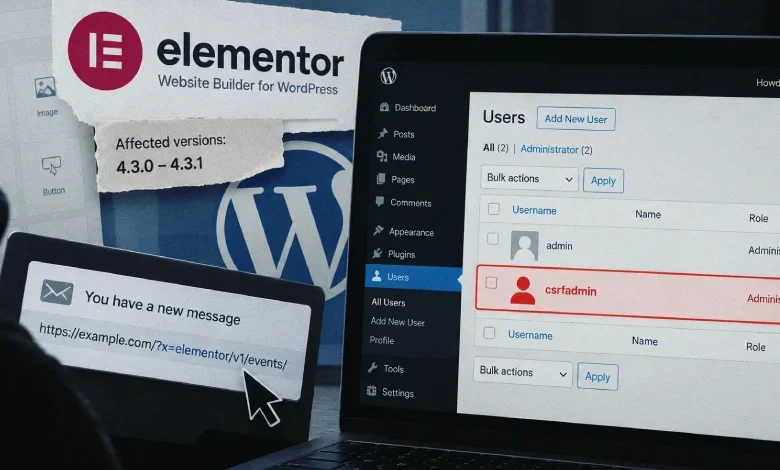
Website administrators and cybersecurity professionals are racing to patch a critical vulnerability discovered within the Elementor Website Builder, one of the most widely deployed plugins in the WordPress ecosystem. The high-severity security flaw, which carries a critical Common Vulnerability Scoring System (CVSS) rating of 8.8 out of 10.0, grants remote attackers an alarming pathway to compromise targeted sites completely. By leveraging a significant oversight in how the plugin handles cross-site request forgery (CSRF) protections for cookie-authenticated REST API requests, unauthenticated malicious actors can trick logged-in administrators into executing unauthorized commands. Most dangerously, this flaw enables attackers to silently spawn rogue administrator accounts, effectively granting them full structural and operational control over the affected web property.
The discovery highlights the fragile nature of modern web components, where a single coding misstep in a popular tool can immediately place millions of digital storefronts, blogs, and corporate platforms at severe risk. While the bug has been swiftly addressed by the plugin’s development team, the sheer velocity at which vulnerabilities in core plugins are weaponized underscores the critical importance of automated patch management and proactive security monitoring across all enterprise and personal web architectures.
Anatomy of the Elementor Flaw: How the CSRF Bypass Works
To understand the severity of the threat, security analysts must examine the underlying mechanics that allowed the bypass to occur. According to technical breakdowns provided by WordPress security firm Patchstack and the original bug reporter—a researcher operating under the alias "Saggre"—the vulnerability stems directly from the plugin’s newly introduced Editor Events module.
In versions 4.3.0 and 4.3.1 of the Elementor plugin, the developers implemented a mechanism intended to handle specific event tracking operations. However, the code contains a fatal logic flaw: it skips crucial CSRF protections for cookie-authenticated REST API requests whenever the literal string elementor/v1/events/ appears anywhere within the incoming request URI.
Crucially, in web architecture, the request URI includes the query string. Because query strings are inherently dictated by the entity composing the link—the threat actor—any REST request can effectively opt itself out of essential security validations simply by appending a benign-looking parameter to the URL.
This oversight effectively creates a gaping security loophole that applies not only to Elementor’s internal routing but to the entire REST API surface of the targeted WordPress installation. This includes WordPress core routes as well as the endpoints of every other installed plugin and theme on the site. An attacker can leverage this global scope to interact directly with sensitive endpoints, such as the user-creation route located at /wp/v2/users. By crafting a weaponized URL containing malicious POST parameters alongside the trailing string elementor/v1/events/, an external party can force a browser session to execute administrative commands without the user’s knowledge or consent.
The Mechanics of a Weaponized Link
Unlike complex web attacks that require sophisticated phishing infrastructure, multi-stage payloads, or direct access to a web shell, exploiting this Elementor vulnerability requires remarkably little friction. The attack does not rely on JavaScript execution, multi-part form submissions, or external web pages controlled by the threat actor.
Instead, the vector can be delivered via a standard, plain anchor tag embedded anywhere digital content is consumed. An administrator browsing an infected forum, reading a compromised comment section, checking their internal corporate chat messages, or even opening a routine email could trigger the exploit simply by clicking a hyperlink while maintaining an active login session on their WordPress dashboard.
"One link, opened by a logged-in WordPress user, makes that user carry out any REST API action their account is permitted to perform," Patchstack explained in an exhaustive technical advisory. "On a stock installation, an administrator clicking the link creates a second administrator account for the attacker."
Once the secondary administrator account is successfully provisioned via the fraudulent REST API call, the attacker gains unfettered access to the backend dashboard. From there, they can install malicious plugins, upload web shells, exfiltrate sensitive customer databases, redirect traffic to malicious phishing domains, or leverage the compromised site to launch further attacks against other targets within an internal network.

Scope and Impact: Millions of Sites in the Crosshairs
The scale of potential exposure is vast. Elementor is an industry titan within the content management system landscape, boasting active installations on more than 10 million WordPress websites worldwide. Fortunately, the specific vulnerability is isolated to a narrow window of releases: versions 4.3.0 and 4.3.1. Versions prior to 4.3.0 do not include the Editor Events proxy module and remain entirely immune to this specific flaw.
Nevertheless, statistical data compiled from WordPress.org indicates that the two impacted versions alone were actively deployed across more than 2 million live websites during the brief period they were available in the wild. This rapid adoption rate—typical of massive software updates pushed out to global user bases—means that millions of web properties were simultaneously exposed to potential remote exploitation before patches could be distributed.
Timeline of Discovery, Disclosure, and Remediation
The rapid containment of this high-severity vulnerability highlights the critical role of coordinated vulnerability disclosure programs within the open-source software community.
- Discovery and Reporting: The security flaw was independently discovered by researcher "Saggre," who promptly reported the security bug to the vendor through responsible disclosure channels, ensuring that details were withheld from the public until a viable patch could be engineered and tested.
- Vendor Response: The Elementor development team mobilized quickly upon receiving the intelligence. They audited the Editor Events module, reconstructed the input validation logic, and prepared an emergency software patch.
- Patch Release: Elementor officially released version 4.3.2 of the website builder plugin, completely removing the vulnerable logic path that permitted URI-based CSRF bypasses.
- Public Disclosure and Warnings: Security firms, including Patchstack, published detailed advisories to alert system administrators, web hosting providers, and digital agencies to the urgency of applying the update immediately.
Broader Implications for WordPress Security
The Elementor incident serves as a stark reminder of the inherent complexities and risks associated with extensible web platforms. WordPress powers a dominant share of the global internet, relying on a decentralized ecosystem of third-party plugins and themes to provide advanced functionality. While this modular approach democratizes web development, it also expands the attack surface exponentially.
When a foundational plugin like Elementor introduces a flaw that inadvertently disables CSRF protection across an entire site’s REST API, the security posture of the underlying WordPress core and unrelated plugins is instantly compromised. Modern web applications are tightly interconnected ecosystems where a single broken link in the security chain can undermine layers of otherwise robust defensive architecture.
Furthermore, the reliance on cookie-based authentication within REST APIs remains a persistent architectural challenge. As web applications increasingly lean toward asynchronous, API-driven front-ends and administrative interfaces, ensuring rigorous validation and strict boundary controls for cross-site requests is paramount. Developers must implement defense-in-depth strategies that do not rely on easily manipulated query strings or superficial URI string matching to enforce authorization checks.
Actionable Recommendations for Website Administrators
In light of the severity of this vulnerability and the ease with which it can be exploited via social engineering, web administrators must take immediate defensive action.
- Update Immediately: All websites running Elementor versions 4.3.0 or 4.3.1 must be updated to version 4.3.2 (or the latest available release) without delay. Automated update policies should be enabled where feasible to minimize the window of exposure for future zero-day or rapid-response vulnerabilities.
- Audit User Accounts: Site administrators should conduct an immediate audit of all registered user accounts, particularly those assigned administrative or editor privileges. Any unfamiliar, unverified, or suspicious accounts should be revoked and deleted immediately.
- Review Security Logs: Web server access logs and WordPress audit trails should be examined for unusual requests targeting the /wp/v2/users endpoint, particularly those originating from unexpected IP addresses or containing anomalous query strings matching the exploit signature.
- Implement Robust Security Solutions: Deploying a reliable Web Application Firewall (WAF) or security plugin can provide an additional layer of defense, blocking common exploit patterns and safeguarding administrative routes against unauthorized access attempts.
As cyber threats continue to evolve in sophistication and scale, proactive patch management and vigilant access control remain the frontline defense for maintaining the integrity and security of the digital landscape.
Related posts: