The Evolution of Signal Backups: A Chronological Overview
For years, Signal users were tethered to the physical integrity of their primary device. While the platform prioritized privacy above all else, its "privacy-first" architecture meant that data was strictly siloed on the device’s local storage. If a phone was lost, damaged, or upgraded, chat histories were often permanently purged, a trade-off that many privacy advocates accepted but mainstream users found cumbersome.
The shift began in late 2024 when Signal introduced secure cloud backups for Android. This initial rollout provided a bridge for users to maintain their message threads through a cloud-hosted encrypted architecture. However, the ecosystem remained fragmented. iOS users, constrained by Apple’s sandboxed file system, and desktop users, who relied on a complex "linked device" architecture, were left without a robust backup solution.
Version 8.30, released in September 2026, serves as the final piece of the puzzle. It not only extends the local backup capability to iOS and desktop clients but also refactors the legacy Android backup protocols to ensure that every device on the network speaks the same cryptographic language. This update ensures that a backup generated on an iPhone can, in theory, be recognized by a desktop client, provided the user holds the requisite recovery key.
Understanding the Architecture: Cloud vs. Local
The new backup framework offers users a dual-track system, providing flexibility based on storage needs and security preferences.
The first option, Signal-hosted backups, utilizes the platform’s infrastructure to store encrypted chat data. For free-tier users, this is subject to specific constraints: a 45-day window for media files and a 128 KB limit per individual message. Paid subscribers, however, gain access to 100 GB of storage, facilitating the retention of larger media archives. These backups are protected by a two-tiered security model: a user-held recovery key and a supplemental key that rotates daily within a Trusted Execution Environment (TEE). This TEE implementation ensures forward secrecy, meaning that even if a historical key were compromised, the most recent messages remain shielded.
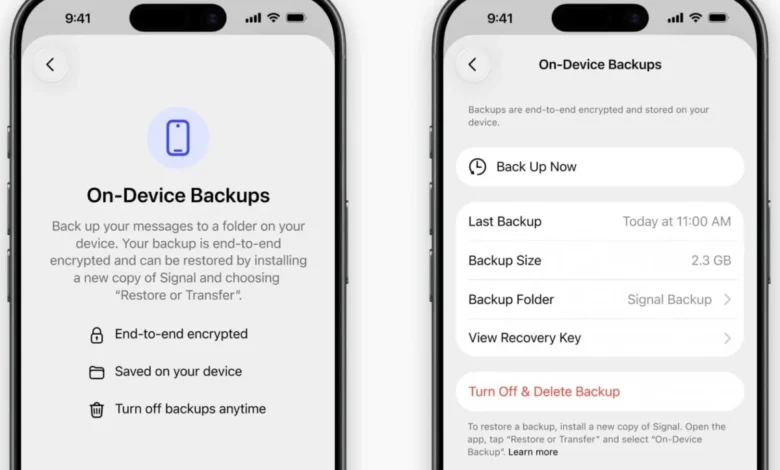
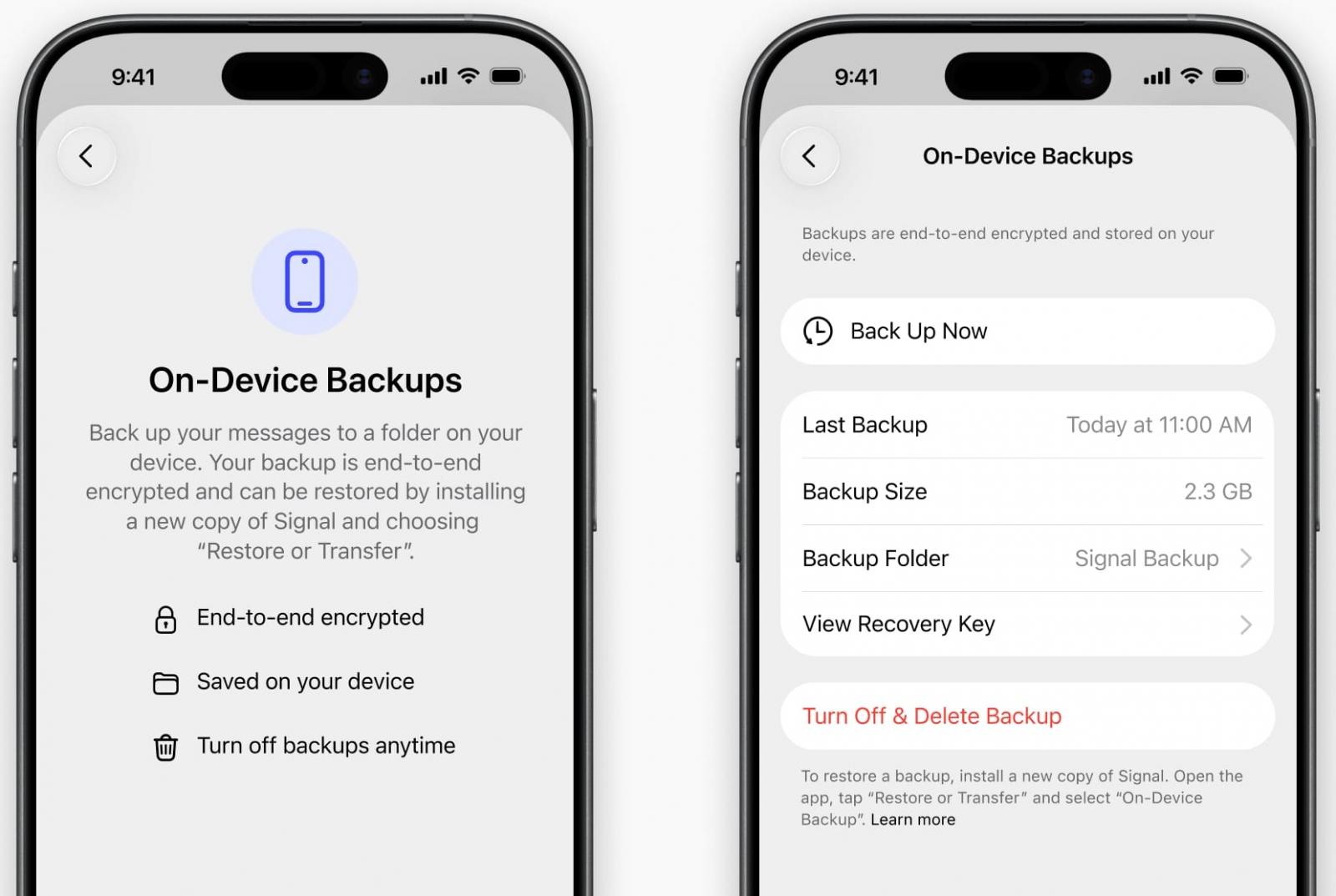
The second, and perhaps more significant, addition is the local, on-device backup. Unlike cloud backups, these files reside entirely on the user’s hardware or chosen storage medium. There are no size restrictions, making this the ideal solution for "power users" who maintain years of chat history and high-resolution media attachments. The security of this method rests entirely on the user’s recovery key—a long, alphanumeric string that acts as the sole gatekeeper for decryption.
The Security Implications of Recovery Keys
The introduction of the recovery key has not gone unnoticed by the cybersecurity community or, more ominously, by state-sponsored threat actors. Because the recovery key can decrypt all past backup files it was originally tasked with protecting, it has become a "high-value target" for intelligence agencies and criminal syndicates.
Following the initial Android deployment, reports surfaced indicating that groups, including those linked to Russian intelligence and the FBI, began shifting their investigative focus toward acquiring these recovery keys. The implications are clear: while Signal remains a gold standard for end-to-end encrypted communication, the "weakest link" has effectively migrated from the transit of the message to the storage of the backup.
Signal’s decision to standardize the backup format across all platforms simplifies the user experience but also concentrates the risk. If a user stores their recovery key in a non-secure environment—such as a plain text file on a cloud drive or a poorly secured password manager—the encryption becomes moot. The company has repeatedly urged users to store these keys in physical form or within hardened, offline hardware security modules.
Architectural Enhancements and Optimization
Version 8.30 brings more than just backup capabilities; it introduces significant performance optimizations to the way data is handled. One of the most critical changes is the decoupling of media from the core chat database. By storing attachments as separate objects and implementing a de-duplication mechanism, Signal has significantly reduced the overhead associated with frequent backups.
In previous iterations, syncing a new device often resulted in redundant data transfers, straining local bandwidth and storage capacity. Now, when a user links a new device, the system intelligently identifies missing attachments and retrieves them, rather than re-downloading the entire history. Furthermore, for paid users, the inclusion of a "purge old media" feature allows the app to offload high-resolution files to the cloud while keeping low-resolution thumbnails on the device. This "on-demand" retrieval model balances the need for instant access with the reality of storage constraints on mobile devices.
Handling Disappearing Messages and Data Integrity
A point of confusion for many users has been the interaction between the backup system and the "disappearing messages" feature. Signal has confirmed that messages set to expire within 24 hours are excluded from both hosted and local backups. This is a deliberate design choice aimed at reinforcing the ephemeral nature of the communication.
During the restoration process, the application validates the timestamps of these messages. If a local backup contains messages that have technically "expired" according to the original timer, those messages are purged during the restoration sequence. This ensures that the state of the restored device is consistent with the privacy settings established by the user, preventing the "resurrection" of messages that were intended to be deleted.
iOS-Specific Improvements: iPhone-to-iPhone Transfer
The 8.30 update also introduces a refined peer-to-peer transfer mechanism for iOS users. By utilizing a local, end-to-end encrypted Wi-Fi Aware link, Signal has moved away from traditional backup-and-restore via cloud intermediaries for device migration. This direct iPhone-to-iPhone transfer is significantly faster and more reliable, particularly for users with large databases that would otherwise time out during a standard iCloud upload or download.
By leveraging the local network, the data never touches a third-party server, maintaining the privacy integrity that Signal has built its reputation upon. This is a crucial development for users in regions with limited internet infrastructure, where cloud-based backups are often slow or prone to failure.
Broader Implications and Future Outlook
The completion of this backup project represents a shift in Signal’s strategic focus. With the core messaging and backup infrastructure now considered "feature-complete" by the engineering team, the organization is pivoting toward non-backup systems. Industry analysts suggest that this will likely involve deeper integration with decentralized identity protocols and perhaps more robust tools for managing group chat administration, which remains a challenge for the platform as it scales to enterprise-level usage.
However, the primary impact of this update is the normalization of high-security backups. By providing an accessible, encrypted, and cross-platform solution, Signal is attempting to lower the barrier to entry for privacy-conscious communication. For the average user, the choice between security and convenience has long been a zero-sum game; with version 8.30, Signal has successfully moved the needle in favor of both.
The challenge moving forward remains user education. While the technical implementation of the backup system is robust, the human element—specifically the management of the recovery key—remains the primary vulnerability. As threat actors continue to evolve their methodologies to target these keys, the responsibility of data protection increasingly rests with the user. The platform provides the vault, but the user must guard the key.
In conclusion, Signal version 8.30 is a testament to the platform’s commitment to user sovereignty. By successfully navigating the technical complexities of cross-platform synchronization and secure data storage, the team has solidified its position as the leader in the encrypted messaging space. Whether this will lead to an influx of users migrating from more "convenient" but less private alternatives remains to be seen, but for those already committed to the Signal ecosystem, the release marks the end of an era of data anxiety and the beginning of a more resilient, user-controlled communication experience.