The rapid ascent of Large Language Models (LLMs) and generative AI has fundamentally altered the requirements for modern data architecture. As developers seek to implement Retrieval-Augmented Generation (RAG) and semantic search, they are frequently confronted with a binary choice: extend their existing relational database via the open-source pgvector extension or migrate to a purpose-built, dedicated vector database. For many engineering teams, the decision is often driven by marketing claims rather than empirical data. This analysis examines the technical performance, operational trade-offs, and scalability implications of both approaches to provide a definitive guide for production workloads.
The Rise of Vector Search in Relational Ecosystems
The emergence of pgvector, which debuted on GitHub in 2021, represented a significant shift in database capability. By enabling Postgres to store, index, and query vector embeddings alongside traditional relational data, it simplified the stack for many startups. Version 0.8.6, the current iteration, supports Postgres 13 and later, offering native vector types and various indexing methods, including HNSW (Hierarchical Navigable Small World) and IVFFlat.
Historically, developers relied on standalone vector engines. However, the operational overhead of maintaining a separate service—managing synchronization, data consistency, and additional infrastructure—often outweighed the benefits for mid-sized datasets. pgvector effectively collapsed this complexity, allowing developers to execute hybrid queries—filtering by relational metadata while simultaneously performing similarity searches—within a single SQL transaction. This atomicity is a critical feature for applications requiring strict data integrity, as it eliminates the "dual-write" problem where the primary database and the vector store might fall out of sync.
Defining the Competitive Landscape
Dedicated vector databases, such as Pinecone, Qdrant, Weaviate, Milvus, and ChromaDB, were architected from the ground up for high-dimensional vector operations. Unlike pgvector, which treats vectors as an extension of a general-purpose relational engine, these systems are built with specialized storage engines designed to optimize for vector search throughput and latency.
The market for these databases has segmented significantly over the last 24 months. Pinecone has captured the low-ops, cloud-native enterprise market by offering a fully managed, serverless experience. Qdrant, built in Rust, has emerged as a high-performance contender known for its efficient JSON payload filtering. Weaviate provides an AI-native interface with built-in vectorization, while Milvus remains the industry standard for massive, distributed, GPU-accelerated workloads. ChromaDB, by contrast, has secured a strong foothold in the local prototyping and Python-centric developer community. Each of these platforms addresses specific architectural needs that extend beyond basic similarity matching, such as complex metadata filtering or distributed clustering.
Empirical Analysis: The Performance Gap
To move beyond subjective opinion, it is necessary to examine data from controlled benchmarks. While local testing on a standard laptop with 100,000 vectors is a useful exercise for verifying implementation mechanics, it is insufficient for production planning. A more rigorous benchmark, recently conducted using 50 million Cohere embeddings on AWS r6id.4xlarge hardware (16 vCPUs, 128GB RAM), offers a clearer picture.
It is vital to note that this specific comparison utilized Postgres with both pgvector and pgvectorscale—an additional extension from Timescale that introduces the StreamingDiskANN index type. This hybrid setup significantly alters the performance profile of Postgres.
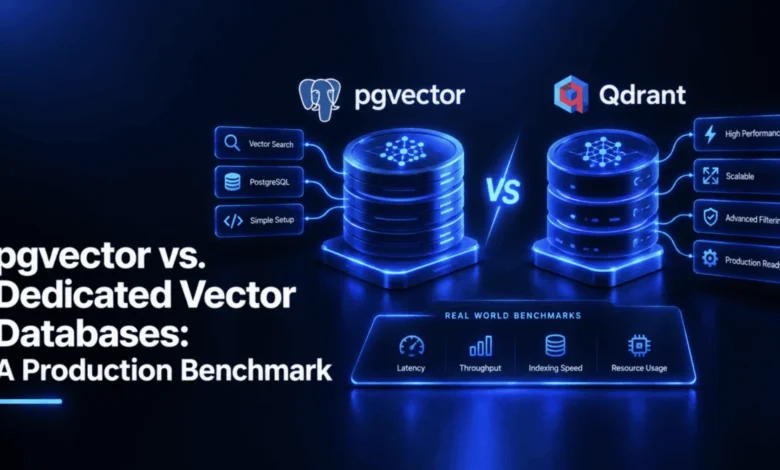
The findings reveal a nuanced reality. At 99% recall, the pgvector + pgvectorscale stack achieved a throughput of approximately 471.57 Queries Per Second (QPS), while Qdrant managed 41.47 QPS. This suggests that for high-throughput, read-heavy workloads, the optimized Postgres configuration possesses a substantial advantage. However, Qdrant demonstrated superior stability in tail latency, recording a p99 latency of 38.71 ms, compared to 74.60 ms for the Postgres-based configuration.
Furthermore, the indexing time for 50 million vectors highlights the operational efficiency of specialized systems: Qdrant built its index in approximately 3.3 hours, whereas the Postgres-based solution required 11.1 hours. These metrics indicate that while pgvector can scale to tens of millions of records, the engineering effort required to tune it for performance can be substantial compared to the out-of-the-box optimization of dedicated vector databases.
Chronology of Adoption and Industry Trends
The industry shift toward vector search has occurred in three distinct phases.
- The Prototyping Phase (2021–2022): Initial experimentation with vector search primarily occurred in Python environments using libraries like FAISS, often without persistent database support.
- The Integration Phase (2022–2023): The release of pgvector and the maturation of early vector startups brought vector search into the enterprise. During this time, the "Postgres-first" mentality dominated, as teams sought to avoid the complexity of new infrastructure.
- The Specialization Phase (2023–Present): As datasets grew into the hundreds of millions of vectors, the limitations of general-purpose databases became apparent. This has led to a surge in the adoption of dedicated databases by large-scale enterprises, while simultaneously pushing the Postgres community to release performance-enhancing extensions like pgvectorscale.
Strategic Implications for Production Workloads
When determining the optimal path, organizations should evaluate their requirements against three primary criteria: operational complexity, data consistency, and query latency requirements.
When to choose pgvector:
For the vast majority of applications—particularly those containing fewer than 10 million vectors—pgvector is the most pragmatic choice. It leverages existing database expertise, maintains transactional integrity, and minimizes infrastructure costs. If your application requires high-performance filtering based on standard SQL columns (e.g., "Find the most similar vector where user_id = X and status = ‘active’"), Postgres handles this natively without requiring complex external index synchronization.
When to choose a dedicated vector database:
Engineering teams should consider a dedicated vector engine if they reach specific architectural thresholds. First, if the dataset size exceeds 50 million vectors, the indexing and maintenance costs of Postgres can become prohibitive. Second, if your application has stringent p99 tail-latency SLAs that are sensitive to the 30–50ms range, the specialized architecture of engines like Qdrant may provide better consistency. Finally, if the organization lacks the internal expertise to tune Postgres for high-concurrency vector workloads, a managed service like Pinecone effectively outsources the operational burden entirely.
Concluding Observations
The debate between pgvector and dedicated vector databases is often framed as a conflict between "convenience" and "performance." However, the data suggests this is a false dichotomy. Both approaches have matured to a point where they can comfortably serve production-grade requirements.
The primary lesson for architects is that neither solution is a silver bullet. A dedicated database provides a streamlined, purpose-built path for massive scale and low tail latency, while pgvector provides a versatile, cost-effective, and consistent environment for the vast majority of enterprise use cases. As the landscape continues to evolve, the most successful implementations will be those that match the architectural choice to the specific scale and consistency requirements of the application, rather than following industry trends or unverified vendor claims. Future advancements in both pgvector’s indexing algorithms and the efficiency of dedicated vector databases will likely continue to narrow these performance gaps, further benefiting the development community at large.