Adaptive Market Regime Trading: A Machine Learning Framework for Dynamic Financial Strategies


The fundamental premise of traditional quantitative trading often relies on the assumption of market stationarity, where statistical properties such as mean and variance remain constant over time. However, global financial markets are inherently dynamic, oscillating between periods of relative calm and intense volatility. A new Python-based algorithmic framework developed by quantitative researcher José Carlos Gonzáles Tanaka offers a departure from rigid, one-size-fits-all strategies by utilizing Hidden Markov Models (HMM) to detect shifting market regimes and deploy tailored predictive models in response.
The Mechanics of Market Regime Detection
Market regimes represent distinct phases in price behavior, typically categorized by volatility levels, trending directionality, or liquidity constraints. A strategy that excels during a low-volatility, trending bull market often fails during high-volatility, mean-reverting phases. The HMM approach addresses this by treating the market as a system with "hidden" states. By analyzing observable historical data—primarily daily returns—the algorithm infers which latent state the market currently occupies.
The HMM functions by estimating the probability of transitioning between these states. Once the system identifies the current regime, the trading architecture switches to a pre-trained specialist model optimized specifically for that environment. This modularity allows the algorithm to pivot its risk parameters and predictive logic based on the detected climate, effectively acting as a meta-strategy that manages sub-strategies beneath it.
Chronology of Strategy Development and Backtesting
The development of this framework follows a structured pipeline designed for high-performance quantitative analysis. The process begins with the aggregation of historical price data, typically sourced through financial APIs such as yfinance. The raw data undergoes rigorous feature engineering, where technical indicators are derived to provide the model with context beyond simple price action.
The backtesting phase employs a "walk-forward" optimization methodology. Unlike static backtesting, which uses a fixed train-test split that can lead to overfitting, walk-forward optimization continuously retrains the model on expanding windows of data. This simulates real-world conditions where the strategy must adapt to new, unseen market cycles.
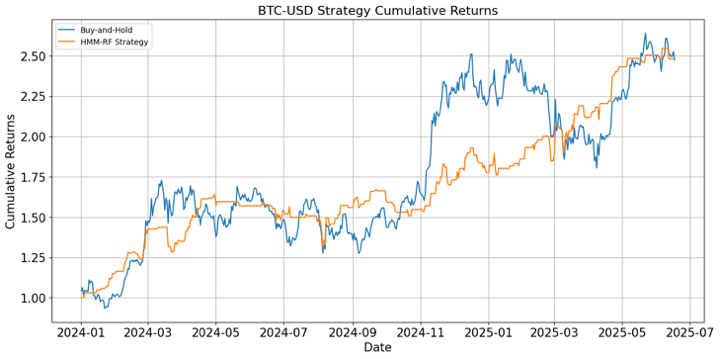
In a recent demonstration focusing on Bitcoin—a highly volatile asset—the strategy was backtested against a standard Buy-and-Hold benchmark using data spanning from 2008 to 2025. The implementation of the regime-based model between January 2024 and the current period showed a significant improvement in risk-adjusted returns, providing a practical case study for the efficacy of adaptive systems in crypto-asset environments.
Empirical Performance Metrics
Comparative analysis between a traditional Buy-and-Hold strategy and the proposed adaptive model highlights the benefits of volatility management. While the Buy-and-Hold approach yielded a cumulative return of 136.83% with an annual volatility of 43.06%, the adaptive strategy achieved 148.11% with a substantially lower annual volatility of 26.24%.
The most striking differences appear in the risk-adjusted metrics. The adaptive strategy produced a Sharpe ratio of 1.76 compared to 1.16 for the benchmark, indicating superior risk-adjusted performance. Furthermore, the maximum drawdown for the regime-based strategy was restricted to 20.03%, significantly outperforming the 28.14% decline observed in the buy-and-hold portfolio. These metrics suggest that by filtering out weak signals and adjusting to market conditions, the strategy effectively mitigates the impact of sharp, high-volatility sell-offs.
Implications for Algorithmic Trading
The shift toward regime-aware algorithms reflects a broader trend in institutional and retail quantitative trading: the move from predictive models based on linear assumptions to complex, adaptive architectures. The primary implication of this framework is the reduction of model risk. By acknowledging that a strategy’s performance is conditional, developers can build in "circuit breakers" or regime-specific filters that prevent capital exposure during unfavorable environments.
However, the implementation of such systems is not without challenges. The reliance on HMMs requires robust statistical grounding, as the model’s effectiveness depends heavily on the quality and stationarity of the chosen input features. Furthermore, the computational overhead of running multiple models in a walk-forward loop necessitates efficient coding practices, particularly when dealing with high-frequency or multi-asset datasets.
Expert Perspectives and Theoretical Context
Industry experts emphasize that regime-based trading is not a panacea for market uncertainty. According to academic research into financial time series, the primary risk in HMM-based trading is "regime misclassification," where the model incorrectly identifies a state, leading to inappropriate asset allocation. Consequently, the integration of risk management tools—such as dynamic position sizing and stop-loss mechanisms—remains a critical component of any live deployment.
Practitioners often cite the necessity of combining machine learning with classic technical analysis. The current framework encourages this by allowing users to substitute underlying models, such as Random Forests or Extreme Gradient Boosting (XGBoost), for the predictive component. This flexibility ensures that as machine learning techniques evolve, the foundational architecture of the regime-detection engine remains relevant.
Broader Impact on Financial Modeling
The adoption of this methodology signifies a maturation in algorithmic strategy design. By moving away from "black box" models that attempt to predict price movement in a vacuum, researchers are creating systems that recognize the socio-economic context of market fluctuations. Whether applied to equities, foreign exchange, or decentralized assets, the ability to categorize market "mood" allows for more disciplined, rules-based execution.
As the financial industry continues to lean into artificial intelligence, the divide between static and adaptive strategies will likely widen. The framework discussed here provides a blueprint for developers to transition from basic automated trading to more sophisticated, state-aware quantitative systems. For those looking to implement similar models, the focus must remain on rigorous validation through walk-forward testing and the continuous monitoring of model performance against changing macroeconomic indicators.
Strategic Recommendations for Implementation
For practitioners looking to build upon this framework, several evolutionary steps are recommended:
- Expansion of Feature Sets: Incorporating macro-economic indicators, such as interest rate changes or inflationary data, can enhance the HMM’s ability to identify long-term structural shifts.
- Alternative Modeling Approaches: While HMMs are effective for state detection, exploring deep learning architectures, such as Recurrent Neural Networks (RNNs) or Long Short-Term Memory (LSTM) networks, may offer better predictive accuracy for short-term signal generation.
- Enhanced Risk Controls: Implementing dynamic position sizing based on the probability confidence of the HMM can further optimize the Sharpe ratio and mitigate potential losses during regime transition periods.
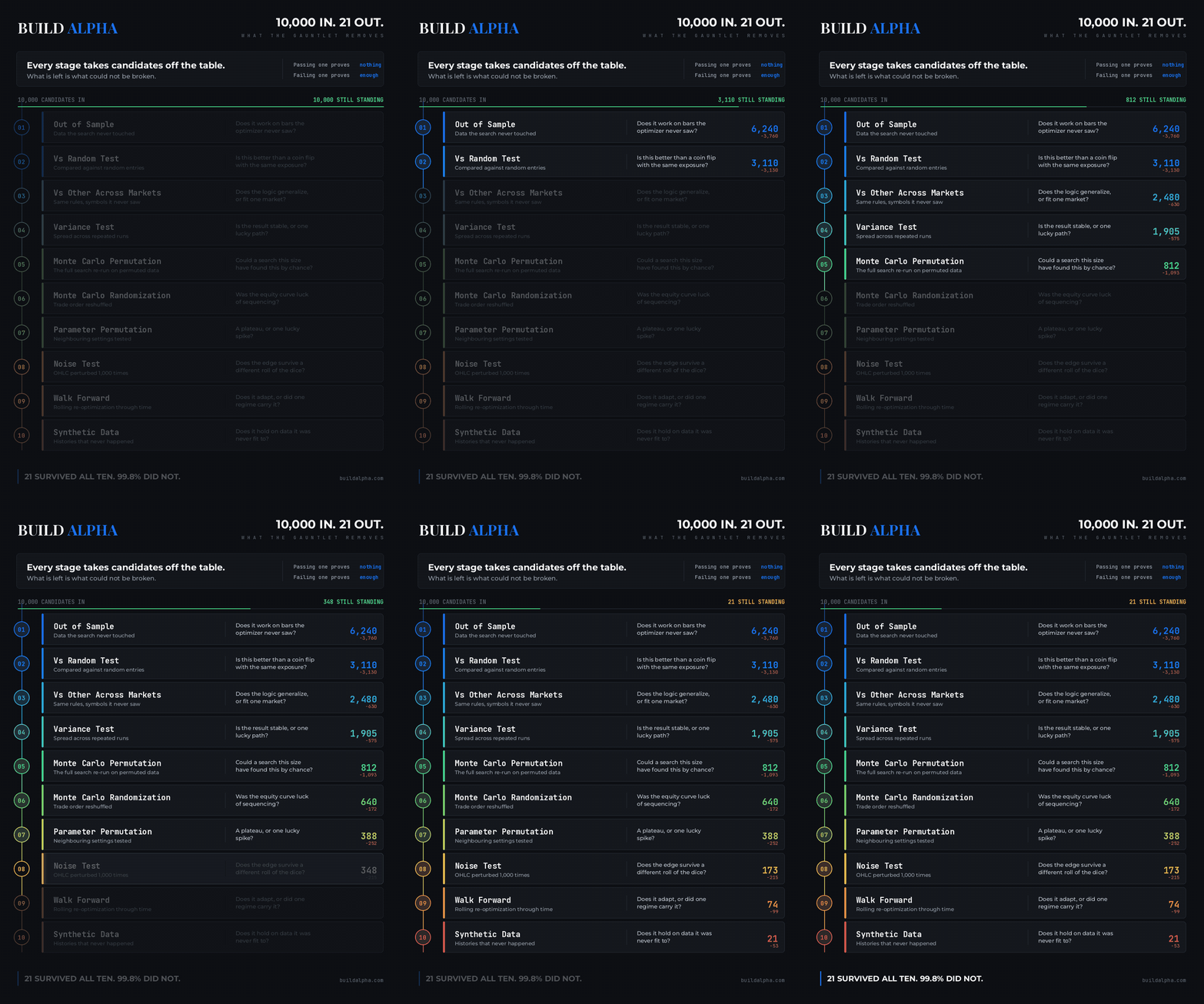
- Validation and Stress Testing: Before deploying in live markets, strategies should undergo Monte Carlo simulations and out-of-sample testing to ensure that the regime-detection logic holds up under extreme market stress, such as liquidity shocks or "black swan" events.
In conclusion, the integration of market regime detection into trading strategies represents a significant step forward in quantitative finance. By acknowledging the chaotic and non-stationary nature of modern markets, developers can move toward more resilient systems that perform with greater consistency across varying economic cycles. While the barrier to entry for these sophisticated frameworks has historically been high, the democratization of Python libraries and open-source quantitative research is making these advanced tools increasingly accessible to a wider audience of traders and analysts. As the landscape of algorithmic trading continues to evolve, the ability to adapt to changing regimes will remain a definitive competitive advantage for market participants.