Binance says withdrawals reopen on 1 November after replenishing 90% of the stolen $6.3 billion

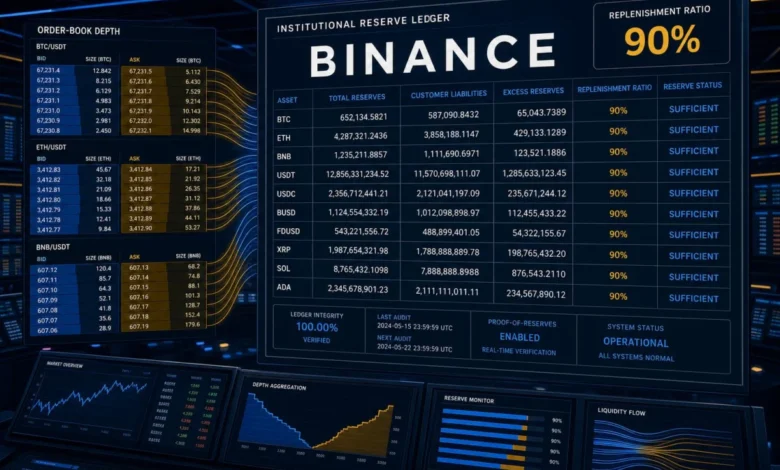
Cryptocurrency exchange Binance has announced that it successfully replaced 90% of the approximately $6.3 billion in digital assets stolen during a massive security breach on October 29. The platform remains on schedule to resume normal customer withdrawals on Sunday, November 1. This crucial milestone was detailed in a public update shared via the exchange’s official channel on X on October 31, building upon a previous recovery benchmark of 80% reported just a day prior. Alongside the recovery figures, the exchange released a provisional proof-of-reserves snapshot indicating a fully backed 100% reserve status, seeking to reassure a jittery global user base ahead of the weekend market reopening.
The scale of the October 29 exploit sent shockwaves through the digital asset ecosystem, testing the infrastructural resilience of one of the world’s largest centralized trading platforms. As the clock ticks toward Sunday’s scheduled resumption of services, the industry watches closely to see how the exchange handles the transition from halted transactions to full operational capacity.
A Detailed Chronology of the Breach and Response
The sequence of events leading up to the November 1 reopening began unfolding in the late hours of October 29, when abnormal outward transactions were first flagged by automated security monitors and on-chain intelligence firms. Within hours, it became clear that malicious actors had siphoned an unprecedented $6.34 billion from the platform’s hot wallets.
October 29 (The Breach): Automated alerts detect anomalous outflows. Binance engineers immediately halt all withdrawal operations to contain the bleeding, initiating emergency protocols and notifying law enforcement agencies, blockchain forensics specialists, and key token issuers.
October 30 (Initial Tally and Treasury Mobilization): Binance confirms the magnitude of the exploit, putting the loss figure at roughly $6.34 billion. In an aggressive countermeasure, the exchange announces that it has earmarked $6.34 billion of corporate treasury funds—including $5 billion held in the exact token assets affected—to cover the shortfall entirely without dipping into customer account balances. Industry partners, notably stablecoin issuers Tether and Circle, step in to freeze approximately $3 billion of the stolen funds as they attempt to move across secondary networks.
October 31 (90% Recovery Milestone): Binance issues an updated statement on X, confirming that 90% of the stolen capital has been fully replaced. The company publishes an updated proof-of-reserves overview demonstrating complete coverage. Preparations for a phased or full withdrawal reopening on November 1 are confirmed to be on track.
November 1 (The Test of Reopening): Scheduled resumption of customer withdrawals. This day marks the ultimate stress test for the exchange, verifying whether its logistical architecture and liquidity management can withstand simultaneous user withdrawal requests across multiple asset classes.
November 3 (Cryptographic Verification Due): Binance’s scheduled release date for its complete, zero-knowledge proof-of-reserves audit. This cryptographic verification is expected to independently corroborate the self-reported figures provided during the immediate crisis response.
Anatomy of the Financial Recovery: Treasury, SAFU, and Liquidity Pressures
One of the central concerns for account holders following any major exchange hack is the origin of the recovery capital. In this instance, Binance leadership has been transparent about the financial engineering required to bridge a multi-billion-dollar gap almost overnight.
According to official disclosures, the replacement funds were pulled from a combination of the exchange’s corporate treasury reserves, a strategic partial drawdown of the Secure Asset Fund for Users (SAFU)—an emergency insurance fund maintained specifically for catastrophic system failures—and the internal insurance pool designated for derivatives position coverage. Crucially, user-designated balances and active trading accounts remain entirely untouched by the deficit, insulating retail and institutional traders from direct losses.
The operational challenge, however, extends beyond simply having the capital on paper; it involves the physical composition of the assets. Binance stated that major liquid holdings—including Bitcoin (BTC), Ether (ETH), Tether (USDT), Binance Coin (BNB), Solana (SOL), USD Coin (USD), XRP, USD1, RLUSD, and Zcash (ZEC)—have been fully matched one-for-one.
Yet, the final 10% of the gap has proven more complex to resolve. These remaining funds are tied up in tokens with significantly thinner market liquidity. Acquiring these assets requires navigating over-the-counter (OTC) channels and spot markets carefully to avoid causing artificial price slippage or market manipulation. In its October 30 advisory, the exchange cautioned that this final leg of procurement "can take longer because some tokens may have low liquidity and OTC settlement also takes time." Consequently, holders of these specific, low-liquidity altcoins may experience longer waiting periods before full withdrawal functionality is restored for their specific token balances.
External Scrutiny and the Verification Process
While Binance’s rapid self-reporting and treasury deployment have been praised for speed and transparency, independent oversight bodies have urged caution until verifiable cryptographic proof is rendered. Blockchain security and auditing firm CertiK noted that while the corporate commitment of over $5 billion in replacement holdings is a positive step, independent verification requires deep on-chain analysis and time-intensive cryptographic validation.
To address transparency concerns, Binance has committed to publishing a comprehensive zero-knowledge proof-of-reserves audit by November 3. Exchange representatives explained that generating this advanced cryptographic proof is computationally intensive, typically requiring approximately 40 to 50 hours of processing time to ensure absolute accuracy.
Simultaneously, the collaborative efforts between Binance and external blockchain intelligence entities have yielded tangible results regarding asset containment. Out of the total stolen volume, approximately $3 billion has been successfully frozen at the smart contract level by issuers such as Tether and Circle. This frozen capital represents a distinct pool from the newly replenished treasury tokens, meaning that if law enforcement and industry partners eventually recover portions of the frozen assets, those funds will serve as an additional buffer to replenish the depleted SAFU insurance fund, which Binance has formally pledged to rebuild to its baseline $1 billion valuation.
Broader Industry Implications and Precedents
The scale of the October 29 incident places it among the largest security breaches in the history of decentralized and centralized financial systems. The event immediately draws comparisons to other notable industry exploits, such as the Bitget hack in September, which involved a $388 million breach and required a similarly tense, multi-day phased withdrawal resumption. However, the sheer size of Binance’s $6.3 billion incident magnifies the systemic risks involved.
Market analysts point out that the swiftness with which Binance mobilized billions of dollars in liquid assets highlights the profound balance-sheet strength of top-tier centralized exchanges, while simultaneously underscoring the persistent vulnerabilities associated with hot-wallet infrastructure. The crisis has reignited industry-wide discussions regarding the adoption of multi-party computation (MPC) custody solutions, advanced hardware security modules (HSMs), and mandatory decentralized insurance protocols.
As the global cryptocurrency community prepares for the November 1 withdrawal window, market participants will be monitoring order books, network gas fees, and transaction throughput rates. A smooth resumption of services could serve as a powerful testament to modern exchange resilience and crisis management. Conversely, any technical bottlenecks, delayed processing queues, or liquidity bottlenecks could provoke sustained market volatility and prompt renewed regulatory scrutiny regarding custodial risk management across the digital asset sector.