The landscape of corporate Bitcoin adoption in Asia has undergone a significant transformation this week as BitPlanet, formerly known as SGA Co., officially transitioned from a passive Bitcoin treasury holder to an active mining producer. This strategic pivot, facilitated by a consortium led by Sora Ventures, marks the first instance of a KOSDAQ-listed company integrating self-owned mining operations to bolster its digital asset reserves. While many public companies rely exclusively on market-based acquisitions to grow their Bitcoin holdings, BitPlanet’s move introduces a new, production-based model that could serve as a blueprint for other East Asian firms navigating the complexities of cryptocurrency balance sheets.
The Evolution of the Corporate Treasury Model
Historically, corporate Bitcoin treasuries have been characterized by a "buy-and-hold" strategy. Companies raise capital—often through equity offerings or debt—and purchase Bitcoin at the prevailing spot price. However, this model is inherently limited by the company’s ability to raise cash and the volatility of market prices. BitPlanet, which currently holds approximately 300 BTC against a long-term goal of 10,000 BTC, recognized the structural limitations of relying solely on capital markets.
By launching an internal mining division, the company has effectively created a second engine for growth. Mined coins will be booked as operational revenue, creating a non-linear accumulation path that does not require constant market participation. CEO Lee Sung-hoon noted that the transition was legally and administratively complex, requiring extensive collaboration with external legal and accounting firms to establish frameworks for disclosures and currency procedures that lacked domestic precedent within the South Korean regulatory environment.
Technical Specifications and Operational Capacity
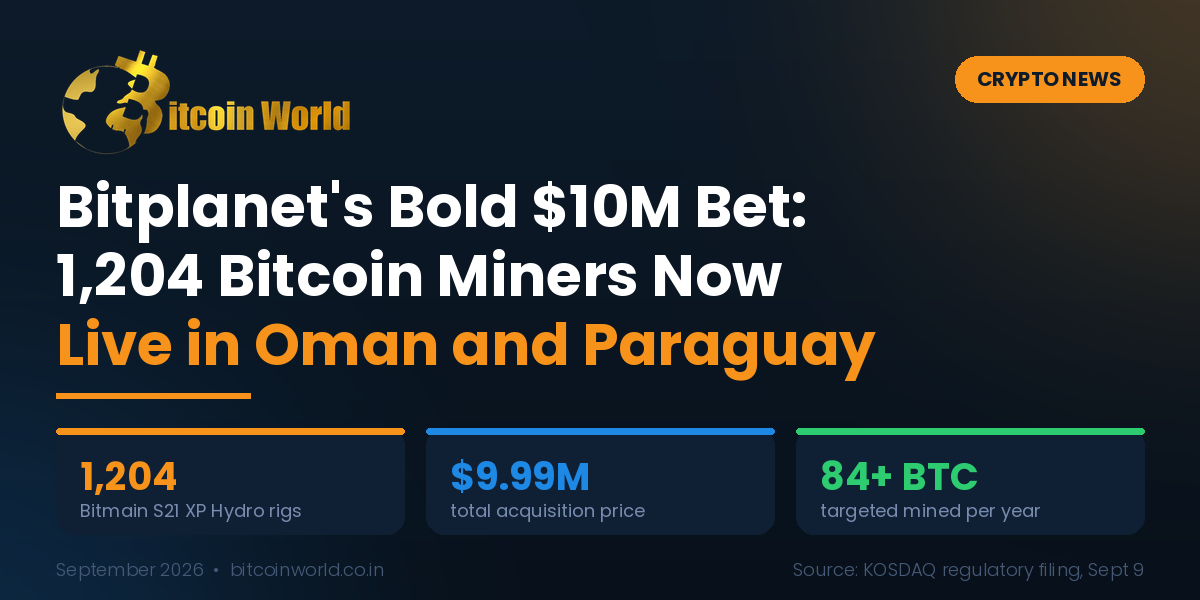
The core of BitPlanet’s mining infrastructure consists of a high-efficiency fleet designed for durability and performance in varying energy climates. The deployment includes 454 S21 XP Hydro units, capable of 473 TH/s, and 750 S21e XP Hydro units, providing 860 TH/s. Combined, these rigs deliver a total hash rate of approximately 860 PH/s. While this represents a modest slice of the global network—roughly 0.09% of the total hash rate nearing 930 EH/s—it is a significant initial footprint for a publicly traded software company.
Current projections suggest an output of approximately 13 BTC per month at full uptime. However, BitPlanet’s management has provided a more conservative guidance of 7 BTC per month. This discrepancy is attributed to the inclusion of hosting fees, joint-venture profit-sharing agreements, and necessary maintenance downtime. By guiding toward net output rather than gross theoretical capacity, the company is demonstrating a commitment to realistic shareholder expectations.
Market Context and Strategic Hedging
The timing of this deployment is particularly noteworthy. Throughout the spring and summer of this year, the "hashprice"—the revenue a miner earns per unit of hash rate—fluctuated between $30 and $33 per PH/s per day. Many industry analysts, including those at Hashrate Index, viewed these levels as a breakeven point or worse for less efficient operators. However, a roughly 22% bounce in Bitcoin’s value during the autumn provided a much-needed margin of safety.
BitPlanet’s entry into the market occurred while many legacy mining incumbents were offloading equipment to cover costs or pivoting their infrastructure toward high-performance computing (HPC) for artificial intelligence. By acquiring hardware at a time of industry consolidation, BitPlanet secured equipment with an efficiency rating of 12 to 13 J/TH. This level of efficiency positions the company to remain profitable even if margins compress during future market downturns.

Furthermore, the company has employed a geographical diversification strategy to mitigate risk. By splitting its mining fleet between natural gas-powered operations in Oman and hydroelectric-powered facilities in Paraguay, BitPlanet is hedging against both energy price volatility and regional geopolitical shifts. This dual-jurisdiction approach is a sophisticated risk-management tactic rarely seen in traditional tech-sector balance sheets.
Chronological Development
The transition to a mining-integrated treasury did not happen overnight. The following timeline outlines the major developments leading to this milestone:
- September 2023: A consortium led by Sora Ventures completes the acquisition of a controlling stake in the legacy Korean software firm SGA Co.
- Late 2023 – Early 2024: The company undergoes a rebranding process to BitPlanet, signaling a strategic shift toward digital asset infrastructure.
- Q1 2024: Initial feasibility studies are conducted, involving complex legal consultations to ensure compliance with South Korean financial and accounting standards.
- Q2 2024: Procurement of S21 XP Hydro and S21e XP Hydro mining rigs is finalized as the market experiences a period of consolidation.
- Q3 2024: Installation and testing of the fleet across Omani and Paraguayan facilities commence.
- October 2024: Official regulatory filings confirm the activation of the mining fleet and the recognition of mined assets as corporate revenue.
Broader Implications for the Korean Market
The success of BitPlanet’s model is being watched closely by other KOSDAQ-listed firms. In South Korea, where the appetite for cryptocurrency is high but regulatory oversight remains stringent, companies have been historically hesitant to hold Bitcoin directly on their balance sheets. BitPlanet’s ability to successfully navigate the accounting for mined assets provides a template for transparency.
If BitPlanet successfully adds 84 BTC to its treasury annually through mining alone, it would represent a 30% increase in its holdings without the need for additional capital raises or equity dilution. While this is a meaningful contribution, it remains a fraction of the company’s 10,000 BTC objective. Industry analysts suggest that if the joint ventures perform as expected, a second phase of expansion is likely, which would further solidify the mining-treasury model as a legitimate corporate strategy.

Conclusion
BitPlanet has effectively utilized a standard regulatory filing to address a fundamental question facing all corporate Bitcoin treasuries: how to scale holdings when market-based accumulation becomes too costly or capital-intensive. The company has demonstrated that mining is an operational discipline that requires more than just capital—it requires sophisticated hosting partnerships and a deep understanding of energy markets.
As the industry moves into the next cycle of Bitcoin adoption, the shift from "passive holding" to "active production" may prove to be the most resilient path for listed companies. By prioritizing energy efficiency, geographical diversity, and rigorous accounting, BitPlanet has not only distinguished itself from its peers but has also provided a blueprint for how traditional 1997-vintage software companies can evolve into the digital asset conglomerates of the future. The next several quarters will be critical, as shareholders look for evidence that the first 84 coins are indeed produced at a cost basis lower than the prevailing market price. If successful, BitPlanet will have set a new standard for Asian public companies looking to secure their place in the global Bitcoin economy.
Disclaimer: The information provided in this report is for educational and informational purposes only and does not constitute financial, investment, or legal advice. BitcoinWorld holds no liability for any investment decisions made based on the information provided. Investors are strongly encouraged to conduct their own independent research and consult with a qualified financial professional before engaging in digital asset investments. The performance of mining operations is subject to network difficulty, energy costs, and Bitcoin price volatility, all of which carry significant risk.