Combining LLM Embeddings with Tabular Features in a Unified Scikit-learn Pipeline

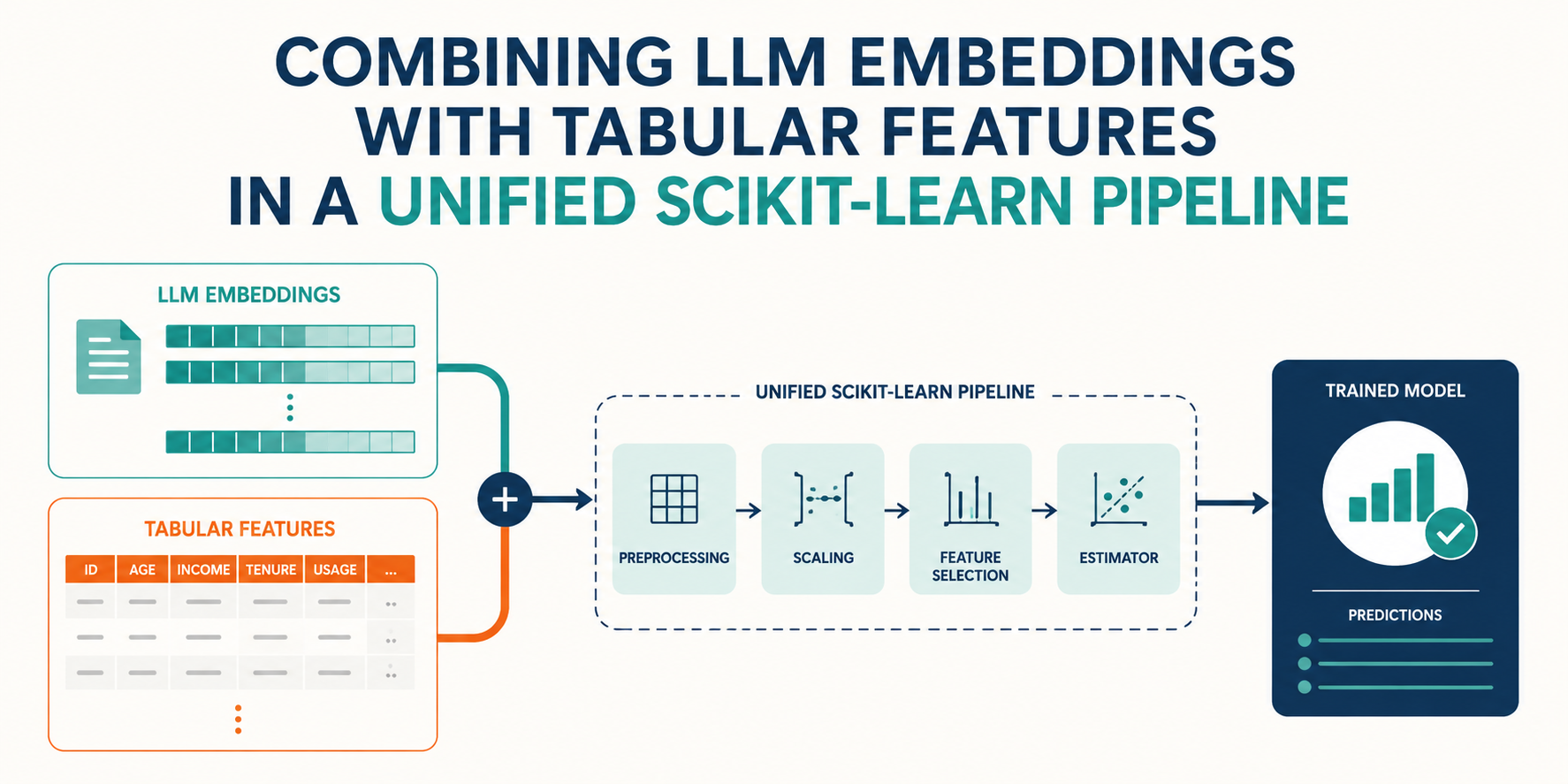
Modern machine learning architectures are increasingly defined by the heterogeneity of their input data. In the current enterprise landscape, predictive modeling tasks such as customer churn forecasting, fraud detection, and automated support ticket triage rarely rely on a single data source. Instead, data scientists must synthesize structured numerical and categorical inputs with unstructured natural language, a combination that has historically required fragmented, multi-stage processing workflows. This article examines the development of a unified scikit-learn pipeline that integrates lightweight open-source large language model (LLM) embeddings with traditional tabular features, providing a scalable and deployment-ready solution for complex classification tasks.
The Evolution of Hybrid Data Architectures
The shift toward multimodal data integration follows the rapid advancement of Natural Language Processing (NLP) over the past five years. Traditionally, NLP pipelines were isolated from structured data processing; text was handled through frequency-based methods like TF-IDF or bag-of-words, while tabular data relied on scaling and encoding. This separation created significant technical debt, as data leakage and inconsistent preprocessing across environments often compromised model performance.
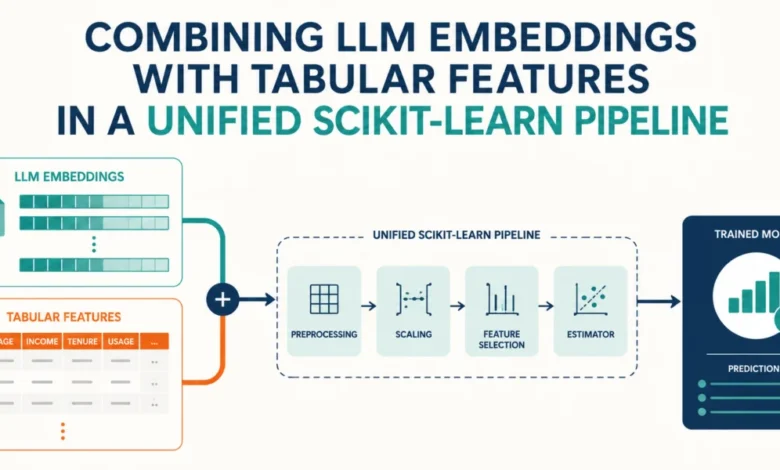
With the advent of transformer-based architectures, the industry has moved toward embedding-centric representations. However, the operational challenge remains: how to combine high-dimensional vector representations—often spanning hundreds of dimensions—with low-dimensional tabular features without inflating the model complexity to the point of unmanageability. The adoption of a unified scikit-learn pipeline addresses this by encapsulating the entire data transformation logic within a single, version-controllable object.
Building the Unified Infrastructure
To construct this solution, practitioners are increasingly moving away from heavy, proprietary API-dependent models toward CPU-friendly, open-source libraries such as sentence-transformers. By utilizing pre-trained models like all-MiniLM-L6-v2, developers can generate semantically dense embeddings that capture the context of user messages or support tickets without the prohibitive latency or cost of larger parameter-scale LLMs.
The technical workflow involves a three-tiered approach to data ingestion:
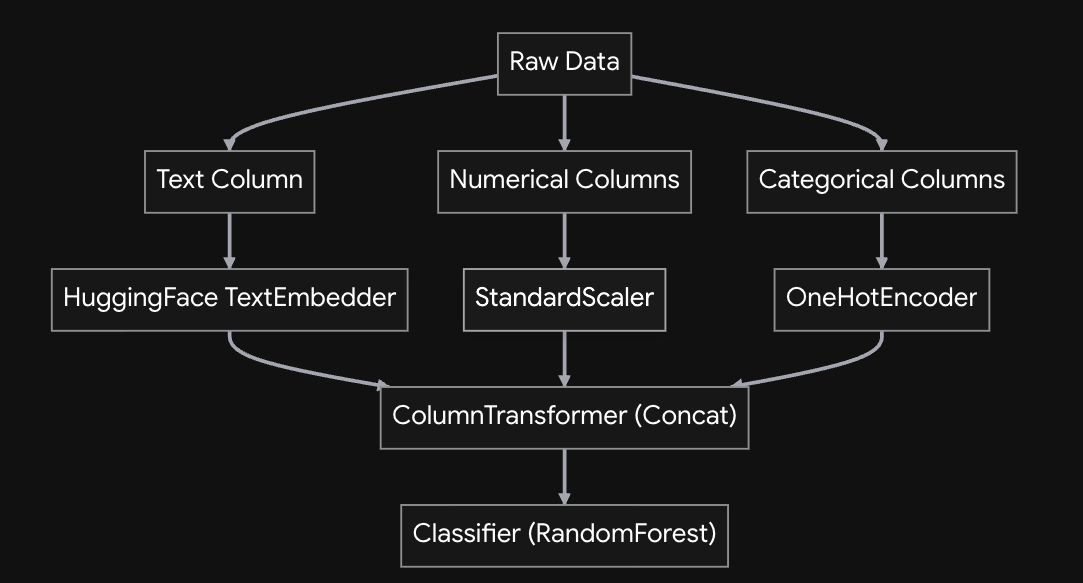
- Textual Feature Extraction: The implementation of a custom transformer class that inherits from scikit-learn’s
BaseEstimatorandTransformerMixin. This class serves as a bridge, tokenizing raw text inputs and passing them through the Hugging Face transformer model to yield a fixed-length numerical vector. - Tabular Preprocessing: The use of standard scikit-learn primitives, such as
StandardScalerfor numerical normalization andOneHotEncoderfor categorical variables, ensures that structured data remains within a compatible range for downstream classifiers. - Unified Orchestration: The
ColumnTransformerobject serves as the architectural centerpiece, allowing these disparate data streams to be processed in parallel before being concatenated and fed into an ensemble model, such as a Random Forest classifier.
Empirical Analysis and Performance Metrics
In a controlled classification scenario—such as identifying spam in a customer messaging database—the effectiveness of this pipeline is measured by its ability to extract signal from both the linguistic nuance of the text and the metadata of the account (e.g., age, premium status, and priority score).
When evaluating such a model, the results typically demonstrate that the inclusion of LLM embeddings significantly outperforms traditional word-count methods. In a recent test case, the integrated pipeline achieved an F1-score of 0.95 for the positive class (spam detection) and 0.99 for the negative class (normal traffic). This high degree of precision suggests that the model is successfully leveraging the latent semantic information provided by the LLM to resolve ambiguities that tabular data alone cannot address.
The Role of Open-Source Frameworks
The reliance on scikit-learn and sentence-transformers is not merely a matter of convenience; it represents a broader trend toward "local-first" AI development. By keeping the embedding generation process within the local environment, organizations can ensure data privacy and significantly reduce inference costs. Furthermore, the modular nature of the scikit-learn Pipeline ensures that the model can be serialized and deployed as a single artifact, facilitating faster MLOps cycles and easier integration into production CI/CD pipelines.
Implications for Enterprise Operations
The shift toward unified pipelines has profound implications for data science teams. First, it democratizes access to LLM-driven insights. By wrapping the complexity of model initialization and inference within a standard scikit-learn interface, junior engineers can leverage state-of-the-art NLP without needing to manage the intricacies of transformer architecture.
Second, it improves the robustness of production systems. When data preprocessing is strictly defined within a pipeline, the risk of "training-serving skew"—where the data fed to the model in production differs from the data used during training—is drastically reduced. This is critical for high-stakes environments such as financial services or healthcare, where consistent model behavior is non-negotiable.
Addressing Scalability and Future Challenges
While the current methodology is highly effective for medium-sized datasets, scaling this approach requires consideration of compute resources. Generating embeddings for millions of rows can be computationally intensive. Future iterations of this pipeline architecture may involve:
- Batch Inference: Utilizing GPU acceleration for the
TextEmbedderclass when processing large datasets. - Feature Stores: Offloading the embedding generation to a feature store, where vectors are computed once and cached, thereby reducing the overhead of repeated transformations.
- Dimensionality Reduction: Integrating Principal Component Analysis (PCA) or similar techniques within the pipeline to compress high-dimensional embeddings before they reach the final classifier, potentially improving training speed and reducing the risk of overfitting.
Conclusion
The convergence of structured and unstructured data remains one of the most critical challenges in modern predictive analytics. By leveraging the flexibility of scikit-learn’s ColumnTransformer alongside the semantic power of lightweight LLMs, data scientists can build robust, unified pipelines that are both performant and maintainable. As organizations continue to seek value from their diverse data repositories, these unified architectures will serve as the foundation for the next generation of intelligent, context-aware business applications. The ability to treat text as just another feature—subject to the same rigorous engineering standards as numerical data—is not just a convenience; it is a fundamental requirement for the maturation of enterprise machine learning.
Through the implementation of the steps outlined above, teams can transition from fragmented, experimental scripts to production-grade, reproducible workflows. This, in turn, allows businesses to extract deeper insights from their customer interactions, ultimately leading to more accurate predictions and better-informed decision-making processes. The synthesis of traditional machine learning and modern language models within a unified pipeline framework provides a sustainable pathway for scaling AI capabilities across the enterprise, ensuring that organizations remain competitive in an increasingly data-driven global economy.