Industrial AI on the Factory Floor Requires Strict Governance and Frontline Integration

As manufacturing enterprises accelerate their digital transformations, the integration of artificial intelligence into physical factory workflows presents a complex operational challenge. While digitized records have become standard across many modern plants, operators frequently find themselves piecing together fragmented data from disconnected systems. Disparities in legacy equipment, local workflows, and worker experience levels across multi-site manufacturing networks further complicate the consistent application of this information.
Recent research underscores these systemic hurdles. A 2026 paper published in Data in Brief identifies inconsistent data-exchange standards as a primary barrier to interoperability within modern manufacturing environments. Simultaneously, operational technology (OT) security guidelines from the Australian Signals Directorate and international cybersecurity partners emphasize that robust physical safety and deep operational knowledge must serve as the non-negotiable foundations of industrial security. Consequently, manufacturers introducing AI into physical workflows must carefully account for fragmented data ecosystems alongside stringent environmental safety requirements.
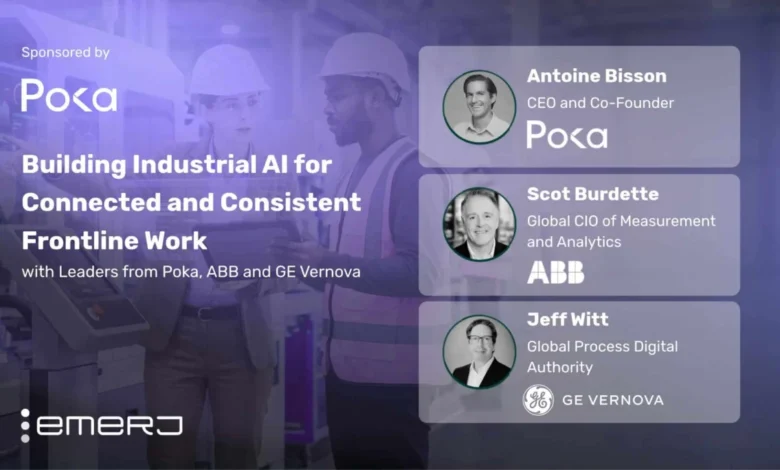
To examine how these real-world constraints shape the evolution of industrial AI, Emerj recently convened top-tier manufacturing technology leaders on the Emerj AI in Business Podcast. The expert panel included Antoine Bisson, CEO and Co-Founder at Poka; Scot Burdette, Global CIO of Measurement and Analytics at ABB; and Jeff Witt, Global Process Digital Authority at GE Vernova. Their discussions explored why industrial AI fundamentally differs from standard enterprise IT software, highlighting the necessity of building applications directly around frontline workers and the physical realities of the factory floor.
The Evolution and Chronology of Industrial Digitalization
The journey toward AI-native manufacturing has evolved significantly over the past decade, moving from basic data collection to advanced edge computing and context-aware agents.
During the early 2010s, industrial digitalization primarily focused on supervisory control and data acquisition (SCADA) integration and the initial migration of paper logs to digital databases. However, these early systems frequently operated in silos, creating localized islands of information that could not easily be shared across an enterprise. By the late 2010s and early 2020s, the emergence of the Industrial Internet of Things (IIoT) enabled broader device connectivity, though issues of data interoperability and legacy system friction persisted.
A major milestone in this chronology occurred in 2023 with the strategic acquisition of Poka by industrial software giant IFS, signaling a broader industry shift toward connected frontline worker platforms. By 2025, as generative AI capabilities matured, Poka transitioned Antoine Bisson from Chief Technology Officer to Chief Officer of AI to spearhead a company-wide AI transformation. This culminated in Bisson’s appointment as CEO in 2026, with an explicit mandate to establish an AI-native organization tailored specifically for the manufacturing sector.
Concurrently, heavy industry leaders like ABB and GE Vernova have spent decades refining asset performance management. Scot Burdette brings more than 40 years of technology and integration experience—including foundational work with General Motors through EDS—to ABB’s global measurement and analytics division. Meanwhile, Jeff Witt has spent over a decade driving global reliability systems, asset health strategies, and digital transformations across multinational industrial networks. The cumulative insights of these leaders trace a clear path forward for organizations seeking to scale industrial AI successfully.
Purpose-Built Industrial AI for Controlled Physical Operations
Unlike corporate software where an incorrect text generation or delayed analysis merely causes minor administrative friction, industrial AI interacts directly with physical machinery, safety protocols, and human operators. In a factory environment, erroneous guidance can contribute directly to unexpected downtime, costly equipment damage, workplace injuries, or severe safety incidents.
Antoine Bisson emphasizes that these high-stakes consequences make strict governance an essential component of system design from day one. For software developers and plant managers, this requires explicitly defining what operational data workers can access, how artificial intelligence is permitted to answer inquiries, and what automated actions are restricted. Bisson argues that the ultimate litmus test for releasing any industrial AI feature is whether it delivers measurable, tangible value within rigid safety safeguards.
"It cannot be some fluff; it cannot be just AI, AI, AI," Bisson explains. "It needs to be tangible; it needs to be providing something that is concrete to the customer. Even if it takes more time to go to market, I’d rather do this and provide real value that is governed, that is safe, and safety is also a really key topic here."
In addition to safety governance, industrial AI architecture must accommodate strict network and computing limitations. Jeff Witt highlights that many shop-floor machines and control systems are deliberately isolated from external corporate networks for cybersecurity purposes. For applications that interface directly with equipment or sensitive processes, Witt advocates for edge computing—running machine learning models locally on hardware situated close to the machinery rather than relying entirely on centralized cloud infrastructure. This decentralized architecture ensures that data travel remains secure and operational latency is minimized.
Furthermore, operational control requires drawing a clear line between recommending an action and executing it. Bisson outlines a progressive framework where AI tools assist by creating issue records, suggesting possible root causes, or proposing parameter adjustments, while leaving final execution firmly in human hands. While automatic equipment adjustments represent a prospective future scenario, they remain strictly conditional on previously observed operational patterns and explicit human validation to confirm that a proposed fix is appropriate.
Connected Operational Data and Context-Specific Guidance
For artificial intelligence to be genuinely useful on a shop floor, it must possess deep contextual awareness. Bisson defines this context as an amalgamation of real-time machine telemetry, inputs from diverse factory software systems, established operator working practices, and historical records of recent safety incidents. Once a manufacturing facility has digitized its records, leadership must evaluate whether these disparate digital systems are truly connected and capable of seamless communication.
Jeff Witt illustrates the intricate operational context that a frontline supervisor or operator inherently brings to a decision during an active machine alert. When an asset faults, the human responder immediately factors in the specific product currently running, the exact machine cell involved, preceding maintenance history, and upcoming production schedules.
Witt contends that AI-generated guidance must match this highly localized, machine-specific context to earn the trust of the workforce. If a tool provides a generic, surface-level response to an operator’s initial query, it can quickly erode confidence before the technology becomes an accepted part of daily routines. Recommendations must reflect the exact asset, environmental conditions, and current production run.
Scot Burdette expands this perspective by incorporating customer-specific requirements into the operational context. In complex manufacture-to-order environments, product specifications frequently vary significantly from one order to the next, with different personnel owning successive stages of production. Each downstream team must understand its exact role, access relevant engineering data, and accurately pass critical production parameters along to the next shift.
Burdette also bridges the gap between data access and workforce training. Local operational teams must adequately prepare workers for their responsibilities, ensuring they possess the digital literacy required to find, interpret, and apply technical data. Cross-training, detailed workflow modeling, and shared knowledge repositories extend the digitalization mandate beyond mere machine connectivity: workers must understand precisely what data metrics mean for their immediate physical tasks.
By integrating operational telemetry with business planning data, manufacturing teams can leverage equipment performance insights alongside customer demand requirements. An equipment manual or a generic predictive maintenance alert in isolation often fails to explain current production commitments or upstream process anomalies.
Workflow-Embedded AI Assistance for Accelerated Problem-Solving
Usability remains a decisive factor in whether frontline manufacturing personnel will adopt digital tools. Burdette stresses that usability must precede complex performance metrics because workers will naturally resist software that is difficult to navigate during high-pressure shifts. Recognizing the operational friction of learning new enterprise systems while maintaining aggressive production quotas, Burdette recommends carving out dedicated time away from active production lines for training and system familiarization.
Modern workflow-embedded tools allow operators to access device diagnostics, maintenance manuals, and troubleshooting guides directly from the field via mobile interfaces. When an issue exceeds local expertise, workers can seamlessly share diagnostic data and collaborate with remote engineering experts through the same unified system. This dual-capability provides workers with immediate, self-service guidance alongside direct pathways to specialized human support.
Bisson notes that reporting routine shop-floor issues has historically involved cumbersome administrative friction. Instead of forcing operators to manually select issue categories, attach image files, and input text across multiple software fields, modern AI-native platforms allow workers to provide simple voice descriptions or capture a quick photograph. Artificial intelligence then interprets the visual and auditory data to automatically categorize and record the problem, drastically reducing the manual administrative burden between noticing an anomaly and initiating corrective action.
Moreover, intelligent software agents can actively assist beyond the initial incident report. In advanced maintenance workflows, unexpected downtime exceeding a predefined threshold can automatically trigger an initial issue record, prompt an automated preliminary investigation into likely root causes, and compile a briefing packet for plant supervisors. This architecture ensures that administrative preparation is handled autonomously while high-consequence operational decisions remain subject to human validation.
Witt emphasizes that artificial intelligence should minimize, rather than add to, the administrative steps required of frontline workers. Operators should not be expected to halt their tasks, open a separate chat window, and manually explain which specific machine they are standing in front of. Assistant interfaces should automatically inherit work-cell and equipment context to deliver hyper-targeted guidance instantly.
Following an AI-assisted intervention, human oversight remains critical. Maintenance technicians must evaluate preliminary diagnostic assessments, determine safe remediation strategies, execute physical repairs, and verify machine integrity before returning an asset to service. Furthermore, systems benefit directly from closed-loop feedback: simple interface mechanisms—such as binary thumbs-up or thumbs-down ratings—allow workers to grade the utility of specific AI recommendations. Combined with historical asset data, this continuous feedback loop refines system accuracy over time.
Standardizing Workflows for Repeatable Multisite Deployment
A successful digital pilot at a single manufacturing plant does not guarantee viability across an enterprise-wide network. Burdette points out that multi-site manufacturing organizations frequently operate as isolated silos, characterized by divergent equipment inventories, localized legacy processes, and distinct workforce cultures. Valuable local knowledge that makes one facility highly efficient often remains trapped on-site, unavailable to sister plants facing identical challenges.
Consequently, Bisson identifies workflow standardization as the essential next step following basic digitization. By standardizing work instructions, operational procedures, and required skill matrices across facilities, manufacturers can transform proven institutional knowledge into a reusable enterprise asset rather than forcing every plant to reinvent solutions independently.
Witt advocates for a disciplined sequence: thoroughly document and optimize an existing workflow before attempting to augment it with artificial intelligence or scale it across multiple facilities. This methodology relies on identifying mature, highly repeatable processes that already operate efficiently within a network.
"Has the process been fully documented? Has the process been optimized? Have we applied lean principles to this and taken all of the waste out of this process already?" Witt asks, highlighting the foundational prerequisite of lean manufacturing principles prior to software automation.
To achieve enterprise scalability, organizations must establish structured taxonomies, such as standardized asset hierarchies that allow maintenance teams to navigate seamlessly from corporate divisions down to specific plants, production lines, work cells, and individual hardware components. While establishing these unified data templates requires significant upfront capital and engineering investment, their long-term value compounds as subsequent digital applications reuse the underlying architecture.
Simultaneously, enterprise leaders must carefully navigate complex build-versus-buy decisions. Bisson cautions that rapid software development capabilities do not absolve internal IT teams from ongoing responsibilities regarding cybersecurity compliance, data governance, multi-site deployment logistics, and long-term technical support. For many industrial enterprises, purchasing an established, purpose-built software foundation and configuring differentiated workflows via modern no-code tools offers a more sustainable path than custom-developing proprietary applications from scratch.
Ultimately, scaling industrial AI successfully requires a disciplined, methodical roadmap: conducting comprehensive internal audits of existing systems, identifying operational gaps, prioritizing high-impact entry points, optimizing physical workflows, and enforcing rigorous human governance. By grounding artificial intelligence in the rigorous realities of physical factory operations and centering solutions around the frontline workforce, industrial leaders can unlock sustainable, enterprise-wide productivity gains without compromising safety or operational integrity.