Court-Ordered Domain Seizure Strips Radaris.com of Control Following Violations of New Jersey Privacy Legislation


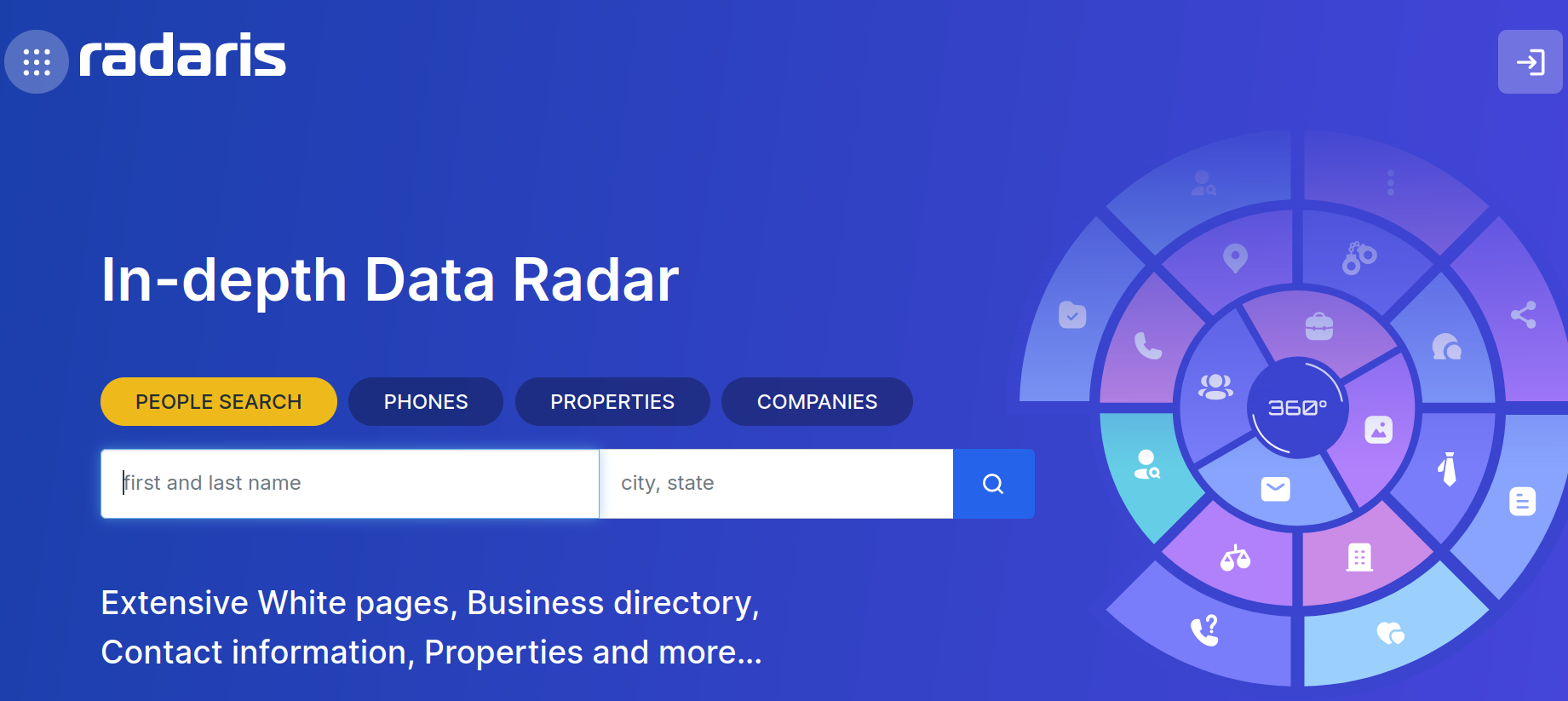
The sprawling consumer data broker network behind Radaris.com has suffered a historic legal defeat, culminating in a federal and state judicial reckoning that forced the transfer of radaris.com and more than a dozen associated web domains to plaintiffs enforcing a strict New Jersey privacy statute. Long notorious for ignoring consumer removal requests and engaging in complex jurisdictional shell games, the people-search empire was brought to a standstill after a federal and state legal offensive pierced its corporate veil.
The legal mechanism driving the takeover is New Jersey’s Daniel’s Law, a statute designed to protect judges, law enforcement personnel, and government officials from targeted harassment by ensuring their personal information is scrubbed from commercial databases. Under the law, data brokers face penalties of $1,000 per violation for failing to comply with valid removal requests. The recent default judgment and subsequent asset seizures mark a watershed moment in the accountability of online people-search directories, exposing the hidden networks of shell companies, fictitious executives, and offshore entities that have shielded data brokers from liability for decades.
Origins of the Legal Battle and Daniel’s Law
Enacted following the tragic murder of the son of a federal judge, Daniel’s Law provides robust protections for public servants by compelling data brokers to remove personal records upon request. In February 2024, Atlas Data Privacy Corp—a private entity aggressively pursuing non-compliant data brokers—filed a lawsuit against Radaris for systematically ignoring the statute.
What followed was a familiar pattern of legal evasion. Attorneys representing the network repeatedly stonewalled plaintiffs, disputed service of process, and deployed complex jurisdictional maneuvers. When pressed on corporate ownership, defense counsel pointed to shifting foreign entities located in the Marshall Islands, the British Virgin Islands, and Cyprus.
However, investigative reporting and exhaustive discovery revealed a different reality. Internal emails and corporate documents obtained during the litigation demonstrated that Radaris and at least 25 sister websites—including Veripages, Nuwber, and various affiliate networks—were operated by a small, centralized group based near Boston, Massachusetts. Specifically, the documents tied the massive data harvesting operation to Russian-born brothers Igor and Dmitry (also known as Dan) Lubarsky.
Corporate Shell Games and the "Island-Hopping" Phase
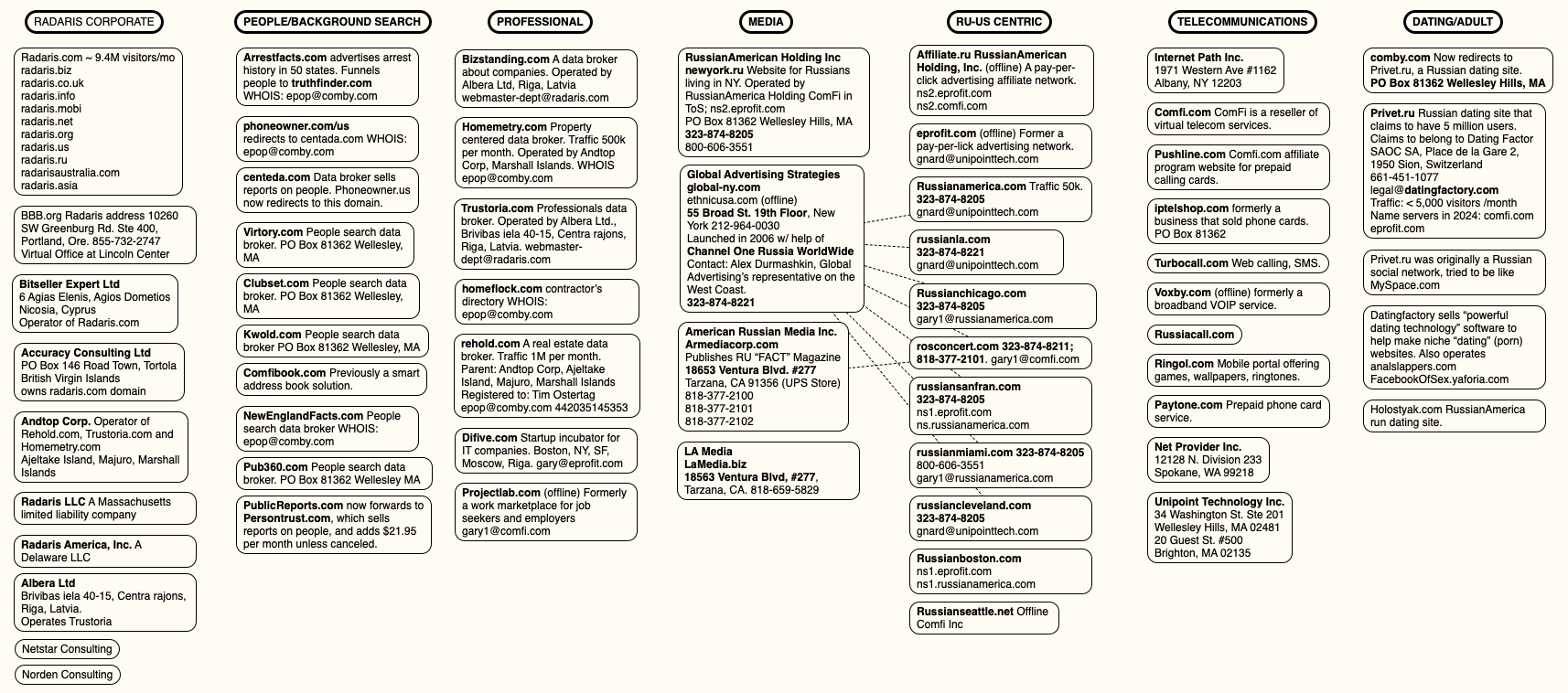
For years, the Radaris enterprise maintained a veneer of legitimacy while actively obfuscating its true ownership. Investigative findings showed that the network operated under a dizzying array of nominal corporate vehicles, such as Bitseller Expert Limited, Digital Orbit Corp, Core Solutions Group, and Lucky Solutions Inc. Despite these varying names, internal administrative functions, payment processing systems, and banking credentials remained unified under a single set of administrators.
Matt Adkisson, president and CEO of Atlas, characterized the defense strategy as an "island-hopping" phase. According to court records and investigative summaries, whenever plaintiffs closed in on a specific operating entity, the defendants updated their terms of service to shift liability to a brand-new, often nonexistent offshore shell company. In one instance, after Radaris claimed management had been transferred to a Marshall Islands entity, investigators discovered the designated company had not even been legally formed at the time of the declaration.
Furthermore, investigative reports revealed that the network had previously fabricated a fictitious CEO named "Gary Norden" to issue press releases and pitch investors, an admission later confirmed by Boston-based attorney Val Gurvits during legal proceedings.
Financial Architecture of the Data Broker Network
The discovery process yielded more than 10,000 internal documents, offering an unprecedented glimpse into the lucrative economics of the people-search industry. According to financial records uncovered by Atlas, individual nodes within the Radaris network generated tens of thousands of dollars in monthly revenue. Radaris.com alone pulled in approximately $42,000 per month, while sister site Veripages generated roughly $45,000 monthly through partnerships with mainstream marketing and advertising conglomerates like the Lifetime Value Company, which operates brands such as PeopleLooker, PeopleSmart, and Bumper.
The financial web extended even further, revealing profitable partnerships with privacy-washing entities. Internal records showed that the Radaris ecosystem earned up to $25,000 per month from Onerep, a privacy service that ostensibly helps consumers remove their data from people-search sites while simultaneously sharing operational roots with the broader data broker ecosystem.
Court-Ordered Seizures and Defendant Response
Faced with persistent non-appearance and deliberate procedural delays, the New Jersey court moved forward with enforcement mechanisms. On August 26, the presiding judge ruled that the defendants had been afforded ample opportunity to mount a defense but chose instead to default. Consequently, the court ordered domain registries to transfer radaris.com and 13 sister domains directly to the plaintiffs.
Today, visiting radaris.com does not lead to the traditional dossier-selling interface. Instead, the domain redirects to a formal notice detailing the court-ordered transfer and providing links to investigative reporting regarding the network’s operations.
Defense counsel has pushed back against the enforcement actions. Victor Worms, representing the defendants following changes in legal representation, argued that the default judgment is void because "Radaris.com" is a domain name rather than a formal legal entity with the capacity to be sued. Defense attorneys have filed motions to vacate the judgment and indicated plans to pursue appeals, arguing that the domain seizure violates constitutional due process and principles of property forfeiture.
Broader Constitutional Challenges and the Future of Privacy Law
While the seizure of Radaris.com represents a major victory for privacy advocates, the broader legal battle over Daniel’s Law is far from over. The wider data broker industry has launched a concerted counter-offensive, moving dozens of similar lawsuits into federal court and challenging the constitutionality of Daniel’s Law on First Amendment grounds. Critics of the statute argue that it places an overly broad restriction on the publication of publicly available records.
The U.S. Court of Appeals for the Third Circuit is currently reviewing these constitutional challenges, with legal analysts predicting the ultimate destination will be the U.S. Supreme Court. Meanwhile, other states are monitoring the outcome closely; at least 14 states have enacted legislation modeled after Daniel’s Law, though similar statutes—such as West Virginia’s version—have faced initial setbacks in federal district courts.
Privacy experts point out that state-level patchwork laws can only achieve so much against an entrenched multi-million-dollar surveillance economy. Justin Sherman, a privacy researcher and author focusing on the data broker industry, notes that people-search businesses will continue to thrive as long as state and federal laws exempt vast categories of "public" records—including voting registries, property deeds, marriage certificates, and motor vehicle databases—from privacy protections.
Without comprehensive federal privacy legislation that restricts how commercial entities acquire, aggregate, and monetize government and public records, enforcement actions like the Radaris domain seizure remain isolated battles in a much larger war. As data brokers continue to adapt their corporate structures to evade regulatory oversight, lawmakers, privacy advocates, and judicial systems face mounting pressure to establish modern data protection standards fit for the 21st century.