Court-Ordered Domain Seizure Strips Radaris of Its Flagship Web Address Following Repeated Non-Compliance with State Privacy Statutes


The sprawling and often opaque consumer data broker ecosystem suffered a major legal blow when a New Jersey court ordered the transfer of the flagship domain radaris.com—along with more than a dozen sister web properties—to the plaintiffs in a landmark privacy lawsuit. The punitive action came after years of deliberate evasion, procedural stonewalling, and shell games orchestrated by the operators of Radaris to sidestep a New Jersey statute designed to protect the personal information of law enforcement officials and government personnel.
For over a decade, Radaris built a reputation for ignoring consumer removal requests and dodging accountability through complex corporate structuring. That strategy finally fractured under the weight of relentless litigation brought by Atlas Data Privacy Corp, a firm specializing in enforcing Daniel’s Law. The resulting forfeiture of radaris.com marks a watershed moment in the ongoing battle between privacy advocates and the multi-million-dollar people-search industry, underscoring the growing legal risks faced by data brokers that profit from publishing sensitive public-sector data.
The Origins and Enforcement of Daniel’s Law
Enacted in response to a tragic shooting at the home of a federal judge in New Jersey, Daniel’s Law provides robust protections for state law enforcement officers, judicial personnel, prosecutors, and their immediate families. The statute grants these individuals the legal right to have their personal information completely scrubbed from commercial data brokers and people-search engines. Crucially, the law imposes severe financial penalties of up to $1,000 per violation on companies that knowingly ignore legitimate removal requests or continue to publish protected records.
In February 2024, Atlas Data Privacy Corp launched a concerted legal campaign against Radaris, accusing the company of systemic non-compliance with the statute. Rather than complying with New Jersey law or mounting a substantive defense, attorneys representing Radaris engaged in a familiar pattern of delay tactics. Defense counsel repeatedly contested jurisdiction, claimed faulty service of process, and argued that the plaintiffs were suing improperly identified foreign entities.
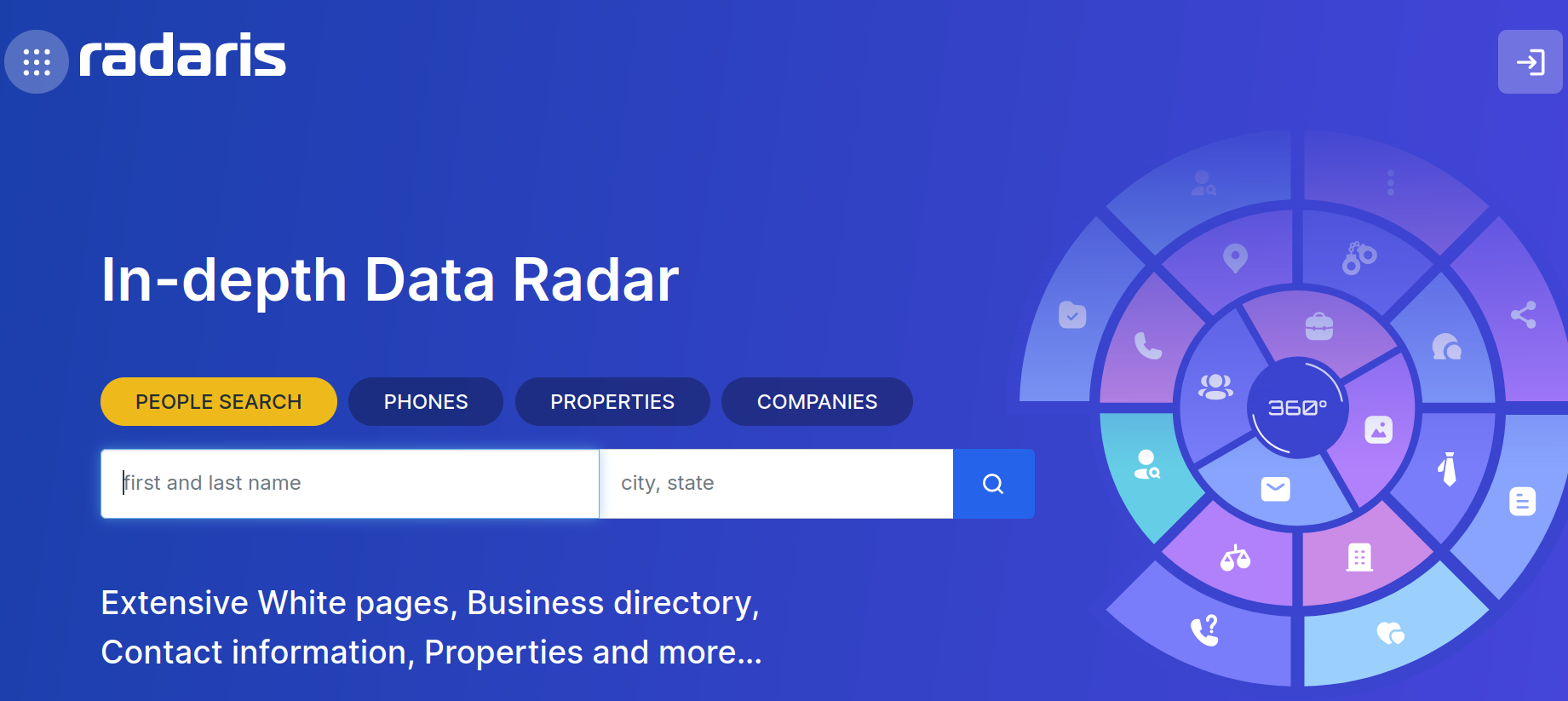
This legal friction ultimately culminated in default judgments when the defendants failed to mount a credible defense on the merits. Recognizing the systemic threat that the Radaris network posed to public safety officials in New Jersey, the presiding judge ordered the domain registry Verisign to transfer radaris.com and 13 associated web properties directly to the plaintiffs. Today, the once-lucrative search portal no longer sells detailed personal dossiers; instead, it greets visitors with a court-ordered notice detailing the seizure.
Unraveling the Corporate Shell Game
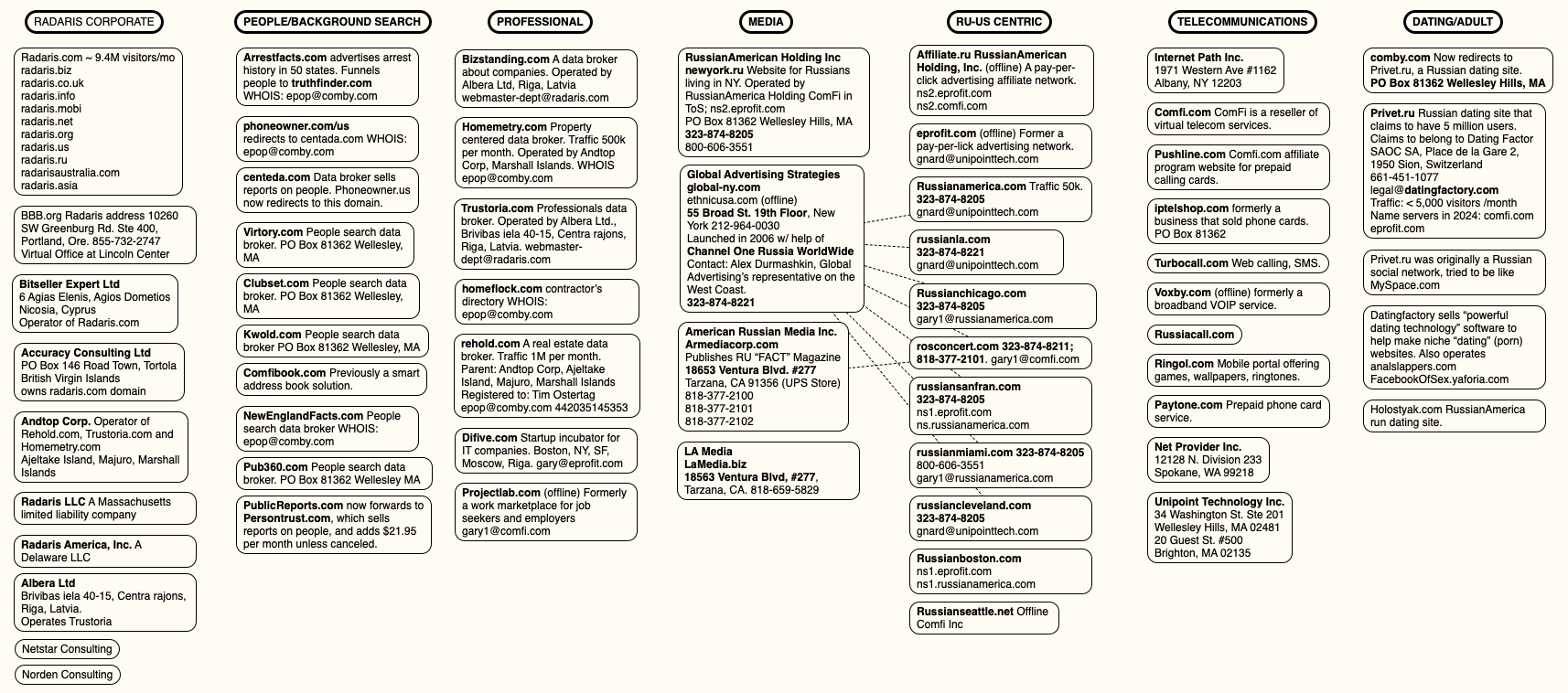
The takedown of radaris.com pulled back the curtain on a complex, international corporate network operated by Russian-born brothers Igor and Dmitry Lubarsky, who reside in Massachusetts. Investigative reporting by KrebsOnSecurity previously exposed the brothers’ extensive portfolio of people-search websites, Russian-language dating services, and affiliate programs.
Throughout the litigation, the true ownership of Radaris proved exceptionally difficult to pin down. Atlas executives described the defendants’ defense strategy as an "island-hopping phase," characterized by shifting privacy policies and shell companies incorporated in offshore jurisdictions such as the Marshall Islands, the British Virgin Islands, and Seychelles.
According to Matt Adkisson, president and CEO of Atlas, the defendants routinely cycled through nominal corporate entities to frustrate plaintiffs and exhaust their legal resources. "Defense lawyers told the court that certain entities merely operated the domains and were the proper parties to sue," Adkisson explained. "But by the time a judgment neared, those entities would be discarded and new entities would appear." In one instance, after Radaris updated its terms of service to claim management by a newly formed Marshall Islands company, an Atlas-hired investigator discovered that the purported entity did not even legally exist.
Internal documents and emails subpoenaed during the litigation—numbering more than 10,000 pages—dispelled any remaining doubt regarding the operation’s centralized control. The records established that nominal legal vehicles such as Radaris America, Inc., Bitseller Expert Limited, Digital Orbit Corp., and Veripages Inc. were all administered by the same core group of individuals from shared mailboxes, funded through unified payment processing streams, and managed from a single virtual office.

Financial disclosures within the document cache revealed the staggering scale of the operation. Radaris.com reportedly pulled in approximately $42,000 per month, while sister site Veripages.com generated roughly $45,000 monthly through lucrative partnerships with marketing conglomerates like the Lifetime Value Company—owner of brands such as PeopleLooker, PeopleSmart, and NumberGuru. Furthermore, the network allegedly brought in up to $25,000 monthly through commercial arrangements with Onerep, a privacy-as-a-service firm whose founder has historic ties to the launch of numerous competing people-search platforms.
Legal Pushback and Constitutional Challenges
Despite the decisive domain transfers, the legal battles surrounding Daniel’s Law are far from over. Victor Worms, an attorney representing the defendants in the post-judgment phase, filed motions to vacate the default judgment, arguing that the New Jersey court lacked the legal capacity to seize radaris.com because it is a domain name rather than a formal legal entity. Worms asserted that the transfer constitutes an unlawful forfeiture and vowed to pursue all available appellate avenues.
At the same time, the broader data broker industry has launched a coordinated counter-offensive against Daniel’s Law itself. More than 150 consumer data broker firms currently targeted by Atlas lawsuits have mounted aggressive constitutional challenges, arguing that the New Jersey statute infringes upon First Amendment protections regarding the dissemination of publicly available information.
More than 70 of these active lawsuits have been removed to federal court. While the U.S. Court of Appeals for the Third Circuit weighs the constitutionality of the New Jersey statute, legal analysts expect the ultimate resolution to wind its way to the U.S. Supreme Court. The stakes are exceptionally high: at least 14 other states have enacted similar legislation modeled after Daniel’s Law, while others actively weigh parallel measures. However, the legal viability of these statutes remains uneven, highlighted by a federal district court ruling in August 2025 that struck down West Virginia’s version of Daniel’s Law as facially unconstitutional under the First Amendment.
The Broader Implications for Digital Privacy
The Radaris enforcement action highlights a foundational weakness in contemporary privacy regulation: the persistent reliance on piecemeal state laws to police a multi-billion-dollar data aggregation industry that operates on a national scale.
Privacy experts emphasize that state-level statutes, while impactful for targeted groups like law enforcement, leave the general public entirely unprotected against commercial data harvesting. Justin Sherman, a privacy expert and author of the forthcoming book The Middlemen, noted that state privacy frameworks almost universally exempt records deemed "public" or "government documents," including property filings, marriage certificates, voting registries, and motor vehicle databases.
"The average person can look at Daniel’s Law and have a perfectly normal reaction, which is that everyone should be covered, not just police and judges," Sherman observed. He pointed out that despite frequent public wake-up calls regarding data security—such as massive third-party breaches exposing millions of state driver’s licenses—intense lobbying by big tech, social media platforms, cryptocurrency advocates, and artificial intelligence proponents has consistently neutralized comprehensive federal privacy reform.
As long as public records remain freely scrapable and commercial data brokers can hide behind shifting offshore holding companies, platforms like Radaris and its affiliates will continue to adapt and thrive. For now, the successful seizure of radaris.com serves as both a historic victory for state-level privacy enforcement and a stark reminder of the immense legal hurdles standing in the way of comprehensive digital rights in the United States.
Related posts: