Industrial AI on the Factory Floor: How Global Manufacturers Are Scaling Operational Intelligence with Poka, ABB, and GE Vernova

As manufacturing enterprises accelerate their digital transformation initiatives, many industrial operators find themselves piecing together vital information from fragmented, disconnected systems. Despite decades of enterprise software adoption, differences in legacy equipment, localized workflows, and varying levels of worker experience across plants continue to create barriers that hinder the consistent application of operational data.
A 2026 study published in the journal Data in Brief underscores this ongoing friction, identifying inconsistent data-exchange standards as a critical hurdle to seamless interoperability in modern manufacturing environments. Concurrently, regulatory guidance issued by the Australian Signals Directorate and international security partners emphasizes that deep operational knowledge and physical safety protocols must serve as the uncompromised foundations of operational technology (OT) security. As industrial enterprises introduce artificial intelligence into physical workflows, leadership teams must navigate these technical silos while strictly adhering to rigorous safety and regulatory frameworks.
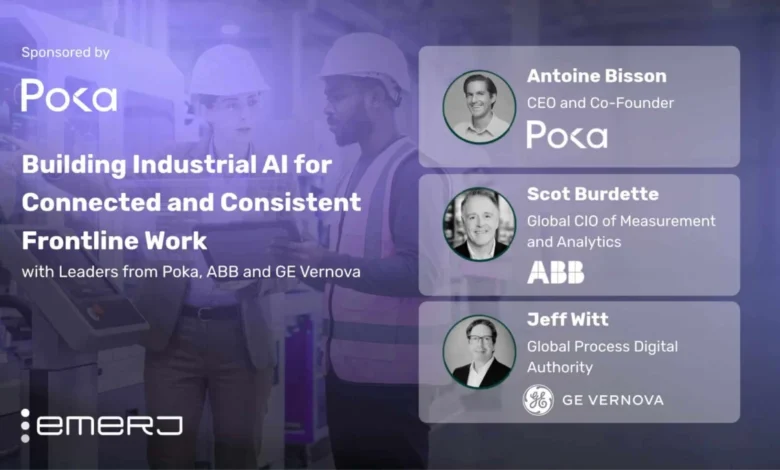
To examine how industrial leaders are balancing these complex constraints, the Emerj AI in Business Podcast recently convened a panel of prominent manufacturing technology executives. The expert panel included Antoine Bisson, CEO and Co-Founder at Poka; Scot Burdette, Global CIO of Measurement and Analytics at ABB; and Jeff Witt, Global Process Digital Authority at GE Vernova. Their discussions illuminated a foundational truth for the industrial sector: industrial AI cannot simply mirror generic enterprise AI. Instead, it must be architected specifically around the realities of frontline workers, physical machinery, and high-stakes operational environments.
The Evolution of Industrial Digitalization: A Chronological Retrospective
To understand the current imperative for purpose-built industrial AI, industry analysts often look back at the trajectory of manufacturing technology over the past three decades.
During the 1990s and early 2000s, the primary focus of manufacturing IT was enterprise resource planning (ERP) integration and computerized maintenance management systems (CMMS). These early software deployments successfully digitized high-level administrative records, supply chain logistics, and financial reporting. However, they largely ignored the shop floor, leaving frontline operators reliant on paper manuals, physical whiteboards, and tribal knowledge.
By the 2010s, the advent of Industry 4.0 and the Industrial Internet of Things (IIoT) drove widespread sensor deployment. Factories began capturing millions of data points regarding machine vibrations, temperature fluctuations, and cycle times. Yet, this influx of machine-generated telemetry frequently created data overload. Operators and maintenance technicians were left drowning in metrics without adequate contextual frameworks to translate raw data streams into actionable, real-time decisions.
Entering the mid-2020s, the rapid maturation of generative AI and machine learning introduced new possibilities for automation and cognitive assistance. However, initial attempts to deploy generic enterprise AI models directly into industrial settings exposed glaring vulnerabilities. Large language models trained on public internet data lacked awareness of physical equipment safety constraints, proprietary plant topologies, and specialized regulatory compliance standards.
This historical context brings the insights shared by Bisson, Burdette, and Witt into sharp relief. Today, the industrial technology sector stands at a critical juncture: transitioning from raw data collection and unguided automation to governed, context-aware, workflow-embedded intelligence designed explicitly for the frontline worker.
Purpose-Built Industrial AI for Controlled Physical Operations
Unlike corporate finance or marketing departments, where a software error typically results in minor administrative inconvenience, a miscalculation on the factory floor can lead to catastrophic equipment downtime, severe injury, or regulatory violations. Consequently, purpose-built industrial AI must be meticulously engineered to respect the physical limits, safety protocols, and permitted actions of specific production workflows.
Antoine Bisson, whose manufacturing software company Poka was acquired by industrial software giant IFS in 2023, emphasizes that governance must be embedded directly into the system’s core architecture from day one. In his view, software developers cannot afford to adopt a "move fast and break things" mentality when dealing with heavy machinery.
"It cannot be some fluff; it cannot be just AI, AI, AI," Bisson stated during his appearance on the Emerj podcast. "It needs to be tangible; it needs to be providing something that is concrete to the customer. Even if it takes more time to go to market, I’d rather do this and provide real value that is governed, that is safe, and safety is also a really key topic here."
This governance requires strict perimeter controls governing what information workers can access and how generative systems are permitted to formulate responses. Furthermore, physical realities dictate infrastructure design. Jeff Witt of GE Vernova points out that many critical shop-floor assets are deliberately isolated from external cloud networks to mitigate cybersecurity risks. For applications involving direct process control or sensitive machine telemetry, industrial organizations must increasingly rely on edge computing—running models locally on hardware adjacent to the machinery rather than routing data through distant cloud servers.
Bridging the Gap: Connected Operational Data and Contextual Guidance
A recurring challenge highlighted by industry leaders is the historical compartmentalization of plant data. Data generated by programmable logic controllers (PLCs), enterprise asset management systems, and human-entered shift logs often reside in isolated databases. Without unified integration, an operator facing an unexpected machine fault receives little more than a generic error code.
Scot Burdette of ABB illustrates how customized manufacturing operations—such as engineer-to-order production environments—magnify the need for fluid information sharing. In these complex settings, product specifications vary wildly from one production run to the next, and distinct teams manage successive stages of the manufacturing lifecycle. If an upstream team fails to pass critical quality parameters or calibration settings down the line, downstream operators are forced to operate in the dark.
Furthermore, Burdette stresses that connecting digital records is only half the battle; workers must be adequately trained to interpret and apply that data within their specific operational context. This requires robust cross-training programs, detailed workflow modeling, and a cultural commitment to shared knowledge across shifts and facilities.
When an unexpected machine alert triggers, an experienced frontline worker intuitively evaluates multiple variables simultaneously: the specific asset’s health history, the exact product currently moving down the line, recent maintenance interventions, and environmental conditions. For an AI assistant to earn the trust of these seasoned professionals, its diagnostic recommendations must mirror this localized, multi-dimensional context. Generic troubleshooting steps that fail to account for the unique operating environment quickly erode frontline adoption.
Workflow-Embedded AI Assistance for Accelerated Problem-Solving
Even the most sophisticated algorithms will fail if they introduce friction into the daily routines of busy shop-floor personnel. Frontline workers operating in high-tempo manufacturing environments have little patience for cumbersome user interfaces that require manual data entry across multiple screens.
To mitigate this friction, Poka has pioneered interface designs that leverage multimodal capabilities. Instead of forcing an operator to halt production, navigate a complex software menu, select an issue category, and manually type out a detailed incident report, operators can simply capture a photograph or provide a brief voice description. AI models then interpret the input, automatically categorizing the anomaly and initiating the appropriate workflow.
Similarly, ABB has integrated diagnostic tools directly into the daily workflow of field technicians. When maintenance personnel encounter an unfamiliar machine fault, the system provides immediate access to relevant equipment manuals, historical repair logs, and diagnostic checklists. If the local team exhausts its troubleshooting options, the platform facilitates seamless escalation to remote subject-matter experts, sharing real-time telemetry and visual feeds to accelerate resolution without sacrificing oversight.
Crucially, these systems are designed to augment human decision-making rather than replace it. In a maintenance workflow supported by AI, human operators retain absolute responsibility for reviewing diagnostic assessments, deciding on corrective interventions, and validating outcomes. Feedback mechanisms—such as simple thumbs-up or thumbs-down ratings on AI-generated recommendations—allow the system to continuously learn and refine its accuracy over time while building institutional resilience.
Standardizing Workflows for Repeatable, Multisite Deployment
A successful digital pilot at a single manufacturing facility does not guarantee viability across a global industrial enterprise. Many multinational manufacturers operate networks of plants characterized by disparate legacy machinery, divergent local work practices, and entrenched cultural silos.
To achieve enterprise-wide scale, leaders must prioritize standardization. Jeff Witt of GE Vernova advocates for a rigorous process optimization methodology before attempting to overlay artificial intelligence. Before automating or augmenting any workflow, manufacturing leadership must thoroughly document the process, eliminate operational waste, and apply proven Lean manufacturing principles.
"Has the process been fully documented? Has the process been optimized? Have we applied lean principles to this and taken all of the waste out of this process already?" Witt asks, outlining the necessary prerequisites for scalable digital transformation.
Once a core workflow is optimized and standardized across multiple manufacturing sites—such as standardizing asset hierarchies from enterprise divisions down to individual work cells and pumps—organizations can deploy repeatable digital templates. This structured approach allows enterprises to scale innovations rapidly without stripping away the vital local context required for frontline execution.
Strategic Implications and the Path Forward
The collective insights from leaders at Poka, ABB, and GE Vernova offer a clear roadmap for industrial enterprises evaluating artificial intelligence and digital transformation investments:
- Prioritize Safety and Governance: Industrial AI must be engineered with strict guardrails and permission structures tailored to physical machinery and human safety regulations.
- Emphasize Edge Architecture: Where network security and low-latency control loops are paramount, deploy computing resources locally rather than relying solely on cloud-based infrastructure.
- Contextualize Operational Data: Break down data silos to ensure that machine telemetry, maintenance histories, and production requirements are accessible as a unified operational picture.
- Design for Frontline Usability: Minimize administrative friction through intuitive interfaces, multimodal inputs, and workflow-embedded assistance that respects the time constraints of shop-floor workers.
- Standardize Before Scaling: Optimize, document, and streamline physical processes using established lean principles before attempting to automate or scale digital solutions across multiple enterprise sites.
As the industrial sector continues to navigate the complexities of digital evolution, the organizations that succeed will be those that view artificial intelligence not as a standalone software upgrade, but as a disciplined operational strategy centered firmly on the empowerment, safety, and expertise of the frontline workforce.