Navigating the Next Frontier of Payments Fraud: Insights from MoneyGram and Riskified on AI-Driven Defenses

Fraud prevention in the modern money-movement ecosystem resembles a perpetual game of catch-up, where malicious actors iterate on their tactics faster than legacy, rule-bound control systems can adapt. Traditional static controls, which rely on rigid parameters designed to catch known attack vectors, frequently fail to intercept sophisticated account takeovers (ATOs) while simultaneously creating friction that blocks legitimate, high-value customers. This dynamic presents a formidable operational challenge for financial institutions, fintech platforms, and remittance providers alike, forcing executives to constantly recalibrate the delicate balance between security and frictionless user experience.
The Scale of the Crisis: Industry Data and Financial Exposure
The scope of payments fraud across United States organizations remains pervasive. According to comprehensive benchmark research published by the Association for Financial Professionals (AFP), an overwhelming 76% of surveyed organizations reported experiencing either attempted or actual payments fraud. More concerningly, two-thirds of enterprise companies generating over $1 billion in annual revenue acknowledged suffering direct financial losses as a result. Despite this high exposure, the adoption of advanced technological countermeasures remains remarkably low; the same AFP survey revealed that a mere 17% of organizations currently deploy artificial intelligence to combat financial crime.
Regulatory data further underscores the systemic nature of the threat. An in-depth analysis conducted by the Financial Crimes Enforcement Network (FinCEN)—examining suspicious activity reports filed under the Bank Secrecy Act—linked 42% of all reviewed filings to identity-related financial crime, totaling an astounding $212 billion. Bad actors consistently exploit identity verification workflows across the entire customer lifecycle, targeting vulnerabilities during initial account creation, ongoing access management, and final transaction processing. According to FinCEN, compromised credentials exert a disproportionately severe financial impact compared to alternative methods of identity exploitation, while the circumvention of basic verification protocols stands as the single most frequently reported infraction by money services businesses.
Industry Leaders Convene to Address Adaptive Threats
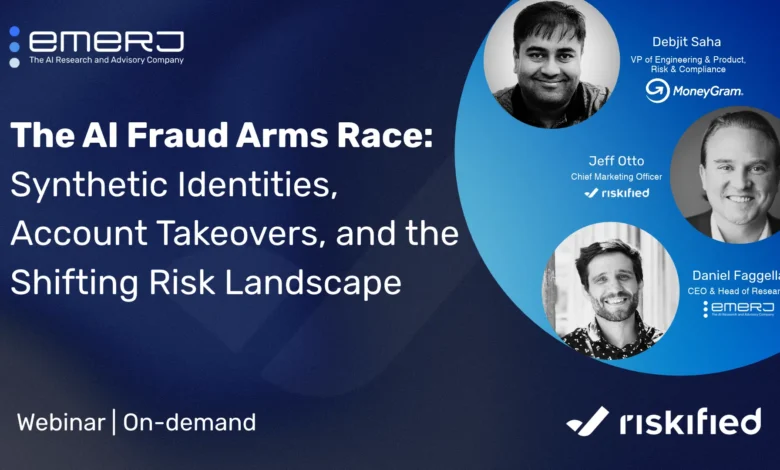
To dissect these mounting pressures and explore how modern money-movement enterprises can outpace rapidly evolving fraud rings, Emerj CEO and Head of Research Daniel Faggella hosted an on-demand virtual briefing. He was joined by two prominent industry authorities: Debjit Saha, Vice President of Engineering and Product, Risk and Compliance at MoneyGram; and Jeff Otto, Chief Marketing Officer at Riskified.
The panel convened to evaluate a modern triad of defense strategies: layered identity intelligence, rail-specific risk controls, and value-based adaptive friction. Together, these methodologies aim to slash organizational losses without sacrificing legitimate transaction approval rates.
Debjit Saha brings extensive expertise in financial crime technology and risk engineering to MoneyGram, where he oversees the architectural development of data- and AI-driven controls designed to safeguard global compliance, risk, and payments decisioning. Prior to his current role, Saha advised major global financial institutions as a senior management consultant at EY and earned his Master of Business Administration from the University of Chicago Booth School of Business.
Complementing this perspective, Jeff Otto leads global marketing at Riskified, an AI-powered enterprise ecommerce risk intelligence platform. Otto’s background includes executive marketing leadership positions at Marqeta and a seven-year tenure at Salesforce scaling product strategy across financial services, healthcare, and enterprise technology, preceded by foundational financial engineering experience within Morgan Stanley’s technology and data division. He holds an MBA in Finance from the McCombs School of Business at the University of Texas, where he was recognized as a Venture Fellow and Dean’s Award recipient.
Layered Identity Intelligence: Moving Beyond Static Rules
During the discussion, Saha outlined how fraud patterns are mutating across multiple money-movement channels, migrating fluidly between web applications, mobile interfaces, and physical walk-in brick-and-mortar locations. Modern criminal syndicates routinely deploy synthetic identities—which seamlessly fuse authentic PII with fabricated data points—alongside cross-channel account takeovers, compromised identification documents, illicit mule accounts, and sophisticated social engineering schemes targeting customer service call centers to orchestrate unauthorized password resets.
According to Saha, behavioral drift represents the core hurdle for traditional security architectures:
"You cannot identify fraud from a single signal. You have to bring all the signals together to understand behavioral drift. The older rule-based approaches are no longer very effective, because fraudsters have become far more sophisticated. They know the rules and the patterns, and they use that to their advantage."
Supporting this observation, Riskified’s threat intelligence analysts—who continuously monitor illicit marketplaces across both the dark web and clear web—have tracked a significant economic premium on aged, established accounts. While standard fraud detection protocols aggressively scrutinize new customers due to a lack of baseline history, legacy accounts frequently enjoy relaxed oversight because of their historical legitimacy. Fraudsters actively exploit this built-in trust, utilizing stolen credentials to execute fraudulent fund transfers that effortlessly bypass outdated rule sets.
Advanced machine learning models and identity graphs are increasingly deployed to counter this vulnerability. By cross-referencing first-time customers against broader, multi-institution networks, systems can unearth hidden histories before localized fraud occurs. Otto notes that enterprise loss data consistently traces a disproportionate share of financial damage to a minute fraction—approximately 20 basis points—of a broader customer base, comparing the phenomenon to a few drops of poison contaminating an entire lake. Identity graphs successfully isolate these high-risk actors, ensuring they are instantly recognized even when attempting to re-emerge behind newly created accounts.
Rail-Specific Risk Controls: The Hidden Dangers of ACH
As digital platforms diversify their service offerings, payment rails present vastly contrasting economic models and risk profiles. While credit cards and Automated Clearing House (ACH) bank transfers dominate modern money movement, their operational dynamics differ profoundly.
ACH transactions offer enticingly low processing fees and high initial conversion rates, but these very benefits serve as a magnet for criminal syndicates. Otto highlights that typical ACH decline rates hover between 1% and 2%, starkly contrasting with the 10% to 15% decline rates observed in certain credit card verticals. Furthermore, Riskified’s empirical analysis reveals that the average ACH transaction value runs roughly 3.6 times larger than the average credit card transaction, creating a lucrative target for bad actors:
"ACH is a low-cost rail with high-cost surprises. Depending on what you negotiate with your bank, transaction fees can be as low as 20 cents, which makes it very economically attractive for a good transaction. The problem is the risk profile; our analysis found that fraud attempts on ACH were 2.3 times higher than on credit cards. And unlike the card networks, you don’t have a dispute representment process. The bank just sends a return code, so there’s a real risk of losing the entire value of the transaction if you get it wrong."
Saha expands on this technical distinction, noting that while an individual can successfully pass standard Know Your Customer (KYC) onboarding checks, they may subsequently fund an ACH transfer from a bank account that legally belongs to an entirely different party. This ownership gap represents the primary vulnerability inherent to ACH rails. Conversely, card fraud typically relies on stolen physical or virtual card credentials, prompting the maturation of highly sophisticated card-monitoring controls—such as deep scrutiny applied to unusually large initial purchases.
Because ACH dispute mechanisms lack the structured representment processes native to credit card networks, financial institutions absorb the full financial exposure of a reversed transaction. Consequently, compliance architects must engineer distinct, rail-specific risk frameworks to preserve operational profitability.
Value-Based Adaptive Friction and Strategic Implications
In an intensely competitive fintech marketplace, user experience heavily dictates customer retention. When platforms enforce heavy-handed verification protocols indiscriminately, legitimate users abandon onboarding and transaction funnels in droves. To resolve this tension, Saha champions the concept of "adaptive friction," a strategy that dynamically introduces verification checks only when tangible risk signals materialize during a session.
Otto advocates a surgical approach to risk mitigation, ensuring that high-value customers experience frictionless processing while intensive security controls are deployed selectively. When high-net-worth clients or high-lifetime-value (LTV) cohorts are incorrectly flagged by automated risk engines, the cost of a false positive extends far beyond a single blocked transaction.
As Otto explains:
"Maybe in the old way of doing it, the rule would say decline, and now you have a high-net-worth customer with a high customer lifetime value that just got a really bad experience. The numbers always show that if you give somebody a bad experience, one-third of the time they may never come back. So you really have to be careful, balance the risk with the experience, and segment your populations so you understand who the highest-value cohort is."
Rather than enforcing automated declines, forward-thinking organizations utilize AI to route flagged high-value transactions into high-touch review queues—such as concierge-level outreach or manual verification calls—deepening customer trust rather than eroding it.
Ultimately, industry experts agree that optimizing fraud prevention requires a paradigm shift in key performance indicators (KPIs). If a fraud team operates under the singular mandate of achieving zero fraud, the inevitable result is over-tightened controls that cripple business growth. By aligning risk management with overall customer lifetime value, enterprise platforms can harness advanced identity intelligence and adaptive friction to safeguard assets while securing hundreds of basis points in incremental conversion and revenue.