Choosing an LLM Inference Optimization Technique: A Decision-Tree Approach

The Anatomy of the Inference Bottleneck
In the current AI landscape, inference optimization is categorized by how specific techniques address distinct layers of the compute stack. When an LLM service experiences latency spikes or throughput degradation, the underlying cause is rarely uniform. It often stems from a mismatch between the chosen optimization strategy and the actual hardware utilization pattern.
Historically, the industry treated LLM inference as a monolithic task. However, the maturation of serving engines—such as vLLM, TensorRT-LLM, and TGI—has forced a shift toward modular optimization. The primary constraints typically fall into one of three buckets: memory bandwidth, which limits how fast weights can be loaded; compute capacity, which limits the speed of floating-point operations; and request scheduling, which dictates how efficiently a GPU can process multiple users simultaneously. Understanding these constraints is the difference between a high-performance system and a resource-heavy service that fails to scale.
A Chronology of Optimization Advancements
The evolution of inference optimization has followed a distinct timeline, driven by the rapid increase in parameter counts. In the early stages of the LLM boom, developers relied on basic, high-precision inference that consumed massive amounts of VRAM.
- The Era of Naive Serving (2022-2023): Initial deployments focused on getting models running. Optimization was limited to simple batching, which often resulted in severe underutilization of GPU resources due to the variable nature of text generation.
- The Introduction of PagedAttention (Late 2023): The publication of the PagedAttention research paper marked a turning point. By treating the Key-Value (KV) cache like virtual memory in an operating system, developers could eliminate the "fragmentation tax," allowing for significantly larger batch sizes.
- The Disaggregation Phase (2024-Present): As models moved toward long-context windows (128k+ tokens), the industry began separating the "prefill" phase (processing the input prompt) from the "decode" phase (generating tokens). This shift acknowledges that these two processes have different computational profiles: prefill is compute-bound, while decoding is memory-bandwidth-bound.
Evaluating the Decision Tree: A Six-Step Diagnostic
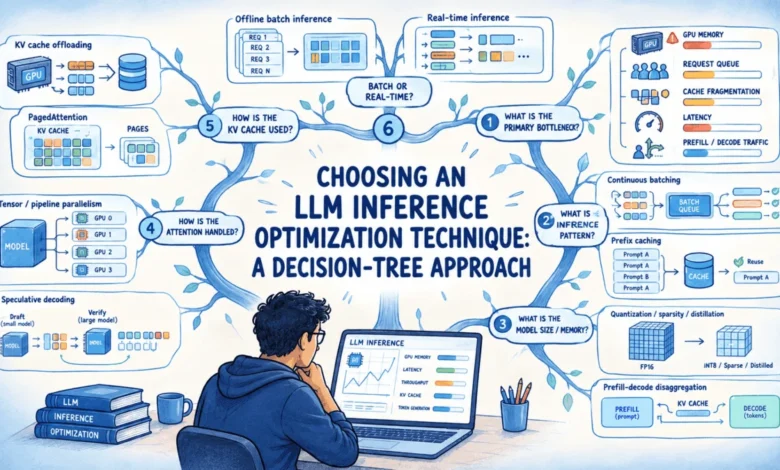
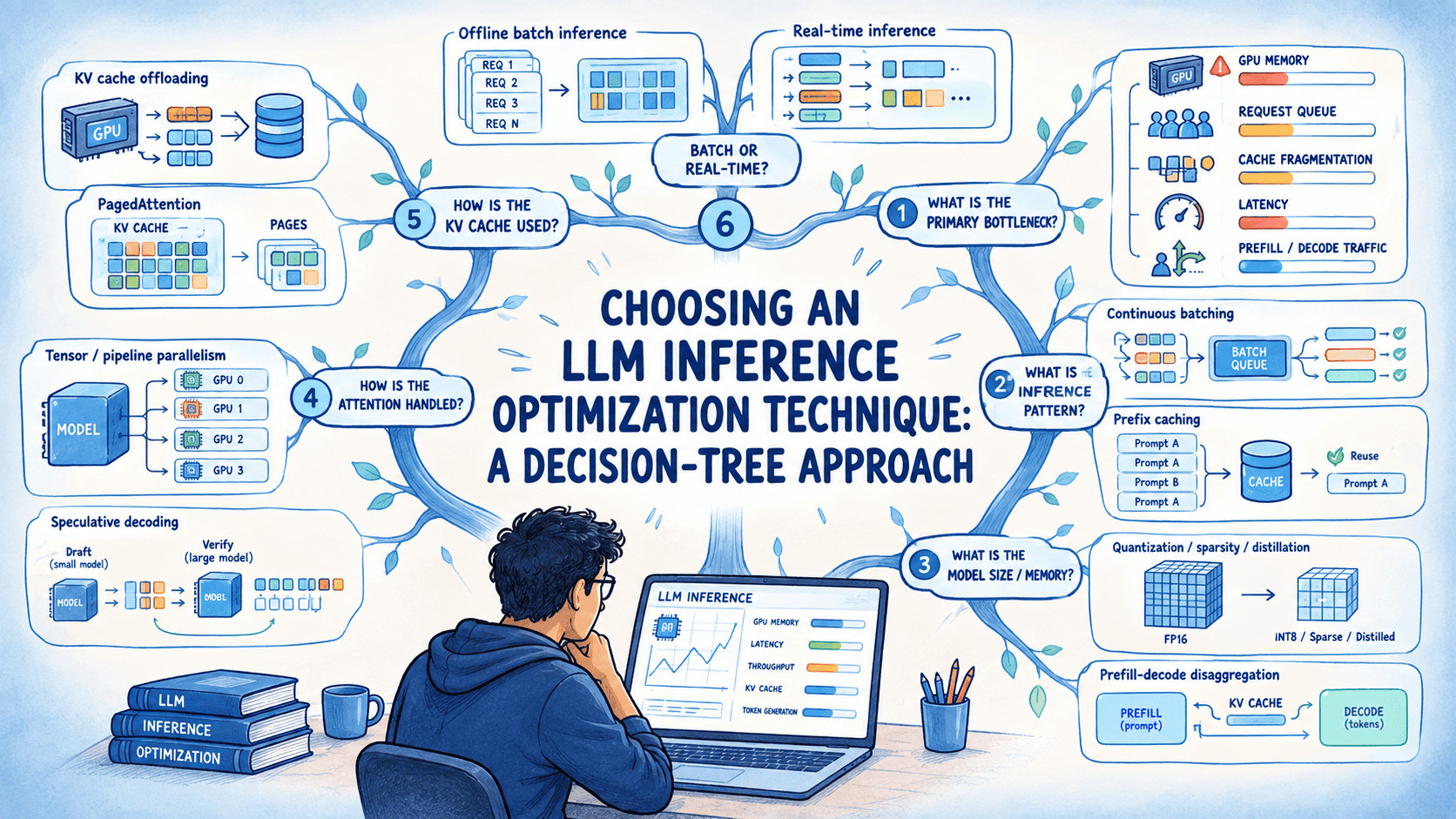
To determine the appropriate optimization path, technical teams must evaluate their workload against six core questions. This diagnostic process prevents the common pitfall of "over-engineering," where developers apply heavy-duty optimizations that provide marginal gains at the cost of massive operational complexity.
1. Hardware Footprint and Model Compression
The first inquiry is fundamental: Does the model fit within the target hardware? If a model occupies 90% of the available GPU memory, the system is inherently fragile. It lacks the "headroom" required for the KV cache to expand during long generations. In this scenario, quantization—reducing the precision of weights from FP16 to INT8 or FP4—is the necessary starting point. Recent benchmarks indicate that 4-bit quantization can often reduce memory requirements by up to 70% with less than a 2% degradation in perplexity, making it a high-utility starting point for resource-constrained environments.
2. Pattern Recognition and Prefix Caching
For applications involving RAG (Retrieval-Augmented Generation) or persistent chat interfaces, the prompt often contains redundant data. When a user sends a long conversation history, the LLM re-processes the entire sequence every time. Prefix caching changes this by storing the KV cache of the static portions of the prompt. By bypassing re-computation, latency can be reduced by several orders of magnitude for subsequent turns in a conversation, effectively treating "static" parts of the prompt as zero-cost operations.
3. Addressing Dynamic Batching
Continuous batching has become the industry standard for production environments. Unlike static batching, where the system waits for all requests in a batch to finish before accepting new ones, continuous batching allows the server to insert new requests the moment a slot opens up. This is critical for maintaining high throughput in environments where output lengths vary wildly—such as a system that simultaneously handles short Q&A queries and long document summaries.
4. Managing Memory Fragmentation
If a server has high GPU utilization but low throughput, the issue is often memory fragmentation. KV caches are often allocated for the "worst-case scenario" (e.g., a 4,000-token output). If the model only generates 50 tokens, the remaining memory is wasted. Implementing PagedAttention effectively turns this wasted space into usable capacity, allowing the system to handle significantly more concurrent requests.
5. Speculative Decoding for Latency
In scenarios where per-token latency is the primary KPI—such as real-time coding assistants—speculative decoding offers a pathway to faster response times. By using a small, "draft" model to predict the next few tokens, the main, larger model can verify them in parallel. If the draft model is accurate, the system can output multiple tokens in a single clock cycle, significantly reducing the perceived wait time for the end-user.
6. The Architecture of Disaggregation
At the highest tier of production scale, the contention between prefill and decode phases becomes a bottleneck. Prefill operations are "bursty" and require heavy matrix multiplication, while decoding is steady and bandwidth-intensive. By disaggregating these two phases onto dedicated hardware, infrastructure teams can tune the hardware to the specific needs of each task. This is, however, a high-complexity maneuver that introduces network overhead, and it should only be pursued when traffic volume justifies the added complexity of distributed KV cache management.
Implications for Future Deployment
The rapid pace of research in inference optimization has created a "toolbox" approach to AI engineering. Industry leaders now emphasize that there is no single "silver bullet." Instead, the most efficient systems are those that implement a tiered strategy. For instance, a robust system might use 4-bit quantization for base model deployment, continuous batching for request management, and prefix caching for chat sessions.
The broader implication for the industry is that the "AI tax"—the massive cost of running LLMs—is decreasing. As developers become more adept at matching optimization techniques to their specific workload bottlenecks, the cost per token continues to trend downward. This democratization of efficiency is what will ultimately enable the next generation of AI applications, moving them from high-cost, low-utility experiments to highly scalable, cost-effective infrastructure.
Summary of Best Practices
For teams navigating these choices, the golden rule remains: measure before you optimize. The cost of implementing complex techniques like prefill-decode disaggregation can outweigh the benefits if the underlying bottleneck is actually a lack of basic request batching. By systematically working through the six-question tree, organizations can ensure they are solving the right problems, optimizing for the correct metrics, and ultimately delivering the most efficient service possible for their specific use case. The path to mastery is not found in the newest, most complex algorithm, but in the precise alignment of infrastructure with the unique demands of the workload.