Ethereum Poised for Major Upside as Key Technical Breakouts Signal Rally Towards $2,900

Ethereum (ETH), the world’s second-largest cryptocurrency by market capitalization, is currently exhibiting robust signs of a significant trend reversal, with a confluence of bullish technical indicators suggesting an imminent price expansion. Following a period of consolidation, the digital asset has successfully breached critical resistance levels, fostering renewed market confidence and positioning the $2,900 mark as a primary target for its next upward trajectory. This renewed momentum is not merely a short-term fluctuation but appears to be a structural shift, moving Ethereum into a confirmed expansionary phase underpinned by strong technical formations and an improving market sentiment.
Ascending Triangle Breakout Signals Bullish Continuation
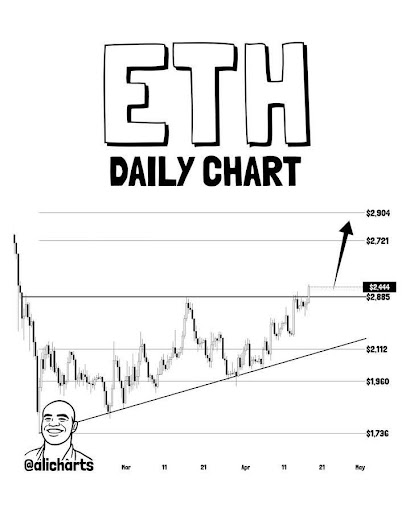
A pivotal development in Ethereum’s recent price action, as highlighted by prominent market analyst Ali Charts, involves the decisive breakout from a long-standing ascending triangle pattern. This technical formation, widely regarded as a bullish continuation pattern, typically precedes significant upward movements. The breakthrough was specifically characterized by Ethereum’s ability to clear the horizontal X-axis of this pattern, specifically overcoming the crucial $2,385 resistance level. This particular price point had acted as a formidable ceiling, preventing higher price discovery for an extended period.
The significance of this breakout extends beyond a mere price increase; it represents a fundamental structural shift in Ethereum’s market dynamics. By decisively conquering $2,385, Ethereum has effectively transitioned out of a prolonged consolidation phase, where price action was largely contained, and into a confirmed expansionary period. In technical analysis, the successful conversion of a previous resistance level into a foundational support floor is a powerful bullish signal. This "flip" indicates that sellers who previously dominated at this price point have been exhausted, and buyers have stepped in with sufficient strength to absorb the supply and establish a new base. The previous overhead supply, which had created friction for upward movement, has now been absorbed, paving the way for a smoother ascent.
The primary technical objective derived from this ascending triangle formation is now set at $2,900. This target is calculated using the "measured move" principle, a common technical analysis technique where the height of the triangle’s base is projected upwards from the breakout point. This methodology provides a data-driven target, offering a clear roadmap for potential price expansion. As long as Ethereum maintains its position above the critical $2,385 support level, the momentum is expected to remain firmly in the hands of the bulls, setting the stage for a steady rally towards the upper end of the $2,900 range. This adherence to the established support is crucial, as a fall back below this level could invalidate the breakout and suggest a false signal.
The "Bitcoin Top Versus Ethereum Bottom" Narrative Gains Traction
Adding further weight to Ethereum’s bullish outlook is a compelling narrative articulated by analyst MarketMaestro, which posits a cyclical shift where a potential Bitcoin top coincides with an Ethereum bottom. This thesis is supported by the development of an inverse Head and Shoulders pattern within a larger triangle reaccumulation zone on Ethereum’s charts. An inverse Head and Shoulders pattern is a classic bullish reversal formation, signaling that a downtrend is likely to end and an uptrend is beginning. It consists of three troughs, with the middle trough (the "head") being the lowest, and the two outer troughs (the "shoulders") being shallower.
Currently, Ethereum’s price action is navigating the second region of the "head" structure, a critical phase for establishing a definitive price floor for the asset. This pattern suggests that significant selling pressure has been absorbed, and a base is being formed from which a sustained rally can launch. Further bolstering this conviction is a significant positive divergence observed on the Relative Strength Index (RSI). RSI divergence occurs when the price of an asset makes a lower low, but the RSI makes a higher low, indicating that selling momentum is weakening despite the price drop. This discrepancy provides a highly bullish signal for momentum, strengthening the conviction that the $1,876 level served as the definitive price floor for this cycle. With both the RSI and price action now aligning in this bullish configuration, the bottoming process is considered almost fully confirmed by technical standards, marking a potential turning point for investors.
The outlook for the upcoming summer months, according to MarketMaestro, remains very optimistic, suggesting a period of sustained positive performance for Ethereum. Investors are advised to closely monitor the formation of the "right shoulder" on the chart, as this phase often represents the final entry opportunity before a significant upward move. Once the current triangle reaccumulation pattern finally breaks decisively to the upside, the market is anticipated to enter a brand-new phase of price action. MarketMaestro expects the narrative to shift towards a much stronger and more aggressive rally scenario, potentially leading to the conclusive end of the bottoming phase and the vigorous commencement of a new market trend. This thesis implies a rotation of capital from Bitcoin, which may be nearing a local peak, into alternative cryptocurrencies like Ethereum, often referred to as an "altcoin season."

Ethereum’s Fundamental Strength: Beyond Chart Patterns
While technical analysis provides crucial insights into market sentiment and potential price movements, Ethereum’s underlying fundamental strength provides a robust foundation for any sustained rally. Ethereum is not just a cryptocurrency; it is a decentralized global computing platform powering a vast ecosystem of decentralized applications (dApps), decentralized finance (DeFi) protocols, non-fungible tokens (NFTs), and Layer 2 scaling solutions.
The network’s utility as the backbone of the Web3 economy continues to expand. DeFi, which allows users to engage in financial services like lending, borrowing, and trading without intermediaries, largely runs on Ethereum. The total value locked (TVL) in Ethereum-based DeFi protocols, despite market fluctuations, remains substantial, demonstrating ongoing user engagement and developer activity. Similarly, the NFT market, while experiencing periods of boom and bust, has seen its most significant innovations and trading volumes on the Ethereum blockchain. This vibrant ecosystem generates consistent demand for ETH, which is required to pay for transaction fees (gas) and to participate in various network activities.
Moreover, significant network upgrades have fundamentally enhanced Ethereum’s architecture and tokenomics. The "Merge" in September 2022 transitioned Ethereum from a proof-of-work (PoW) consensus mechanism to a more energy-efficient proof-of-stake (PoS) system. This upgrade not only drastically reduced Ethereum’s energy consumption but also introduced a deflationary mechanism through EIP-1559, which burns a portion of transaction fees. This reduction in the circulating supply, combined with the staking of ETH to secure the network, creates a supply shock that can exert upward pressure on prices. As more ETH is staked, less is available on the open market, potentially driving up its value in periods of high demand.
The subsequent "Shanghai" and "Dencun" upgrades further solidified Ethereum’s position. Shanghai enabled staked ETH withdrawals, removing a previous barrier to institutional participation and enhancing liquidity for stakers. Dencun, implemented more recently, introduced "proto-danksharding" (EIP-4844), significantly reducing transaction costs and increasing throughput for Layer 2 rollups. This enhancement is crucial for scaling Ethereum and making its ecosystem more accessible and affordable, thereby attracting more users and developers. These continuous improvements demonstrate Ethereum’s commitment to innovation and scalability, strengthening its long-term value proposition and providing fundamental support for bullish price movements.
Historical Context and Market Chronology
Ethereum’s journey has been marked by periods of immense growth and significant corrections, mirroring the cyclical nature of the broader cryptocurrency market. Launched in 2015, ETH quickly gained traction, culminating in its first major bull run in 2017, where it surged from mere dollars to over $1,400. This period saw the explosion of initial coin offerings (ICOs) built on Ethereum. The subsequent bear market of 2018 brought prices down significantly, testing investor resolve.
The next major bull cycle, starting in late 2020 and peaking in late 2021, saw Ethereum reach its all-time high of over $4,800. This rally was fueled by the explosion of DeFi and NFTs, along with increasing institutional interest. Following this peak, the market entered another correction phase throughout 2022 and early 2023, with ETH retracing significantly from its highs. During these periods of correction, the current price levels, particularly around the $1,800-$2,400 range, have historically served as significant battlegrounds between bulls and bears, often acting as accumulation zones before subsequent rallies.
The current technical patterns, such as the ascending triangle and inverse Head and Shoulders, often emerge after prolonged consolidation or corrective phases. The breakout above $2,385 and the establishment of $1,876 as a potential floor align with historical market behavior where such patterns precede renewed uptrends. Understanding this chronology provides context, suggesting that the current bullish signals are not isolated events but rather part of a larger market cycle, potentially positioning Ethereum for a repeat of previous growth phases.
Macroeconomic Landscape and Institutional Interest
The broader macroeconomic environment plays a significant role in the performance of risk assets like cryptocurrencies. Factors such as global interest rates, inflation data, and geopolitical events can influence investor appetite. Currently, there is a cautious optimism in global markets, with expectations of potential interest rate cuts by central banks later in the year. A more accommodative monetary policy typically bodes well for risk assets, as investors seek higher returns outside of traditional fixed-income instruments.
Furthermore, institutional interest in Ethereum is on a noticeable upward trend. The approval of spot Bitcoin Exchange-Traded Funds (ETFs) in the United States in early 2024 has paved the way for similar products for other major cryptocurrencies. Speculation surrounding the potential approval of spot Ethereum ETFs by the U.S. Securities and Exchange Commission (SEC) has become a significant market catalyst. If approved, these ETFs would provide a regulated and accessible investment vehicle for institutional investors and traditional financial players to gain exposure to ETH without directly holding the asset. This influx of institutional capital could significantly boost demand and liquidity for Ethereum, driving its price substantially higher.
Beyond ETFs, major corporations and financial institutions are increasingly exploring and adopting blockchain technology, often leveraging Ethereum or Ethereum-compatible networks for various applications, including tokenization of real-world assets, supply chain management, and enterprise solutions. This growing institutional embrace validates Ethereum’s technology and strengthens its long-term viability, moving it from a niche asset to a more mainstream investment class.
Market Dynamics, Risks, and Future Outlook
While the confluence of technical and fundamental factors paints a decidedly bullish picture for Ethereum, it is imperative for investors to remain cognizant of the inherent volatility and risks associated with the cryptocurrency market. Regulatory uncertainty remains a persistent concern globally. Different jurisdictions have varying approaches to crypto regulation, and any adverse policy decisions could impact market sentiment. Competition from other Layer 1 blockchains, often dubbed "Ethereum killers," also poses a long-term challenge, though Ethereum’s established network effects and developer community provide a strong moat.
Moreover, the market can be susceptible to sudden shifts in sentiment, often driven by news events, macroeconomic surprises, or unexpected whale movements. Maintaining the $2,385 support level is critical; a decisive break below it could invalidate the current bullish structure and signal a potential retest of lower support zones.
However, if Ethereum successfully maintains its current trajectory and breaches the $2,900 target, the next significant psychological and technical resistance levels could be found around $3,200-$3,500, with an eventual retest of its all-time high remaining a long-term possibility within a sustained bull market. The current market dynamics suggest a period of sustained accumulation and a potential shift in market leadership towards altcoins, with Ethereum poised to lead this charge.
In conclusion, Ethereum’s recent price action, characterized by a decisive ascending triangle breakout and the emergence of a bullish inverse Head and Shoulders pattern, signals a robust trend reversal. Supported by strong fundamentals, ongoing network upgrades, growing institutional interest, and a favorable macroeconomic outlook, the path towards $2,900 appears increasingly clear. While caution and risk management remain paramount in the volatile crypto landscape, the current confluence of factors presents a compelling case for a significant upside movement for Ethereum in the coming months.