Sandboxing AI Agent Code Execution in Python: Containers, MicroVMs and Beyond

The rapid integration of Large Language Models (LLMs) into autonomous agent workflows has shifted the primary security challenge from prompt injection to the execution of untrusted, model-generated code. As AI agents gain the ability to invoke external tools and manipulate local environments, the risk of "jailbreaking" the host system—whereby an agent inadvertently or maliciously accesses unauthorized files, networks, or system processes—has become a critical concern for software architects. Implementing robust sandboxing is no longer optional; it is the fundamental defensive layer required to deploy agentic systems in production environments.
The Evolution of Execution Security
To understand the current state of agent security, one must examine the progression of isolation technologies. Historically, software developers relied on simple subprocesses, which offered high performance but minimal security. As containerization became the industry standard in the 2010s, Docker provided a mechanism for packaging applications; however, the reliance on shared kernel architecture introduced vulnerabilities.
The security landscape shifted significantly in November 2025, when a series of high-profile "runc" container breakout vulnerabilities demonstrated that even well-configured containers could be compromised. These events forced a re-evaluation of isolation, leading to the adoption of hardware-level virtualization, specifically Firecracker microVMs. Developed by AWS for Lambda and Fargate, Firecracker provides a "machine-level" boundary that separates the guest kernel from the host, effectively nullifying traditional kernel-exploitation vectors.
Three Tiers of Isolation
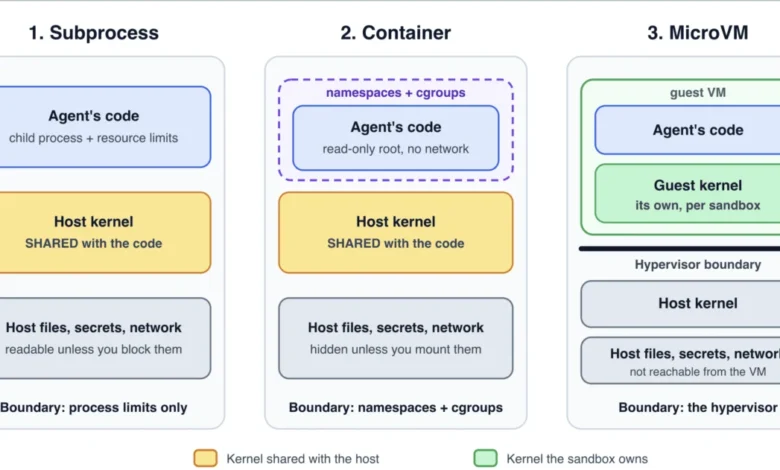
Architects must balance the trade-off between security and latency. The three primary tiers of isolation—Subprocesses, Containers, and MicroVMs—represent distinct philosophies in defensive engineering.
1. The Limited Subprocess: The Performance Benchmark
A subprocess remains the fastest method for executing code. By leveraging Linux features such as unshare (for network namespaces) and resource limits (for CPU and memory caps), developers can create a restrictive environment for short-lived tasks. However, this tier shares the host’s kernel and filesystem. Even with strict UID/GID dropping, the surface area for a breakout remains large, making it suitable only for internal, trusted scripts.
2. The Hardened Container: Namespace-Based Defense
Containers provide a middle ground. By utilizing Linux namespaces and cgroups, containers can effectively wall off resources. To achieve "hardened" status, developers must employ specific security configurations: disabling the network (--network none), mounting the root filesystem as read-only, and utilizing the --no-new-privileges flag. Despite these safeguards, the shared kernel remains the "Achilles’ heel." Security researchers consistently warn that if a container process exploits a vulnerability in the host kernel, the container boundary is effectively bypassed.
3. The MicroVM: The Gold Standard
MicroVMs represent the current frontier of agent security. By running a full guest kernel inside a hardware-assisted hypervisor, each execution session is entirely isolated from the host and other sessions. In the context of AI agents, this is vital. When an agent requires the ability to install dependencies or perform complex file operations, the microVM approach ensures that any compromise is contained within a virtual machine that can be discarded immediately upon completion of the task.
Benchmarking Safety and Latency
In practical testing, the variance in latency between these methods is significant. A subprocess execution often completes in under 50 milliseconds, as it requires no overhead beyond the Python interpreter. A container execution, factoring in the invocation of the Docker daemon and resource allocation, typically ranges between 200 and 500 milliseconds. MicroVMs, while the most secure, historically carried a heavier latency penalty. However, modern implementations like E2B have optimized the boot-to-execution cycle to approximately 150 milliseconds, making them increasingly viable for real-time agentic applications.
Tactical Implementation and Infrastructure
For developers building these systems, the implementation must be decoupled from the agent logic. The agent should interact with an abstraction layer—a "sandbox interface"—that manages the backend. Whether the system initializes a SubprocessSandbox, a DockerSandbox, or an E2BSandbox, the interface remains constant: run(code).
The configuration of these environments must be handled by the infrastructure, not the model. This is a critical security principle: the agent should never have the authority to define its own execution environment. Instead, the system should strictly enforce policies such as:
- Network Isolation: Denying all external traffic unless explicitly whitelisted via infrastructure rules.
- Ephemeral Storage: Ensuring that no filesystem state persists between calls, preventing "state-poisoning" attacks.
- Resource Quotas: Hard-capping memory, CPU, and process counts to mitigate "Denial of Wallet" (DoW) attacks, where a malicious prompt forces an agent to exhaust expensive cloud resources.
The Broader Impact: Towards a Standardized Agent Runtime
The industry is clearly moving toward a standardized, hypervisor-backed execution environment. The release of "Docker Sandboxes" in early 2026 and the continued expansion of AWS Lambda’s microVM capabilities signal a shift in cloud architecture. For enterprise-grade AI, the expectation is that the execution environment will become a "stateless, disposable compute unit."
The implications for developers are twofold. First, the "security-by-default" model is replacing the need for complex, manual hardening of containers. Second, the cost of security is decreasing. As microVMs become the default for serverless and agentic workloads, the performance penalty is approaching parity with standard containers.
Recommendations for Future-Proofing
To prepare for the next generation of AI agents, organizations should:
- Audit existing execution layers: Determine if current agent implementations are relying on shared kernels and migrate to microVMs where sensitive data or external API access is involved.
- Implement "Fail-Closed" Networking: Ensure that sandboxes lack network access by default, and provide connectivity only through controlled, outbound proxies or VPC endpoints.
- Automate Red Teaming: Integrate "hostile" test cases into the CI/CD pipeline—such as attempts to read
/etc/passwdor perform fork bombs—to verify that sandbox boundaries remain intact.
As agents transition from simple assistants to autonomous actors, the sandbox is the only thing standing between a successful task completion and a critical system breach. By prioritizing hardware-level isolation, developers can harness the full potential of AI agents while maintaining the integrity and security of their core infrastructure. The evolution of these technologies ensures that while the agent may be "intelligent," the environment in which it operates remains strictly defined, limited, and secure.