The rapid ascent of Large Language Models (LLMs) and Retrieval-Augmented Generation (RAG) architectures has triggered a fundamental shift in database infrastructure. As organizations move from experimental AI prototypes to production-grade systems, engineering teams face a persistent, high-stakes architectural question: should they extend their existing relational databases with vector capabilities or migrate to specialized, purpose-built vector databases? This debate, often fueled by marketing rhetoric rather than empirical evidence, requires a rigorous examination of performance, operational overhead, and scalability.
The core of the dilemma lies in the emergence of extensions like pgvector, which allow developers to store and query high-dimensional vector embeddings within the familiar ecosystem of PostgreSQL. Conversely, dedicated vector databases—such as Pinecone, Qdrant, Weaviate, Milvus, and ChromaDB—have arrived on the market promising superior latency, massive scalability, and optimized indexing structures designed exclusively for similarity search.
The Evolution of Vector Search Infrastructure
For years, database management was divided between the relational world, optimized for structured transactional data, and the specialized world of NoSQL or search engines. The integration of vector search into PostgreSQL, spearheaded by the pgvector extension, was a watershed moment. By allowing vectors to reside in the same row as traditional relational metadata, pgvector eliminated the need for complex dual-write patterns or distributed synchronization logic.
The timeline of this shift accelerated in early 2023. As vector search moved from niche research to the backbone of enterprise RAG, dedicated vector databases secured massive venture capital funding, creating a market narrative that general-purpose databases could not handle the rigors of production-scale AI. However, this narrative often ignored the iterative improvements made to PostgreSQL itself. Version 0.8.6 of pgvector, for instance, supports advanced indexing methods like Hierarchical Navigable Small Worlds (HNSW) and Inverted File (IVFFlat), bringing PostgreSQL closer to the performance characteristics of dedicated systems than many industry observers initially predicted.
Comparative Architectural Profiles
To understand the trade-offs, one must distinguish between the two approaches. A dedicated vector database functions as an autonomous service, typically utilizing a microservices architecture that separates storage from computation. This allows for horizontal scaling, where vector shards can be distributed across a cluster, often with GPU acceleration for indexing operations.
In contrast, pgvector operates within the PostgreSQL process space. Its primary advantage is ACID compliance. When an application updates a user profile and its associated vector embedding, these operations occur in a single transaction. This prevents the "stale index" problem, where a user might retrieve an outdated vector that no longer aligns with the updated relational record. However, because pgvector shares CPU and memory resources with the wider database, it faces challenges in isolation and resource contention during high-concurrency periods.
Benchmarking at Scale: Beyond the Laptop
While developers often test these systems on local machines using small datasets, such benchmarks frequently fail to reflect the complexities of production environments. A local test of 100,000 vectors—which both systems can handle in milliseconds—masks the underlying differences in index efficiency and garbage collection that manifest only at the 50-million-record mark.
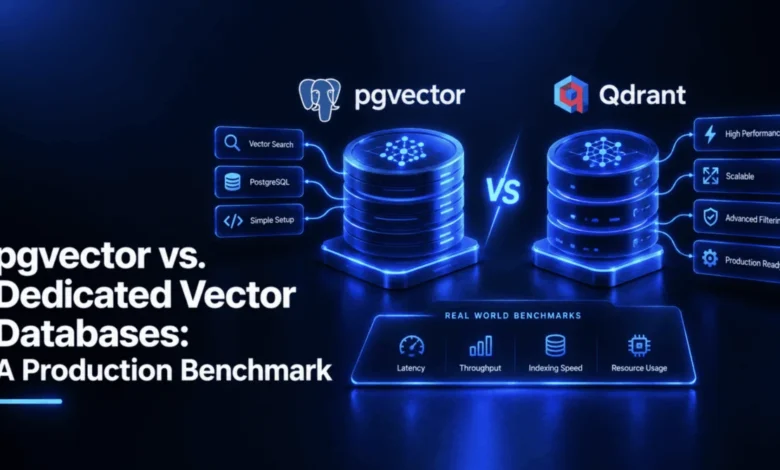
Recent, methodologically rigorous benchmarks—notably those conducted by data engineering firms utilizing the ANN-Benchmarks framework—provide a clearer picture. Using AWS r6id.4xlarge instances, testing revealed a nuanced performance dichotomy. When comparing pgvector (specifically when paired with pgvectorscale, an extension designed to optimize HNSW for large-scale datasets) against Qdrant, the data showed that neither system is a universal victor.
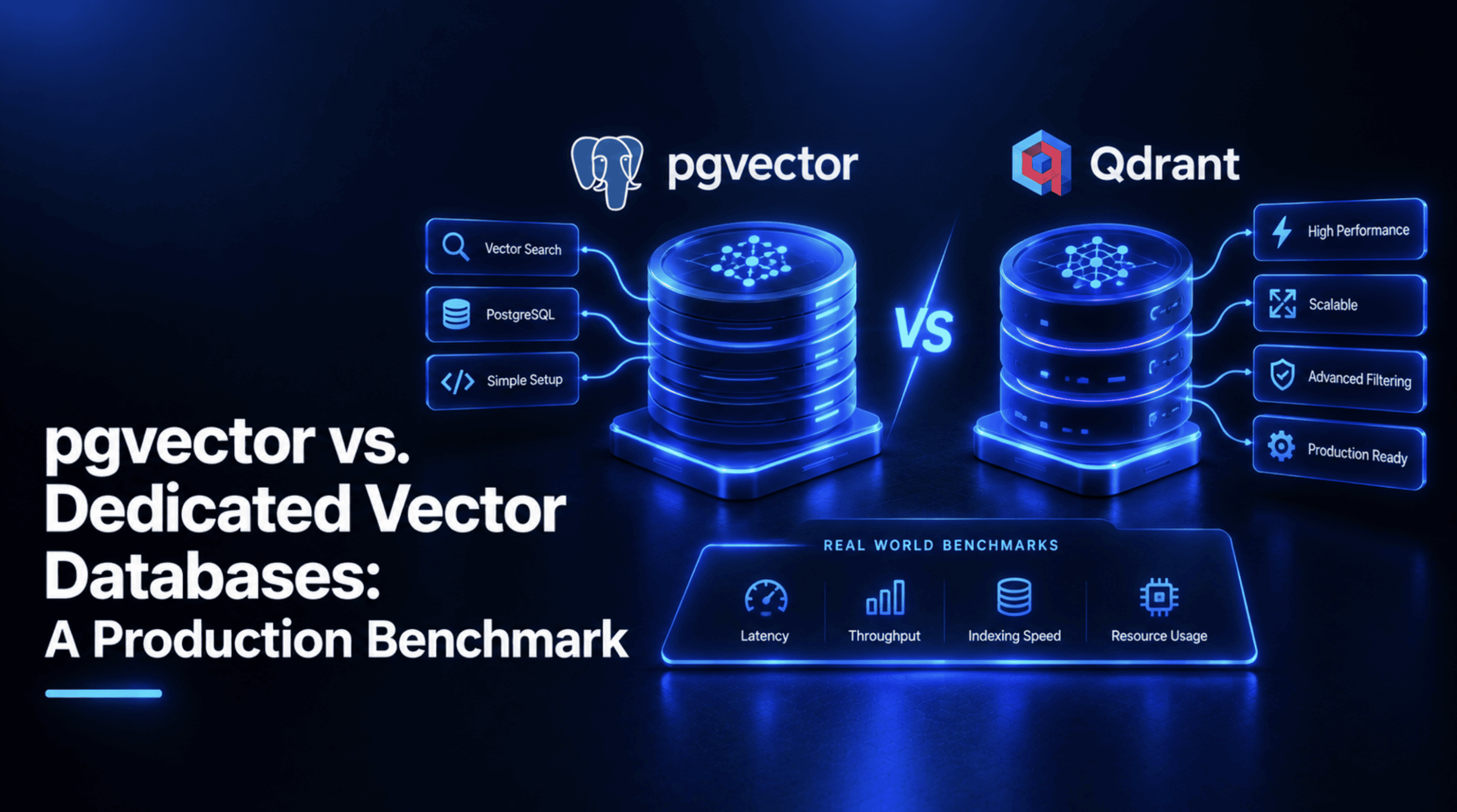
In these tests, the Postgres-based approach excelled in throughput, processing over 470 queries per second (QPS) at 99% recall, significantly outperforming Qdrant’s 41 QPS in that specific configuration. This suggests that for high-volume, read-heavy workloads where concurrency is a priority, a well-tuned Postgres instance is not just "good enough"—it is exceptionally efficient.
Conversely, Qdrant demonstrated superior tail latency. In distributed systems, p99 latency—the time taken by the slowest 1% of queries—is often the most critical metric for user experience. Qdrant maintained a p99 latency of approximately 38 milliseconds, while the Postgres configuration lagged at roughly 74 milliseconds. This gap highlights the architectural advantage of dedicated systems: they are engineered to prevent "noisy neighbor" scenarios and long-tail delays that can occur in general-purpose database engines.
Operational and Organizational Implications
The decision between these two paths is as much about human capital as it is about hardware performance. Organizations with a deep, existing investment in PostgreSQL expertise—including established monitoring, backup, and security pipelines—gain immediate value by adopting pgvector. The cost of managing an additional, specialized system, including training staff on a new API and managing data replication between systems, is often prohibitive for mid-sized teams.
However, for organizations operating at the "billion-vector" scale, the operational overhead of a dedicated database is a worthwhile investment. Specialized systems like Milvus or Pinecone offer built-in support for features that are difficult to implement in PostgreSQL, such as advanced filtering on metadata, native multi-tenancy, and seamless integration with hardware acceleration. For these companies, the primary constraint is not the cost of the software, but the cost of the latency and the engineering time required to maintain custom-built workarounds.
The Verdict on Production Readiness
The data suggests that the "migration to a real vector database" pitch, often used by vendors to disrupt existing Postgres workflows, is not universally applicable. For the vast majority of enterprise applications, the bottleneck is not the database search speed, but the quality of the embeddings themselves and the retrieval pipeline.
When should an organization stick with PostgreSQL?
- When data size remains under the 10-20 million vector threshold.
- When transactional consistency between relational data and vector embeddings is a non-negotiable requirement.
- When the team is already proficient in PostgreSQL operations and wants to avoid adding a new piece of infrastructure to the stack.
When should an organization reach for a dedicated vector database?
- When the dataset reaches into the hundreds of millions or billions of rows.
- When the application requires extreme performance SLAs, such as strict tail-latency limits that must be met even under heavy load.
- When the infrastructure team has a mandate for managed, "zero-ops" cloud services that offload all maintenance, scaling, and indexing tasks to a provider.
Ultimately, the choice of infrastructure should be driven by the specific constraints of the workload rather than industry trends. Both the extension-based and the purpose-built approaches have crossed the threshold of production maturity. The competition between them has forced both ecosystems to improve, resulting in a robust market where developers now have the luxury of choosing based on their actual scaling needs, rather than theoretical limitations. As AI development continues to mature, the focus is likely to shift from "which database is faster" to "which database provides the best integration with the modern data stack," where PostgreSQL currently holds a significant, albeit challenged, advantage.
Related posts: