Single-Agent vs. Multi-Agent AI Systems: When the Complexity Is Worth It

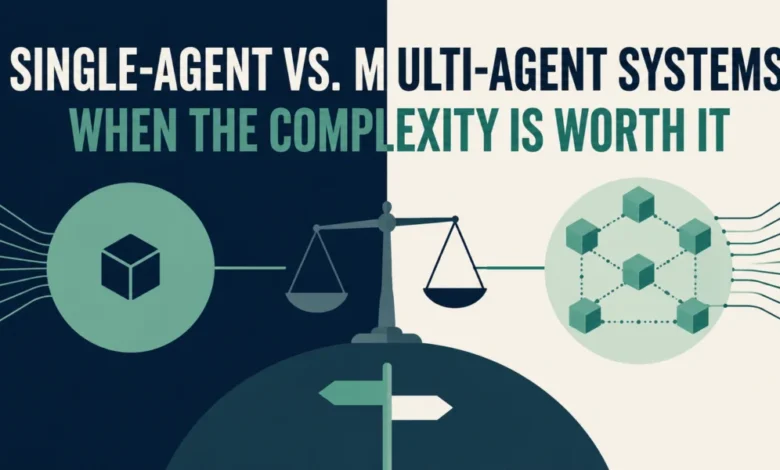
The rapid evolution of Large Language Models (LLMs) has transitioned from simple chat interfaces to sophisticated, autonomous agents capable of executing complex workflows. As developers and enterprises increasingly rely on AI to automate business processes, a critical architectural debate has emerged: should systems be built around a single, highly capable "generalist" agent, or a decentralized, specialized "multi-agent" framework? This decision carries significant implications for operational efficiency, cost management, and system reliability, representing a fundamental crossroads in contemporary AI engineering.
Understanding the distinction between these two architectures requires first defining an "agentic" system. Unlike a standard LLM, which functions primarily as a request-response engine, an agent operates within a recursive loop. It analyzes a goal, evaluates its environment, selects appropriate tools—such as web search engines, code interpreters, or database APIs—and executes sequences of actions. The fundamental divergence between single-agent and multi-agent designs lies in the degree of autonomy and the structure of task coordination.
The Rise of the Generalist: The Case for Single-Agent Systems
The single-agent paradigm operates on a centralized model. A single LLM instance is granted access to a suite of tools and is tasked with managing a workflow from inception to completion. This approach has become the industry standard for a wide range of applications, including automated customer support triage, data extraction from unstructured documents, and initial research synthesis.
From an engineering perspective, the single-agent model offers distinct advantages. Because the logic is contained within a single process, latency remains minimal, which is essential for real-time applications. Furthermore, the economic profile is favorable; by reducing the number of LLM inference calls, companies can maintain lower API costs. Debugging is also simplified, as engineers only need to trace a single conversation history and one decision-making loop to identify points of failure.
Historically, this "skilled generalist" approach has proven sufficient for roughly 70% to 80% of enterprise use cases. However, as organizations move toward more nuanced tasks, the limitations of a single-agent architecture—primarily related to context windows and tool-use precision—become apparent. When a system is forced to juggle too many disparate responsibilities, the likelihood of "hallucination" or procedural error increases significantly.
The Complexity Tax: Navigating the Multi-Agent Paradigm
Multi-agent systems represent a shift toward modularity. In this architecture, work is distributed across a cohort of specialized agents, each operating under a specific system prompt and utilizing a distinct subset of tools. An "orchestrator" agent typically governs this hierarchy, delegating sub-tasks and synthesizing the resulting outputs.
While this model enables the automation of highly complex, multi-step operations that were previously impossible, it introduces a "complexity tax." This tax manifests in four primary areas:
- Compound Latency: Because agents often operate in sequential chains—where Agent B cannot proceed until Agent A finishes—the total time to task completion increases significantly.
- Economic Overhead: Every agent in the system generates its own inference costs. In high-traffic environments, the token consumption of a multi-agent system can exceed that of a single-agent system by an order of magnitude.
- Failure Propagation: In a distributed system, a small error introduced by a peripheral agent can cascade, leading to a catastrophic failure of the final output. Identifying the source of these errors requires sophisticated logging and monitoring tools.
- Orchestration Difficulty: Managing shared state and memory across multiple autonomous entities remains one of the most challenging hurdles in current AI research. Ensuring that Agent C possesses the necessary context from Agent A’s prior actions requires rigid protocols and robust data pipelines.
Strategic Deployment: When Complexity Yields ROI
The transition from a single-agent to a multi-agent architecture should not be driven by technical enthusiasm, but by specific operational requirements. Industry data and developer case studies suggest that the added complexity is justified under four specific conditions.
1. The Adversarial or Critic Workflow
Research indicates that LLMs are inherently poor at self-correction. When a model acts as both author and reviewer, it often inherits its own biases and blind spots. A multi-agent system mitigates this by assigning one agent as an "actor" and another as a "critic." The critic, unburdened by the generative process, can focus exclusively on quality assurance, logic verification, and security compliance.
2. Tool Set Segmentation
When a single agent is provided with an exhaustive library of tools, its performance often degrades. This phenomenon, known as "tool confusion," occurs when the model struggles to map the correct tool to the current task. By segmenting agents based on tool domains—for example, one agent for financial data retrieval and another for natural language generation—developers can create a more stable, predictable environment.
3. Parallelized Execution
In scenarios where tasks are independent, a multi-agent architecture offers clear performance benefits. If an application must query multiple databases or conduct research on several competitors simultaneously, distributing these tasks across parallel agents can reduce total system latency by 50% or more, depending on the concurrency model.
4. Specialized Persona Requirements
Different stages of a workflow often demand varying levels of tone, formality, and safety guardrails. A single agent struggling to switch between a customer-facing persona and an internal data-processing mode is prone to "instruction leakage," where the constraints of one mode bleed into the other. Distinct agents with dedicated system prompts provide cleaner, more reliable behavioral boundaries.
Comparative Heuristics and Industry Implications
To determine the appropriate architecture, developers should employ a "human-equivalent" heuristic. If a human professional can complete a task at a single workstation without needing to consult a separate department or switch to different software, a single-agent system is almost always the optimal choice. Conversely, if the task requires a team of specialists, each working in their own software environment, a multi-agent system is likely the more scalable architecture.
| Metric | Single-Agent Architecture | Multi-Agent Architecture |
|---|---|---|
| Latency | Low (Single-pass) | High (Requires handoffs) |
| Cost | Baseline | Elevated (Multi-inference) |
| Debugging | Linear/Traceable | Complex/Multi-turn |
| Task Scope | Focused/Linear | Parallel/Cross-functional |
| Risk Profile | Contained | Propagative |
Looking Ahead: The Evolution of AI Systems
The current trend in the industry is toward "modular autonomy." Many leading AI research labs are shifting their focus toward the orchestration layer, developing frameworks that allow agents to communicate more effectively and share context without the latency penalties associated with traditional architectures.
The implications for businesses are clear: the most successful AI implementations will not be those that jump immediately to the most complex architecture, but those that follow an iterative lifecycle. By starting with a single, highly refined agent and allowing the architecture to grow only when observed limitations demand it, organizations can avoid the "complexity trap."
Ultimately, the choice between single and multi-agent systems is not a binary decision between "simple" and "advanced." It is a strategic choice about how to manage the lifecycle of a digital worker. As the ecosystem matures, the ability to discern which problems require a specialist’s touch and which require a generalist’s speed will become a critical differentiator in the competitive landscape of enterprise AI. Building for longevity means building for the simplest possible version that solves the problem, then adding the structural scaffolding of multi-agent systems only when the complexity of the task demands it.