Solana Network Shatters Records With 263,000 New Tokens Issued in a Single Day Driven by Exploding Launchpad Activity

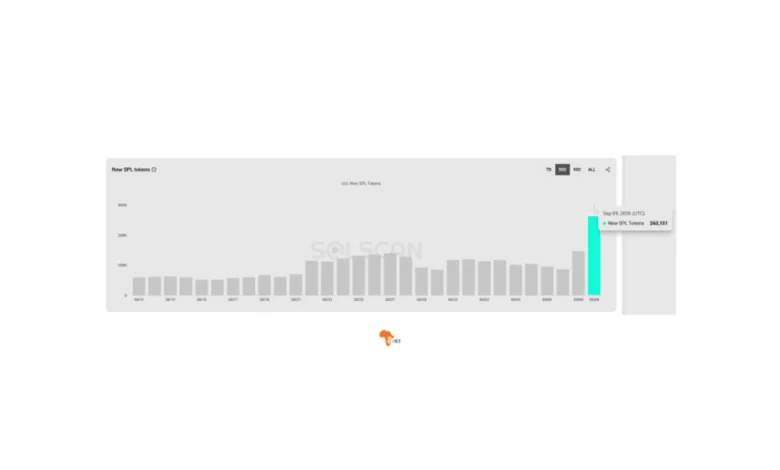
The Solana blockchain has achieved a monumental milestone in decentralized asset creation, recording an unprecedented 263,000 new tokens issued within a single 24-hour period. According to data released by the Solana Foundation, this staggering figure highlights an exponential acceleration in blockchain activity, vastly outpacing historical metrics and signaling a profound shift in how retail and programmatic participants interact with decentralized finance (DeFi) and launchpad ecosystems.
This latest surge in network activity is largely anchored by the dominant performance of Pump.fun, a Solana-native token launchpad and protocol that has continually redefined the economics of user-generated digital assets. In a single day of peak trading, Pump.fun generated approximately $1.8 million in revenue, briefly eclipsing competing platforms such as the Fomo trading app and capturing the lion’s share of network transaction volume. The protocol’s meteoric rise is not an isolated anomaly; rather, it represents the continuation of a dominant financial trend that has solidified Pump.fun as the single largest revenue-generating application on the Solana network.
To understand the sheer magnitude of the current token-generation frenzy, analysts have pointed to the stark contrast between today’s metrics and previous market cycles. During the height of the Solana memecoin mania in December 2024—a period previously celebrated for its intense network congestion and speculative fervor—daily token issuance typically hovered between 40,000 and 50,000. The new record of 263,000 daily tokens represents a more than fivefold increase over those previous peaks, demonstrating that the underlying infrastructure is handling vastly greater throughput while maintaining operational resilience.
The Evolution of Token Launchpads on Solana
The architecture of modern public blockchains has fundamentally lowered the technical barrier to creating digital assets. Historically, launching a new cryptographic token required deep technical expertise in smart contract development, security auditing, and liquidity pool configuration. Platforms like Pump.fun have democratized and gamified this process, enabling any user to deploy a standardized token on Solana with minimal capital and virtually no coding knowledge.
This reduction in friction has transformed Solana into a prolific incubator for speculative assets. The launchpad model typically couples automated token creation with a bonding curve mechanism. Once a newly minted token reaches a specific market capitalization and liquidity threshold on the platform, a portion of its liquidity is automatically migrated to decentralized exchanges (DEXs) like Raydium, securing a decentralized trading venue.
This streamlined pipeline has transformed token creation from an enterprise-grade undertaking into a pervasive, retail-driven activity. Consequently, the Solana Foundation and associated network validators have had to process unprecedented volumes of state updates, testing the limits of the network’s high-performance consensus mechanism, Proof-of-History (PoH).

Financial Dominance and Ecosystem Revenue
The economic implications of this token creation wave extend far beyond simple ledger statistics; they represent a fundamental reshaping of application-layer revenues within the broader blockchain economy. Financial audits from earlier in the year underscored the outsized footprint of launchpad protocols. Data covering the first quarter of the year revealed that Pump.fun single-handedly accounted for more than one-third of all application-level revenue generated across the entire Solana ecosystem.
Out of a total ecosystem application revenue pool of $342 million, Pump.fun generated an impressive $124 million. This concentration of revenue highlights a unique economic dynamic within high-throughput layer-1 blockchains: while decentralized exchanges, lending markets, and cross-chain bridges form the structural backbone of the ecosystem, consumer-facing applications centered on speculation and community formation frequently capture the most direct capital inflows.
The influx of capital driven by these applications directly benefits validator operators through priority fees and maximum extractable value (MEV) tips, while also burning Solana’s native token, SOL, through transaction fee mechanisms. However, this heavy reliance on memecoin and launchpad activity has also drawn scrutiny from market analysts who monitor the sustainability of network revenues during broader macroeconomic downturns or shifts in crypto market sentiment.
Comparative Analysis: December 2024 Versus the Current Expansion
To contextualize the current milestone, industry researchers frequently look back at the developmental trajectory of Solana’s application ecosystem. In late 2024, the crypto market experienced a coordinated bull run that propelled Solana-based speculative assets into the global spotlight. During that epoch, daily issuance figures of 40,000 to 50,000 tokens were considered extreme outliers, frequently pushing network validators to their absolute limits and triggering debates regarding transaction prioritization and validator hardware requirements.
The leap to 263,000 tokens per day in late 2026 indicates that developer tooling, infrastructure scaling, and user demand have entered an entirely new paradigm. Network upgrades deployed over the intervening years have significantly enhanced Solana’s ability to process parallel transactions without suffering the catastrophic outages that plagued earlier iterations of the blockchain. As a result, the network absorbed the latest surge in token creation without experiencing systemic liveness failures, validating the engineering focus on local fee markets and optimized consensus processing.
Broader Industry Implications and Market Reactions

The staggering rate of token creation on Solana has sparked intense debate among industry stakeholders, economists, and regulatory observers. Proponents argue that the frictionless deployment of digital assets represents the ultimate realization of permissionless innovation. In an open-financial system, anyone should have the right to issue a token, establish a community, and test an economic hypothesis without gatekeepers. From this perspective, platforms like Pump.fun are viewed as experimental sandboxes for viral marketing, decentralized autonomous organization (DAO) formation, and novel tokenomics.
Conversely, critics and consumer protection advocates have raised valid concerns regarding the proliferation of low-quality, highly speculative, and predatory assets. The vast majority of the 263,000 tokens minted in a single day hold little to no fundamental utility, functioning instead as zero-sum speculative instruments where early participants often profit at the expense of late-arriving retail traders. The ease of token creation has also complicated security efforts, as malicious actors frequently deploy scam tokens to exploit unsuspecting participants through rug pulls and honeypot smart contracts.
Institutional perspective remains nuanced. While traditional financial institutions are generally cautious regarding networks heavily associated with memecoin speculation, institutional infrastructure providers continue to view Solana’s high throughput, low latency, and growing developer mindshare as vital components of the modern Web3 stack. The ability of the network to settle hundreds of thousands of distinct asset issuance events smoothly serves as a stress test for enterprise use cases ranging from real-world asset (RWA) tokenization to global digital payments.
Outlook for the Solana Ecosystem
As Solana continues to cement its status as a primary hub for high-frequency digital asset issuance, the network faces both unprecedented opportunities and persistent challenges. Maintaining high throughput while suppressing network spam remains a continuous engineering objective for core developers. Furthermore, ecosystem leaders are increasingly challenged with finding ways to bridge the massive liquidity generated by launchpad speculation into more durable, long-term DeFi protocols, infrastructure projects, and decentralized applications.
The record-shattering issuance of 263,000 tokens in a single day is a definitive testament to the vibrancy, engagement, and speculative appetite of the Solana user base. Whether this velocity of asset creation represents a sustainable baseline for future blockchain growth or an ephemeral peak driven by cyclical market exuberance remains to be seen. What is undeniable, however, is that Solana has successfully scaled its operational capacity to meet the demands of an increasingly hyper-active digital economy, setting a new benchmark for high-performance distributed ledgers globally.