ASCN.AI Private AI Dinner Dubai: Strategic Networking and the Future of Autonomous Business Agents

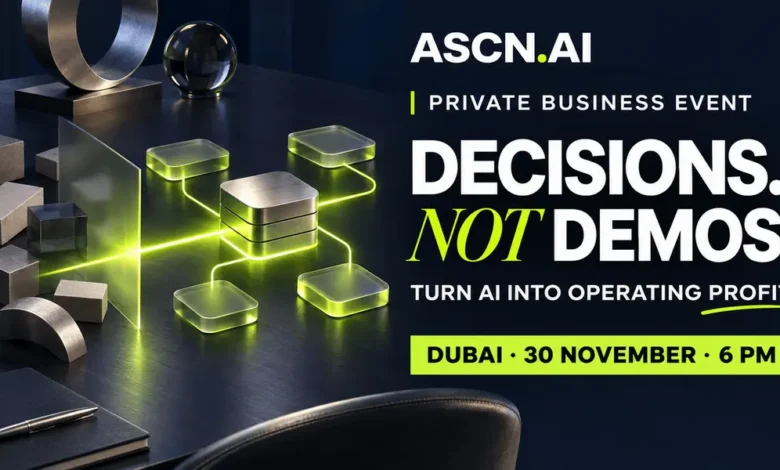
The global artificial intelligence landscape is currently undergoing a structural pivot from passive, conversational interfaces toward active, autonomous agentic workflows. As businesses shift their focus from the novelty of generative text to the tangible realities of return on investment (ROI), the demand for high-utility AI automation has reached a critical inflection point. To address this transition, industry leaders, investors, and technology founders are set to convene on November 30 in Dubai for the ASCN.AI Private AI Dinner. This exclusive gathering serves as a nexus for discussing the integration of AI-driven automation into daily corporate operations, moving beyond isolated prompts to the implementation of "accountable" digital employees.
The Evolution of the AI Automation Paradigm
The current market environment is characterized by an abundance of sophisticated software demos, yet a persistent gap remains between experimental technology and measurable business outcomes. For modern enterprises, the primary objective is no longer merely the adoption of AI, but the reduction of operating costs, the acceleration of execution, and the creation of new revenue streams.
AI automation agencies are now evolving into strategic partners rather than mere software vendors. The most successful platforms in the current ecosystem are those that integrate directly into existing workflows—such as CRM systems, email platforms, and spreadsheet databases—to ensure that agentic tasks are not only executed but are verifiable by management. This shift represents a move from "chatbots" that provide information to "autonomous agents" that execute complex tasks, such as lead qualification, automated market research, and multi-channel customer support.
Event Chronology and Strategic Objectives
The ASCN.AI Private AI Dinner, scheduled for November 30, 2026, at 6:00 PM, is structured to move away from the traditional, lecture-heavy conference format. Instead, it prioritizes peer-to-peer exchange in an intimate setting. By removing the conventional barrier of stage-based presentations, the organizers aim to foster high-level discourse among more than 50 pre-selected entrepreneurs, investors, and technologists.

The event follows a decade-long trajectory for the organizers. The ASCN.AI team has been orchestrating specialized industry side events since 2014, with successful iterations in major global hubs including Istanbul, Bangkok, and previous editions in Dubai. This experience has allowed the organizers to refine a format that prioritizes actionable networking over theoretical discussion.
Central to the upcoming event is an unveiling by Alexey Khitrov, the CEO of ArbitrageScanner and a prominent figure in the intersection of cryptocurrency and automation. Khitrov is expected to present a new technological tool designed to bridge the gap between AI capabilities and blockchain-based business operations. While specific details remain under embargo until the event, industry analysts suggest that this development could significantly alter how corporations manage cross-platform integration between decentralized finance (DeFi) infrastructures and AI-driven business logic.
Data-Driven Insights: The Shift Toward Agentic Efficiency
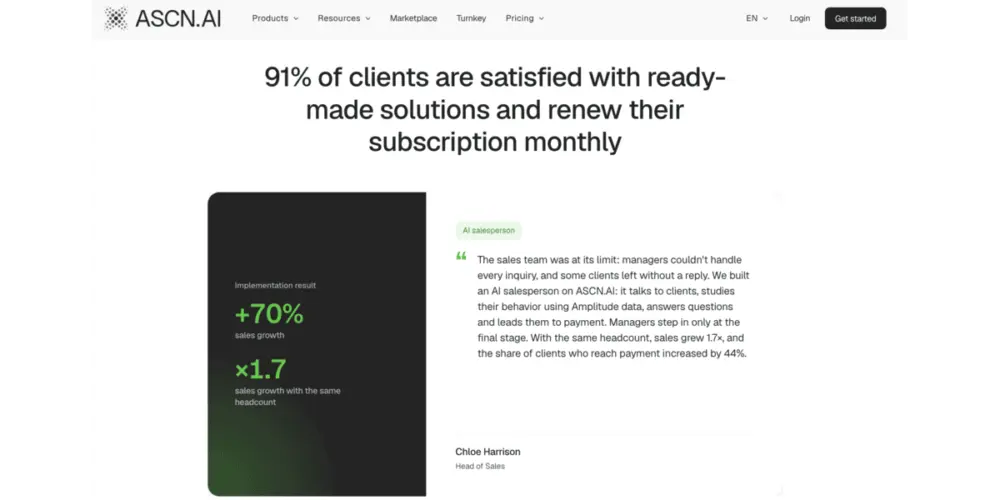
The business case for AI automation is rooted in quantifiable efficiency gains. According to industry data, the adoption of specialized AI agents—as opposed to generalist large language models—can yield significant operational improvements. For instance, companies utilizing AI-driven sales agents have reported substantial increases in conversion rates and pipeline velocity. In one documented case, a firm leveraging such technology saw a 1.7x increase in sales output with a static headcount, while simultaneously improving the lead-to-payment conversion rate by 44%.
The economic model for these services has also become increasingly accessible. With entry-level pricing for specialized AI employees starting at approximately $1 per day, the barrier to entry for small-to-medium enterprises (SMEs) has effectively evaporated. This affordability, combined with the availability of marketplaces offering over 300 pre-configured agents, allows companies to deploy functional AI assets within minutes rather than months.
Operational Framework: Beyond the Chatbot
The core differentiation between a standard chatbot and an ASCN.AI employee lies in its integration capabilities. While a chatbot is typically confined to a browser window, an autonomous agent acts as an extension of the human workforce. By connecting to core business tools, these agents can perform end-to-end tasks:
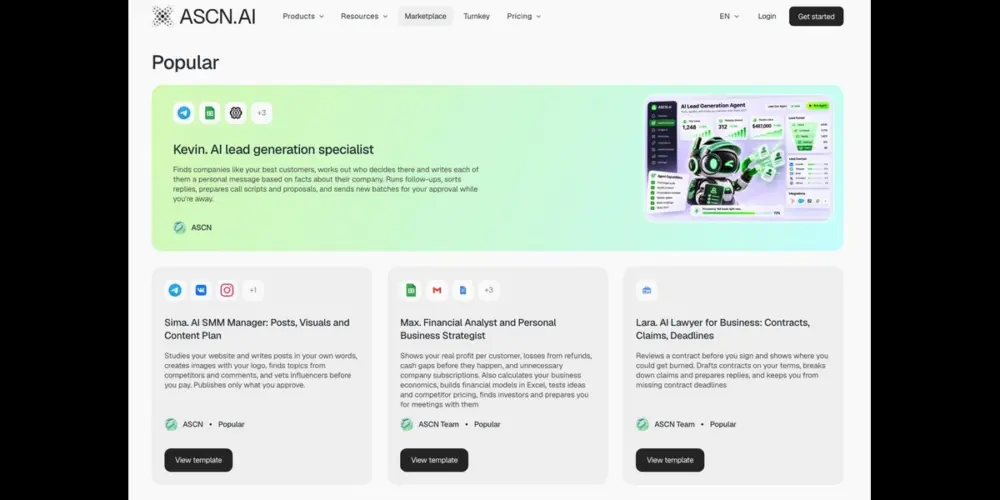
- Sales and Lead Generation: Identifying high-intent prospects and populating CRM systems with verified contact data.
- Customer Support: Handling high-volume inquiries during off-peak hours and escalating only the most complex cases to human supervisors.
- Market Analysis and SEO: Monitoring brand presence in AI-generated search results and formulating strategies for improved visibility in machine-learning-driven discovery.
The platform utilizes a multi-model architecture, incorporating industry-leading large language models such as GPT-4, Claude, Gemini, and DeepSeek, ensuring that users are not locked into a single technological ecosystem. Furthermore, the ability to deploy these agents without deep-code requirements—often referred to as "no-code configuration"—lowers the technical burden on internal IT teams.
Industry Implications and Market Outlook
The widespread adoption of AI agents is expected to have long-term implications for organizational structure. As agents take over repetitive, high-frequency tasks, the role of human personnel is shifting toward strategic oversight, quality assurance, and high-level decision-making.
The 91% monthly renewal rate cited by the ASCN.AI platform suggests a high level of customer satisfaction and successful integration, signaling that once these agents are embedded into a business’s workflow, they become an essential part of the company’s "operating layer." For agencies and consultants, the challenge now lies in packaging these workflows into repeatable service models—a topic that will be front and center at the Dubai dinner.
Accessing the Event: A Curated Community
In alignment with its focus on high-quality networking, the ASCN.AI Private AI Dinner employs a manual vetting process for all attendees. Applications are processed through the Luma platform and are categorized into three tiers:
- Free Pass: Designed for professionals who can contribute to the community discourse. Applicants are required to articulate their expertise and potential value-add to the group.
- VIP Pass: Reserved for senior executives, investors, and strategic partners. This tier provides access to a premium lounge and dedicated networking sessions with industry leaders.
- Media Pass: Specifically for journalists, influencers, and media entities. Interested parties must coordinate directly with the event’s PR team to verify credentials.
The organizers emphasize the importance of early application, as the capacity constraints of the private venue are strictly enforced to maintain the quality of the interactions.
Conclusion and Future Trajectory
The upcoming ASCN.AI Private AI Dinner represents more than just a networking opportunity; it is a manifestation of the current industrial shift toward practical, agentic AI. As the technology matures, the competitive advantage will belong to those who can effectively "employ" AI agents to handle the friction of daily operations.
For organizations currently on the sidelines, the recommendation from industry analysts is to move away from broad, non-specific AI strategies and instead target a single, high-impact workflow. By benchmarking the current costs, time-to-completion, and quality of a specific process, businesses can perform a pilot program to measure the tangible impact of AI automation. As evidenced by the success stories currently emerging from the sector, the path from experimentation to production is increasingly clear for those who prioritize defined roles, clear access controls, and measurable results.
The November 30 event in Dubai stands as a testament to the fact that the future of business automation is no longer a futuristic aspiration, but a present-day operational reality being built by a select group of pioneers. Those interested in the intersection of AI, automation, and business strategy are encouraged to submit their applications through the official Luma portal, ensuring they provide a detailed overview of their background and contribution to the AI ecosystem.