Tether Reports $1.5 Billion Q3 Net Operating Profit as Excess Reserves Surge Near $8 Billion

Tether, the issuer of the world’s largest stablecoin, USDT, has announced a robust financial performance for the third quarter, reporting a net operating profit of $1.5 billion. The latest figures underscore a period of substantial growth for the company, driven by an expanding user base, soaring global demand for dollar-denominated digital assets, and high-yielding reserve assets. Alongside its impressive quarterly earnings, Tether revealed that its excess reserves nearly doubled to reach nearly $8 billion, providing an exceptionally thick financial buffer to back its flagship digital token and maintain its steadfast parity with the United States dollar.
This latest financial milestone elevates Tether’s total year-to-date net operating profit to approximately $10 billion. The continuous accumulation of wealth stems primarily from the company’s massive reserve portfolio, which is strategically diversified across high-liquidity and safe-haven instruments, including U.S. Treasury securities, gold, and other stable financial assets. As digital assets increasingly intersect with traditional macroeconomic structures, Tether’s financial footprint has expanded to rival major global financial institutions, particularly in terms of sovereign debt holdings.
Breaking Down the Balance Sheet: Assets, Liabilities, and Reserves
An examination of Tether’s financial standing reveals a balance sheet of unprecedented scale for a private cryptocurrency issuer. Total assets surpassed the $181 billion threshold during the third quarter, while total liabilities hovered around $173 billion, the vast majority of which correspond to issued and circulating USDT tokens. This leaves the company with an estimated $8 billion in net assets above its total obligations to token holders.
Crucially, Tether’s dedicated excess reserve buffer—the capital held above and beyond the 1:1 backing required for every circulating USDT—grew by approximately $3.5 billion during the quarter alone. This dramatic expansion brings the total excess reserve pool to nearly $8 billion. Industry analysts note that this robust buffer acts as a vital shock absorber, designed to protect the stablecoin ecosystem against potential market downturns, credit events, or sudden fluctuations in the valuation of its reserve assets.

Simultaneously, the circulation of USDT reached an all-time high of approximately $174 billion. This surge reflects sustained, organic demand for stablecoins across both emerging and developed global markets, where users increasingly rely on dollar-pegged digital assets for cross-border remittances, hedging against local currency inflation, and liquidity management within decentralized and centralized cryptocurrency trading venues.
Heavyweight Sovereign Debt Holder and Diversification Strategy
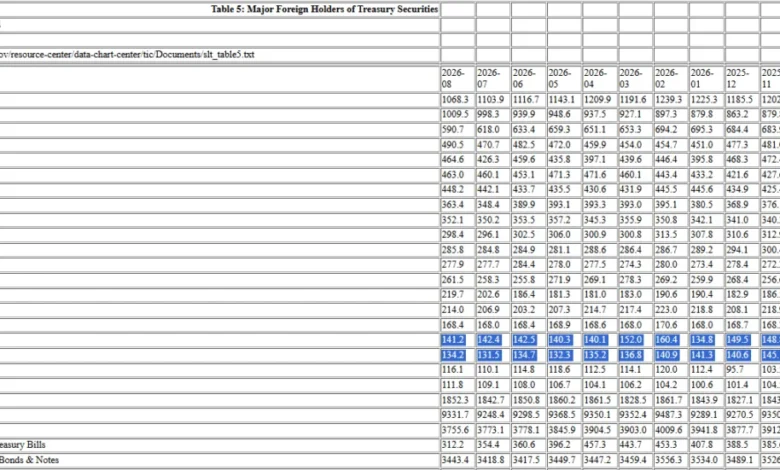
A defining characteristic of Tether’s business model is its massive exposure to traditional financial instruments, most notably U.S. government debt. According to the company’s disclosures, its direct and indirect exposure to U.S. Treasury securities has exceeded $135 billion. This immense volume positions Tether as one of the largest foreign holders of U.S. government debt globally, placing it in the company of sovereign nations and major central banks.
Beyond U.S. Treasuries, Tether has systematically diversified its treasury portfolio over recent years to include substantial holdings of physical gold and other liquid assets. This strategic pivot toward hard assets and short-term sovereign paper is intended to mitigate counterparty risk and protect the stablecoin’s backing against inflationary pressures and shifts in monetary policy enacted by the U.S. Federal Reserve.
The sheer scale of Tether’s Treasury holdings has attracted the attention of macroeconomic analysts and policymakers alike. Stablecoin issuers, once viewed as niche players in the digital asset fringe, are now recognized as systemic buyers of short-term government paper, directly influencing liquidity and demand dynamics within the broader U.S. sovereign debt market.
Regulatory Scrutiny and the Push for Transparency
As Tether and the broader stablecoin market scale to systemic proportions, regulatory scrutiny from international watchdogs, lawmakers, and central banks has intensified exponentially. Regulators have increasingly focused on the quality, liquidity, and transparency of the reserve assets backing stablecoins, demanding clearer redemption safeguards and verifiable proof of reserves to prevent potential "run-on-the-bank" scenarios.

In response to these mounting regulatory pressures, Tether has consistently published quarterly assurance reports detailing the composition of its reserves. The latest figures were independently reviewed and attested by accounting firm BDO. While these attestations offer a detailed look into the company’s financial health at specific points in time, industry observers and critics continue to push for a comprehensive, full financial audit by a "Big Four" accounting firm. Tether has previously signaled its intention to pursue a full institutional audit, a step that would represent a major milestone in establishing long-term traditional financial legitimacy for the enterprise.
Implications for the Broader Digital Asset Ecosystem
Tether’s third-quarter financial results carry profound implications for the cryptocurrency market and the future of digital finance. The ability of a private stablecoin issuer to generate multi-billion-dollar quarterly profits highlights the lucrative nature of the stablecoin business model, which essentially captures the yield on high-interest sovereign debt while passing minimal or zero yield directly to end-users of the token.
Furthermore, the continuous expansion of Tether’s financial buffer reinforces market confidence in USDT’s ability to withstand extreme stress tests. Historically, skepticism regarding the true backing of Tether has been a persistent narrative within cryptocurrency circles. However, consecutive quarters of record profits, billions in excess reserves, and massive holdings of ultra-liquid U.S. Treasuries have significantly subdued systemic concerns regarding its solvency.
Nevertheless, the concentration of so much financial power within a single private entity raises complex questions for global monetary authorities. As central banks worldwide explore the development of their own Central Bank Digital Currencies (CBDCs) and tighten regulatory perimeters around private stablecoin issuers, firms like Tether find themselves navigating a delicate balance between rapid private-sector innovation and tightening public-sector oversight.
For now, Tether remains the undisputed titan of the stablecoin sector. Its Q3 performance not only cements its commercial dominance but also serves as a testament to the deepening integration between traditional fiat monetary instruments and the rapidly evolving architecture of decentralized finance.
Related posts: